

The DOI matches its Crossref record; 29 of the 29 references it cites were found in a registry or an index.
Mendelian randomization with a binary exposure variable: interpretation and presentation of causal estimates
Open accessAbstract
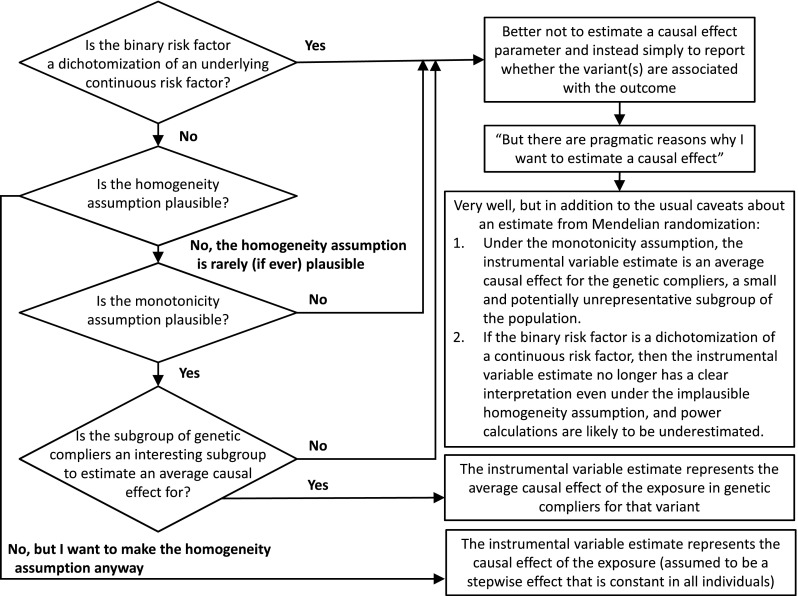
Mendelian randomization uses genetic variants to make causal inferences about a modifiable exposure. Subject to a genetic variant satisfying the instrumental variable assumptions, an association between the variant and outcome implies a causal effect of the exposure on the outcome. Complications arise with a binary exposure that is a dichotomization of a continuous risk factor (for example, hypertension is a dichotomization of blood pressure). This can lead to violation of the exclusion restriction assumption: the genetic variant can influence the outcome via the continuous risk factor even if the binary exposure does not change. Provided the instrumental variable assumptions are satisfied for the underlying continuous risk factor, causal inferences for the binary exposure are valid for the continuous risk factor. Causal estimates for the binary exposure assume the causal effect is a stepwise function at the point of dichotomization. Even then, estimation requires further parametric assumptions. Under monotonicity, the causal estimate represents the average causal effect in 'compliers', individuals for whom the binary exposure would be present if they have the genetic variant and absent otherwise. Unlike in randomized trials, genetic compliers are unlikely to be a large or representative subgroup of the population. Under homogeneity, the causal effect of the exposure on the outcome is assumed constant in all individuals; rarely a plausible assumption. We here provide methods for causal estimation with a binary exposure (although subject to all the above caveats). Mendelian randomization investigations with a dichotomized binary exposure should be conceptualized in terms of an underlying continuous variable.
Overview
The claims and statistics of this paper haven’t been checked yet.
Run the check — free, no account needed. It reads the open-access text and checks the sources it cites.
Integrity signals
Registry
Cites
Statistics
Figures
Verification
Claims the paper makes
The claims and statistics of this paper haven’t been checked yet.
Run the check — free, no account needed. It reads the open-access text and checks the sources it cites.
Claims other papers make about this one
Each is checked against this paper’s own text: does it say what the citing paper says it does?
In the citing paper
“Also, if the exposure is a dichotomisation of a continuous risk factor, this poses a further threat to the violation of the exclusion restriction assumption.114”
From Strengthening the Reporting of Observational Studies in Epidemiology using Mendelian Randomisation (STROBE-MR): explanation and elaboration. (2021) · cites this paper as [114]
In the citing paper
“Caution is especially warranted when interpreting effect estimates with a binary exposure.114”
From Strengthening the Reporting of Observational Studies in Epidemiology using Mendelian Randomisation (STROBE-MR): explanation and elaboration. (2021) · cites this paper as [114]
Self-check
Percentages, sums and reported differences re-computed from the paper’s own numbers.
The self-check needs the paper’s full text.
Citations
Cites
Introductory Econometrics: A Modern Approach
Wooldridge, J. M. (1999) · Cited by 14,354
Bowden, J., Davey Smith, G., & Burgess, S. (2015) · International Journal of Epidemiology · doi:10.1093/ije/dyv080 · Cited by 9,816
Self-citationMostly Harmless Econometrics: An Empiricist's Companion
Angrist, J. D., & Pischke, J.-S. (2009) · doi:10.1515/9781400829828 · Cited by 9,467
Bowden, J., Davey Smith, G., Haycock, P. C., & Burgess, S. (2016) · Genetic Epidemiology · doi:10.1002/gepi.21965 · Cited by 8,922
Self-citationMendelian Randomization Analysis With Multiple Genetic Variants Using Summarized Data
Burgess, S., Butterworth, A., & Thompson, S. G. (2013) · Genetic Epidemiology · doi:10.1002/gepi.21758 · Cited by 6,050
Self-citationDavey Smith, G., & Ebrahim, S. (2003) · International Journal of Epidemiology · doi:10.1093/ije/dyg070 · Cited by 5,882
Identification of Causal Effects Using Instrumental Variables
Angrist, J. D., Imbens, G. W., & Rubin, D. B. (1996) · Journal of the American Statistical Association · doi:10.1080/01621459.1996.10476902 · Cited by 4,230
EPIC- InterAct Consortium, Burgess, S., Scott, R. A., Timpson, N. J., Davey Smith, G., & Thompson, S. G. (2015) · European Journal of Epidemiology · doi:10.1007/s10654-015-0011-z · Cited by 1,803
Self-citationCalculating statistical power in Mendelian randomization studies.
Brion, M.-J. A., Shakhbazov, K., & Visscher, P. M. (2013) · International Journal of Epidemiology · doi:10.1093/ije/dyt179 · Cited by 1,751
Instruments for Causal Inference: An Epidemiologist's Dream?
Hernán, M. A., & Robins, J. M. (2006) · Epidemiology · doi:10.1097/01.ede.0000222409.00878.37 · Cited by 961
Cited by
Sorted by citations
Sanderson, E., Glymour, M. M., Holmes, M. V., Kang, H., Morrison, J., Munafò, M. R., Palmer, T., Schooling, C. M., Wallace, C., Zhao, Q., et al. (2022) · Nature Reviews Methods Primers · doi:10.1038/s43586-021-00092-5 · Cited by 2,229
Skrivankova, V. W., Richmond, R. C., Woolf, B. A. R., Davies, N. M., Swanson, S. A., VanderWeele, T. J., Timpson, N. J., Higgins, J. P. T., Dimou, N., Langenberg, C., et al. (2021) · BMJ · doi:10.1136/bmj.n2233 · Cited by 1,648
Mendelian randomisation for mediation analysis: current methods and challenges for implementation
Carter, A. R., Sanderson, E., Hammerton, G., Richmond, R. C., Davey Smith, G., Heron, J., Taylor, A. E., Davies, N. M., & Howe, L. D. (2021) · European Journal of Epidemiology · doi:10.1007/s10654-021-00757-1 · Cited by 1,215
Mendelian Randomization: Concepts and Scope
Richmond, R. C., & Davey Smith, G. (2022) · Cold Spring Harbor Perspectives in Medicine · doi:10.1101/cshperspect.a040501 · Cited by 841
Objectives, design and main findings until 2020 from the Rotterdam Study
Ikram, M. A., Brusselle, G., Ghanbari, M., Goedegebure, A., Ikram, M. K., Kavousi, M., Kieboom, B. C. T., Klaver, C. C. W., de Knegt, R. J., Luik, A. I., et al. (2020) · European Journal of Epidemiology · doi:10.1007/s10654-020-00640-5 · Cited by 463
Metadata
- Authors
- Burgess, S., & Labrecque, J. A.
- Affiliations
- University of Cambridge (GB)
- Erasmus MC (NL)
- Corresponding author
- Burgess, Stephen
- Venue
- European Journal of Epidemiology
- Published
- 2018-07-23
- Volume
- 33
- Issue
- 10
- Pages
- 947-952
- ISSN
- 0393-2990 (ISSN-L)
- 1573-7284
- PMC
- PMC6153517
- OpenAlex
- W2797906093
- Cited by
- 569
- References
- 28
- Citations by year
- 2026: 30 · 2025: 66 · 2024: 173 · 2023: 107 · 2022: 67 · 2021: 68 · 2020: 33 · 2019: 24 · 2018: 1
- FWCI
- 19.28
- Type
- journal article
- Language
- en
- Open access
- hybrid
- doi.org
- Licence
- Locations
- European Journal of Epidemiology (publishedVersion, cc-by)
- Europe PMC (PubMed Central) (publishedVersion, other-oa)
- PubMed Central (publishedVersion, cc-by)
- PubMed (publishedVersion)
- EUR Research Repository (Erasmus University Rotterdam) (publishedVersion, other-oa)
- arXiv (Cornell University) (submittedVersion)
- EUR Research Repository (Erasmus University Rotterdam) (submittedVersion, other-oa)
- RePub (Erasmus University Rotterdam) (submittedVersion, other-oa)
- Apollo (University of Cambridge) (submittedVersion, cc-by)
- arXiv (Cornell University) (cc-by)
- Apollo (cc-by)
- Funders
- Wellcome Trust (204623/Z/16/Z)
- Topics
- Life Sciences › Biochemistry, Genetics and Molecular Biology › Genetics › Genetic Associations and Epidemiology
- Physical Sciences › Mathematics › Statistics and Probability › Advanced Causal Inference Techniques
- Physical Sciences › Mathematics › Statistics and Probability › Statistical Methods in Epidemiology
- Keywords
- Mendelian randomization, binary exposure, dichotomization, exclusion restriction, monotonicity, homogeneity, average causal effect, hypertension, blood pressure, causal effect estimation
- MeSH terms
- Blood Pressure, Humans, Hypertension, Models, Genetic, Random Allocation, Risk Factors, Genetic Variation, Models, Statistical, Likelihood Functions, Mendelian Randomization Analysis
About these checks
Registry, retraction, Cites and statistics results are computed, not judged, with one exception: a printed reference that no index lists is read once by a model before it counts as a citation error. Claims are extracted by a model and kept only when their quote appears verbatim in the text; each cited source is then checked, with a model’s help, for whether it says what the claim relies on. Those verdicts can be wrong — read the claim’s quote and the cited source before relying on one.
Statistics and arithmetic are recomputed, not judged.
Confidence bands are shown only for fields calibrated on our annotated test set. None is calibrated yet, so no band is shown.
What counts as a claim ›How we measure confidence ›How we check this ›
Are you an author, or do you see a problem with this page? Request a review
