

The DOI matches its Crossref record; 66 of the 66 references it cites were found in a registry or an index.
Protecting against researcher bias in secondary data analysis: challenges and potential solutions
Open accessAbstract
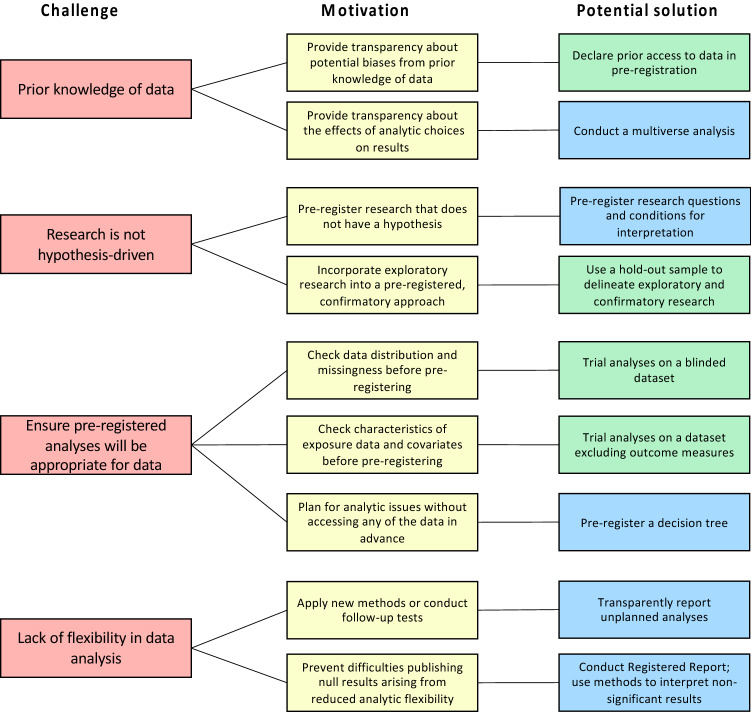
Analysis of secondary data sources (such as cohort studies, survey data, and administrative records) has the potential to provide answers to science and society’s most pressing questions. However, researcher biases can lead to questionable research practices in secondary data analysis, which can distort the evidence base. While pre-registration can help to protect against researcher biases, it presents challenges for secondary data analysis. In this article, we describe these challenges and propose novel solutions and alternative approaches. Proposed solutions include approaches to (1) address bias linked to prior knowledge of the data, (2) enable pre-registration of non-hypothesis-driven research, (3) help ensure that pre-registered analyses will be appropriate for the data, and (4) address difficulties arising from reduced analytic flexibility in pre-registration. For each solution, we provide guidance on implementation for researchers and data guardians. The adoption of these practices can help to protect against researcher bias in secondary data analysis, to improve the robustness of research based on existing data.
Overview
The claims and statistics of this paper haven’t been checked yet.
Run the check — free, no account needed. It reads the open-access text and checks the sources it cites.
Integrity signals
Registry
Cites
Statistics
Figures
Verification
Claims the paper makes
The claims and statistics of this paper haven’t been checked yet.
Run the check — free, no account needed. It reads the open-access text and checks the sources it cites.
Claims other papers make about this one
Each is checked against this paper’s own text: does it say what the citing paper says it does?
In the citing paper
“For example, there is clear evidence from both MR and the natural experiment of an increase in the school leaving age that an increase in the number of years in education has a causal protective effect on health behaviours such as smoking.156–160”
From Mendelian randomization (2022) · cites this paper as [158]
Self-check
Percentages, sums and reported differences re-computed from the paper’s own numbers.
The self-check needs the paper’s full text.
Citations
Cites
1 retracted
RETRACTED ARTICLE: High replicability of newly discovered social-behavioural findings is achievable
Protzko, J., Krosnick, J. A., Nelson, L. D., Nosek, B. A., Axt, J. R., Berent, M., Buttrick, N. R., DeBell, M., Ebersole, C. R., Lundmark, S., et al. (2023) · Nature Human Behaviour · doi:10.1038/s41562-023-01749-9 · Cited by 97
RetractedConfirmation Bias: A Ubiquitous Phenomenon in Many Guises
Nickerson, R. S. (1998) · Review of General Psychology · doi:10.1037/1089-2680.2.2.175 · Cited by 7,267
Simmons, J. P., Nelson, L. D., & Simonsohn, U. (2011) · Psychological Science · doi:10.1177/0956797611417632 · Cited by 6,567
A manifesto for reproducible science
Munafò, M. R., Nosek, B. A., Bishop, D. V. M., Button, K. S., Chambers, C. D., Percie du Sert, N., Simonsohn, U., Wagenmakers, E.-J., Ware, J. J., & Ioannidis, J. P. A. (2017) · Nature Human Behaviour · doi:10.1038/s41562-016-0021 · Cited by 3,397
Lakens, D. (2017) · Social Psychological and Personality Science · doi:10.1177/1948550617697177 · Cited by 2,161
The preregistration revolution
Nosek, B. A., Ebersole, C. R., DeHaven, A. C., & Mellor, D. T. (2018) · Proceedings of the National Academy of Sciences · doi:10.1073/pnas.1708274114 · Cited by 1,998
HARKing: Hypothesizing after the results are known
Kerr, N. L. (1998) · Personality and Social Psychology Review · doi:10.1207/s15327957pspr0203_4 · Cited by 1,989
Equivalence Testing for Psychological Research: A Tutorial
Lakens, D., Scheel, A. M., & Isager, P. M. (2018) · Advances in Methods and Practices in Psychological Science · doi:10.1177/2515245918770963 · Cited by 1,560 · cited 1×
“, Bayesian methods [58] or equivalence tests, which determine whether an observed effect is surprisingly small [52, 59, 60].”
MethodPublication bias in the social sciences: Unlocking the file drawer
Franco, A., Malhotra, N., & Simonovits, G. (2014) · Science · doi:10.1126/science.1255484 · Cited by 1,542
Increasing Transparency Through a Multiverse Analysis
Steegen, S., Tuerlinckx, F., Gelman, A., & Vanpaemel, W. (2016) · Perspectives on Psychological Science · doi:10.1177/1745691616658637 · Cited by 1,512
Research works printed but not linked: 2
- Small DS, Firth D, Keele L, et al. Protocol for a study of the effect of surface mining in central appalachia on adverse birth outcomes. arXiv.org. 2020
- Deshpande SK, Hasegawa RB, Weiss J, Small DS. Protocol for an observational study on the effects of playing football in adolescence on mental health in early adulthood. arXiv preprint 2018
Cited by
Sorted by citations
Sanderson, E., Glymour, M. M., Holmes, M. V., Kang, H., Morrison, J., Munafò, M. R., Palmer, T., Schooling, C. M., Wallace, C., Zhao, Q., et al. (2022) · Nature Reviews Methods Primers · doi:10.1038/s43586-021-00092-5 · Cited by 2,229
Skrivankova, V. W., Richmond, R. C., Woolf, B. A. R., Davies, N. M., Swanson, S. A., VanderWeele, T. J., Timpson, N. J., Higgins, J. P. T., Dimou, N., Langenberg, C., et al. (2021) · BMJ · doi:10.1136/bmj.n2233 · Cited by 1,648
Guidelines for performing Mendelian randomization investigations
Burgess, S., Davey Smith, G., Davies, N. M., Dudbridge, F., Gill, D., Glymour, M. M., Hartwig, F. P., Holmes, M. V., Minelli, C., Relton, C. L., et al. (2020) · Wellcome Open Research · doi:10.12688/wellcomeopenres.15555.2 · Cited by 1,273
Guidelines for performing Mendelian randomization investigations: update for summer 2023
Burgess, S., Smith, G. D., Davies, N. M., Dudbridge, F., Gill, D., Glymour, M. M., Hartwig, F. P., Kutalik, Z., Holmes, M. V., Minelli, C., et al. (2023) · Wellcome Open Research · doi:10.12688/wellcomeopenres.15555.3 · Cited by 747
Reducing bias, increasing transparency and calibrating confidence with preregistration
Hardwicke, T. E., & Wagenmakers, E. (2023) · Nature Human Behaviour · doi:10.1038/s41562-022-01497-2 · Cited by 205
Metadata
- Authors
- Baldwin, J. R., Pingault, J.-B., Schoeler, T., Sallis, H. M., & Munafò, M. R.
- Affiliations
- King's College London (GB)
- University College London (GB)
- University of Bristol (GB)
- Corresponding author
- Baldwin, Jessie R.
- Venue
- European Journal of Epidemiology
- Published
- 2022-01
- Volume
- 37
- Issue
- 1
- Pages
- 1-10
- ISSN
- 0393-2990 (ISSN-L)
- 1573-7284
- PMC
- PMC8791887
- OpenAlex
- W4205384179
- Cited by
- 178
- References
- 63
- Citations by year
- 2026: 55 · 2025: 50 · 2024: 31 · 2023: 27 · 2022: 10
- FWCI
- 17.81
- Type
- journal article
- Language
- en
- Open access
- hybrid
- doi.org
- Licence
- Locations
- European Journal of Epidemiology (publishedVersion, cc-by)
- PubMed Central (publishedVersion, cc-by)
- PubMed (publishedVersion)
- Bristol Research (University of Bristol) (submittedVersion, cc-by)
- UCL Discovery (University College London) (submittedVersion)
- Explore Bristol Research (submittedVersion, cc-by)
- PsyArXiv (OSF Preprints) (submittedVersion)
- Funders
- Wellcome Trust (215917/Z/19/Z)
- Medical Research Foundation (MRF-160-0002-ELP-PINGA)
- Topics
- Social Sciences › Decision Sciences › Statistics, Probability and Uncertainty › Meta-analysis and systematic reviews
- Physical Sciences › Mathematics › Statistics and Probability › Statistical Methods in Epidemiology
- Physical Sciences › Computer Science › Information Systems › Research Data Management Practices
- Keywords
- researcher bias, secondary analysis, preregistration, questionable research practices, research robustness
- MeSH terms
- Humans, Surveys and Questionnaires, Cohort Studies, Bias
About these checks
Registry, retraction, Cites and statistics results are computed, not judged, with one exception: a printed reference that no index lists is read once by a model before it counts as a citation error. Claims are extracted by a model and kept only when their quote appears verbatim in the text; each cited source is then checked, with a model’s help, for whether it says what the claim relies on. Those verdicts can be wrong — read the claim’s quote and the cited source before relying on one.
Statistics and arithmetic are recomputed, not judged.
Confidence bands are shown only for fields calibrated on our annotated test set. None is calibrated yet, so no band is shown.
What counts as a claim ›How we measure confidence ›How we check this ›
Are you an author, or do you see a problem with this page? Request a review
