

Changes of the phytoplankton community as symptoms of deterioration of water quality in a shallow lake
Open accessThe DOI matches its Crossref record; 55 of the 55 references it cites were found in a registry or an index.
Abstract
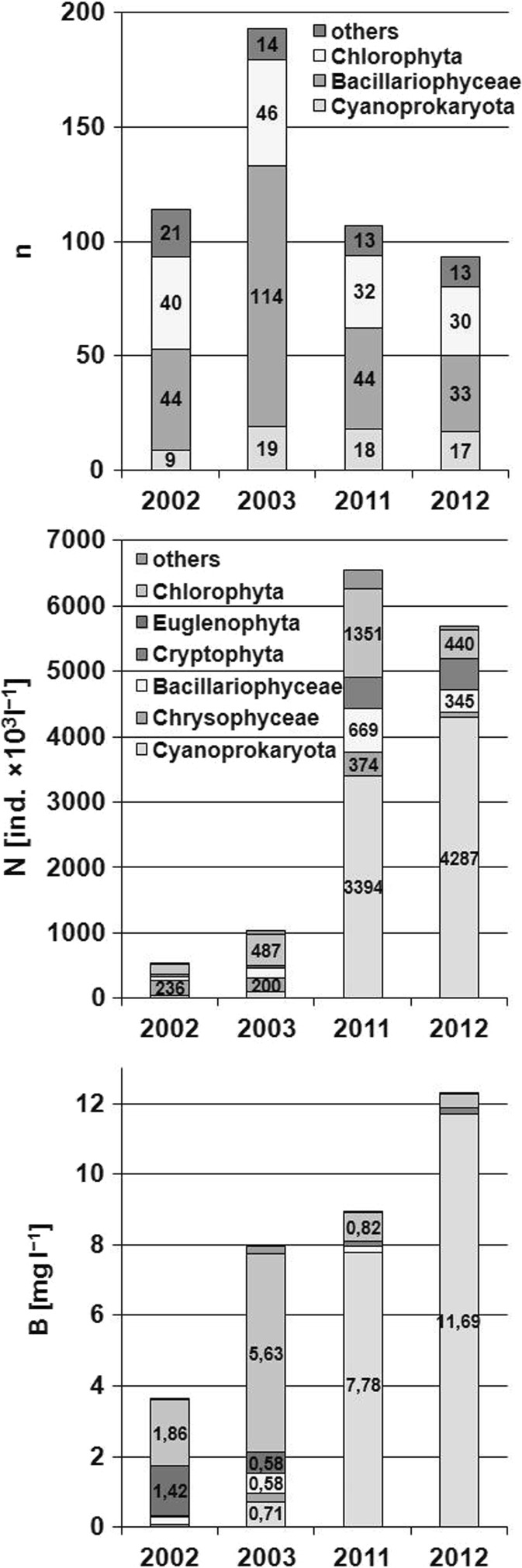
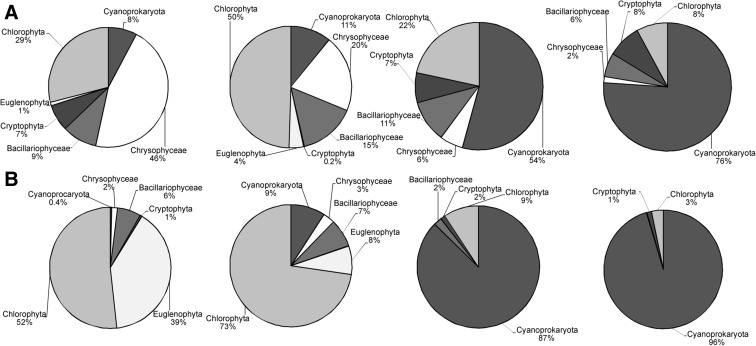
Covering more than 60% of the lake surface, macrophytes determined the taxonomic composition of phytoplankton. We have found numerous indications of ecological deterioration and an increased trophic level year to year: an increased total number of taxa; a significantly increased number of species of Chlorophyta, Bacillariophyceae and Cyanoprokaryota; a decreased number of Chrysophyceae; increased Nygaard index, and high diversity and variability of phytoplankton functional groups. Within 2 years (2002 and 2003) algal biomass doubled: from 3.616 to 7.968 mg l −1 . An increased contribution of Chlorococcales and Cyanoprokaryota indicates progressive eutrophication of the lake. The average size of planktonic algae increased, particularly Cyanoprokaryota, where small-celled decreased dramatically and were replaced by large colonies. Cyanoprokaryota remained the dominant group of phytoplankton after 10 years, and the ecosystem of the lake remained in the turbid state. This group of algae had the average biomass 9.734 mg l −1 , which constituted almost 92% of the total biomass.
Overview
The claims and statistics of this paper haven’t been checked yet.
Free: it reads the open-access text and checks the first 5 claims that cite a source we can check. Create a free account to check every claim.
Integrity signals
Registry
Cites
Statistics
Figures
Verification
Claims the paper makes
The claims and statistics of this paper haven’t been checked yet.
Free: it reads the open-access text and checks the first 5 claims that cite a source we can check. Create a free account to check every claim.
Claims other papers make about this one
Each is checked against this paper’s own text: does it say what the citing paper says it does?
The check wasn’t confident either way, so it gives no verdict — never disputed.
In the citing paper
“It has, however, been observed that in shallow water bodies these desmid genera can grow well (Coesel et al. 1978; Taylor et al. 1980; Dembowska et al. 2018).”
From Ecological health and water quality of village ponds in the subtropics limiting their use for water supply and groundwater recharge (2021) · cites this paper as Dembowska et al. 2018
Experimental — accuracy not yet measured
Self-check
Percentages, sums and reported differences re-computed from the paper’s own numbers.
The self-check needs the paper’s full text.
Citations
Cites
Utermöhl, H. (1958) · SIL Communications, 1953-1996 · doi:10.1080/05384680.1958.11904091 · Cited by 5,606 · cited 1×
“Macrophytes are known to significantly influence the phytoplankton community, decreasing its abundance and biomass, and modifying its species composition (Van Donk and Van de Bund 2002).”
BackgroundA trophic state index for lakes1
Carlson, R. E. (1977) · Limnology and Oceanography · doi:10.4319/lo.1977.22.2.0361 · Cited by 4,311 · cited 2×
“The increased contribution of Chlorococcales and Cyanoprokaryota in the biomass is a symptom of progressive eutrophication of the lake (Carlson 1977; Carlson and Simpson 1996; Napiórkowska-Krzebietke and Hutorowicz 2006; Jekatierynczuk-Rudczyk et al. 2014), frequently preceded by the dominance or…”
BackgroundHutchinson, E. G. (1957) · Medical Entomology and Zoology · Cited by 3,896
BIOVOLUME CALCULATION FOR PELAGIC AND BENTHIC MICROALGAE
Hillebrand, H., Dürselen, C., Kirschtel, D., Pollingher, U., & Zohary, T. (1999) · Journal of Phycology · doi:10.1046/j.1529-8817.1999.3520403.x · Cited by 3,635 · cited 1×
“Biovolumes of all algal species were calculated using the volumetric method by Hillebrand et al. (1999) and Sun and Liu (2003) and assuming that 1 mm3 of algae is equal to 1 mg (Holmes et al. 1969; Elser and Carpenter 1988).”
MethodTowards a functional classification of the freshwater phytoplankton
Reynolds, C. S., Huszar, V., Kruk, C., Naselli-Flores, L., & Melo, S. (2002) · Journal of Plankton Research · doi:10.1093/plankt/24.5.417 · Cited by 2,030
Geometric models for calculating cell biovolume and surface area for phytoplankton
Sun, J. (2003) · Journal of Plankton Research · doi:10.1093/plankt/fbg096 · Cited by 1,130 · cited 1×
“Phytoplankton serves as an indicator of trophic state and ecological condition of lakes and rivers (Padisák et al. 2006; Szilágyi et al. 2008; Pasztaleniec and Poniewozik 2010; Phillips et al. 2014; Dembowska and Józefowicz 2015; Dembowska et al. 2015).”
BackgroundPadisák, J., Crossetti, L. O., & Naselli-Flores, L. (2009) · Hydrobiologia · doi:10.1007/s10750-008-9645-0 · Cited by 921 · cited 2×
“– Functional groups (Reynolds et al. 2002; updated by Padisák et al. (2009)), based on ecological and morphological features of the species which prevail in phytoplankton biomass.”
Backgroundvan Donk, E., & van de Bund, W. J. (2002) · Aquatic Botany · doi:10.1016/s0304-3770(01)00205-4 · Cited by 608 · cited 1×
“In shallow lakes, meteorological factors can also affect phytoplankton biomass and composition (Weithoff et al. 2000), occasionally transforming the entire biological community.”
Background(2019) · Polish Journal of Ecology · doi:10.3161/pjoe · Cited by 565
Padisák, J., Borics, G., Grigorszky, I., & Soróczki-Pintér, É. (2006) · Hydrobiologia · doi:10.1007/s10750-005-1393-9 · Cited by 386 · cited 1×
“Phytoplankton serves as an indicator of trophic state and ecological condition of lakes and rivers (Padisák et al. 2006; Szilágyi et al. 2008; Pasztaleniec and Poniewozik 2010; Phillips et al. 2014; Dembowska and Józefowicz 2015; Dembowska et al. 2015).”
Background
Research works printed but not linked: 8
- Chudyba H Czaplicka A Sociological studies on the phytoplankton in Lake Stopka Acta Hydrobiologica 1993 36 1 31 47
- Kowalczyk C Radwan S Groups of pelagic zooplankton in three lakes of different trophy Acta Hydrobiologica 1982 24 1 39 51
- Luścińska M Rutkowska M Phytoplankton of lakes Wdzydze and Gołuń AUNC Limnological Papers 1995 19 23 36
- Mc Cauley E Downing JA Rigler FH The estimation of abundance and biomass of zooplankton in samples A manual on methods for assessment of secondary productivity in fresh waters IBP Handbook 17 1984 Hoboken Blackwell Scientific Publications 228 261
- Nogrady T Wallance RL Snell TW Dumont HJF Rotifera, biology, ecology and systematics Guides to the identification of the microinvertebrates of the continental waters of the world 1993 Amsterdam SPB Acad. Publ. 1 42
- Patalas K Stosunki termiczne i tlenowe oraz przezroczystość wody w 44 jeziorach okolic Węgorzewa Roczniki Nauk Roln. B 1960 77 106 182
- Radwan, S. (2004). (ed.). Polish Freshwater Fauna: 32A and 32B. Wrotki. Rotifera. Tercja Press Łódź, 407 p.
- Utermöhl H Zur Vervollkommnung der quantitativen Phytoplankton Methodik Mitteilungen der Internationalen Vereinigung Limnologie 1958 9 1 38
Cited by
A review on plankton as a bioindicator: A promising tool for monitoring water quality
Chandel, P., Mahajan, D., Thakur, K., Kumar, R., Kumar, S., Brar, B., Sharma, D., & Sharma, A. K. (2023) · World Water Policy · doi:10.1002/wwp2.12137 · Cited by 67
Guo, C., Zhu, G., Qin, B., Zhang, Y., Zhu, M., Xu, H. Y., Chen, Y., & Paerl, H. W. (2019) · Ecological Indicators · doi:10.1016/j.ecolind.2019.05.034 · Cited by 51
Musa, M., Lusiana, E. D., Buwono, N. R., Arsad, S., & Mahmudi, M. (2020) · Biodiversitas Journal of Biological Diversity · doi:10.13057/biodiv/d211031 · Cited by 50
“Hence, they can raise water transparency levels and support phytoplankton production (Dembowska et al. 2018).”
BackgroundGoyal, V. C., Singh, O., Singh, R., Chhoden, K., Kumar, J., Yadav, S., Singh, N., Shrivastava, N. G., & Carvalho, L. (2021) · Journal of Environmental Management · doi:10.1016/j.jenvman.2020.111450 · Cited by 30
Krupa, E. G., Romanova, S. M., Berkinbayev, G. D., Albinovna, Y. N., & Sadvakasov, E. (2020) · Water · doi:10.3390/w12092580 · Cited by 26
Zhang, C., McIntosh, K., Sienkiewicz, N., Stelzer, E. A., Graham, J. L., & Lu, J. (2023) · Water Research · doi:10.1016/j.watres.2023.119679 · Cited by 25
Kumar, J., Alam, A., Sarkar, U. K., Das, B. K., Kumar, V., & Srivastava, S. K. (2020) · Sustainable Water Resources Management · doi:10.1007/s40899-020-00470-z · Cited by 21
“Therefore, the study on phytoplankton composition and its dynamics in an aquatic system concerning various physico-chemical parameters is necessary for constant monitoring of environmental conditions as well as enhancement of fish production (Dembowska et al. 2018).”
BackgroundTracking pollution and its sources in the catchment‐lake system of major waterbodies in Kazakhstan
Krupa, E. G., Barinova, S. S., & Аубакирова, М. (2020) · Lakes & Reservoirs Science Policy and Management for Sustainable Use · doi:10.1111/lre.12302 · Cited by 20
Chen, D., Shi, Z., Li, R., Li, X., Cheng, Y., & Xu, J. (2023) · Frontiers in Marine Science · doi:10.3389/fmars.2023.1293354 · Cited by 16
Cyanobacteria respond to trophic status in shallow aquatic ecosystems
Kuczyńska‐Kippen, N., Kozak, A., & Celewicz-Gołdyn, S. (2024) · The Science of The Total Environment · doi:10.1016/j.scitotenv.2024.174932 · Cited by 20
Anyanwu, I. N., Ezema, C. A., Ebi, S., Nwajiuba, C. A., Nworie, O., & Anorue, C. O. (2021) · African Journal of Aquatic Science · doi:10.2989/16085914.2021.1931000 · Cited by 16
“Furthermore, the observed increase in taxa of cyanobacteria (M. flos-aquae, M. aeruginosa, M. wesenbergii and C. raciborskii) is an indication of progressive eutrophication of the lakes (NapiórkowskaKrzebietkeand Hutorowicz 2006; JekatierynczukRudczyketal 2014; Dembowska et al. 2018).”
BackgroundInfluentialSummer phytoplankton assemblages and carbon biomass in the northern south China sea
Gui, J., Wei, Y., Sun, J., Le, F., Cai, Y., & Xiuren, N. (2020) · Continental Shelf Research · doi:10.1016/j.csr.2020.104276 · Cited by 15
Massi, L., Maselli, F., Rossano, C., Gambineri, S., Chatzinikolaou, E., Dailianis, T., Arvanitidis, C., Nuccio, C., Scapini, F., & Lazzara, L. (2019) · Oceanologia · doi:10.1016/j.oceano.2019.04.001 · Cited by 15
Krupa, E. G., Romanova, S. M., Serikova, А., & Shakhvorostova, L. (2024) · Water · doi:10.3390/w16070973 · Cited by 14
Krupa, E. G., Barinova, S. S., Romanova, S. M., Аубакирова, М., & Ainabaeva, N. (2020) · Water · doi:10.3390/w12123409 · Cited by 13
Garlapati, D., Kumaraswami, M., Rao, V. R., Karri, R., & Mallavarapu, V. R. (2021) · Environmental Science and Pollution Research · doi:10.1007/s11356-021-15086-9 · Cited by 11
Teubner, K., Teubner, I., Pall, K., Tolotti, M., Kabas, W., Drexler, S.-S., Waidbacher, H., & Dokulil, M. T. (2022) · Frontiers in Environmental Science · doi:10.3389/fenvs.2022.901924 · Cited by 10
“, 2007; Exler and Janauer, 2012; Pall, 2018) or macrophyte coverage (Ibelings et al., 2007; Cheruvelil and Soranno, 2008; Dembowska et al., 2018; Ferreira et al., 2018), but the magnitude beyond the stated yield is often not shown.”
BackgroundStamenković, O., Piperac, M. S., Čerba, D., Milošević, D., Ostojić, A. M., Đorđević, N. B., Simić, S. B., Cvijanović, D., & Buzhdygan, O. Y. (2022) · Aquatic Sciences · doi:10.1007/s00027-022-00893-0 · Cited by 11
Smith, J. E., Wolny, J. L., Hill, R. L., Stocker, M., & Pachepsky, Y. A. (2022) · Environments · doi:10.3390/environments9110142 · Cited by 9
Physico-chemical and biological water quality of Warna and Pengilon Lakes, Dieng, Central Java
Soeprobowati, T. R., Addadiyah, N. L., Hariyati, R., & Jumari, J. (2022) · Journal of Water and Land Development · doi:10.24425/jwld.2021.139013 · Cited by 9
“Long-term water quality monitoring in Warna and Pengilon lakes is necessary for effective prediction and efficient lake management.”
BackgroundSmith, J. E., Wolny, J. L., Stocker, M., Hill, R. L., & Pachepsky, Y. A. (2021) · Frontiers in Water · doi:10.3389/frwa.2021.724025 · Cited by 9
“Concentrations of cyanobacteria within Pond 1 were similar to those previously reported within temperate lakes (Dembowska et al., 2018; Jia et al., 2019), including those studied”
ResultMirosław‐Grabowska, J., Obremska, M., Zawisza, E., Radzikowska, M., & Stańczak, J. (2019) · CATENA · doi:10.1016/j.catena.2019.104262 · Cited by 9
Jiang, Z., Shi, Z., Chen, D., Li, X., Li, R., & Xu, J. (2024) · Journal of Geophysical Research Oceans · doi:10.1029/2024jc021101 · Cited by 9
Piranti, A. S., & Wibowo, D. N. (2020) · Journal of Water and Land Development · doi:10.24425/jwld.2020.134210 · Cited by 7
Chen, Z., Zeng, Y., Xia, Z., Cao, J., Li, S., Zhang, J., & He, P. (2025) · Marine Environmental Research · doi:10.1016/j.marenvres.2025.106973 · Cited by 6
Makwinja, R., Inagaki, Y., Tesfamichael, S. G., & Curtis, C. J. (2024) · Journal of Environmental Management · doi:10.1016/j.jenvman.2024.121462 · Cited by 6
Changes in Algal Plankton Composition and Physico-Chemical Variables in a Shallow Oxbow Lake
Yaqoob, M. M., Berta, C., Szabó, L. J., Dévai, G., Szabó, S., Nagy, S., Bácsi, I., Simon, A., Nagy, J., Somlyai, I., et al. (2021) · Water · doi:10.3390/w13172339 · Cited by 9
“Water bodies can be divided into at least two categories based on their transparency [9].”
BackgroundThe diversity of plankton as bioindicators in Kakap River Estuary, West Kalimantan
Soetignya, W. P., Marniati, P., Adijaya, M., & Anzani, Y. M. (2021) · DEPIK · doi:10.13170/depik.10.2.21303 · Cited by 5
“According Dembowska et al. (2018), the predominance of diatoms population is an indication of eutrophic state of waters.”
BackgroundBarinova, S. S., Krupa, E. G., & Khitrova, E. (2022) · Diversity · doi:10.3390/d14121071 · Cited by 5
The Effect of Fish Production and Environmental Factors on Phytoplankton in Hypertrophic Fishponds
Radojičić, M., Kopp, R., Müllerová, B., & Šorf, M. (2023) · Acta Universitatis Agriculturae et Silviculturae Mendelianae Brunensis · doi:10.11118/actaun.2022.030 · Cited by 5
Chen, D., Li, R., Shi, Z., & Xu, J. (2026) · Marine Pollution Bulletin · doi:10.1016/j.marpolbul.2026.119886 · Cited by 4
Yin, Q., Lin, F., Xu, B., Jiang, X., Li, H., Xian, H., He, K., Zhao, X., & Chen, X. (2024) · ACS ES&T Water · doi:10.1021/acsestwater.3c00831 · Cited by 5
RAMANCHUK, A., Макаревич, Т. А., Хомич, С. А., Machowski, R., Rzetala, M. A., & Rzętała, M. (2021) · Ecological Indicators · doi:10.1016/j.ecolind.2021.107995 · Cited by 3
Mama, A. C., Ghepdeu, G. F. Y., Tankoua, O. F., Bonga, M. D., Bodo, W. K. A., Mandeng, T. I., Edoa, F. D. O., Tangko, N. C., & Ngoupayou, J. R. N. (2023) · Oceanological and Hydrobiological Studies · doi:10.26881/oahs-2023.1.02 · Cited by 3
Barinova, S. S., Krupa, E. G., & Khitrova, Y. (2023) · Ecologies · doi:10.3390/ecologies4020017 · Cited by 3
“At the same time, ecological mapping of lakes in Kazakhstan revealed a positive relationship between the number of species and saprobity indices and a negative relationship with salinity as in other European lakes [35,36].”
BackgroundThe influence of locks on zooplankton in canals (the Bydgoszcz Canal and the Noteć Canal, Poland)
Kolarova, N., & Napiórkowski, P. (2023) · Ecohydrology & Hydrobiology · doi:10.1016/j.ecohyd.2023.11.011 · Cited by 2
Self-citationChaffai, A., Hamil, S., Adaouri, I., Arab, S., Moussouni, A., & Arab, A. (2022) · BIODIVERSITY JOURNAL · doi:10.31396/biodiv.jour.2022.13.1.55.64 · Cited by 1
Chen, X., Li, B., Li, S., Xu, Y., Jiang, B., Xie, C., Du, Q., Wang, N., Gao, L., Jiang, T., et al. (2026) · Journal of Cleaner Production · doi:10.1016/j.jclepro.2026.148947 · Cited by 1
Mandal, I., & Pal, S. (2022) · Geography of the physical environment · doi:10.1007/978-3-031-04532-5_4 · Cited by 1
ФИТОПЛАНКТОН ЗАЛИВОВ АРАЛЬСКОГО МОРЯ
Молдрахман, А. С., Mazhibaeva, Z. O., Б.А, К., Barakbayev, T. T., & Исбеков, Қ. Б. (2023) · HERALD OF SCIENCE OF S SEIFULLIN KAZAKH AGRO TECHNICAL UNIVERSITY · doi:10.51452/kazatu.2023.1(116).1345 · Cited by 1
Игнатенко, М. Е., Yatsenko-Stepanova, T. N., & Геннадьевна, К. О. (2020) · BIO Web of Conferences · doi:10.1051/bioconf/20202400027 · Cited by 1
On the algae flora of some natural monuments of the Orenburg region
Игнатенко, М. Е., Yatsenko-Stepanova, T. N., & Геннадьевна, К. О. (2020) · Vestnik of Orenburg State Pedagogical University Electronic Scientific Journal · doi:10.32516/2303-9922.2020.36.6 · Cited by 1
MICROBIOTA: THE VITAL ROLE IN SUPPORTING SUSTAINABLE DEVELOPMENT GOALS 2030 FROM A MICROSCOPIC SCALE
Hidayah, H. A., Al-Hakim, R. R., Pangestu, A., & Saragih, E. (2023) · IJMS Indonesian Journal of Mathematics and Natural Science · doi:10.61214/ijms.v1i1.18
“In addition, recently studied in Poland, Cyanoprokaryota remained the dominant group (Dembowska et al., 2018).”
BackgroundDevi, P., & Bhatnagar, A. (2023) · Environment Conservation Journal · doi:10.36953/ecj.24582661
“Chlorophyceae are found in abundance in lakes having sufficient light intensity (Dembowska et al ., 2018) and High N and P content also favors chlorophyceae (Deyab, 2002).”
BackgroundNikolenko, Y. V., & Маренков, О. М. (2025) · Hydrobiological Journal · doi:10.1615/hydrobj.v61.i3.20
Ghising, S. (2023) · Nepalese Journal of Aquaculture and Fisheries · doi:10.3126/njaf.v10i1.78787
“From the result it can be inferred that the change in biomass may be associated with several factors, such as predation, food availability, environmental stressors, and the presence of submerged macrophytes etc. (Dembowska et al. 2018; Gurung et al. 2019; Takamura 2003).”
Zhang, C., McIntosh, K., Sienkiewicz, N., Stelzer, E. A., Graham, J. L., & Lu, J. (2026) · Elsevier eBooks · doi:10.1016/b978-0-443-41741-2.00026-0
Metadata
- Authors
- Dembowska, E. A., Mieszczankin, T., & Napiórkowski, P.
- Affiliations
- Nicolaus Copernicus University (PL)
- Corresponding author
- Napiórkowski, Paweł
- Venue
- Environmental Monitoring and Assessment
- Published
- 2018-01-25
- Volume
- 190
- Issue
- 2
- Pages
- 95-95
- ISSN
- 0167-6369 (ISSN-L)
- 1573-2959
- PMC
- PMC5785590
- OpenAlex
- W2793532493
- Cited by
- 48
- References
- 55
- Citations by year
- 2026: 3 · 2025: 2 · 2024: 5 · 2023: 11 · 2022: 8 · 2021: 6 · 2020: 10 · 2019: 3
- FWCI
- 2.48
- Type
- journal article
- Language
- en
- Open access
- hybrid
- doi.org
- Licence
- cc-by
- creativecommons.org/licenses/by/4.0 (tdm)
- Locations
- Environmental Monitoring and Assessment (publishedVersion, cc-by)
- Europe PMC (PubMed Central) (publishedVersion, cc-by)
- PubMed Central (publishedVersion, cc-by)
- PubMed (publishedVersion)
- Funders
- Uniwersytet Mikolaja Kopernika w Toruniu
- Topics
- Physical Sciences › Environmental Science › Environmental Chemistry › Aquatic Ecosystems and Phytoplankton Dynamics
- Physical Sciences › Earth and Planetary Sciences › Oceanography › Marine Plankton and Biogeochemistry
- Physical Sciences › Environmental Science › Ecology › Water Resources and Management
- Keywords
- phytoplankton community structure, shallow lakes, water quality degradation, eutrophication, cyanobacteria, Chlorophyta, diatoms, Chrysophyceae, algal biomass, phytoplankton functional groups, aquatic plants, turbidity, trophic state, Chlorococcales
- MeSH terms
- Chlorophyta, Environmental Monitoring, Eutrophication, Phytoplankton, Plankton, Water Pollutants, Diatoms, Ecosystem, Biomass, Lakes, Water Quality
About these checks
Registry, retraction, Cites and statistics results are computed, not judged, with one exception: a printed reference that no index lists is read once by a model before it counts as a citation error. Claims are extracted by a model and kept only when their quote appears verbatim in the text; each cited source is then checked, with a model’s help, for whether it says what the claim relies on. Those verdicts can be wrong — read the claim’s quote and the cited source before relying on one.
Statistics and arithmetic are recomputed, not judged.
Confidence bands are shown only for fields calibrated on our annotated test set. None is calibrated yet, so no band is shown.
What counts as a claim ›How we measure confidence ›How we check this ›
Are you an author, or do you see a problem with this page? Request a review
Data sources
Bibliographic data: Semantic Scholar, OpenAlex, Crossref.
Contains information from the Semantic Scholar Academic Graph Datasets, made available under the ODC Attribution License (ODC-BY 1.0).
Semantic Scholar’s data is described in: Kinney, R., et al. (2023). The Semantic Scholar Open Data Platform. arXiv:2301.10140.
