

Revisiting the Belmont Report’s ethical principles in internet-mediated research: perspectives from disciplinary associations in the social sciences
Open accessThe DOI matches its Crossref record; 52 of the 53 references it cites were found in a registry or an index.
Abstract
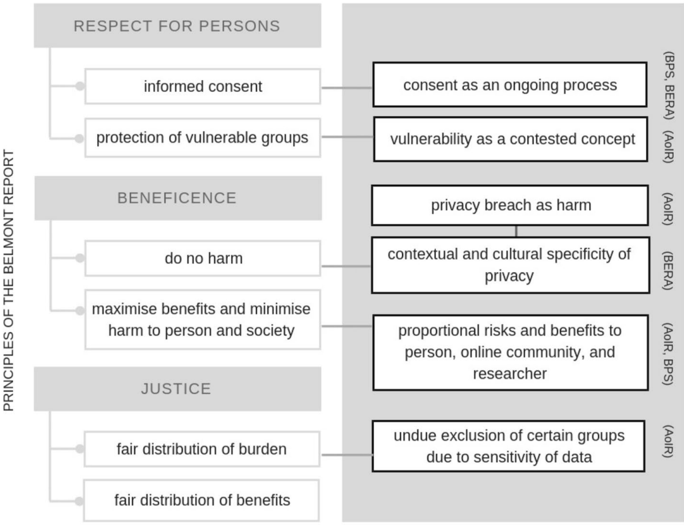
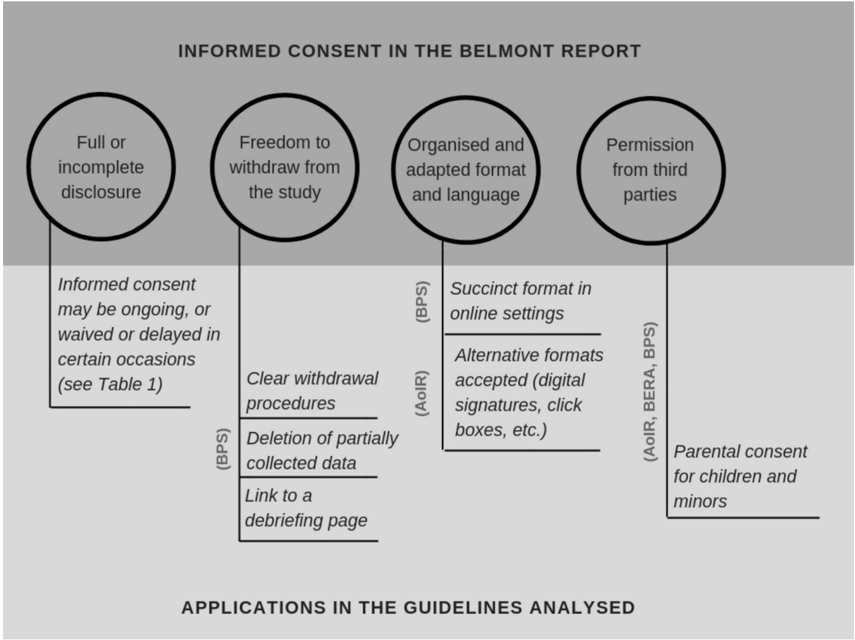
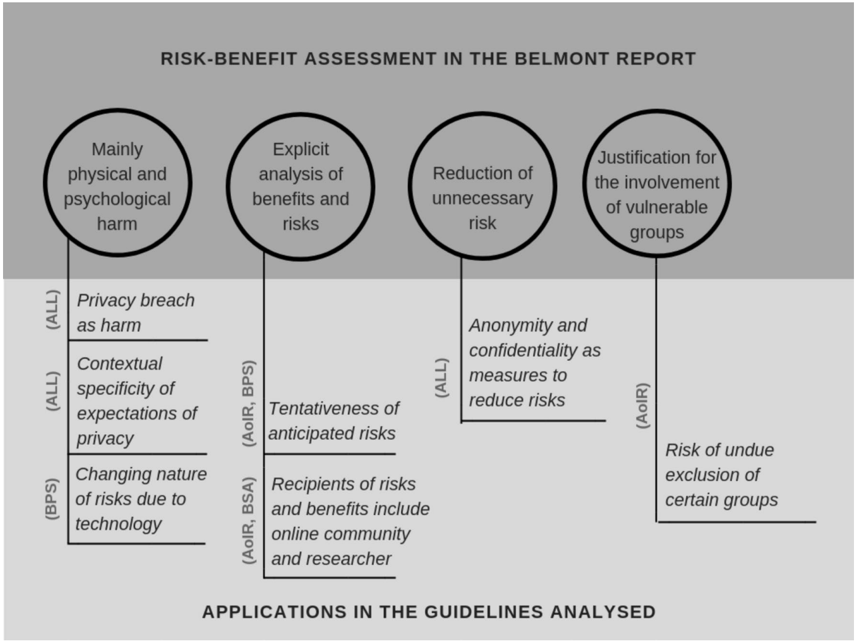
The purpose of this article is to illuminate the conceptualisations and applications of the Belmont Report’s key ethical principles of respect for persons, beneficence, and justice based on a document analysis of five of the most relevant disciplinary guidelines on internet research in the social sciences. These seminal documents are meant to provide discipline-specific guidance for research design and implementation and are regarded as key references when conducting research online. Our analysis revealed that the principles of respect and beneficence were explicitly conveyed in the documents analysed, offering nuanced interpretations on issues of informed consent, privacy, and benefits and risks as well as providing recommendations for modifying traditional practices to fit the online setting. However, the invocations of the principle of justice were rather implicit and reflect an important shift from the Belmont Report’s protectionist ethical position towards more situational and dialogic approaches. With the rapidly evolving nature of internet technologies, this analysis is projected to contribute to the ongoing developments in research ethics in the social sciences by outlining the tensions and implications of the use of the internet as a methodological tool. We also seek to provide recommendations on how disciplinary associations can proceed to facilitate ethically sensitive internet research.
Overview
The claims and statistics of this paper haven’t been checked yet.
Free: it reads the open-access text and checks the first 5 claims that cite a source we can check. Create a free account to check every claim.
Integrity signals
Registry
Cites
Statistics
Figures
Verification
Claims the paper makes
The claims and statistics of this paper haven’t been checked yet.
Free: it reads the open-access text and checks the first 5 claims that cite a source we can check. Create a free account to check every claim.
Claims other papers make about this one
Each is checked against this paper’s own text: does it say what the citing paper says it does?
The source backs part of the claim, not all of it — or backs it for a different population, condition or comparison.
In the citing paper
“This approach is also used in the disciplinary ethical guidance produce for internet-mediated researchers by the Belmont Report (Anabo et al. 2019), and by La Fors et al. (2019) who sought to integrate existing design-based ethical approaches for new technologies by matching lists of values the practical abstraction from mid-level ethics (principles) to what (Hagendorff 2019) calls ‘microethics.’”
From From What to How: An Initial Review of Publicly Available AI Ethics Tools, Methods and Research to Translate Principles into Practices (2020) · cites this paper as Anabo et al. 2019
Experimental — accuracy not yet measured
Self-check
Percentages, sums and reported differences re-computed from the paper’s own numbers.
The self-check needs the paper’s full text.
Citations
Cites
The Coding Manual for Qualitative Researchers
Saldana, J. (2025) · SAGE Publications Ltd eBooks · doi:10.4135/9781036235611 · Cited by 17,944
Principles of Biomedical Ethics
(2012) · Thieves of Virtue · doi:10.7551/mitpress/9079.003.0009 · Cited by 13,453
(2003) · Manual for Research Ethics Committees · doi:10.1017/cbo9780511550089.028 · Cited by 3,413
An 'American psychologist': (312492004-035)
O'Connor, E. (2001) · PsycEXTRA Dataset · doi:10.1037/e312492004-035 · Cited by 2,342
The Internet Galaxy: Reflections on the Internet, Business, and Society
Kling, R., & Castells, M. (2002) · Academe · doi:10.2307/40252194 · Cited by 1,888
Stanford Encyclopedia of Philosophy
Wahlberg, L. (2017) · Lund University Publications (Lund University) · Cited by 1,854
Social Network Sites as Networked Publics: Affordances, Dynamics, and Implications
(2010) · A Networked Self · doi:10.4324/9780203876527-8 · Cited by 1,724 · cited 1×
“As Boyd (2010) points out, the greater risk to privacy in online settings is due to the fact that internet-mediated data and tools are persistent, searchable, scalable, and replicable.”
BackgroundCastells, M. (2001) · VS Verlag für Sozialwissenschaften eBooks · doi:10.1007/978-3-322-89613-1 · Cited by 1,666
A Review of Facebook Research in the Social Sciences
Wilson, R. E., Gosling, S. D., & Graham, L. T. (2012) · Perspectives on Psychological Science · doi:10.1177/1745691612442904 · Cited by 1,226
Secrets and lies: digital security in a networked world
(2001) · Choice Reviews Online · doi:10.5860/choice.38-3941 · Cited by 1,159
Research works printed but not linked: 7
- Armstrong, R. (2003). Human subjects research and the Internet: Ethi- cal dilemmas. Research Review. University of Texas Office of Research Administration. Retrieved from https ://resea rch.utexa s.edu/wp-conte nt/uploa ds/sites /3/2015/10/ehtic al_dilem mas_inter net.pdf.
- Buchanan, E., Markham, A., & Ess, C. (2010). Ethics and internet research commons: Building a sustainable future. Association of Internet Researchers 11th Annual Conference Workshop. Gotten- burg, Sweden.
- Dench, S., Iphofen, R., & Huws, U. (2004). An EU code of ethics for socio-economic research. Brighton: The Institute for Employment Studies.
- Frankel, M., & Siang, S. (1999). Ethical and legal issues of human subjects research on the Internet-Report of a workshop June 10-11. Retrieved from http://shr.aaas.org/proje cts/human _subje cts/cyber space / repor t.pdf.
- Hine, C. (2011). Internet research and unobtrusive methods. Social Research Update, 61, 1.
- Mann, C., & Stewart, F. (2011). Internet communication and qualita- tive research: A handbook for research online. London: SAGE.
- Vilar Martín, J. (2013). Cuestiones éticas en la educación social: Del compromiso político a la responsibilidad en la práctica profe- sional. Barcelona: UOC.
Cited by
Morley, J., Floridi, L., Kinsey, L., & Elhalal, A. (2020) · Science and Engineering Ethics · doi:10.1007/s11948-019-00165-5 · Cited by 882
Artificial intelligence for human flourishing – Beyond principles for machine learning
Stahl, B. C., Andreou, A., Brey, P., Hatzakis, T., Kirichenko, A., Macnish, K., Laulhé Shaelou, S., Patel, A., Ryan, M., & Wright, D. (2021) · Journal of Business Research · doi:10.1016/j.jbusres.2020.11.030 · Cited by 203
Morley, J., Floridi, L., Kinsey, L., & Elhalal, A. (2021) · Philosophical studies series · doi:10.1007/978-3-030-81907-1_10 · Cited by 235
Information privacy, impact assessment, and the place of ethics
Raab, C. D. (2020) · Computer Law & Security Review · doi:10.1016/j.clsr.2020.105404 · Cited by 93
The Ethics of Publicly Available Data Research: A Situated Ethics Framework for Reddit
Gliniecka, M. (2023) · Social Media + Society · doi:10.1177/20563051231192021 · Cited by 121
First do no harm: An exploration of researchers’ ethics of conduct in Big Data behavioral studies
Favaretto, M., Clercq, E. D., Gaab, J., & Elger, B. S. (2020) · PLoS ONE · doi:10.1371/journal.pone.0241865 · Cited by 81
Appiah, R., Raviola, G. J., & Weobong, B. (2024) · Journal of Empirical Research on Human Research Ethics · doi:10.1177/15562646241237669 · Cited by 44
Algorithmic learning or learner autonomy? Rethinking AI’s role in digital education
Nopas, D.-S. (2025) · Qualitative Research Journal · doi:10.1108/qrj-11-2024-0282 · Cited by 67
Scoping the ethical principles of cybersecurity fear appeals
Dupuis, M., & Renaud, K. (2020) · Ethics and Information Technology · doi:10.1007/s10676-020-09560-0 · Cited by 33
Challenges in gaining ethical approval for sensitive digital social science studies
Winter, C., & Gundur, R. V. (2022) · International Journal of Social Research Methodology · doi:10.1080/13645579.2022.2122226 · Cited by 33
Favaretto, M., Clercq, E. D., Briel, M., & Elger, B. S. (2020) · Journal of Empirical Research on Human Research Ethics · doi:10.1177/1556264620935223 · Cited by 20
Harris, J., Germain, J., McCoy, E., & Schofield, R. (2024) · PLoS ONE · doi:10.1371/journal.pone.0302924 · Cited by 18
EDM and Privacy: Ethics and Legalities of Data Collection, Usage, and Storage.
Klose, M., Desai, V., Song, Y., & Gehringer, E. F. (2020) · Educational Data Mining · Cited by 11
Design and Psychometric Properties of the BAtSS: A New Tool to Assess Attitudes towards Bats
Pérez, B., Álvarez, B., Boso, À., & Lisón, F. (2021) · Animals · doi:10.3390/ani11020244 · Cited by 13
Favaretto, M., Clercq, E. D., Caplan, A. L., & Elger, B. S. (2023) · PLoS ONE · doi:10.1371/journal.pone.0280542 · Cited by 15
When the Researched Refused Confidentiality: Reflections from Fieldwork Experience in Ghana
Akuffo, A. G. (2023) · Journal of Academic Ethics · doi:10.1007/s10805-023-09471-x · Cited by 25
The Quest for Actionable AI Ethics
Ruttkamp, E. (2020) · Communications in computer and information science · doi:10.1007/978-3-030-66151-9_3 · Cited by 20
The Belmont Report doesn’t need reform, our moral imagination does
Serpico, K. (2024) · Research Ethics · doi:10.1177/17470161241235772 · Cited by 22
On how VoIP attacks foster the malicious call ecosystem
Carrillo-Mondéjar, J., Martínez, J. L., & Suárez‐Tangil, G. (2022) · Computers & Security · doi:10.1016/j.cose.2022.102758 · Cited by 18
Pérez, B., Concha‐Salgado, A., Aburto-González, V., Mandiola-Sandoval, C., Muñoz-Henríquez, C., & Cerda-Muñoz, D. (2022) · International Journal of Social Psychology Revista de Psicología Social · doi:10.1080/02134748.2022.2034290 · Cited by 9
Ethical Issues in Researching Higher Education Teaching and Learning
Golding, J., & Ince, A. (2024) · Encyclopedia · doi:10.3390/encyclopedia4030074 · Cited by 12
Yupari-Azabache, I. L., Díaz-Ortega, J. L., Bardales-Aguirre, L. B., Sevillano, S. B., & Paredes-Díaz, S. E. (2023) · Risk Management and Healthcare Policy · doi:10.2147/rmhp.s420330 · Cited by 6
Makhortykh, M. (2023) · Studies in computational intelligence · doi:10.1007/978-981-99-7184-8_4 · Cited by 4
Educational Research Ethics Committees as Space for Situated Learning in Higher Education
Madikizela-Madiya, N., & Motlhabane, A. T. (2022) · Education Research International · doi:10.1155/2022/7971812 · Cited by 4
Ethical Benefits and Drawbacks of Digitally Informed Consent
Charles, W., & Magtanong, R. V. (2021) · Advances in human and social aspects of technology book series · doi:10.4018/978-1-7998-8467-5.ch008 · Cited by 3
Macharaga, E. (2021) · DUT Open Scholar (Durban University of Technology) · doi:10.51415/10321/3578 · Cited by 6
The DECIDE Framework: Describing Ethical Choices in Digital-Behavioral-Data ExplorationsPreprint
Shaw, H., Brown, O., Hinds, J. M., Nightingale, S. J., Towse, J. N., & Ellis, D. A. (2023) · PsyArXiv (OSF Preprints) · doi:10.31234/osf.io/c8ert · Cited by 4
Navigating the Ethical Complexities: Unveiling the Implications of Social Media Research
Same’e, S. A., & Anmary, A. S. (2024) · Advances in information quality and management · doi:10.4018/978-1-6684-8526-2.ch009 · Cited by 2
Agarwal, S., Papasavva, A., Suárez‐Tangil, G., & Vasek, M. (2025) · ACM Internet Measurement Conference (IMC) · doi:10.1145/3730567.3764431 · Cited by 5
Tripathi, S., & Chaturvedi, R. K. (2024) · International Journal of Ethics and Systems · doi:10.1108/ijoes-05-2023-0117 · Cited by 5
Sørensen, J. B., Thomassen, J. L., Meyrowitsch, D. W., Kingod, N. R., Konradsen, F., & Ploug, T. (2024) · Scandinavian Journal of Public Health · doi:10.1177/14034948231219725 · Cited by 3
Hinay, C. P. C., & Deloy, E. D. A. (2022) · International Journal of Research Publications · doi:10.47119/ijrp10011011020223983 · Cited by 2
Bachmann, A. S. (2021) · Journal of Scandinavian Cinema · doi:10.1386/jsca_00043_1 · Cited by 2
La justice en jeu : regard sur la recherche avec des êtres humains
Bergeron, M. G., Marceau, E., & Masella, M.-A. (2024) · Lex Electronica · doi:10.7202/1108626ar · Cited by 2
Aspectos éticos de la investigación mediada por internet: Un recordatorio
Domínguez-Lara, S., & Torres-Villalobos, G. (2020) · Educación Médica · doi:10.1016/j.edumed.2020.06.011 · Cited by 2
Ethical principles for the introduction and use of modern technologies in academic work
Chen, L., Saharuddin, N., & Abdullah, N. S. M. (2025) · Innovations in Education and Teaching International · doi:10.1080/14703297.2025.2555960 · Cited by 6
AI Ethicist in Action: Strategies for Operationalising AI Ethics
Carnevale, A. (2025) · Springer eBooks · doi:10.1007/978-3-032-05526-2_4 · Cited by 1
Bajar, J. T. (2022) · International Journal of Ethics Education · doi:10.1007/s40889-022-00141-x · Cited by 1
López, R. Q., Gavín-Chocano, Ó., & Ferra, M. P. (2022) · Roteiro · doi:10.18593/r.v47.30105 · Cited by 1
Gulo, J. E., & Deloy, E. D. A. (2022) · International Journal of Research Publications · doi:10.47119/ijrp10011011020223952 · Cited by 1
Baker-Brunnbauer, J. (2022) · Business guides on the go · doi:10.1007/978-3-031-18275-4_7 · Cited by 2
Akuffo, A. G. (2024) · SN Social Sciences · doi:10.1007/s43545-024-00923-8 · Cited by 1
The DECIDE Framework: Describing Ethical Choices in Digital-Behavioral-Data Explorations
Shaw, H., Brown, O., Hinds, J. M., Nightingale, S. J., Towse, J. N., & Ellis, D. A. (2025) · Advances in Methods and Practices in Psychological Science · doi:10.1177/25152459251361013 · Cited by 2
Digal, E. L., & Deloy, E. D. A. (2022) · International Journal of Research Publications · doi:10.47119/ijrp10011011020223975
Factors associated with knowledge of Sci-Hub in Peruvian dental students
Corrales-Reyes, I. E., Hernández-Silva, V., Perú, U. N. S. L. G. D. I. F. D. O., del Perú., A. N. C. D. E. D. O., González, P. F., Perú, U. N. S. L. G. D. I. F. D. O., del Perú., A. N. C. D. E. D. O., Verástegui, R. L., del Perú., A. N. C. D. E. D. O., Universidad Nacional Mayor de San Marcos. Facultad de Odontología. Lima, P., et al. (2022) · Journal Of Oral Research · doi:10.17126/joralres.2022.033
Developing Privacy Incident Responses to Combat Information Warfare
McElroy, S., & McKee, L. (2023) · International Conference on Cyber Warfare and Security · doi:10.34190/iccws.18.1.958 · Cited by 2
Assessment of Sponsored Education Through Scholarship: Basis for Policy Improvement
Yanga, M. B., FAUNDO, D. F. F., RATAY, E., & POLICARPIO, M. (2023) · International Journal of Research Publications · doi:10.47119/ijrp1001311820235383
Blockchain-Based Dynamic Consent for Healthcare and Research
Charles, W. (2023) · Future of business and finance · doi:10.1007/978-3-031-45339-7_3 · Cited by 1
Rajar, U. D. M., Ashraf, N., & Fahim, A. (2024) · ATHENS JOURNAL OF HEALTH & MEDICAL SCIENCES · doi:10.30958/ajhms.11-1-4
Opportunities Encountered by the Teachers in the New Normal
Caracut, R. M. O., Malnegro, M. A. L., & Diaz, L. J. B. (2024) · International Journal of Research Publication and Reviews · doi:10.55248/gengpi.5.0524.1430
Xia, H., & Liu, J. (2024) · Journal of Information Communication and Ethics in Society · doi:10.1108/jices-01-2024-0011 · Cited by 1
Williams, M. A., & Tucker, J. (2025) · Business Management Research and Applications A Cross-Disciplinary Journal · doi:10.54093/bmra.v4.i1.8837 · Cited by 1
Academic and professional qualifications of accounting educators in South African higher education
Nwosu, L. I., Ogundele, O. S., & Olarewaju, O. M. (2025) · Social Sciences & Humanities Open · doi:10.1016/j.ssaho.2025.102007
Card-Not-Present Fraud resulting from Smishing Attacks: An Experimental Study
Agarwal, S., & Vasek, M. (2025) · New Security Paradigms Workshop · doi:10.1145/3774761.3774919 · Cited by 1
Une perspective principiste sur l’éthique des systèmes de mesure de la performance
Leca, B. L., Casarin, V., Linder, S., Moraru‐Arfire, A., & Translations, C. A. (2026) · Comptabilité - Contrôle - Audit · doi:10.3917/cca.pa.0006
Ventura‐León, J., Baños-Chaparro, J., Lino‐Cruz, C., Tocto‐Muñoz, S., Gamboa‐Melgar, G., & Ruiz‐Castro, J. (2026) · Distance Education · doi:10.1080/01587919.2026.2676943
The Intersection of Psychotherapy, Spirituality, Religion, and Ethics
Rassool, G. H. (2026) · Springer eBooks · doi:10.1007/978-3-032-26515-9_1
Hewson, C. (2026) · Springer eBooks · doi:10.1007/978-3-031-52643-5_25-1
Teachers’ Perception of a Two-Tier RtI Pilot to Support English Learners’ Reading Performance
Nash, A. (2026) · Colombian Applied Linguistics Journal · doi:10.14483/22487085.22952
Metadata
- Authors
- Anabo, I. F., Elexpuru-Albizuri, I., & Villardón-Gallego, L.
- Affiliations
- Universidad de Deusto (ES)
- Corresponding author
- Anabo, Icy Fresno
- Venue
- Ethics and Information Technology
- Published
- 2018-12-28
- Volume
- 21
- Issue
- 2
- Pages
- 137-149
- ISSN
- 1388-1957 (ISSN-L)
- 1572-8439
- OpenAlex
- W2906928358
- Cited by
- 60
- References
- 53
- Citations by year
- 2026: 5 · 2025: 8 · 2024: 13 · 2023: 9 · 2022: 11 · 2021: 5 · 2020: 8 · 2019: 1
- FWCI
- 7.97
- Type
- journal article
- Language
- en
- Open access
- hybrid
- doi.org
- Licence
- cc-by
- creativecommons.org/licenses/by/4.0 (tdm)
- Locations
- Ethics and Information Technology (publishedVersion, cc-by)
- Funders
- Universidad de Deusto
- Topics
- Social Sciences › Sociology and Political Science › Focus Groups and Qualitative Methods
- Social Sciences › Sociology and Political Science › Qualitative Research Methods and Ethics
- Social Sciences › Sociology and Political Science › Survey Methodology and Nonresponse
- Keywords
- Belmont Report, research ethics, online research, respect for persons, beneficence, justice, informed consent, privacy, benefits and risks, social sciences, ethical principles
About these checks
Registry, retraction, Cites and statistics results are computed, not judged, with one exception: a printed reference that no index lists is read once by a model before it counts as a citation error. Claims are extracted by a model and kept only when their quote appears verbatim in the text; each cited source is then checked, with a model’s help, for whether it says what the claim relies on. Those verdicts can be wrong — read the claim’s quote and the cited source before relying on one.
Statistics and arithmetic are recomputed, not judged.
Confidence bands are shown only for fields calibrated on our annotated test set. None is calibrated yet, so no band is shown.
What counts as a claim ›How we measure confidence ›How we check this ›
Are you an author, or do you see a problem with this page? Request a review
Data sources
Bibliographic data: Semantic Scholar, OpenAlex, Crossref.
Contains information from the Semantic Scholar Academic Graph Datasets, made available under the ODC Attribution License (ODC-BY 1.0).
Semantic Scholar’s data is described in: Kinney, R., et al. (2023). The Semantic Scholar Open Data Platform. arXiv:2301.10140.
