

The DOI matches its Crossref record; 54 of the 54 references it cites were found in a registry or an index.
The Breakthrough of Large Language Models Release for Medical Applications: 1-Year Timeline and Perspectives
Open accessAbstract
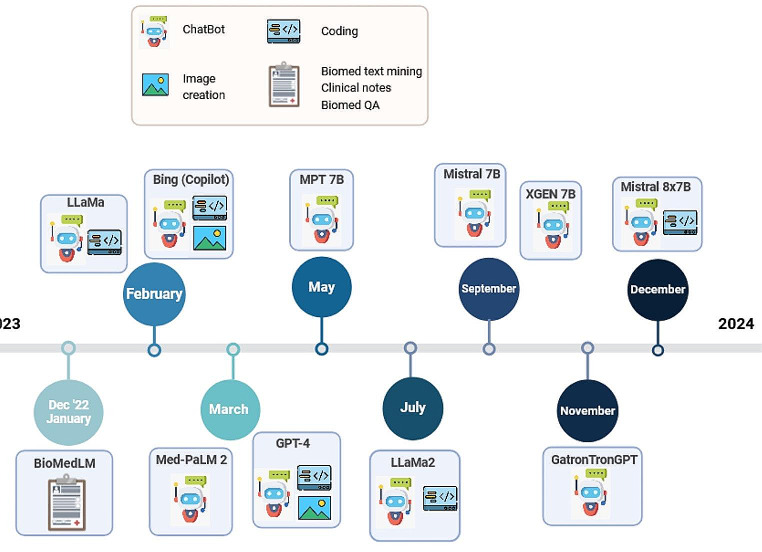
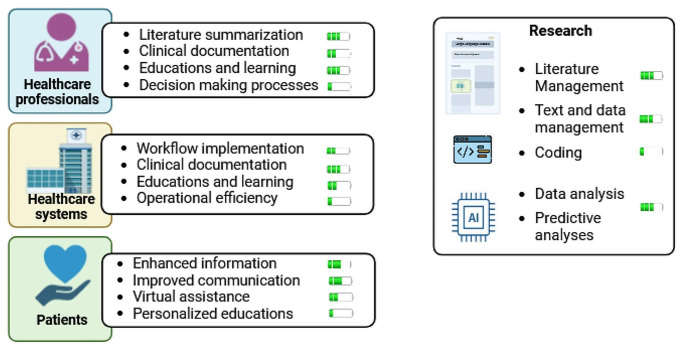
Within the domain of Natural Language Processing (NLP), Large Language Models (LLMs) represent sophisticated models engineered to comprehend, generate, and manipulate text resembling human language on an extensive scale. They are transformer-based deep learning architectures, obtained through the scaling of model size, pretraining of corpora, and computational resources. The potential healthcare applications of these models primarily involve chatbots and interaction systems for clinical documentation management, and medical literature summarization (Biomedical NLP). The challenge in this field lies in the research for applications in diagnostic and clinical decision support, as well as patient triage. Therefore, LLMs can be used for multiple tasks within patient care, research, and education. Throughout 2023, there has been an escalation in the release of LLMs, some of which are applicable in the healthcare domain. This remarkable output is largely the effect of the customization of pre-trained models for applications like chatbots, virtual assistants, or any system requiring human-like conversational engagement. As healthcare professionals, we recognize the imperative to stay at the forefront of knowledge. However, keeping abreast of the rapid evolution of this technology is practically unattainable, and, above all, understanding its potential applications and limitations remains a subject of ongoing debate. Consequently, this article aims to provide a succinct overview of the recently released LLMs, emphasizing their potential use in the field of medicine. Perspectives for a more extensive range of safe and effective applications are also discussed. The upcoming evolutionary leap involves the transition from an AI-powered model primarily designed for answering medical questions to a more versatile and practical tool for healthcare providers such as generalist biomedical AI systems for multimodal-based calibrated decision-making processes. On the other hand, the development of more accurate virtual clinical partners could enhance patient engagement, offering personalized support, and improving chronic disease management.
Overview
The claims and statistics of this paper haven’t been checked yet.
Run the check — free, no account needed. It reads the open-access text and checks the sources it cites.
Integrity signals
Registry
Cites
Statistics
Figures
Verification
Claims the paper makes
The claims and statistics of this paper haven’t been checked yet.
Run the check — free, no account needed. It reads the open-access text and checks the sources it cites.
Self-check
Percentages, sums and reported differences re-computed from the paper’s own numbers.
The self-check needs the paper’s full text.
Citations
Cites
Vaswani, A., Shazeer, N., Parmar, N., Uszkoreit, J., Jones, L., Gomez, A. N., Kaiser, L., & Polosukhin, I. (2017) · arXiv · doi:10.48550/arxiv.1706.03762 · Cited by 120,404
Language Models are Few-Shot Learners
Brown, T. B., Mann, B., Ryder, N., Subbiah, M., Kaplan, J., Dhariwal, P., Neelakantan, A., Shyam, P., Sastry, G., Askell, A., et al. (2020) · arXiv · doi:10.48550/arxiv.2005.14165 · Cited by 23,372
Advances in neural information processing systems 7
Cios, K. J., & Shields, M. E. (1997) · Neurocomputing · doi:10.1016/s0925-2312(97)90018-7 · Cited by 22,093
Advances in neural information processing systems 7
(1996) · Computers & Mathematics with Applications · doi:10.1016/s0898-1221(96)90463-0 · Cited by 14,759
Rudin, C. (2019) · Nature Machine Intelligence · doi:10.1038/s42256-019-0048-x · Cited by 10,561
Large language models encode clinical knowledge
Singhal, K., Azizi, S., Tu, T., Mahdavi, S. S., Wei, J., Chung, H. W., Scales, N., Tanwani, A., Cole-Lewis, H., Pfohl, S., et al. (2023) · Nature · doi:10.1038/s41586-023-06291-2 · Cited by 4,083
Large Language Models Encode Clinical Knowledge
Singhal, K., Azizi, S., Tu, T., Mahdavi, S. S., Wei, J., Chung, H. W., Scales, N., Tanwani, A., Cole-Lewis, H., Pfohl, S., et al. (2022) · arXiv · doi:10.48550/arxiv.2212.13138 · Cited by 4,083
Sallam, M. (2023) · Healthcare · doi:10.3390/healthcare11060887 · Cited by 3,126 · cited 1×
“These approaches may offer alternative learning pathways and can be used for designing interactive tools for medical educa - tion, enhancing the learning experience [42].”
The Power of Scale for Parameter-Efficient Prompt Tuning
Lester, B., Al-Rfou, R., & Constant, N. (2021) · Proceedings of the 2021 Conference on Empirical Methods in Natural Language Processing · doi:10.18653/v1/2021.emnlp-main.243 · Cited by 3,096
The Power of Scale for Parameter-Efficient Prompt Tuning
Lester, B., Al-Rfou, R., & Constant, N. (2021) · arXiv · doi:10.48550/arxiv.2104.08691 · Cited by 3,092
Research works printed but not linked: 1
- Radford A, Narasimhan K. Improving Language Understanding by Generative Pre-Training. 2018. https://api.semanticscholar.org/CorpusID:49313245.
Cited by
Sorted by citations
Sociodemographic biases in medical decision making by large language models
Omar, M., Soffer, S., Agbareia, R., Bragazzi, N. L., Apakama, D. U., Horowitz, C. R., Charney, A. W., Freeman, R., Kummer, B., Glicksberg, B. S., et al. (2025) · Nature Medicine · doi:10.1038/s41591-025-03626-6 · Cited by 173
Industrial applications of large language models
Raza, M., Jahangir, Z., Riaz, M. B., Saeed, M. J., & Sattar, M. A. (2025) · Scientific Reports · doi:10.1038/s41598-025-98483-1 · Cited by 234
Can artificial intelligence models serve as patient information consultants in orthodontics?
Dursun, D., & Geçer, R. B. (2024) · BMC Medical Informatics and Decision Making · doi:10.1186/s12911-024-02619-8 · Cited by 90
Woo, J. J., Yang, A. J., Olsen, R. J., Hasan, S. S., Nawabi, D. H., Nwachukwu, B. U., Williams, R. J., & Ramkumar, P. N. (2024) · Arthroscopy The Journal of Arthroscopic and Related Surgery · doi:10.1016/j.arthro.2024.10.042 · Cited by 69
Ma, C., Zhang, H., Rao, Y., Jiang, X., Liu, B., Sun, Z., Song, Z., Gao, Y., Cui, Y., Liu, X., et al. (2025) · npj Digital Medicine · doi:10.1038/s41746-025-02198-6 · Cited by 61
Metadata
- Authors
- Cascella, M., Semeraro, F., Montomoli, J., Bellini, V., Piazza, O., & Bignami, E.
- Affiliations
- University of Salerno (IT)
- Ospedale Maggiore Carlo Alberto Pizzardi (IT)
- Ospedale Infermi di Rimini (IT)
- University of Parma (IT)
- Corresponding author
- Bellini, Valentina
- ORCID
- Venue
- Journal of Medical Systems
- Published
- 2024-02-17
- Volume
- 48
- Issue
- 1
- Pages
- 22-22
- ISSN
- 0148-5598 (ISSN-L)
- 1573-689X
- PMC
- PMC10873461
- OpenAlex
- W4392782765
- Cited by
- 219
- References
- 40
- Citations by year
- 2026: 65 · 2025: 103 · 2024: 51
- FWCI
- 5.00
- Type
- journal article
- Language
- en
- Open access
- hybrid
- doi.org
- Locations
- Journal of Medical Systems (publishedVersion, cc-by)
- PubMed Central (publishedVersion, cc-by)
- PubMed (publishedVersion)
- Funders
- Università degli Studi di Parma
- Topics
- Health Sciences › Medicine › Health Informatics › Artificial Intelligence in Healthcare and Education
- Physical Sciences › Computer Science › Artificial Intelligence › Machine Learning in Healthcare
- Physical Sciences › Computer Science › Artificial Intelligence › Topic Modeling
- Keywords
- large language models, medical applications of AI, clinical decision support, healthcare chatbots, triage, multimodal AI, chronic disease management
- MeSH terms
- Communication, Documentation, Educational Status, Humans, Language, Electric Power Supplies
About these checks
Registry, retraction, Cites and statistics results are computed, not judged, with one exception: a printed reference that no index lists is read once by a model before it counts as a citation error. Claims are extracted by a model and kept only when their quote appears verbatim in the text; each cited source is then checked, with a model’s help, for whether it says what the claim relies on. Those verdicts can be wrong — read the claim’s quote and the cited source before relying on one.
Statistics and arithmetic are recomputed, not judged.
Confidence bands are shown only for fields calibrated on our annotated test set. None is calibrated yet, so no band is shown.
What counts as a claim ›How we measure confidence ›How we check this ›
Are you an author, or do you see a problem with this page? Request a review
