

The DOI matches its Crossref record; 56 of the 56 references it cites were found in a registry or an index.
Late Holocene climate and environment of the SE Pampa grasslands, Argentina, inferred from biological indicators in shallow, freshwater Lake Nahuel Rucá
Abstract
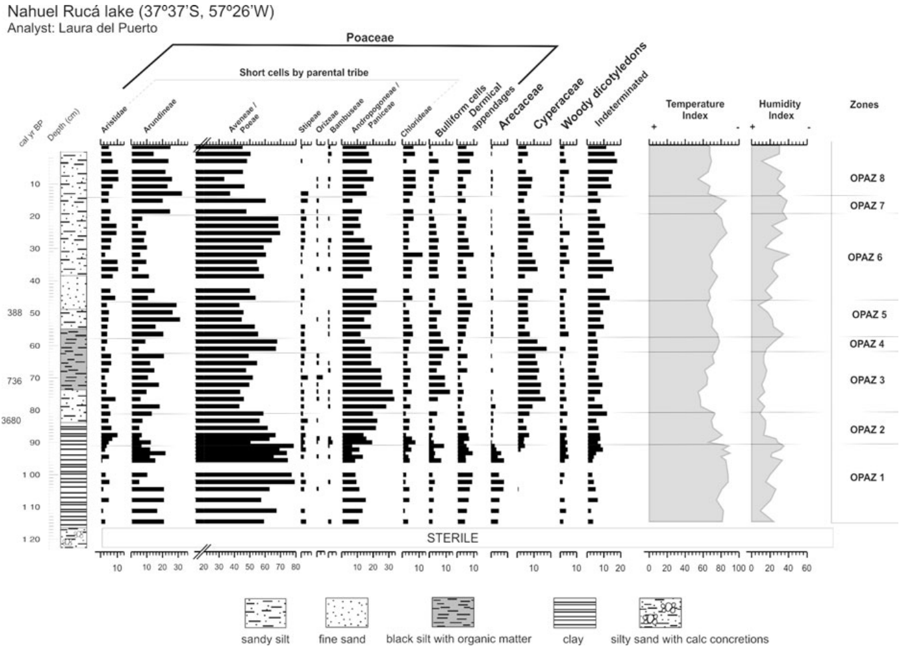
We analyzed pollen, non-pollen palynomorphs (NPPs), calcareous microfossils, plant macrofossils, diatoms, chrysophyte cysts, opal phytoliths and organic matter content in a 123-cm sediment sequence from Nahuel Rucá Lake, a shallow, freshwater system in the southeastern Pampa grasslands, Argentina. Three stages in the lake evolution were identified. Before 3,680 cal year BP, only pollen, NPPs (dinoflagellate cysts and acritarchs) and ostracods were recovered, suggesting brackish/saline conditions in the lake and nearby areas. Freshwater conditions are, however, indicated by Myriophyllum , Pediastrum and Zygnemataceae. The brackish/saline conditions could have been caused by marine influence during a Holocene sea level high stand that affected the area ca. 6,000 year BP. Between 3,680 and 390 cal year BP, macrophyte pollen and plant macrofossils indicate increasingly freshwater conditions in the lake and the adjacent area. Diatom and ostracod assemblages, however, suggest brackish and oligotrophic conditions, giving way to freshwater and meso-eutrophic conditions toward the end of this period. The relationship between submersed macrophytes ( Myriophyllum , Potamogeton , Ceratophyllum , Chara ) and planktonic algae (Chlorophyta and diatoms), suggests a shift in the lake from a clear to a turbid state. This turbid state is more evident after 390 cal year BP. High values of Pediastrum , Scenedesmus and diatoms ( Cyclotella meneghiniana , Aulacoseira granulata , A. muzzanensis ) observed during this stage could have reduced light penetration, with consequent loss of submersed plants. Pollen and plant macrofossils in the uppermost 20 cm indicate a shallow, freshwater lake similar to present, though an increase in brackish/freshwater diatoms suggests an increase in salinity, perhaps related to periodic droughts. Opal phytoliths yield a regional paleoclimatic reconstruction that agrees closely with inferences made using pollen, mammals and sediment characteristics.
Overview
The claims and statistics of this paper haven’t been checked yet.
Run the check — free, no account needed. It reads the open-access text and checks the sources it cites.
Integrity signals
Registry
Cites
Statistics
Figures
Verification
Claims the paper makes
The claims and statistics of this paper haven’t been checked yet.
Run the check — free, no account needed. It reads the open-access text and checks the sources it cites.
Claims other papers make about this one
Each is checked against this paper’s own text: does it say what the citing paper says it does?
The source backs part of the claim, not all of it — or backs it for a different population, condition or comparison.
In the citing paper
“Essentially, the size, shape and formation of these water sources changed throughout the Holocene (Iriondo & Garcia 1993; Johnson et al. 2012; Stutz et al. 2010; Stutz & Prieto, 2003; Zárate et al. 2000).”
From A maxent predictive model for hunter-gatherer sites in the southern pampas, argentina (2021) · cites this paper as Stutz et al. 2010
Experimental — accuracy not yet measuredThe source backs part of the claim, not all of it — or backs it for a different population, condition or comparison.
In the citing paper
“Essentially, the size, shape and formation of these water sources changed throughout the Holocene (Iriondo & Garcia 1993; Johnson et al. 2012; Stutz et al. 2010; Stutz & Prieto, 2003; Zárate et al. 2000).”
From A maxent predictive model for hunter-gatherer sites in the southern pampas, argentina (2021) · cites this paper as Stutz et al. 2010
Experimental — accuracy not yet measured
Self-check
Percentages, sums and reported differences re-computed from the paper’s own numbers.
The self-check needs the paper’s full text.
Citations
Cites
Heiri, O., Lotter, A. F., & Lemcke, G. (2001) · Journal of Paleolimnology · doi:10.1023/a:1008119611481 · Cited by 5,012
Grimm, E. C. (1987) · Computers & Geosciences · doi:10.1016/0098-3004(87)90022-7 · Cited by 3,355
Scheffer, M. (2004) · Springer eBooks · doi:10.1007/978-1-4020-3154-0 · Cited by 2,022
Determination of the number of zones in a biostratigraphical sequence
BENNETT, K. D. (1996) · New Phytologist · doi:10.1111/j.1469-8137.1996.tb04521.x · Cited by 1,205
SHCal04 Southern Hemisphere calibration, 0-11.0 cal kyr BP
McCormac, F. G., Hogg, A. G., Blackwell, P. G., Buck, C. E., Higham, T. F. G., & Reimer, P. J. (2004) · Radiocarbon · doi:10.1017/s0033822200033014 · Cited by 955
Paleolimnology: the history and evolution of lake systems
(2004) · Choice Reviews Online · doi:10.5860/choice.41-3461 · Cited by 599
PAST - PAlaeontological STatistics
Hammer, Ø. (2001) · Cited by 554
Paleolimnology: The History and Evolution of Lake Systems
Cohen, A. S. (2003) · Oxford University Press eBooks · doi:10.1093/oso/9780195133530.001.0001 · Cited by 492
Modern Phytolith Assemblages from the North American Great Plains
Fredlund, G. G., & Tieszen, L. T. (1994) · Journal of Biogeography · doi:10.2307/2845533 · Cited by 445
Predicted World Distribution of C3 and C4 Grass Phytoliths
Twiss, P. C. (1992) · Phytolith Systematics · doi:10.1007/978-1-4899-1155-1_6 · Cited by 418
Regime Shifts in Shallow Lakes
Scheffer, M., & Jeppesen, E. (2007) · Ecosystems · doi:10.1007/s10021-006-9002-y · Cited by 294
Tonni, E. P., Cione, A. L., & Figini, A. J. (1999) · Palaeogeography, Palaeoclimatology, Palaeoecology · doi:10.1016/s0031-0182(98)00140-0 · Cited by 274
Climatic variations in the Argentine plains during the last 18,000 years
Iriondo, M. H., & Garcia, N. O. (1993) · Palaeogeography, Palaeoclimatology, Palaeoecology · doi:10.1016/0031-0182(93)90013-9 · Cited by 223
Paleoclimate, Global Change and the Future
(2003) · Global change - the IGBP series · doi:10.1007/978-3-642-55828-3 · Cited by 211
Blindow, I., Hargeby, A., & Andersson, G. K. A. (2002) · Aquatic Botany · doi:10.1016/s0304-3770(01)00208-x · Cited by 204
Late Quaternary Vegetational and Climatic Changes in the Pampa Grassland of Argentina
Prieto, A. R. (1996) · Quaternary Research · doi:10.1006/qres.1996.0007 · Cited by 199
The Climate of the Last Millennium
Bradley, R. S., Briffa, K. R., Cole, J. E., Hughes, M. K., & Osborn, T. J. (2003) · Global change - the IGBP series · doi:10.1007/978-3-642-55828-3_6 · Cited by 175
Holocene sea-level fluctuation in the southern hemisphere
Isla, F. I. (1989) · Quaternary Science Reviews · doi:10.1016/0277-3791(89)90036-x · Cited by 173
Classification of Opal Phytoliths Formed in Selected Dicotyledons Native to the Great Plains
Bozarth, S. R. (1992) · Springer eBooks · doi:10.1007/978-1-4899-1155-1_10 · Cited by 170
Quattrocchio, M. E., Borromei, A. M., Deschamps, C. M., Grill, S., & Zavala, C. A. (2007) · Quaternary International · doi:10.1016/j.quaint.2007.02.018 · Cited by 165
Fredlund, G. G., & Tieszen, L. L. (1997) · Palaeogeography Palaeoclimatology Palaeoecology · doi:10.1016/s0031-0182(97)00040-0 · Cited by 152
Late Holocene Phytolith and Carbon-Isotope Record from a Latosol at Salitre, South-Central Brazil
Alexandre, A., Meunier, J., Mariotti, A. A., & Soubiès, F. (1999) · Quaternary Research · doi:10.1006/qres.1998.2027 · Cited by 147
Mid-Holocene climatic variability reconstruction from pollen records (32°–52°S, Argentina)
Mancini, M. V., Paez, M. M., Prieto, A. R., Stutz, S., Tonello, M. S., & Vilanova, I. (2004) · Quaternary International · doi:10.1016/j.quaint.2004.07.013 · Cited by 146
Self-citationMarkgraf, V., D'antoni, H. L., & Morbelli, M. A. (1978) · Medical Entomology and Zoology · Cited by 122
Vegetational history of the Late glacial–Holocene transition in the grasslands of eastern Argentina
Prieto, A. R. (2000) · Palaeogeography Palaeoclimatology Palaeoecology · doi:10.1016/s0031-0182(99)00163-7 · Cited by 108
Prieto, A. R., Blasi, A., FRANCESCO, C. G. D., & Fernández, C. (2004) · Quaternary Research · doi:10.1016/j.yqres.2004.04.006 · Cited by 103
Baker, R. G., Fredlund, G. G., Mandel, R. D., & Bettis, E. A. (2000) · Quaternary International · doi:10.1016/s1040-6182(00)00010-0 · Cited by 78
Karst‐Riddoch, T. L., & Smol, J. P. (2000) · Aquatic Sciences · doi:10.1007/s000270050073 · Cited by 70
Zárate, M., Kemp, R. A., Espinosa, M., & Ferrero, L. (2000) · The Holocene · doi:10.1191/095968300669846317 · Cited by 69
Tonello, M. S., & Prieto, A. R. (2010) · Ameghiniana · doi:10.5710/amgh.v47i4.7 · Cited by 68
Self-citationMartens, K., & Behen, F. (1994) · Cited by 66
Holocene trophic state changes in relation to sea level variation in Lake Blanca, SE Uruguay
García‐Rodríguez, F., Sprechmann, P., Metzeltin, D., Scafati, L., Melendi, D. L., Volkheimer, W., Mazzeo, N., Hiller, A., von Tümpling, P. D. W., & Scasso, F. (2004) · Journal of Paleolimnology · doi:10.1023/b:jopl.0000013281.31891.8e · Cited by 62
Mid–late Holocene cultural and environmental dynamics in Eastern Uruguay
Boksar, R. B., del Puerto, L., Inda, H., & Castiñeira, C. (2004) · Quaternary International · doi:10.1016/j.quaint.2004.07.017 · Cited by 59
Self-citationBracco, R., Inda, H., del Puerto, L., Casti�eira, C., Sprechmann, P., & Garc�a-Rodr�guez, F. (2005) · Journal of Paleolimnology · doi:10.1007/s10933-004-4934-8 · Cited by 51
Self-citationHassan, G. S., Espinosa, M. A., & Isla, F. I. (2005) · Journal of Paleolimnology · doi:10.1007/s10933-005-6444-8 · Cited by 51
Vilanova, I., Prieto, A. R., & Espinosa, M. A. (2005) · Journal of Quaternary Science · doi:10.1002/jqs.953 · Cited by 49
The mammalian record and climatic change over the last 30,000 years in the Pampean Region, Argentina
Prado, J. L., & Alberdi, M. T. (1999) · Quaternary International · doi:10.1016/s1040-6182(98)00057-3 · Cited by 47
Biogeographical Consequences of Recent Climate Changes in the Southern Andes of Argentina
Villalba, R., Masiokas, M. H., Kitzberger, T., & Boninsegna, J. A. (2005) · Advances in global change research · doi:10.1007/1-4020-3508-x_16 · Cited by 46
Fontana, S. L. (2005) · Journal of Paleolimnology · doi:10.1007/s10933-005-5792-8 · Cited by 44
Self-citationCyanobacteria as indicators of phosphate-eutrophication of lakes and pools in the past
Geel, B. V., Odgaard, B. V., & Rałska-Jasiewiczowa, M. (1996) · UvA-DARE (University of Amsterdam) · Cited by 43
Paleolimnological evidence of Holocene climatic changes in Lake Blanca, southern Uruguay
del Puerto, L., García‐Rodríguez, F., Inda, H., Bracco, R., Castiñeira, C., & Adams, J. B. (2006) · Journal of Paleolimnology · doi:10.1007/s10933-006-0012-8 · Cited by 40
Self-citationToy, N., Chadwick, J., Whatley, R., Moguilevsky, A., & Ramos, M. I. F. (1997) · Revista española de micropaleontología · Cited by 38
Holocene evolution of the Mar Chiquita coastal lagoon area (Argentina) indicated by pollen analysis
Stutz, S., Prieto, A. R., & Isla, F. I. (2005) · Journal of Quaternary Science · doi:10.1002/jqs.952 · Cited by 37
Self-citationGarcía‐Rodríguez, F., Stutz, S., Inda, H., del Puerto, L., Boksar, R. B., & Panario, D. (2010) · Hydrobiologia · doi:10.1007/s10750-010-0184-0 · Cited by 30
Self-citationBorel, C. M., Guerstein, G. R., & Prieto, A. R. (2003) · LA Referencia (Red Federada de Repositorios Institucionales de Publicaciones Científicas) · Cited by 29
Self-citationDarwin and Design in Phytolith Systematics: Morphometric Methods for Mitigating Redundancy
Rovner, I., & Russ, J. C. (1992) · Springer eBooks · doi:10.1007/978-1-4899-1155-1_13 · Cited by 27
Late Holocene palaeoenvironments of the Nutria Mansa 1 archaeological site, Argentina
Bonomo, M., Zucol, A. F., Téllez, B. G., Coradeghini, A., & Vigna, M. S. (2008) · Journal of Paleolimnology · doi:10.1007/s10933-008-9225-3 · Cited by 27
Stutz, S., Prieto, A. R., & Isla, F. I. (2002) · Ameghiniana · Cited by 24
Self-citationGarcía‐Rodríguez, F. (2006) · Journal of Paleolimnology · doi:10.1007/s10933-006-0011-9 · Cited by 24
Fontana, S. L. (2007) · Radiocarbon · doi:10.1017/s003382220004193x · Cited by 18
Self-citationCambio climático en la pampa bonaerense : las precipitaciones desde los siglos XVIII al XX
Deschamps, J. R., Otero, O., & Tonni, E. P. (2003) · Cited by 18
Borel, C. M. (2007) · Ameghiniana · Cited by 15
Self-citationGeomorfología de la Pampa Deprimida : base para los estudios edafológicos y agronómicos
Tricart, J. L. F. (1973) · Medical Entomology and Zoology · Cited by 14
Head, M. J., Borel, C. M., Guerstein, G. R., & Harland, R. (2003) · Journal of Paleontology · Cited by 12
Self-citationRecent pollen sedimentation in Los Padres pond, Buenos Aires Province, Argentina
Mancini, M. V. (1994) · Journal of Paleolimnology · doi:10.1007/bf00683143 · Cited by 9
Aspectos ambientales en torno al primer fuerte de la frontera sur de Buenos Aires
Deschamps, J. R., & Tonni, E. P. (2007) · Cited by 2
Research works printed but not linked: 6
- del Puerto L (2009) Silicofitolitos como Indicadores Paleoambientales: bases comparativas y reconstrucción paleoclimática a partir del Pleistoceno Tardío en el SE del Uruguay. Mg Thesis PEDECIBA, Facultad de Ciencias, Universidad de la República, Montevideo, 189 pp (unpublished)
- Frenguelli J (1941) Diatomeas del Río de la Plata. Rev Mus Nac La Plata Tomo 3:213–334
- Frenguelli J (1945) Las diatomeas del Platense. Rev Mus Nac La Plata Tomo 3:77–221
- Stutz S, Prieto AR, Isla FI (1999) Cambios de la vegetación durante el Holoceno en el SE bonaerense: análisis polínico del paleoestuario del arroyo La Ballenera. APA Pub Especial 6:65–69
- Violante RA (1992) Ambientes sedimentarios asociados a un sistema de barrera litoral del Holoceno en la llanura costera al sur de Villa Gesell, Provincia de Buenos Aires. RAGA 47:201–214
- Violante RA, Parker G, Cavallotto JL (2001) Evolución de las llanuras costeras del este bonaerense entre la bahía Samborombón y la laguna Mar Chiquita durante el Holoceno. RAGA 56:51–66
Cited by
A maxent predictive model for hunter-gatherer sites in the southern pampas, argentina
Rafuse, D. J. (2021) · Open Quaternary · doi:10.5334/oq.97 · Cited by 17
Metadata
- Authors
- Stutz, S., Borel, C. M., Fontana, S. L., del Puerto, L., Inda, H., García-Rodriguez, F., & Tonello, M. S.
- Venue
- Journal of Paleolimnology
- Published
- 2010-06-30
- Volume
- 44
- Issue
- 3
- Pages
- 761-775
- ISSN
- 0921-2728
- 1573-0417
- Cited by
- 49
- References
- 56
- Language
- en
About these checks
Registry, retraction, Cites and statistics results are computed, not judged, with one exception: a printed reference that no index lists is read once by a model before it counts as a citation error. Claims are extracted by a model and kept only when their quote appears verbatim in the text; each cited source is then checked, with a model’s help, for whether it says what the claim relies on. Those verdicts can be wrong — read the claim’s quote and the cited source before relying on one.
Statistics and arithmetic are recomputed, not judged.
Confidence bands are shown only for fields calibrated on our annotated test set. None is calibrated yet, so no band is shown.
What counts as a claim ›How we measure confidence ›How we check this ›
Are you an author, or do you see a problem with this page? Request a review
Data sources
Bibliographic data: Semantic Scholar, OpenAlex, Crossref.
Contains information from the Semantic Scholar Academic Graph Datasets, made available under the ODC Attribution License (ODC-BY 1.0).
Semantic Scholar’s data is described in: Kinney, R., et al. (2023). The Semantic Scholar Open Data Platform. arXiv:2301.10140.
