

The DOI matches its Crossref record; 1 of the 1 references it cites were found in a registry or an index.
Genistein induces degradation of mutant huntingtin in fibroblasts from Huntington’s disease patients
Overview
The claims and statistics of this paper haven’t been checked yet.
Run the check — free, no account needed. It reads the open-access text and checks the sources it cites.
Integrity signals
Registry
Cites
Statistics
Figures
Verification
Claims the paper makes
The claims and statistics of this paper haven’t been checked yet.
Run the check — free, no account needed. It reads the open-access text and checks the sources it cites.
Claims other papers make about this one
Each is checked against this paper’s own text: does it say what the citing paper says it does?
In the citing paper
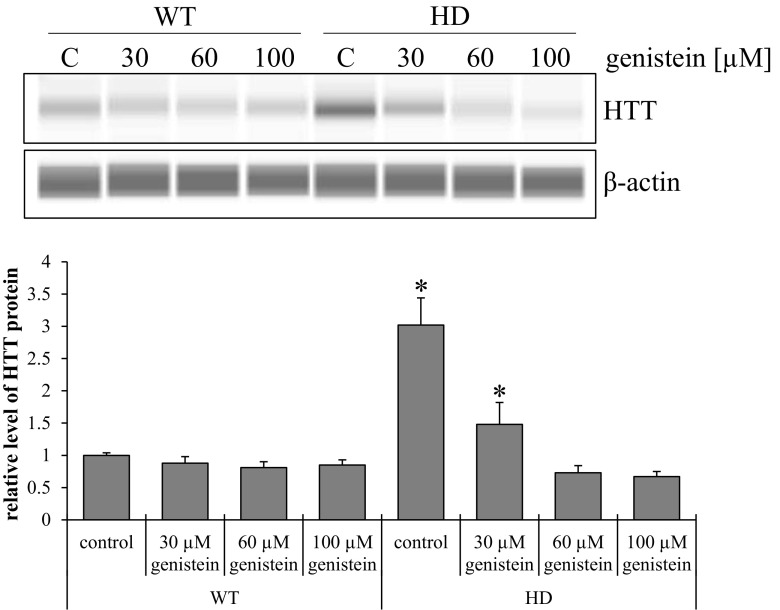
“however, using this system it is not possible to distinguish LC3-I and LC3-II forms (see Figure 9 for comparison of separation of LC3 forms in traditional western blotting and WES).”
From Guidelines for the use and interpretation of assays for monitoring autophagy (4th edition) 1 (2021) · cites this paper as [298]
Self-check
Percentages, sums and reported differences re-computed from the paper’s own numbers.
The self-check needs the paper’s full text.
Citations
Cites
Huntington's disease: The current state of research with peripheral tissues
Sassone, J., Colciago, C., Cislaghi, G., Silani, V., & Ciammola, A. (2009) · Experimental Neurology · doi:10.1016/j.expneurol.2009.05.012 · Cited by 175
Research works printed but not linked: 22
- Aguzzi A, O’Connor T (2010) Protein aggregation diseases: pathogenicity and therapeutic perspectives. Nat Rev Drug Discov 9:237–248 · DOI
- Guo F, Liu X, Cai H, Le W (2018) Autophagy in neurodegenerative diseases: pathogenesis and therapy. Brain Pathol 28:3–13 · DOI
- Huntington Study Group (1996) Unified Huntington’s disease rating scale: reliability and consistency. Mov Disord 11:136–142 · DOI
- Jędrak P, Krygier M, Tońska K et al (2017a) Mitochondrial DNA levels in Huntington disease leukocytes and dermal fibroblasts. Metab Brain Dis 32:1237–1247 · DOI
- Jędrak P, Sowa N, Barańska S, Węgrzyn G (2017b) Characterization of conditions and determination of practical tips for mtDNA level estimation in various human cells. Acta Biochim Pol 64:699–704 · DOI
- Jędrak P, Mozolewski P, Węgrzyn G, Więckowski MR (2018) Mitochondrial alterations accompanied by oxidative stress conditions in skin fibroblasts of Huntington's disease patients. Metab Brain Dis 33:2005–2017 · DOI
- Kegel KB, Meloni AR, Yi Y et al (2002) Huntingtin is present in the nucleus, interacts with the transcriptional corepressor C-terminal binding protein, and represses transcription. J Biol Chem 277:7466–7476 · DOI
- Kim KH, Dodsworth C, Paras A, Burton BK (2013) High dose genistein aglycone therapy is safe in patients with mucopolysaccharidoses involving the central nervous system. Mol Genet Metab 109:382–385 · DOI
- Malinowska M, Wilkinson FL, Bennett W, Langford-Smith KJ, O'Leary HA, Jakobkiewicz-Banecka J, Wynn R, Wraith JE, Wegrzyn G, Bigger BW (2009) Genistein reduces lysosomal storage in peripheral tissues of mucopolysaccharide IIIB mice. Mol Genet Metab 98:235–242 · DOI
- Malinowska M, Wilkinson FL, Langford-Smith KJ, Langford-Smith A, Brown JR, Crawford BE, Vanier MT, Grynkiewicz G, Wynn RF, Wraith JE, Wegrzyn G, Bigger BW (2010) Genistein improves neuropathology and corrects behaviour in a mouse model of neurodegenerative metabolic disease. PLoS One 5:e14192 · DOI
- Marchina E, Misasi S, Bozzato A et al (2014) Gene expression profile in fibroblasts of Huntington’s disease patients and controls. J Neurol Sci 337:42–46 · DOI
- Morreale MK (2015) Huntington's disease: looking beyond the movement disorder. Adv Psychosom Med 34:135–142 · DOI
- Moskot M, Montefusco S, Jakóbkiewicz-Banecka J, Mozolewski P, Węgrzyn A, Di Bernardo D, Węgrzyn G, Medina DL, Ballabio A, Gabig-Cimińska M (2014) The phytoestrogen genistein modulates lysosomal metabolism and transcription factor EB (TFEB) activation. J Biol Chem 289:17054–17069 · DOI
- Petersen MH, Budtz-Jørgensen E, Sørensen SA et al (2014) Reduction in mitochondrial DNA copy number in peripheral leukocytes after onset of Huntington’s disease. Mitochondrion 17:14–21 · DOI
- Pierzynowska K, Gaffke L, Cyske Z, Puchalski M, Rintz E, Bartkowski M, Osiadły M, Pierzynowski M, Mantej J, Piotrowska E, Węgrzyn G (2018a) Autophagy stimulation as a promising approach in treatment of neurodegenerative diseases. Metab Brain Dis 33:989–1008 · DOI
- Pierzynowska K, Gaffke L, Hać A, Mantej J, Niedziałek N, Brokowska J, Węgrzyn G (2018b) Correction of Huntington's disease phenotype by genistein-induced autophagy in the cellular model. NeuroMolecular Med 20:112–123 · DOI
- Pierzynowska K, Podlacha M, Gaffke L, Majkutewicz I, Mantej J, Wegrzyn A, Osiadły M, Myslinska D, Wegrzyn G (2019) Autophagy-dependent mechanism of genistein-mediated elimination of behavioral and biochemical defects in the rat model of sporadic Alzheimer's disease. Neuropharmacology 148:332–346 · DOI
- Shannon KM, Fraint A (2015) Therapeutic advances in Huntington's disease. Mov Disord 30:1539–1546 · DOI
- Sharp AH, Loev SJ, Schilling G et al (1995) Widespread expression of Huntington’s disease gene (IT15) protein product. Neuron 14:1065–1074 · DOI
- Tousley A, Iuliano M, Weisman E, Sapp E, Richardson H, Vodicka P, Alexander J, Aronin N, DiFiglia M, Kegel-Gleason KB (2019) Huntingtin associates with the actin cytoskeleton and α-actinin isoforms to influence stimulus dependent morphology changes. PLoS One 14:e0212337 · DOI
- Wu HC, Hu QL, Zhang SJ, Wang YM, Jin ZK, Lv LF, Zhang S, Liu ZL, Wu HL, Cheng OM (2018) Neuroprotective effects of genistein on SH-SY5Y cells overexpressing A53T mutant α-synuclein. Neural Regen Res 13:1375–1383 · DOI
- Yang YP, Hu LF, Zheng HF, Mao CJ, Hu WD, Xiong KP, Wang F, Liu CF (2013) Application and interpretation of current autophagy inhibitors and activators. Acta Pharmacol Sin 34:625–635 · DOI
Cited by
Sorted by citations
Guidelines for the use and interpretation of assays for monitoring autophagy (4th edition) 1
Klionsky, D. J., Abdel-Aziz, A. K., Abdelfatah, S., Abdellatif, M., Abdoli, A., Abel, S., Abeliovich, H., Abildgaard, M. H., Abudu, Y. P., Acevedo-Arozena, A., et al. (2021) · Autophagy · doi:10.1080/15548627.2020.1797280 · Cited by 2,897
Self-citation
Metadata
- Authors
- Pierzynowska, K., Gaffke, L., Cyske, Z., & Węgrzyn, G.
- ORCID
- Węgrzyn, Grzegorz
- Venue
- Metabolic Brain Disease
- Published
- 2019-03-09
- Volume
- 34
- Issue
- 3
- Pages
- 715-720
- ISSN
- 0885-7490
- 1573-7365
- PMC
- PMC6520327
- Cited by
- 32
- References
- 1
- Language
- en
- Funders
- Narodowym Centrum Nauki (2017/25/N/NZ2/00812)
About these checks
Registry, retraction, Cites and statistics results are computed, not judged, with one exception: a printed reference that no index lists is read once by a model before it counts as a citation error. Claims are extracted by a model and kept only when their quote appears verbatim in the text; each cited source is then checked, with a model’s help, for whether it says what the claim relies on. Those verdicts can be wrong — read the claim’s quote and the cited source before relying on one.
Statistics and arithmetic are recomputed, not judged.
Confidence bands are shown only for fields calibrated on our annotated test set. None is calibrated yet, so no band is shown.
What counts as a claim ›How we measure confidence ›How we check this ›
Are you an author, or do you see a problem with this page? Request a review
How to cite
Cite CoChat for the checks on this page, and the paper for its own findings.
- This page
- CoChat. (2026). Citation check: Genistein induces degradation of mutant huntingtin in fibroblasts from Huntington’s disease patients. https://app.cochat.ai/papers/10.1007/s11011-019-00405-4
- The paper
- Pierzynowska, K., Gaffke, L., Cyske, Z., & Węgrzyn, G. (2019). Genistein induces degradation of mutant huntingtin in fibroblasts from Huntington’s disease patients. Metabolic Brain Disease. https://doi.org/10.1007/s11011-019-00405-4
