

The DOI matches its Crossref record; 1 of the 1 references it cites were found in a registry or an index.
Relational autonomy in the care of the vulnerable: health care professionals’ reasoning in Moral Case Deliberation (MCD)
Open accessAbstract
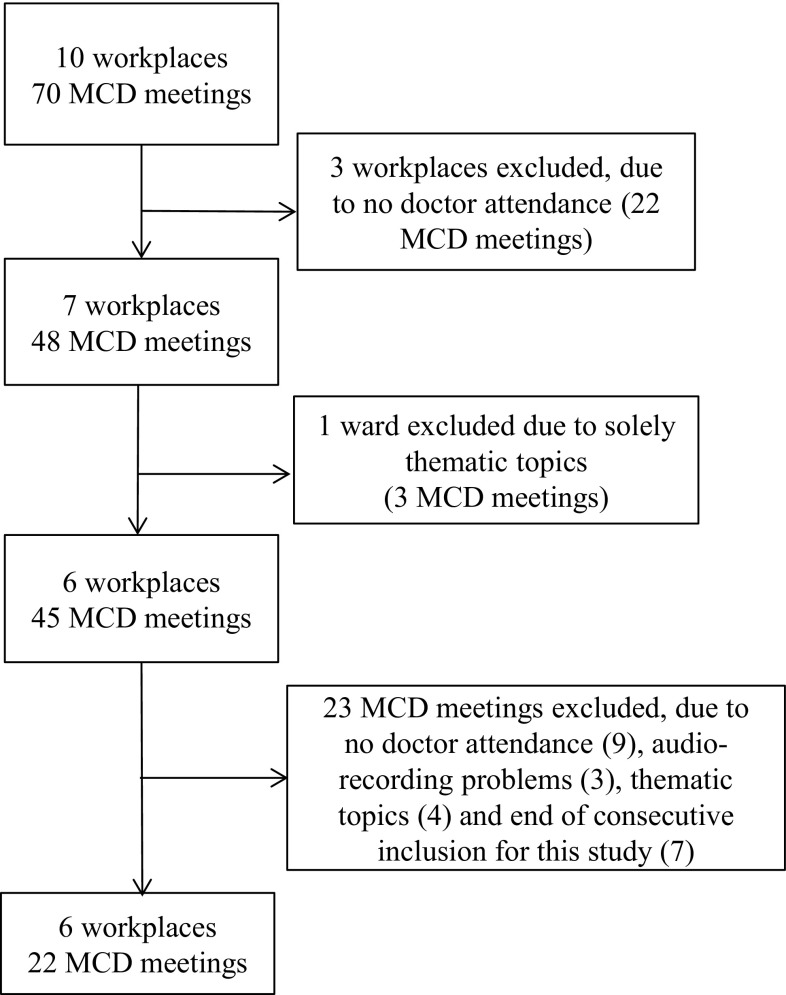
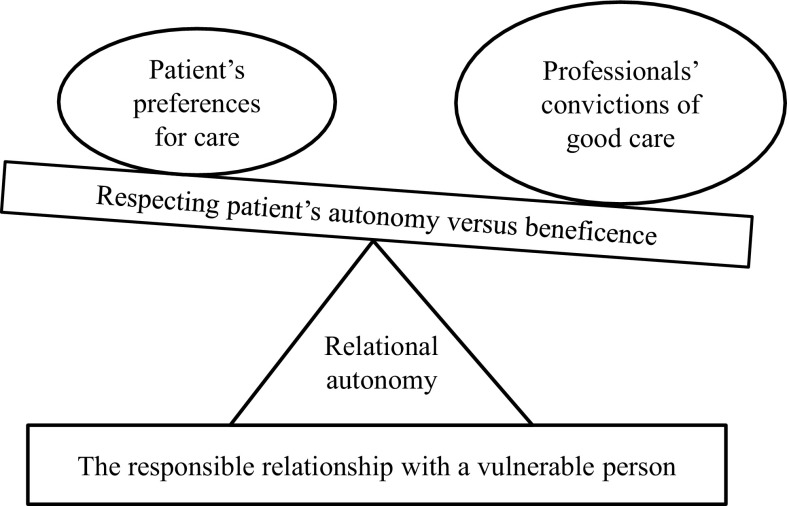
In Moral Case Deliberation (MCD), healthcare professionals discuss ethically difficult patient situations in their daily practice. There is a lack of knowledge regarding the content of MCD and there is a need to shed light on this ethical reflection in the midst of clinical practice. Thus, the aim of the study was to describe the content of healthcare professionals' moral reasoning during MCD. The design was qualitative and descriptive, and data consisted of 22 audio-recorded inter-professional MCDs, analysed with content analysis. The moral reasoning centred on how to strike the balance between personal convictions about what constitutes good care, and the perceived dissonant care preferences held by the patient. The healthcare professionals deliberated about good care in relation to demands considered to be unrealistic, justifications for influencing the patient, the incapacitated patient's nebulous interests, and coping with the conflict between using coercion to achieve good while protecting human dignity. Furthermore, as a basis for the reasoning, the healthcare professionals reflected on how to establish a responsible relationship with the vulnerable person. This comprised acknowledging the patient as a susceptible human being, protecting dignity and integrity, defining their own moral responsibility, and having patience to give the patient and family time to come to terms with illness and declining health. The profound struggle to respect the patient's autonomy in clinical practice can be understood through the concept of relational autonomy, to try to secure both patients' influence and at the same time take responsibility for their needs as vulnerable humans.
Overview
The claims and statistics of this paper haven’t been checked yet.
Run the check — free, no account needed. It reads the open-access text and checks the sources it cites.
Integrity signals
Registry
Cites
Statistics
Figures
Verification
Claims the paper makes
The claims and statistics of this paper haven’t been checked yet.
Run the check — free, no account needed. It reads the open-access text and checks the sources it cites.
Self-check
Percentages, sums and reported differences re-computed from the paper’s own numbers.
The self-check needs the paper’s full text.
Citations
Cites
The qualitative content analysis process
Elo, S., & Kyngäs, H. (2008) · Journal of Advanced Nursing · doi:10.1111/j.1365-2648.2007.04569.x · Cited by 22,617
Research works printed but not linked: 38
- Abma, T. A., V. E. Baur, B. Molewijk, and G. A. Widdershoven. 2010. Inter-ethics: Towards an interactive and interdependent bioethics. Bioethics 24 (5): 242–255. https://doi.org/10.1111/j.1467-8519.2010.01810.x . · DOI
- Bartholdson, C., P. Pergert, and G. Helgesson. 2014. Procedures for clinical ethics case reflections: An example from childhood cancer care. Clinical Ethics 9 (2–3): 87–95. · DOI
- Christman, J. 2014. Relational autonomy and the social dynamics of Paternalism. An International Forum 17 (3): 369–382. https://doi.org/10.1007/s10677-013-9449-9 . · DOI
- Dauwerse, L., T. Abma, B. Molewijk, and G. Widdershoven. 2011. Need for ethics support in healthcare institutions: Views of Dutch board members and ethics support staff. Journal of Medical Ethics 37 (8): 456–460. https://doi.org/10.1136/jme.2010.040626 . · DOI
- Dauwerse, L., M. Stolper, G. Widdershoven, and B. Molewijk. 2014. Prevalence and characteristics of moral case deliberation in Dutch health care. Medicine, Health Care, and Philosophy 17 (3): 365–375. https://doi.org/10.1007/s11019-013-9537-6 . · DOI
- Dodds, S. 2000. Choice and control in feminist bioethics. In Relational autonomy: Feminist perspectives on autonomy, eds. C. Mackenzie, and N. Stoljar. Oxford: Agency, and the Social Self, Oxford University Press
- Donchin, A. 2001. Understanding autonomy relationally: Toward a reconfiguration of bioethical principles. The Journal of Medicine and Philosophy 26 (4): 365. https://doi.org/10.1076/jmep.26.4.365.3012 . · DOI
- Gronlund, C. F., V. Dahlqvist, K. Zingmark, M. Sandlund, and A. Soderberg. 2016. Managing ethical difficulties in healthcare: Communicating in inter-professional clinical ethics support sessions. HEC Forum 28 (4): 321–338. https://doi.org/10.1007/s10730-016-9303-2 . · DOI
- Hansson, M. G. 2002. Imaginative ethics—Bringing ethical praxis into sharper relief. Medicine, Health Care, and Philosophy 5 (1): 33–42. · DOI
- Hem, Marit Helene, Reidar Pedersen, Reidun Norvoll, and Bert Molewijk. 2015. Evaluating clinical ethics support in mental healthcare. Nursing Ethics 22 (4): 452–466. https://doi.org/10.1177/0969733014539783 . · DOI
- Jennings, Bruce. 2016. Reconceptualizing autonomy: A relational turn in bioethics. The Hastings Center Report 46 (3): 11. https://doi.org/10.1002/hast.544 . · DOI
- Kälvemark Sporrong, Sofia. 2007. Ethical competence and moral distress in the health care sector: A prospective evaluation of ethics rounds. dissertation. Uppsala: Uppsala Universitet
- Mackenzie, C. 2008. Relational autonomy, normative authority and perfectionism. Journal of Social Philosophy 39 (4): 512–533. https://doi.org/10.1111/j.1467-9833.2008.00440.x . · DOI
- Mackenzie, C., and N. Stoljar. 2000a. Autonomy refigured. In Relational autonomy. Feminist perspectives an autonomy, agency, and the social self, eds. C. Mackenzie, and N. Stoljar, 3–31. New York: Oxford University Press.
- Mackenzie, C., and N. Stoljar. 2000b. Relational autonomy. Feminist perspectives an autonomy, agency, and the social self. New York: Oxford University Press.
- Mackenzie, C., W. Rogers, and S. Dodds. 2014. Introduction: What is vulnerability, and why does it matter for moral theory? In Vulnerability. New essays in ethics and feminist philosophy, eds. C. Mackenzie, W. Rogers, and S. Dodds, New York: Oxford University Press.
- Martin, Angela K, Nicolas Tavaglione, and Samia Hurst. 2014. Resolving the conflict: Clarifying ‘vulnerability’ in health care ethics. Kennedy Institute of Ethics Journal 24 (1): 51–72. https://doi.org/10.1353/ken.2014.0005 . · DOI
- Materstvedt, L. J. 2011. What is this thing called medical ethics? A Kantian interpretation. In Kant: Here, now, and how. Essays in honour of Truls Wyller, eds. S. G. Carson, J. Knowles, and B. K. Myskja, 207–233. Paderborn: mentis Verlag GmbH. · DOI
- Metselaar, Suzanne, Guy Widdershoven, Rouven Porz, and Bert Molewijk. 2017. Evaluating clinical ethics support: A participatory approach. Bioethics 31 (4): 258–266. https://doi.org/10.1111/bioe.12348 . · DOI
- Molewijk, A. C., T. Abma, M. Stolper, and G. Widdershoven. 2008a. Teaching ethics in the clinic. The theory and practice of moral case deliberation. Journal of Medical Ethics 34 (2): 120–124. https://doi.org/10.1136/jme.2006.018580 . · DOI
- Molewijk, B., M. Verkerk, H. Milius, and G. Widdershoven. 2008b. Implementing moral case deliberation in a psychiatric hospital: Process and outcome. Medicine, Health Care, and Philosophy 11 (1): 43–56. https://doi.org/10.1007/s11019-007-9103-1 . · DOI
- Molewijk, B., D. Kleinlugtenbelt, S. M. Pugh, and G. Widdershoven. 2011. Emotions and clinical ethics support. A moral inquiry into emotions in moral case deliberation. HEC Forum 23 (4): 257–268. https://doi.org/10.1007/s10730-011-9162-9 . · DOI
- Pettersen, T. 2011. The ethics of care: Normative structures and empirical implications. Health Care Analysis 19 (1): 51–64. https://doi.org/10.1007/s10728-010-0163-7 . · DOI
- Plantinga, M., B. Molewijk, M. de Bree, M. Moraal, M. Verkerk, and G. A. Widdershoven. 2012. Training healthcare professionals as moral case deliberation facilitators: Evaluation of a Dutch training programme. Journal of Medical Ethics 38 (10): 630–635. https://doi.org/10.1136/medethics-2012-100546 . · DOI
- Pullman, D., and K. Hodgkinson. 2016. The curious case of the De-ICD: Negotiating the dynamics of autonomy and paternalism in complex clinical relationships. The American Journal of Bioethics: AJOB 16 (8): 3–10. https://doi.org/10.1080/15265161.2016.1187211 . · DOI
- Rasoal, D., A. Kihlgren, I. James, and M. Svantesson. 2015. What healthcare teams find ethically difficult: Captured in 70 moral case deliberations. Nursing Ethics. https://doi.org/10.1177/0969733015583928 . · DOI
- Rasoal, D., M. Svantesson, and A. Kihlgren. 2017. ‘It’s like sailing’—Experiences of the role as facilitator during moral case deliberation. Clinical Ethics 12 (3): 135–142. · DOI
- Silen, M., K. Haglund, M. G. Hansson, and M. Ramklint. 2015. Ethics rounds do not improve the handling of ethical issues by psychiatric staff. Nord J Psychiatry. https://doi.org/10.3109/08039488.2014.994032 . · DOI · Paper page
- Silen, M., M. Ramklint, M. G. Hansson, and K. Haglund. 2016. Ethics rounds: An appreciated form of ethics support. Nursing Ethics 23 (2): 203–213. https://doi.org/10.1177/0969733014560930 . · DOI
- Spronk, B., M. Stolper, and G. A. Widdershoven. 2017. Tragedy in moral case deliberation. A European Journal 20 (3): 321–333. https://doi.org/10.1007/s11019-016-9749-7 . · DOI
- Stolper, M., B. Molewijk, and G. Widdershoven. 2015. Learning by doing. Training health care professionals to become facilitator of moral case deliberation. HEC Forum 27 (1): 47–59. https://doi.org/10.1007/s10730-014-9251-7 . · DOI
- Svantesson, M., A. Anderzen-Carlsson, H. Thorsen, K. Kallenberg, and G. Ahlstrom. 2008a. Interprofessional ethics rounds concerning dialysis patients: Staff’s ethical reflections before and after rounds. Journal of Medical Ethics 34 (5): 407–413. https://doi.org/10.1136/jme.2007.023572 . · DOI
- Svantesson, M., R. Lofmark, H. Thorsen, K. Kallenberg, and G. Ahlstrom. 2008b. Learning a way through ethical problems: Swedish nurses’ and doctors’ experiences from one model of ethics rounds. Journal of Medical Ethics 34 (5): 399–406. https://doi.org/10.1136/jme.2006.019810 . · DOI
- Svantesson, M., J. Karlsson, P. Boitte, J. Schildman, L. Dauwerse, G. Widdershoven, R. Pedersen, M. Huisman, and B. Molewijk. 2014. Outcomes of moral case deliberation–the development of an evaluation instrument for clinical ethics support (the Euro-MCD). BMC Medical Ethics 15: 30. https://doi.org/10.1186/1472-6939-15-30 . · DOI
- Svantesson, M., M. Silén, and I. James. 2017. It´s not all about moral reasoning: Understanding the content of Moral Case Deliberation. Nursing Ethics. https://doi.org/10.1177/0969733017700235 . · DOI
- Verkerk, M. A. 2001. The care perspective and autonomy. Medicine, Health Care, and Philosophy 4 (3): 289–294. · DOI
- Weidema, F. C., B. A. Molewijk, F. Kamsteeg, and G. A. Widdershoven. 2013. Aims and harvest of moral case deliberation. Nursing Ethics 20 (6): 617–631. https://doi.org/10.1177/0969733012473773 . · DOI
- Widdershoven, G., and T. Abma. 2011. Help and coercion from a care ethics perspective. In Global bioethics—perspective for human survival, ed. Chiarelli Brunetto, 27–34. Croatia: Intech.
Metadata
- Authors
- Heidenreich, K., Bremer, A., Materstvedt, L. J., Tidefelt, U., & Svantesson, M.
- Affiliations
- Örebro University (SE)
- Linnaeus University (SE)
- Norwegian University of Science and Technology (NO)
- Corresponding author
- Heidenreich, Kaja
- Venue
- Medicine, Health Care and Philosophy
- Published
- 2017-12-14
- Volume
- 21
- Issue
- 4
- Pages
- 467-477
- ISSN
- 1386-7423 (ISSN-L)
- 1572-8633
- PMC
- PMC6267250
- OpenAlex
- W2775459066
- Cited by
- 41
- References
- 1
- Citations by year
- 2026: 4 · 2025: 6 · 2024: 15 · 2023: 4 · 2022: 1 · 2021: 3 · 2020: 2 · 2019: 6
- FWCI
- 3.38
- Type
- journal article
- Language
- en
- Open access
- hybrid
- doi.org
- Licence
- Locations
- Medicine Health Care and Philosophy (publishedVersion, cc-by)
- Europe PMC (PubMed Central) (publishedVersion, other-oa)
- PubMed Central (publishedVersion, cc-by)
- PubMed (publishedVersion)
- ENLIGHTEN (Jurnal Bimbingan dan Konseling Islam) (acceptedVersion, cc-by-sa)
- NORA - Norwegian Open Research Archives (submittedVersion, cc-by)
- Funders
- AFA Försäkring
- Topics
- Health Sciences › Health Professions › General Health Professions › Ethics in medical practice
- Health Sciences › Medicine › Public Health, Environmental and Occupational Health › Ethics and bioethics in healthcare
- Health Sciences › Medicine › Pediatrics, Perinatology and Child Health › Ethics and Legal Issues in Pediatric Healthcare
- Keywords
- relational autonomy, moral case deliberation, vulnerable patients, patient autonomy, coercion, human dignity, moral responsibility, patient preferences
- MeSH terms
- Adaptation, Psychological, Conflict, Psychological, Health Personnel, Humans, Morals, Philosophy, Medical, Professional-Patient Relations, Sweden, Ethical Analysis, Vulnerable Populations, Qualitative Research
About these checks
Registry, retraction, Cites and statistics results are computed, not judged, with one exception: a printed reference that no index lists is read once by a model before it counts as a citation error. Claims are extracted by a model and kept only when their quote appears verbatim in the text; each cited source is then checked, with a model’s help, for whether it says what the claim relies on. Those verdicts can be wrong — read the claim’s quote and the cited source before relying on one.
Statistics and arithmetic are recomputed, not judged.
Confidence bands are shown only for fields calibrated on our annotated test set. None is calibrated yet, so no band is shown.
What counts as a claim ›How we measure confidence ›How we check this ›
Are you an author, or do you see a problem with this page? Request a review
