

The DOI matches its Crossref record; 2 of the 2 references it cites were found in a registry or an index.
Assessing WildfireGPT: a comparative analysis of AI models for quantitative wildfire spread prediction
Abstract
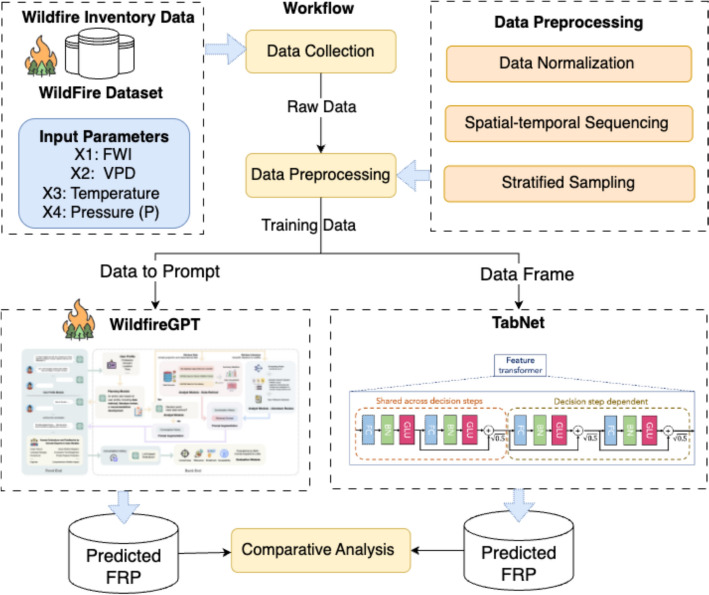
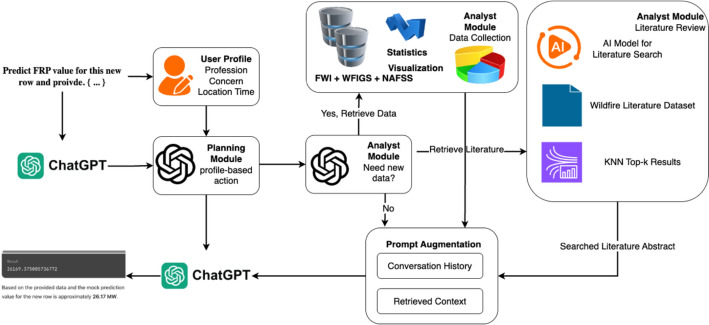
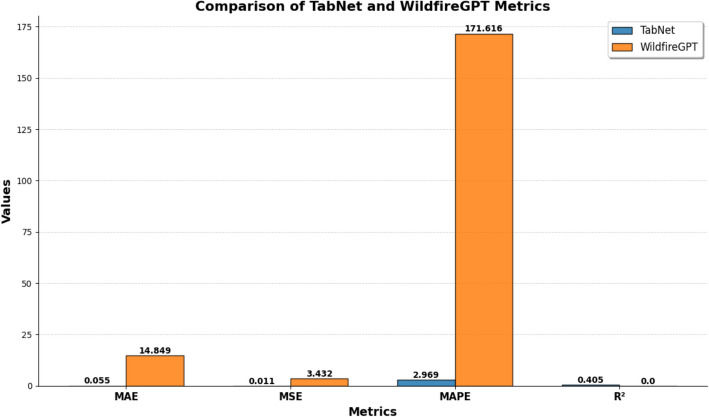
This study examines the application of WildfireGPT for wildfire forecasting, focusing on its limitations in quantitative predicting Fire Radiative Power (FRP) spread and comparing its performance with a specialized predictive model based on TabNet. While WildfireGPT is widely accessible and convenient for wildfire-related discussions, it lacks the specialized training, real-time data integration, and algorithmic precision required for reliable wildfire forecasting. To highlight these shortcomings, we conducted an experiment using real-world NASA Fire Radiative Power (FRP) datasets. Our TabNet-based model, trained on variables such as Vapor Pressure Deficit (VPD), temperature (T), pressure (P), and Fire Weather Index (FWI), demonstrated high correlation, with low Mean Absolute Error (MAE) and Mean Squared Error (MSE) in forecasting FRP values. In contrast, RAG (retrieval-augmented generation) and LLM (large language model)-based chatbots like WildfireGPT have unreliable performance on quantitative FRP forecasting with the same input data as prompts. The findings underscore the potential risks of over-reliance on general-purpose AI tools like WildfireGPT for quantitative modeling tasks in wildfire management. This study advocates for informed usage of AI tools, emphasizing the necessity of domain-specific models for accurate and actionable wildfire forecasting.
Overview
The claims and statistics of this paper haven’t been checked yet.
Run the check — free, no account needed. It reads the open-access text and checks the sources it cites.
Integrity signals
Registry
Cites
Statistics
Figures
Verification
Claims the paper makes
The claims and statistics of this paper haven’t been checked yet.
Run the check — free, no account needed. It reads the open-access text and checks the sources it cites.
Claims other papers make about this one
Each is checked against this paper’s own text: does it say what the citing paper says it does?
In the citing paper
“Ramesh et al. (2025) showed that AI systems like WildfireGPT systematically exclude references without DOIs through validation filters, creating structural biases against research from regions lacking DOI infrastructure.”
From Geographic Variation in LLM DOI Fabrication: Cross-Country Analysis of Citation Accuracy Across Four Large Language Models (2025) · cites this paper as Ramesh et al. (2025)
Self-check
Percentages, sums and reported differences re-computed from the paper’s own numbers.
The self-check needs the paper’s full text.
Citations
Cites
Larian Studios Dev Team (2024) · doi:10.1145/3292500.3330701 · Cited by 8,618 · cited 1×
“Optuna is an open-source tool designed to automate the process of hyperpa-rameter tuning by exploring the hyperparameter space efficiently (Akiba et al. 2019).”
Prechelt, L. (1998) · Lecture Notes in Computer Science · doi:10.1007/3-540-49430-8_3 · Cited by 1,649
Research works printed but not linked: 35
- Achiam J, Adler S, Agarwal S, others (2023) GPT-4 technical report. arXiv preprint arXiv:230308774. https://doi.org/10.48550/arXiv.230308774 · DOI
- Arik SÖ, Pfister T (2021) TabNet: Attentive interpretable tabular learning. In Proceedings of the AAAI Conference on Artificial Intelligence (pp. 6679–6687). · DOI
- Biswas SS (2023) Potential use of ChatGPT in global warming. Ann Biomed Eng 51:1126–1127. https://doi.org/10.1007/s10439-023-03102-8 · DOI
- Breiman. (2001) Random forests. Mach Learn 45(1):5–32. https://doi.org/10.1023/A:1010933404324 · DOI · Paper page
- Chen T, Guestrin C (2016) XGBoost: A scalable tree boosting system. In Proceedings of the 22nd ACM SIGKDD International Conference on Knowledge Discovery & Data Mining (pp. 785–794). https://doi.org/10.1145/2939672.2939785 · DOI · Paper page
- Cheng Y, Lee J, Qiao J (2024) Crisis communication in the age of AI: Navigating opportunities, challenges, and future horizons. Media and Crisis Communication, 172–194. · DOI
- Cherian A, Corcodel R, Jain S, Romeres D (2024) Llmphy: Complex physical reasoning using large language models and world models. arXiv preprint arXiv:2411.08027. · arXiv
- Coen JL, Cameron M, Michalakes J, Patton EG, Riggan PJ, Yedinak KM (2013) WRF-Fire: coupled weather–wildland fire modeling with the weather research and forecasting model. J Appl Meteorol Climatol 52(1):16–38 · DOI
- Davies DK, Ilavajhala S, Wong MM, Justice CO (2008) Fire information for resource management system: archiving and distributing MODIS active fire data. IEEE Trans Geosci Remote Sens 47(1):72–79. https://doi.org/10.1109/TGRS.2008.2002076 · DOI
- Doerr SH, Santín C (2016) Global trends in wildfire and its impacts: Perceptions versus realities in a changing world. Philosophical Trans R Soc b 371(1696):20150345. https://doi.org/10.1098/rstb.2015.0345 · DOI
- Fan W, Ding Y, Ning L, Wang S, Li H, Yin D, Li Q (2024) A survey on rag meeting llms: Towards retrieval-augmented large language models. In: Proceedings of the 30th ACM SIGKDD Conference on Knowledge Discovery and Data Mining (pp. 6491–6501). · DOI · Paper page
- Hutter F, Kotthoff L, Vanschoren J (2019) Automated machine learning: Methods, systems, challenges. Springer. https://doi.org/10.1007/978-3-030-05318-5 · DOI
- Jain P, Coogan SCP, Subramanian SG, Crowley M, Taylor S, Flannigan MD (2020) A review of machine learning applications in wildfire science and management. Environ Rev 28(4):478–505. https://doi.org/10.1139/er-2020-0019 · DOI
- Jin B, Yoon J, Han J, Arik SO (2024) Long-context llms meet rag: Overcoming challenges for long inputs in rag. arXiv preprint arXiv:2410.05983. · arXiv
- Johnson J, Douze M, Jégou H (2019) Billion-scale similarity search with GPUs. IEEE Transactions on Big Data 7(3):535–547 · DOI · Paper page
- Kaiser J, Heil A, Andreae M et al (2012) Biomass burning emissions estimated with a global fire assimilation system based on observed fire radiative power. Biogeosciences 9(2):527–554 · DOI
- Kaur P, Kashyap GS, Kumar A, Nafis MT, Kumar S, Shokeen V (2024) From text to transformation: A comprehensive review of large language models' versatility. arXiv preprint arXiv:2402.16142. · arXiv
- Ke G, Meng Q, Finley T, others (2017). LightGBM: A highly efficient gradient boosting decision tree. Advances in Neural Information Processing Systems, 30.
- Kelly FJ, Fussell JC (2020) Global nature of airborne particle toxicity and health effects: a focus on megacities, wildfires, dust storms, and residential biomass burning. Toxicol Res 9(3):331–345 · DOI
- Keywood M, Kanakidou M, Stohl A et al (2013) Fire in the air: Biomass burning impacts in a changing climate. Crit Rev Environ Sci Technol 43(1):40–83 · DOI
- Laban P, Fabbri AR, Xiong C, Wu, CS (2024) Summary of a haystack: A challenge to long-context llms and rag systems. arXiv preprint arXiv:2407.01370. · DOI
- Langmann B, Duncan B, Textor C et al (2009) Vegetation fire emissions and their impact on air pollution and climate. Atmos Environ 43(1):107–116 · DOI
- Reimers, N. and Gurevych, I., 2019. Sentence-bert: Sentence embeddings using siamese bert-networks. arXiv preprint arXiv:1908.10084. · DOI · Paper page
- Santín C, Doerr SH (2016) Fire effects on soils: the human dimension. Philosophical Trans R Soc b 371(1696):20150171 · DOI
- Sun Z, ten Brink T, Carande W, Koren G, Cristea N, Jorgenson C, Janga B et al. Towards practical artificial intelligence in Earth sciences. Comput Geosci 28:1305–1329 (2024) · DOI
- Syauqillah AR, Khan F, Kim D (2023) Advances in Machine Learning and Deep Learning Techniques for Wildfire Spread Prediction: A Systematic Review. Fire, 7(12): 482. MDPI. https://doi.org/10.3390/fire7120482 · DOI
- Xie Y, Jiang B, Mallick T, others (2024). WildfireGPT: Tailored large language model for wildfire analysis. arXiv preprint arXiv:240207877.
- Zhang Z (2018) Improved Adam optimizer for deep neural networks. In 2018 IEEE/ACM 26th International Symposium on Quality of Service (IWQoS). https://doi.org/10.1109/IWQoS.2018.8624183 · DOI
- Wang C, Zhao J, Gong J (2024) A survey on large language models from concept to implementation. arXiv preprint arXiv:2403.18969. · arXiv
- Chen ZZ, Ma J, Zhang X, Hao N, Yan A, Nourbakhsh A, Yang X, McAuley J, Petzold L, Wang WY (2024) A survey on large language models for critical societal domains: Finance, healthcare, and law. arXiv preprint arXiv:2405.01769. · arXiv
- Carolan K, Fennelly L, Smeaton AF (2024) A review of multi-modal large language and vision models. arXiv preprint arXiv:2404.01322. · arXiv
- Xie Y, Mallick T, Bergerson JD, Hutchison JK, Verner DR, Branham J, Alexander MR, Ross RB, Feng Y, Levy LA, Su W (2024) WildfireGPT: Tailored large language model for wildfire analysis. arXiv preprint arXiv:2402.07877. https://arxiv.org/html/2402.07877v1 · arXiv
- Xie Y, Jiang B, Mallick T, Bergerson JD, Hutchison JK, Verner DR, Branham J, Alexander MR, Ross RB, Feng Y, Levy LA, Su W, Taylor CJ (2024) WildfireGPT: Tailored large language model for wildfire analysis (Version 2). arXiv preprint arXiv:2402.07877. https://arxiv.org/html/2402.07877v2 · arXiv
- Xie J, Bu F, Wang K, Fan C, Zhang F (2024) Wildfire Detection and Prediction using Multimodal Transformers. arXiv preprint arXiv:2503.14150 Wang, T., Ma, P., & Xu, Q. (2023). A Comparative Analysis of Machine Learning Models for Wildfire Prediction. National High School Journal of Science. Link: https://nhsjs.com/2024/a-comparative-analysis-of-machine-learning-models-for-wildfire-prediction · arXiv
- Wang T, Ma P, Xu Q (2023) A Comparative Analysis of Machine Learning Models for Wildfire Prediction. National High School Journal of Science. Link: https://nhsjs.com/2024/a-comparative-analysis-of-machine-learning-models-for-wildfire-prediction
Cited by
Kim, E., Kipchumba, F., & Min, S. (2025) · Publications · doi:10.3390/publications13040049 · Cited by 7
Metadata
- Authors
- Ramesh, M., Sun, Z., Li, Y., Zhang, L., Annam, S. K., Fang, H., & Tong, D.
- ORCID
- Sun, Ziheng
- Venue
- Natural Hazards
- Published
- 2025-05-28
- Volume
- 121
- Issue
- 11
- Pages
- 13117-13130
- ISSN
- 0921-030X
- 1573-0840
- PMC
- PMC12276125
- Cited by
- 11
- References
- 2
- Language
- en
- Funders
- National Aeronautics and Space Administration (80NSSC21M0028)
- National Oceanic and Atmospheric Administration (NA22OAR4590512, NA23OAR4590387, NA23OAR4590388)
- National Science Foundation (2425687, 2117834)
About these checks
Registry, retraction, Cites and statistics results are computed, not judged, with one exception: a printed reference that no index lists is read once by a model before it counts as a citation error. Claims are extracted by a model and kept only when their quote appears verbatim in the text; each cited source is then checked, with a model’s help, for whether it says what the claim relies on. Those verdicts can be wrong — read the claim’s quote and the cited source before relying on one.
Statistics and arithmetic are recomputed, not judged.
Confidence bands are shown only for fields calibrated on our annotated test set. None is calibrated yet, so no band is shown.
What counts as a claim ›How we measure confidence ›How we check this ›
Are you an author, or do you see a problem with this page? Request a review
Data sources
Bibliographic data: Semantic Scholar, OpenAlex, Crossref.
Contains information from the Semantic Scholar Academic Graph Datasets, made available under the ODC Attribution License (ODC-BY 1.0).
Semantic Scholar’s data is described in: Kinney, R., et al. (2023). The Semantic Scholar Open Data Platform. arXiv:2301.10140.
