

The DOI matches its Crossref record; 36 of the 36 references it cites were found in a registry or an index.
Power laws in citation distributions: evidence from Scopus
Open accessAbstract
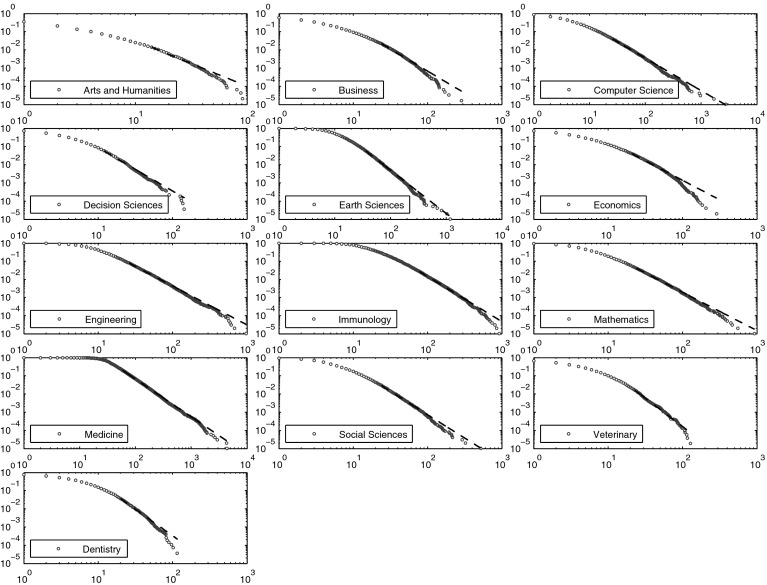
Modeling distributions of citations to scientific papers is crucial for understanding how science develops. However, there is a considerable empirical controversy on which statistical model fits the citation distributions best. This paper is concerned with rigorous empirical detection of power-law behaviour in the distribution of citations received by the most highly cited scientific papers. We have used a large, novel data set on citations to scientific papers published between 1998 and 2002 drawn from Scopus. The power-law model is compared with a number of alternative models using a likelihood ratio test. We have found that the power-law hypothesis is rejected for around half of the Scopus fields of science. For these fields of science, the Yule, power-law with exponential cut-off and log-normal distributions seem to fit the data better than the pure power-law model. On the other hand, when the power-law hypothesis is not rejected, it is usually empirically indistinguishable from most of the alternative models. The pure power-law model seems to be the best model only for the most highly cited papers in "Physics and Astronomy". Overall, our results seem to support theories implying that the most highly cited scientific papers follow the Yule, power-law with exponential cut-off or log-normal distribution. Our findings suggest also that power laws in citation distributions, when present, account only for a very small fraction of the published papers (less than 1 % for most of science fields) and that the power-law scaling parameter (exponent) is substantially higher (from around 3.2 to around 4.7) than found in the older literature.
Overview
The claims and statistics of this paper haven’t been checked yet.
Run the check — free, no account needed. It reads the open-access text and checks the sources it cites.
Integrity signals
Registry
Cites
Statistics
Figures
Verification
Claims the paper makes
The claims and statistics of this paper haven’t been checked yet.
Run the check — free, no account needed. It reads the open-access text and checks the sources it cites.
Claims other papers make about this one
Each is checked against this paper’s own text: does it say what the citing paper says it does?
In the citing paper
“Apart from this, Scopus is one of the most highly regarded academic databases globally, indexing approximately 70% more sources than the Web of Science (Brzezinski 2015).”
From Blockchain technology in the smart city: A bibliometric review (2022) · cites this paper as Brzezinski 2015
Self-check
Percentages, sums and reported differences re-computed from the paper’s own numbers.
The self-check needs the paper’s full text.
Citations
Cites
Power-Law Distributions in Empirical Data
Clauset, A., Shalizi, C. R., & Newman, M. E. J. (2009) · SIAM Review · doi:10.1137/070710111 · Cited by 8,019
Power-law distributions in empirical data
Clauset, A. J., Shalizi, C. R., & Newman, M. E. J. (2018) · Figshare · doi:10.1184/r1/6586835.v1 · Cited by 6,710
Likelihood Ratio Tests for Model Selection and Non-Nested Hypotheses
Vuong, Q. H. (1989) · Econometrica · doi:10.2307/1912557 · Cited by 5,929
Newman (2005) · doi:10.1080/00107510500052444 · Cited by 5,749
Price, D. J. D. S. (1965) · Science · doi:10.1126/science.149.3683.510 · Cited by 3,205
A general theory of bibliometric and other cumulative advantage processes
Price, D. J. D. S. (1976) · Journal of the American Society for Information Science · doi:10.1002/asi.4630270505 · Cited by 2,013
The frequency distribution of scientific productivity
Lotka, A. J. (1926) · Journal of the Washington Academy of Sciences · Cited by 1,999
A Comparison between Two Main Academic Literature Collections: Web of Science and Scopus Databases
Chadegani, A. A., Salehi, H., Yunus, M. M., Farhadi, H., Fooladi, M., Farhadi, M., & Ebrahim, N. A. (2013) · Asian Social Science · doi:10.5539/ass.v9n5p18 · Cited by 1,933
Journal of the Washington Academy of Sciences.
B., H. R. (1918) · The Journal of Geology · doi:10.1086/622567 · Cited by 1,720
How popular is your paper? An empirical study of the citation distribution
Redner, S. (1998) · The European Physical Journal B · doi:10.1007/s100510050359 · Cited by 1,509
Research works printed but not linked: 1
- Albarrán, P., Crespo, J.A., Ortuño, I., & Ruiz-Castillo, J. (2011). The skewness of science in 219 sub-fields and a number of aggregates. Working paper 11–09, Universidad Carlos III. · DOI
Cited by
Sorted by citations
Science Mapping: A Systematic Review of the Literature
Chen, C. (2017) · Journal of Data and Information Science · doi:10.1515/jdis-2017-0006 · Cited by 2,134
Swedberg, R. (2020) · Cambridge University Press eBooks · doi:10.1017/9781108762519.002 · Cited by 471
Digitally-enabled sustainable supply chains in the 21st century: A review and a research agenda
Jabbour, C. J. C., Fiorini, P. D. C., Ndubisi, N. O., de Queiroz, M. M., & Piato, É. L. (2020) · The Science of The Total Environment · doi:10.1016/j.scitotenv.2020.138177 · Cited by 353
Sustainable development in Asian manufacturing SMEs: Progress and directions
Jabbour, A. B. L. D. S., Ndubisi, N. O., & Seles, B. M. R. P. (2019) · International Journal of Production Economics · doi:10.1016/j.ijpe.2019.107567 · Cited by 255
Augmented reality in retailing: a review of features, applications and value
Caboni, F., & Hagberg, J. (2019) · International Journal of Retail & Distribution Management · doi:10.1108/ijrdm-12-2018-0263 · Cited by 227
Metadata
- Authors
- Brzezinski, M.
- Venue
- Scientometrics
- Published
- 2015-01-22
- Volume
- 103
- Issue
- 1
- Pages
- 213-228
- ISSN
- 0138-9130 (ISSN-L)
- 1588-2861
- PMC
- PMC4365275
- OpenAlex
- W2170265466
- Cited by
- 196
- References
- 36
- Citations by year
- 2026: 8 · 2025: 24 · 2024: 21 · 2023: 15 · 2022: 14 · 2021: 17 · 2020: 40 · 2019: 10 · 2018: 13 · 2017: 14 · 2016: 14 · 2015: 6
- FWCI
- 14.27
- Type
- journal article
- Language
- en
- Open access
- hybrid
- doi.org
- Locations
- Scientometrics (publishedVersion, cc-by)
- Europe PMC (PubMed Central) (publishedVersion, cc-by)
- PubMed Central (publishedVersion, cc-by)
- PubMed (publishedVersion)
- RePEc: Research Papers in Economics (submittedVersion, cc-by)
- Topics
- Social Sciences › Library and Information Sciences › scientometrics and bibliometrics research
- Physical Sciences › Computer Science › Information Systems › Web visibility and informetrics
- Social Sciences › Psychology › Experimental and Cognitive Psychology › Psychology Research and Bibliometrics
- Keywords
- citation distribution, power law, highly cited papers, lognormal distribution, likelihood ratio test, model comparison, Scopus, scientific impact
About these checks
Registry, retraction, Cites and statistics results are computed, not judged, with one exception: a printed reference that no index lists is read once by a model before it counts as a citation error. Claims are extracted by a model and kept only when their quote appears verbatim in the text; each cited source is then checked, with a model’s help, for whether it says what the claim relies on. Those verdicts can be wrong — read the claim’s quote and the cited source before relying on one.
Statistics and arithmetic are recomputed, not judged.
Confidence bands are shown only for fields calibrated on our annotated test set. None is calibrated yet, so no band is shown.
What counts as a claim ›How we measure confidence ›How we check this ›
Are you an author, or do you see a problem with this page? Request a review
