

The DOI matches its Crossref record.
Disability Considerations for Measuring Poverty in Canada Using the Market Basket Measure
Abstract
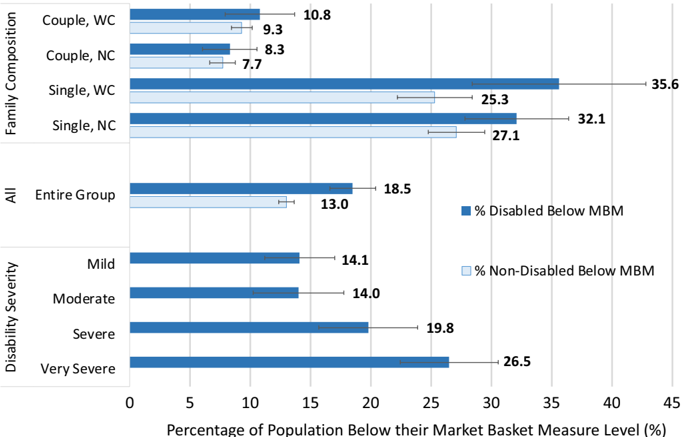
Persons with disability (PWD) in Canada experience disproportionately high poverty rates. Poverty measures are often used to benchmark income assistance levels and social policies across Canada. The Market Basket Measure (MBM) is the official poverty measure in Canada that accounts for differences in family composition and geography. It does not, however, account for cost-incurring factors like disabilities, despite the evidence of differences in daily living costs. PWD experiencing poverty have additional needs to reduce barriers to full participation in society that can translate to higher basic costs for daily living. Given that poverty measures like the MBM may assess eligibility for income support or eligibility for public housing, these measures need to reflect how the cost of living differs for PWD. To critically analyze disability-specific considerations for the Canadian poverty line, we assess the MBM within the context of persons with disabilities. To identify differences in consumption patterns and family composition for PWD, a population based cross-sectional analysis was conducted using data from the 2017 Canadian Survey on Disability. Analysis assessed for bias within the MBM based on the basket contents, family composition and disability severity. PWD experience two times higher poverty rates, worse housing outcomes and incur higher and additional expenses for basic needs of daily living than persons without disability. The MBM underestimates the true poverty rate for persons with disabilities as it does not account for all their additional costs and does not represent their average family composition.
Overview
The claims and statistics of this paper haven’t been checked yet.
Run the check — free, no account needed. It reads the open-access text and checks the sources it cites.
Integrity signals
Registry
Cites
Statistics
Figures
Verification
Claims the paper makes
The claims and statistics of this paper haven’t been checked yet.
Run the check — free, no account needed. It reads the open-access text and checks the sources it cites.
Claims other papers make about this one
Each is checked against this paper’s own text: does it say what the citing paper says it does?
The source backs part of the claim, not all of it — or backs it for a different population, condition or comparison.
In the citing paper
“The MBM provides a benchmark for the cost of essentials, while disability cost-of-living work highlights that many disabled adults face ongoing additional costs for diet, transportation, personal care and participation that are not fully covered by existing allowances (Scott et al, 2022; Sheppard and Yin, 2024; Yin et al, 2024).”
From Income adequacy, administrative burden and digital access for social assistance recipients in Ontario (2026) · cites this paper as Scott et al, 2022
Experimental — accuracy not yet measured
Self-check
Percentages, sums and reported differences re-computed from the paper’s own numbers.
The self-check needs the paper’s full text.
Citations
Cites
No references could be resolved yet.
Research works printed but not linked: 17
- Berrigan, P., Scott, C. W., & Zwicker, J. D. (2020). Employment, education, and income for Canadians with developmental disability: Analysis from the 2017 Canadian survey on disability. Journal of Autism and Developmental Disorders. https://doi.org/10.1007/s10803-020-04603-3 · DOI
- Coudouel, A., Hentschel, J. S., & Wodon, Q. T. (2002). Poverty measurement and analysis. A Sourcebook for Poverty Reduction Strategies, 1, 27–74.
- Djidel, S., Gustajtis, B., Heisz, A., Lam, K., Marchand, I., & McDermott, S. (2020). Report on the second comprehensive review of the Market Basket Measure. Statistics Canada= Statistique Canada
- Dufour, M., Labrie, V., & Tremblay-Pepin, S. (2021). Using the Market Basket Measure to discuss income inequality from the perspective of basic needs. Social Indicators Research, 155(2), 455–478. https://doi.org/10.1007/s11205-020-02580-9 · DOI
- Dunn, S., & Zwicker, J. (2018). Why is uptake of the disability tax credit low in Canada? Exploring possible barriers to access. The School of Public Policy Publications, 11(2), 1–16. https://doi.org/10.11575/sppp.v11i0.43187 · DOI
- Fisher, K. R., Purcal, C., Jones, A., Lutz, D., Robinson, S., & Kayess, R. (2019). What place is there for shared housing with individualized disability support? Disability and Rehabilitation. https://doi.org/10.1080/09638288.2019.1615562 · DOI
- Hatfield, M., Pyper, W., & Gustajtis, B. (2010). First comprehensive review of the Market Basket Measure of low income
- Heisz, A. (2019). An update on the Market Basket Measure comprehensive review (Income Research Paper Series, Issue)
- Kirkpatrick, S. I., & Tarasuk, V. (2011). Housing circumstances are associated with household food access among low-income urban families. Journal of Urban Health, 88(2), 284–296. · DOI
- Law, M. R., Cheng, L., Dhalla, I. A., Heard, D., & Morgan, S. G. (2012). The effect of cost on adherence to prescription medications in Canada. CMAJ, 184(3), 297–302. · DOI
- Lee, K., Jani, T., Cheng, R., & Hunt, J. (2020). Prescribed drug spending in Canada, 2019: A focus on public drug programs. Healthcare Quarterly (toronto, Ont.), 23(1), 10–12. · DOI
- Mitra, S., Palmer, M., Kim, H., Mont, D., & Groce, N. (2017). Extra costs of living with a disability: A review and agenda for research. Disability and Health Journal, 10(4), 475–484. · DOI
- Petit, G., Scott, C., Gallacher, B., Zwicker, J., & Tedds, L. (2020). Less income for more hours of work: Barriers to work for social assistance recipients in BC. The School of Public Policy Publications, 13 · DOI
- Petit, G., & Tedds, L. M. (2020). Programs-based overview of income and social support programs for working-age persons in British Columbia. Available at SSRN 3781875 · DOI
- Royal Bank of Canada. (2018). Housing trends and affordability (RBC Economic Research, Issue). Retrieved October 17, 2020 from http://www.rbc.com/economics/economic-reports/pdf/canadian-housing/house-sep2018.pdf · DOI
- Smart, M., & Stabile, M. (2006). Tax support for the disabled in Canada: Economic principles and options for reform. Can. Tax J., 54, 407.
- Zhang, X., & Hatfield, M. (2014). Market basket measure. In A. C. Michalos (Ed.), Encyclopedia of quality of life and well-being research (pp. 3822–3825). Springer Netherlands. https://doi.org/10.1007/978-94-007-0753-5_3647 · DOI
Cited by
Ferdosi, M. (2026) · Journal of Poverty and Social Justice · doi:10.1332/17598273y2026d000000073
Metadata
- Authors
- Scott, C. W. M., Berrigan, P., Kneebone, R. D., & Zwicker, J. D.
- ORCID
- Zwicker, Jennifer D.
- Venue
- Social Indicators Research
- Published
- 2022-03-04
- Volume
- 163
- Issue
- 1
- Pages
- 389-407
- ISSN
- 0303-8300
- 1573-0921
- Cited by
- 5
- References
- 0
- Language
- en
- Funders
- canada research chairs
- kids brain health network
- canadian institute for health research
- sinneave family foundation
About these checks
Registry, retraction, Cites and statistics results are computed, not judged, with one exception: a printed reference that no index lists is read once by a model before it counts as a citation error. Claims are extracted by a model and kept only when their quote appears verbatim in the text; each cited source is then checked, with a model’s help, for whether it says what the claim relies on. Those verdicts can be wrong — read the claim’s quote and the cited source before relying on one.
Statistics and arithmetic are recomputed, not judged.
Confidence bands are shown only for fields calibrated on our annotated test set. None is calibrated yet, so no band is shown.
What counts as a claim ›How we measure confidence ›How we check this ›
Are you an author, or do you see a problem with this page? Request a review
Data sources
Bibliographic data: Semantic Scholar, OpenAlex, Crossref.
Contains information from the Semantic Scholar Academic Graph Datasets, made available under the ODC Attribution License (ODC-BY 1.0).
Semantic Scholar’s data is described in: Kinney, R., et al. (2023). The Semantic Scholar Open Data Platform. arXiv:2301.10140.
