

The DOI matches its Crossref record; 29 of the 29 references it cites were found in a registry or an index; none of the 8 sources its claims cite is checked for support yet.
A limit formula and recursive algorithm for multivariate Normal tail probability
Open accessPublished version of a preprint
Abstract
Abstract This work develops a formula for the large threshold limit of multivariate Normal tail probability when at least one of the normalised thresholds grows indefinitely. Derived using integration by parts, the formula expresses the tail probability in terms of conditional probabilities involving one less variate, thereby reducing the problem dimension by 1.The formula is asymptotic to Ruben's formula under Salvage's condition. It satisfies Plackett's identity exactly or approximately, depending on the correlation parameter being differentiated. A recursive algorithm is proposed that allows the tail probability limit to be calculated in terms of univariate Normal probabilities only. The algorithm shows promise in numerical examples to offer a semi-analytical approximation under non-asymptotic situations to within an order of magnitude.The number of univariate Normal probability evaluations is at least O(n!), however, and in this sense the algorithm suffers from the curse of dimension.
Overview
CoChat Summary
TL;DR
The paper derives a limit formula for multivariate Normal tail probability when at least one normalized threshold grows indefinitely, expressing the limit via conditional probabilities with one less variate. It proposes a recursive algorithm that reduces the computation to univariate Normal probabilities, with numerical examples suggesting semi-analytical approximation within an order of magnitude but at least O(n!) cost.
Key findings
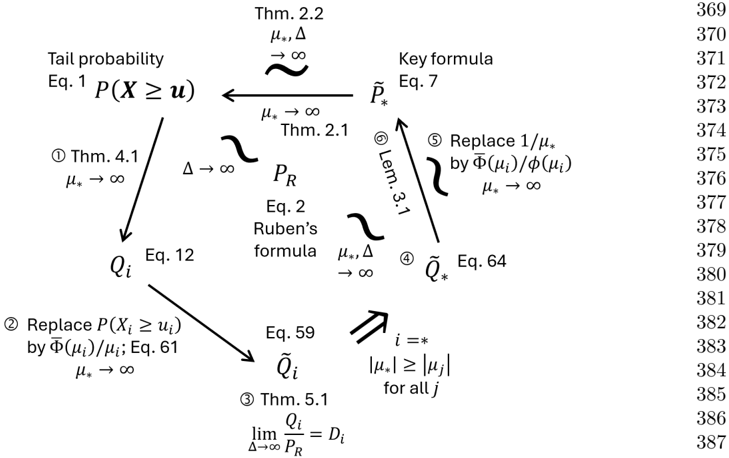
- Theorem 2.1 gives a limit reduction formula: as the largest-magnitude normalized threshold \(\mu_* \to \infty\), \(P(X \ge u) \to P_*\), where \(P_*\) is expressed in terms of conditional probabilities with one less variate, reducing dimension by 1.
- Under Salvage’s condition (\(\Delta = C^{-1}(u-a) \to \infty\)), if the correlation matrix is invertible, \(P_*\) is asymptotic to Ruben’s formula and hence to the tail probability (Theorem 2.2).
- \(P_*\) satisfies Plackett’s identity exactly when differentiating with respect to correlation parameters not involving the selected index \(*\), and approximately when one index is \(*\) (Theorem 2.3).
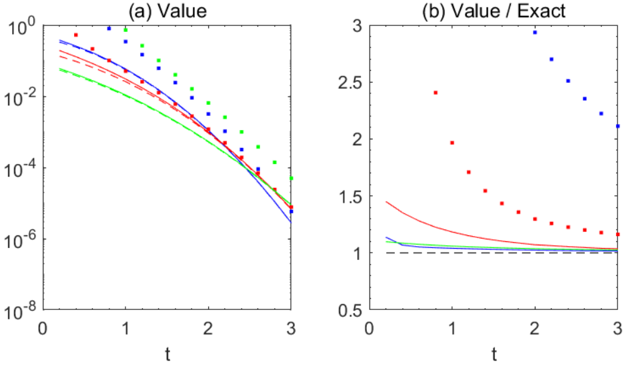
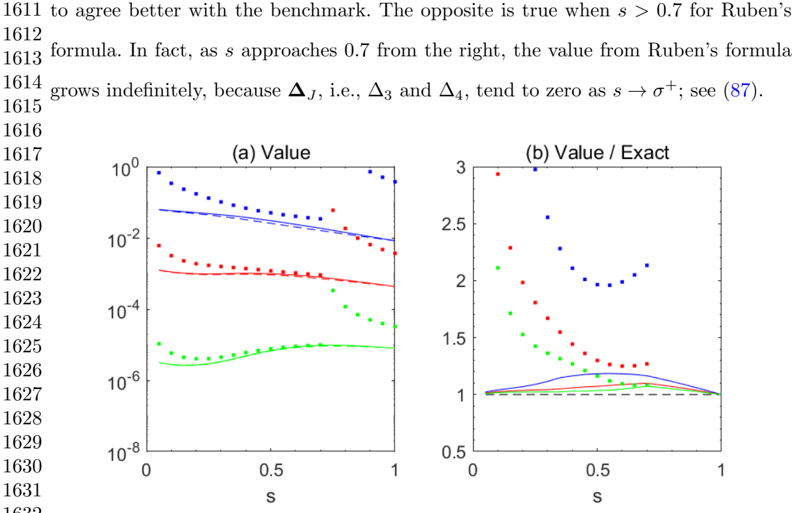
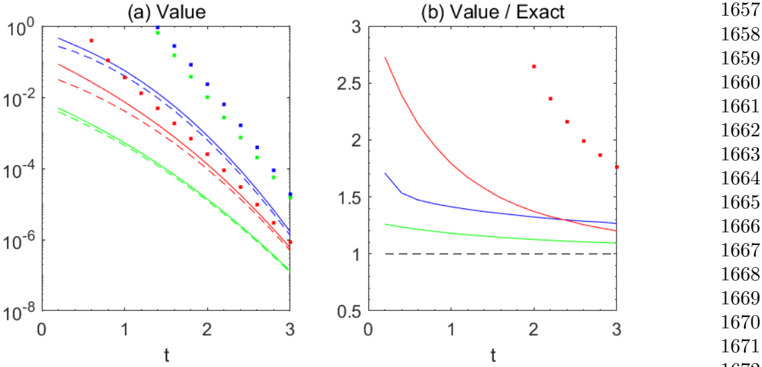
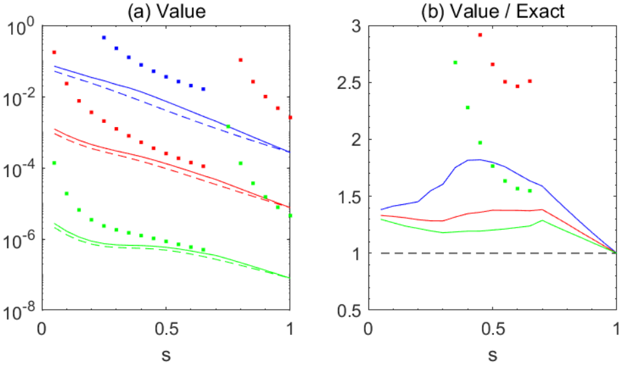
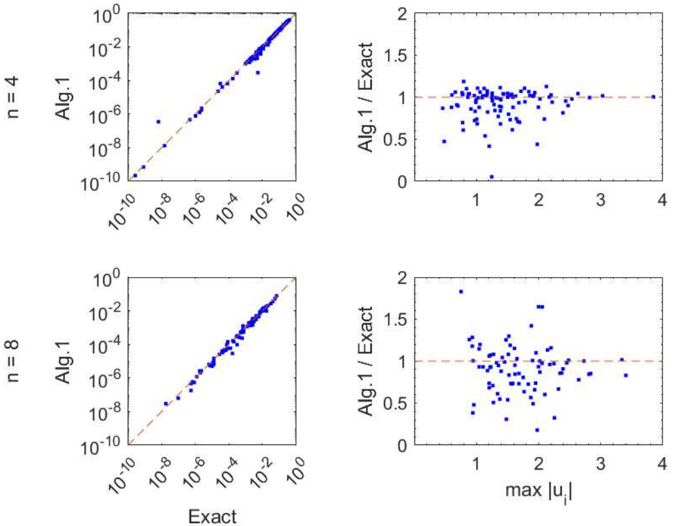
- Algorithm 1 recursively reduces the dimension to univariate Normal CCDF evaluations; numerical examples for \(n=4\) and \(n=8\) variates suggest it can approximate non-asymptotic tail probabilities within an order of magnitude, but the number of univariate Normal probability evaluations is at least \(O(n!)\), so the algorithm suffers from the curse of dimension.
Methods
- Theoretical derivation: integration by parts reduces the tail probability dimension by 1; limit analysis (Lemmas 4.1–4.4) yields the general reduction formula, and asymptotic analysis under Salvage’s condition connects it to Ruben’s formula.
- Recursive algorithm: Algorithm 1 takes threshold vector, mean vector, and covariance matrix; determines the index \(*\) with largest \(|\mu_j|\); if \(\mu_* \ge 0\), applies the reduction formula recursively using conditional means and covariance matrices; if \(\mu_* < 0\), flips the sign of \(X_*\) and uses a difference of two probabilities.
- Numerical experiments: \(n=4\) and \(n=8\) variates, zero mean, covariance with principal variance 1 along a unit vector \(\alpha\) and \(s^2\) along orthogonal directions, \(\sigma=0.7\), \(s=0.1,0.5,0.9\); plus 100 random trials with thresholds generated as standard Normal i.i.d. vectors and correlation matrices uniformly distributed over positive definite correlation matrices using Joe (2006). Benchmarks used Matlab’s `mvncdf`, with absolute error tolerance set to 1% of Algorithm 1’s value and maximum \(10^{10}\) integrand evaluations.
Limitations
- The paper states that unlike the bivariate case, it does not provide a way to calculate the tail probability “exactly,” and that suppressing the curse of dimension remains a future direction.
- The paper states the algorithm requires at least \(O(n!)\) univariate Normal probability evaluations, making computation prohibitive for large \(n\).
- The paper notes that a general proof is not yet available to justify carrying a small-order term over to the derivative \(\partial(\cdot)/\partial u_r\) in the approximate Plackett identity case; it also reports that some Algorithm 1 values were negative and some benchmark trials were omitted because the required tolerance could not be achieved within \(10^{10}\) integrand evaluations.
Model-written summary. Check it against the paper before relying on it.
Integrity signals
Registry
Cites
Statistics
Figures
Verification
Claims the paper makes
0 Valid · 1 Not valid · 7 Not checked · 42 Own results and interpretations
A result the paper states — it cites no source for it, so there is none to check. The quote shows it is in the paper.
In the paper
“Algorithm 1 uses (7) recursively to reduce the dimension down to one, allowing computation in terms of univariate Normal CCDF only.”
- Also stated in: § Abstract · plain
“A recursive algorithm is proposed that allows the tail probability limit to be calculated in terms of univariate Normal probabilities only.”
§ A Limit Formula and Recursive Algorithm for Multivariate Normal Tail Probability > 2.1 Key contributions
plainstates a cause- Asserted: passes — The authors put it forward as true.
- Checkable: passes — It can be checked against evidence.
- Load-bearing: passes — The paper’s conclusions depend on it.
- Based: passes — The paper gives a reason why it holds.
- Also stated in: § Abstract · plain
A result the paper states — it cites no source for it, so there is none to check. The quote shows it is in the paper.
In the paper
“Theorem 2.1 (Limit reduction formula).Let * be the index such that |µ * | ≥ |µ j | for all j ∈ {1, . . ., n}.Then P (X ≥ u) → P * as µ * → ∞, where P * = R * n j=1 ρ * j ϕ(µ j )P (X -j ≥ u -j |X j = u j )(7)”
- Also stated in: § Abstract · plain
“This work develops a formula for the large threshold limit of multivariate Normal tail probability when at least one of the normalised thresholds grows indefinitely.Derived using integration by parts, the formula expresses the tail probability in terms of conditional probabilities involving one less variate, thereby reducing the problem dimension by 1.”
§ A Limit Formula and Recursive Algorithm for Multivariate Normal Tail Probability > 2.1 Key contributions
plainstates a cause- Asserted: passes — The authors put it forward as true.
- Checkable: passes — It can be checked against evidence.
- Load-bearing: passes — The paper’s conclusions depend on it.
- Based: passes — The paper gives a reason why it holds.
- Also stated in: § Abstract · plain
A result the paper states — it cites no source for it, so there is none to check. The quote shows it is in the paper.
In the paper
“Lemma 3.1 (Asymptotics impies limit).If f ∼ g and |g| < ∞ in the limit then f → g.In short, asymptotics implies limit if the limit is bounded.”
§ A Limit Formula and Recursive Algorithm for Multivariate Normal Tail Probability > 3.2 Limits and asymptotics
plainstates a cause- Asserted: passes — The authors put it forward as true.
- Checkable: passes — It can be checked against evidence.
- Load-bearing: passes — The paper’s conclusions depend on it.
- Based: passes — The paper gives a reason why it holds.
A result the paper states — it cites no source for it, so there is none to check. The quote shows it is in the paper.
In the paper
“Theorem 4.1 (General reduction formula).P (X ≥ u) → Q i as µ i → ∞, where Q i = P (X i ≥ u i )P (X -i ≥ u -i |X i = u i ) + n j̸ =i ρ ij s j μij p(u j )P (X -j ≥ u -j |X j = u j )(12) and μij = max{µ i , ρ ij µ j }.”
§ A Limit Formula and Recursive Algorithm for Multivariate Normal Tail Probability > 4 General reduction formula
plainstates a cause- Asserted: passes — The authors put it forward as true.
- Checkable: passes — It can be checked against evidence.
- Load-bearing: passes — The paper’s conclusions depend on it.
- Based: passes — The paper gives a reason why it holds.
A result the paper states — it cites no source for it, so there is none to check. The quote shows it is in the paper.
In the paper
“Theorem 2.2 (Asymptotic property). Recall P * in (7) and ∆ = C -1 (ua) in (3). As µ * → ∞ and ∆ → ∞, if the correlation matrix ρ is invertible then P (X ≥ u) ∼ P * .”
- Also stated in: § Abstract · plain
“The formula is asymptotic to Ruben's formula under Salvage's condition.”
§ A Limit Formula and Recursive Algorithm for Multivariate Normal Tail Probability > Theorem 2.2 (Asymptotic property).
plainstates an association- Asserted: passes — The authors put it forward as true.
- Checkable: passes — It can be checked against evidence.
- Load-bearing: passes — The paper’s conclusions depend on it.
- Based: passes — The paper gives a reason why it holds.
- Rests on an assumption not shown here.
- Also stated in: § Abstract · plain
29 more claims
Create a free account to see all 50 claims and to verify the 5 references still open.
- It may state two separate claims as one. 10
- Probably not a substantial claim. 5
- The quote only partly states this claim. 2
Self-check
Percentages, sums and reported differences re-computed from the paper’s own numbers.
Each contradiction between two passages listed here was confirmed by an independent check.
Rated minor: it would not touch a result — a value no result rests on, a p-value that stays on the same side of the significance level, or a conflict that is clerical, resolved elsewhere in the paper, or outside its own findings.
In the paper
§ A Limit Formula and Recursive Algorithm for Multivariate Normal Tail Probability > 3 Notations and preliminaries
“x -2 = [x 1 , x 3 , x 4 , . . . , u n ] T = [x 1 ; x 3:n ].”
§ A Limit Formula and Recursive Algorithm for Multivariate Normal Tail Probability > 3 Notations and preliminaries
“x -i denotes a vector without the ith entry.”
Rated minor: it would not touch a result — a value no result rests on, a p-value that stays on the same side of the significance level, or a conflict that is clerical, resolved elsewhere in the paper, or outside its own findings.
In the paper
§ A Limit Formula and Recursive Algorithm for Multivariate Normal Tail Probability > Additional information
“The generated correlations are all marginally Beta(n/2, n/2) linearly mapped to (-1, 1).When n = 2, the PDF is uniform on (-1, 1).For n ≥ 3, the PDF has a symmetric bell shape centred at 0 and a variance of 1/4(n + 1)”
§ A Limit Formula and Recursive Algorithm for Multivariate Normal Tail Probability > 8.4 Other thresholds and correlation structures
“The latter can be generated as 2Y -1, where Y (omitting index) is an independently generated Beta(n/2, n/2) variate.”
Rated minor: it would not touch a result — a value no result rests on, a p-value that stays on the same side of the significance level, or a conflict that is clerical, resolved elsewhere in the paper, or outside its own findings.
In the paper
§ A Limit Formula and Recursive Algorithm for Multivariate Normal Tail Probability > 4.3 Proof of Lemma (Limit when µ
“The last expression follows from a ij = a i -s i ρ ij µ j in (40).”
§ A Limit Formula and Recursive Algorithm for Multivariate Normal Tail Probability > 4.3 Proof of Lemma (Limit when µ
“a ij = a i + s i ρ ij µ j s 2 ij = s 2 i (1 -ρ 2 ij ) (40”
Citations
Cites
Numerical Computation of Multivariate Normal Probabilities
Genz, A. (1992) · Journal of Computational and Graphical Statistics · doi:10.1080/10618600.1992.10477010 · Cited by 1,020
Computation of Multivariate Normal and t Probabilities
Genz, A., & Bretz, F. (2009) · Lecture Notes in Statistics · doi:10.1007/978-3-642-01689-9 · Cited by 902
Tables for Computing Bivariate Normal Probabilities
Owen, D. B. (1956) · The Annals of Mathematical Statistics · doi:10.1214/aoms/1177728074 · Cited by 463
Numerical computation of rectangular bivariate and trivariate normal and t probabilities
Genz, A. (2004) · Statistics and Computing · doi:10.1023/b:stco.0000035304.20635.31 · Cited by 283
First excursion probabilities for linear systems by very efficient importance sampling
Au, S. K., & Beck, J. L. (2001) · Probabilistic Engineering Mechanics · doi:10.1016/s0266-8920(01)00002-9 · Cited by 282
Self-citationA REDUCTION FORMULA FOR NORMAL MULTIVARIATE INTEGRALS
PLACKETT, R. L. (1954) · Biometrika · doi:10.1093/biomet/41.3-4.351 · Cited by 273
A reduction formula for normal multivariate integrals
Plackett, R. L. (1954) · Biometrika · doi:10.2307/2332716 · Cited by 262
The Normal Law Under Linear Restrictions: Simulation and Estimation via Minimax Tilting
Botev, Z. I. (2017) · Journal of the Royal Statistical Society Series B: Statistical Methodology · doi:10.1111/rssb.12162 · Cited by 247
Generating random correlation matrices based on partial correlations
Joe, H. (2005) · Journal of Multivariate Analysis · doi:10.1016/j.jmva.2005.05.010 · Cited by 232
Mills' ratio: Monotonicity patterns and functional inequalities
Baricz, Á. (2007) · Journal of Mathematical Analysis and Applications · doi:10.1016/j.jmaa.2007.09.063 · Cited by 96
Cited by
Still being checked.
Metadata
- Authors
- Au, S.-K.
- Affiliations
- Nanyang Technological University (SG)
- Corresponding author
- Au, Siu-Kui
- ORCID
- Au, Siu-Kui
- Venue
- Statistics and Computing
- Published
- 2024-12-28
- Volume
- 35
- Issue
- 1
- ISSN
- 0960-3174 (ISSN-L)
- 1573-1375
- OpenAlex
- W4405856166
- Cited by
- 0
- References
- 28
- FWCI
- 0.00
- Type
- journal article
- Language
- en
- Open access
- green
- doi.org
- Licence
- cc-by
- www.springernature.com/gp/researchers/text-and-data-mining (tdm)
- www.springernature.com/gp/researchers/text-and-data-mining (vor)
- Locations
- Statistics and Computing (publishedVersion)
- Research Square (submittedVersion, cc-by)
- DR-NTU (Nanyang Technological University) (acceptedVersion)
- Funders
- Ministry of Education - Singapore (RG68/22)
- Topics
- Physical Sciences › Mathematics › Statistics and Probability › Probability and Statistical Research
- Physical Sciences › Mathematics › Statistics and Probability › Statistical Distribution Estimation and Applications
- Physical Sciences › Mathematics › Applied Mathematics › Mathematical functions and polynomials
- Keywords
- recursive algorithm, conditional probability, curse of dimensionality, asymptotic approximation, multivariate normal distribution
About these checks
Registry, retraction, Cites and statistics results are computed, not judged, with one exception: a printed reference that no index lists is read once by a model before it counts as a citation error. Claims are extracted by a model and kept only when their quote appears verbatim in the text; each cited source is then checked, with a model’s help, for whether it says what the claim relies on. Those verdicts can be wrong — read the claim’s quote and the cited source before relying on one.
A language model drew the claims from the paper on 2026-11-15, under version 3 of the claim definition (model deepseek-v4.1-flash, prompt extract-v3).
A second model labelled each claim on 2026-11-15 (model jev-1.13-20260917, definition revision gold-guideline-v0.2).
Statistics and arithmetic are recomputed, not judged.
Confidence bands are shown only for fields calibrated on our annotated test set. None is calibrated yet, so no band is shown.
What counts as a claim ›How we measure confidence ›How we check this ›
Are you an author, or do you see a problem with this page? Request a review
How to cite
Cite CoChat for the checks on this page, and the paper for its own findings.
- This page
- CoChat. (2026). Citation check: A limit formula and recursive algorithm for multivariate Normal tail probability. https://app.cochat.ai/papers/10.1007/s11222-024-10552-z
- The paper
- Au, S.-K. (2025). A limit formula and recursive algorithm for multivariate Normal tail probability. Statistics and Computing. https://doi.org/10.1007/s11222-024-10552-z
Data sources
Bibliographic data: Semantic Scholar, OpenAlex, Crossref.
Contains information from the Semantic Scholar Academic Graph Datasets, made available under the ODC Attribution License (ODC-BY 1.0).
Semantic Scholar’s data is described in: Kinney, R., et al. (2023). The Semantic Scholar Open Data Platform. arXiv:2301.10140.
