

Macroelements and heavy metals content in energy crops cultivated on contaminated soil under different fertilization—case studies on autumn harvest
The DOI matches its Crossref record; 7 of the 7 references it cites were found in a registry or an index.
Abstract
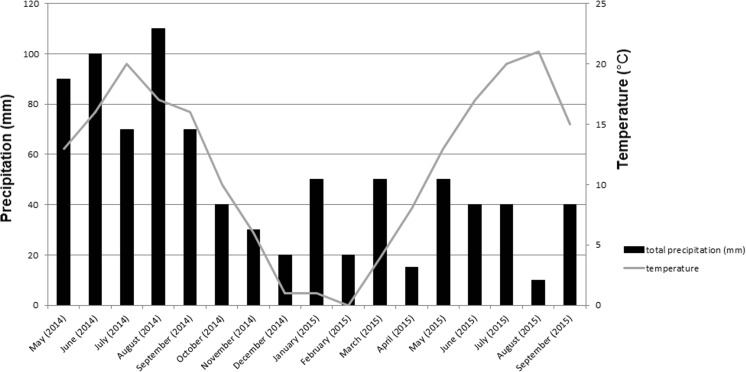
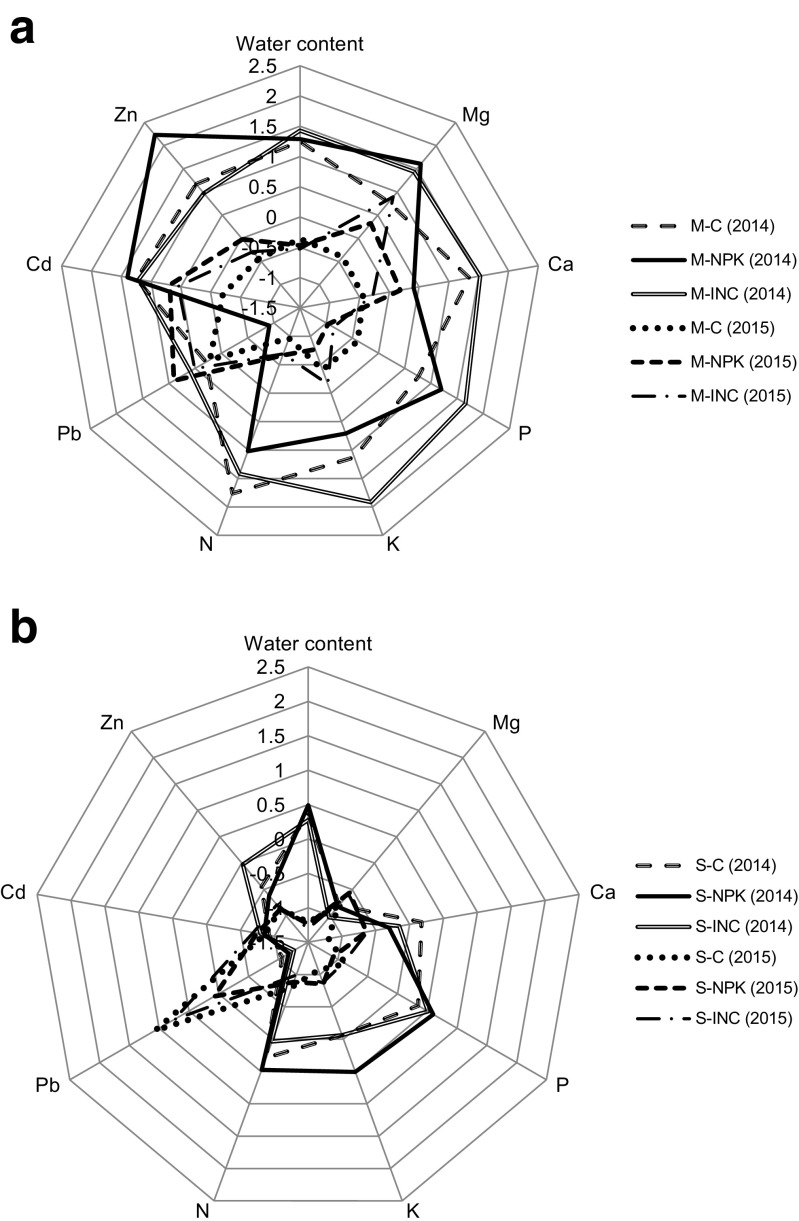
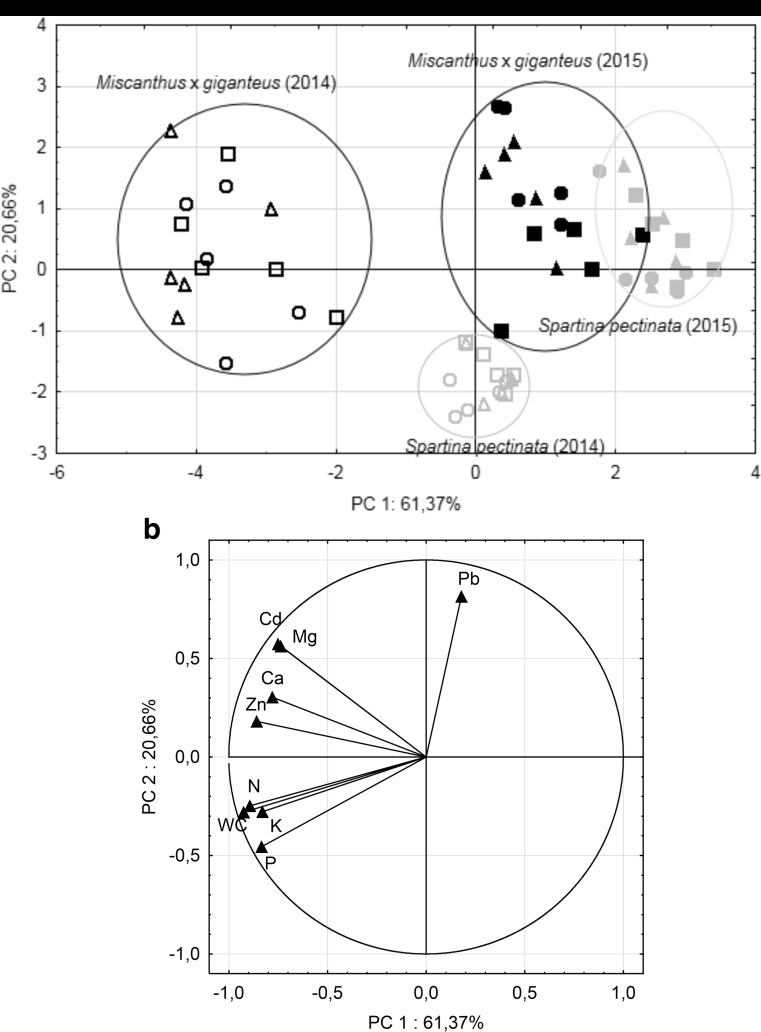
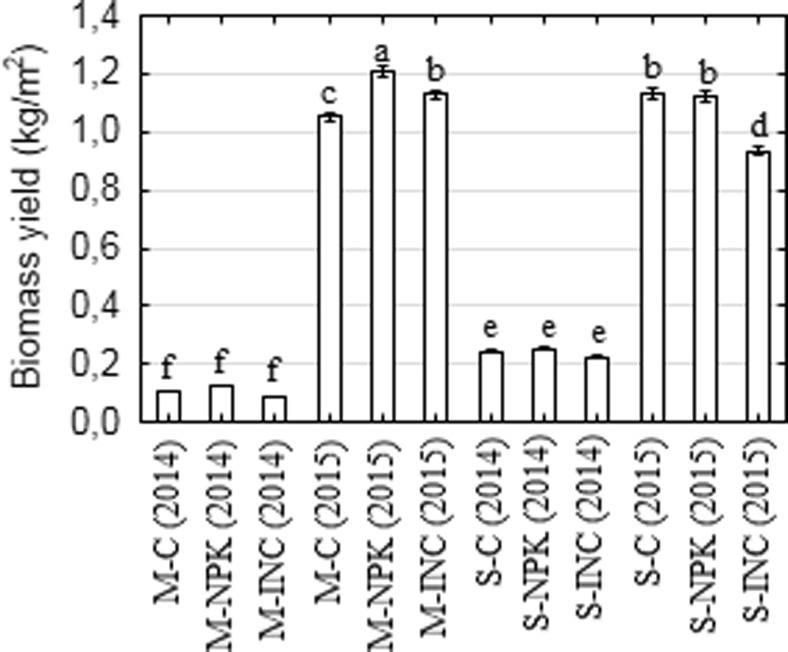
Heavy metals (HMs) contamination of soils is a major problem occurring worldwide. Utility of energy crops for biofuel feedstock production systems offers a feasible solution for a commercial exploitation of an arable land contaminated with HMs. Experiments involved field testing of Miscanthus x giganteus and Spartina pectinata cultivated on HMs-contaminated soil with standard NPK fertilizers and commercially available microbial inoculum. Biomass yield, water content, macronutrients (N, P, K, Mg, Ca), and heavy metal (Cd, Pb, Zn) concentrations in plant shoots were assessed at the end of the first and the second growing season. Independently of the applied fertilizers, Miscanthus x giganteus produced higher biomass yield while contrary results were obtained for S. pectinata. Higher HMs content in plants influenced the status of the mineral macronutrients in particular N and K. Occurrence of hasted senescence induced by drought in the second growing season caused reduction in the concentrations of all elements (except Pb), due to earlier rhizomes relocation.
Overview
The claims and statistics of this paper haven’t been checked yet.
Free: it reads the open-access text and checks the first 5 claims that cite a source we can check. Create a free account to check every claim.
Integrity signals
Registry
Cites
Statistics
Figures
Verification
Claims the paper makes
The claims and statistics of this paper haven’t been checked yet.
Free: it reads the open-access text and checks the first 5 claims that cite a source we can check. Create a free account to check every claim.
Claims other papers make about this one
Each is checked against this paper’s own text: does it say what the citing paper says it does?
The source backs part of the claim, not all of it — or backs it for a different population, condition or comparison.
In the citing paper
“The root sequestration efficiency observed here (Root Bioconcentration Factor > > 1) is comparable to that reported in other Pb-tolerant species like Miscanthus [34]”
From Kinetic modeling of heavy metal uptake and translocation in Brassica juncea L. for phytoremediation engineering (2025) · cites this paper as [34]
Experimental — accuracy not yet measured
Self-check
Percentages, sums and reported differences re-computed from the paper’s own numbers.
The self-check needs the paper’s full text.
Citations
Cites
Lewandowski, I., Scurlock, J. M. O., Lindvall, E., & Christou, M. (2003) · Biomass and Bioenergy · doi:10.1016/s0961-9534(03)00030-8 · Cited by 1,360 · cited 1×
“It was found thatM. x giganteus biomass production seems to be more efficient (0.5–4.4 kg m−2 d.w.) when compared with S. pectinata (0.4–1.8 kg m−2 d.w.) (Lewandowski et al. 2003).”
ResultInfluentialPHYTOREMEDIATION FOR HEAVY METAL‐CONTAMINATED SOILS COMBINED WITH BIOENERGY PRODUCTION
Ginneken, L. V., Meers, E., Guisson, R., Ruttens, A., Elst, K., Tack, F. M. G., Vangronsveld, J., Diels, L., & Dejonghe, W. (2007) · JOURNAL OF ENVIRONMENTAL ENGINEERING AND LANDSCAPE MANAGEMENT · doi:10.3846/16486897.2007.9636935 · Cited by 239
Korzeniowska, J., & Stanislawska-Glubiak, E. (2015) · Environmental Science and Pollution Research · doi:10.1007/s11356-015-4439-1 · Cited by 91 · cited 1×
“Additionally, it has also been found, thatM. x giganteus (Pogrzeba et al. 2010; Korzeniowska and Stanislawska-Glubiak 2015; Pogrzeba et al. 2017) and S. pectinata (Zhang et al. 2015; Korzeniowska and Stanislawska-Glubiak 2015) demonstrate the ability to accumulate HMs in the aboveground organs.”
BackgroundPogrzeba, M., Rusinowski, S., Sitko, K., Krzyżak, J., Skalska, A., Małkowski, E., Ciszek, D., Werle, S., McCalmont, J. P., Mos, M., et al. (2017) · Environmental Pollution · doi:10.1016/j.envpol.2017.03.058 · Cited by 78
Self-citationBalsamo, R. A., Kelly, W. J., Satrio, J. A., Ruiz-Felix, M. N., Fetterman, M., Wynn, R., & Hagel, K. (2015) · International Journal of Phytoremediation · doi:10.1080/15226514.2014.922918 · Cited by 66 · cited 1×
“Application of such approach provides a double benefit, both in degraded land management as well as phytoremediation, due to the stabilization or extraction of toxic elements by plants (Meers et al. 2010; Balsamo et al. 2015).”
BackgroundKocoń, A., & Jurga, B. (2017) · Environmental Science and Pollution Research · doi:10.1007/s11356-016-8241-5 · Cited by 62 · cited 1×
“…be additionally supported by the fact that younger plants grown on soil contaminated with HMs are more sensitive to stress associated with an excess level of these metals than older plants, which could resulted in a lower M. x giganteus yield when compared to S. pectinata (Kocoń and Jurga 2017).”
ResultNsanganwimana, F., Waterlot, C., Louvel, B., Pourrut, B., & Douay, F. (2016) · Journal of Plant Nutrition and Soil Science · doi:10.1002/jpln.201500163 · Cited by 36 · cited 2×
“Additionally, there is a lack of papers considering the effect of heavy metals on mineral nutrient status, that would refer to field tested perennial grasses cultivated for biomass feedstock on contaminated arable land (Nsanganwimana et al. 2016).”
Background
Research works printed but not linked: 33
- Alloway BJ (2013) Sources of heavy metals and metalloids in soils. In Heavy metals in soils (pp. 11-50). Springer Netherlands · DOI · Paper page
- Bello MO Ibrahim AO Ogunwande IA Olawore NO Heavy trace metals and macronutrients status in herbal plants of Nigeria Food Chem 2004 85 67 71 10.1016/j.foodchem.2003.06.004 · doi:10.1016/j.foodchem.2003.06.004
- Borkowska H Molas R Yield comparison of four lignocellulosic perennial energy crop species Biomass Bioenergy 2013 51 145 153 10.1016/j.biombioe.2013.01.017 · DOI
- Bremner JM Sparks DL Page AL Helmke PA Loeppert RH Soltanpour PN Tabatabai MA Johnston CT Sumner ME Nitrogen—total Methods of soil analysis, part 3: chemical method 1996 Madison American Society of Agronomy and Soil Science Society of America 1085 1121
- Egnér H Riehm H Domingo WR Untersuchungen über die chemische Bodenanalyse als Grundlage für die Beurteilung des Nährstoffzustandes der Böden. II. Chemische Extraktionsmethoden zur Phosphor-und Kaliumbestimmung Kungliga Lantbrukshögskolans Annaler 1960 26 199 215
- Gardea-Torresdey JL Peralta-Videa JR Montes M De la Rosa G Corral-Diaz B Bioaccumulation of cadmium, chromium and copper by Convolvulus arvensis L.: impact on plant growth and uptake of nutritional elements Bioresour Technol 2004 92 229 235 10.1016/j.biortech.2003.10.002 14766155 · DOI · Paper page
- Gonçalves JF Antes FG Maldaner J Pereira LB Tabaldi LA Rauber R Rossato LV Bisognin DA Dressler VL de Moraes Flores EM Nicoloso FT Cadmium and mineral nutrient accumulation in potato plantlets grown under cadmium stress in two different experimental culture conditions Plant Physiol Biochem 2009 47 814 821 10.1016/j.plaphy.2009.04.002 19419882 · DOI
- Helios W Kozak M Malarz W Kotecki A Effect of sewage sludge application on the growth, yield and chemical composition of prairie cordgrass (Spartina pectinata link.) J Elem 2014 4 1021 1036 · doi:10.5601/jelem.2014.19.3.725
- Islam E Liu D Li T Yang X Jin X Mahmood Q Tian S Li J Effect of Pb toxicity on leaf growth, physiology and ultrastructure in the two ecotypes of Elsholtzia argyi J Hazard Mater 2008 154 914 926 10.1016/j.jhazmat.2007.10.121 18162296 · DOI · Paper page
- Khan N Bano A Role of plant growth promoting rhizobacteria and Ag-nano particle in the bioremediation of heavy metals and maize growth under municipal wastewater irrigation Int J Phytoremediation 2016 18 211 221 10.1080/15226514.2015.1064352 26507686 · DOI · Paper page
- Kiesel A Lewandowski I Miscanthus as biogas substrate–cutting tolerance and potential for anaerobic digestion GCB Bioenergy 2017 9 153 167 10.1111/gcbb.12330 · DOI · Paper page
- Lim PO Kim HJ Gil Nam H Leaf senescence Annu Rev Plant Biol 2007 58 115 136 10.1146/annurev.arplant.57.032905.105316 17177638 · DOI · Paper page
- McKendry P Energy production from biomass (part 1): overview of biomass Bioresour Technol 2002 83 37 46 10.1016/S0960-8524(01)00118-3 12058829 · DOI · Paper page
- McKendry P Energy production from biomass (part 2): conversion technologies Bioresour Technol 2002 83 47 54 10.1016/S0960-8524(01)00119-5 12058830 · DOI · Paper page
- Meers E Van Slycken S Adriaensen K Ruttens A Vangronsveld J Du Laing G Witters N Thewys T Tack FMG The use of bio-energy crops (Zea mays) for ‘phytoattenuation’ of heavy metals on moderately contaminated soils: a field experiment Chemosphere 2010 78 35 41 10.1016/j.chemosphere.2009.08.015 19837447 · DOI · Paper page
- Monti A Zegada-Lizarazu W Sixteen-year biomass yield and soil carbon storage of giant reed (Arundo donax L.) grown under variable nitrogen fertilization rates Bioenergy Res 2016 9 248 256 10.1007/s12155-015-9685-z · DOI
- Mos M Banks SW Nowakowski DJ Robson PRH Bridgwater AV Donnison IS Impact of Miscanthus x giganteus senescence times on fast pyrolysis bio-oil quality Bioresour Technol 2013 129 335 342 10.1016/j.biortech.2012.11.069 23262009 · DOI
- Naz A Khan S Qasim M Khalid S Muhammad S Tariq M Metals toxicity and its bioaccumulation in purslane seedlings grown in controlled environment Natural Sci 2013 5 573 579 10.4236/ns.2013.55073 · DOI
- Nazar R Iqbal N Masood A Khan MIR Syeed S Khan NA Cadmium toxicity in plants and role of mineral nutrients in its alleviation American J Plant Sci 2012 3 1476 1489 10.4236/ajps.2012.310178 · DOI · Paper page
- Pogrzeba M, Krzyżak J, Sas-Nowosielska A (2010). How to grow energy crop on heavy metal contaminated soil. In Proceedings of 15th International Conference on Heavy Metals in the Environment pp. 676–679
- Robson P Mos M Clifton-Brown J Donnison I Phenotypic variation in senescence in Miscanthus: towards optimising biomass quality and quantity Bioenerg Res 2012 5 95 105 10.1007/s12155-011-9118-6 · DOI
- Sarath G Baird LM Mitchell RB Senescence, dormancy and tillering in perennial C4 grasses Plant Sci 2014 217 140 151 10.1016/j.plantsci.2013.12.012 24467906 · DOI
- Schierup H Larsen V Macrophyte cycling of zinc, copper, lead and cadmium in the littoral zone of a polluted and a non-polluted lake. I. Availability, uptake and translocation of heavy metals in Phragmites australis (Cav.) Trin Aquat Bot 1981 11 197 210 10.1016/0304-3770(81)90061-9 · DOI
- Siedlecka A Some aspects of interactions between heavy metals and plant mineral nutrients Acta Soc Bot Pol 2014 64 265 272 10.5586/asbp.1995.035 · DOI · Paper page
- Singh B Dang YP Mehta SC Influence of nitrogen on the behaviour of nickel in wheat Plant Soil 1990 127 213 218 10.1007/BF00014428 · doi:10.1007/bf00014428
- Singh RP Tripathi RD Sinha SK Maheshwari R Srivastava HS Response of higher plants to lead contaminated environment Chemosphere 1997 34 2467 2493 10.1016/S0045-6535(97)00087-8 9192470 · DOI
- Thomas H Senescence, ageing and death of the whole plant New Phytol 2013 197 696 711 10.1111/nph.12047 23176101 · DOI · Paper page
- Tripathi DK Singh VP Chauhan DK Prasad SM Dubey NK Ahmad P Wani MR Azooz MM L-SP T Role of macronutrients in plant growth and acclimation: recent advances and future prospective Improvement of crops in the era of climatic changes 2014 New York Springer 197 216 · DOI
- Van Slycken S Witters N Meers E Peene A Michels E Adriaensen K Ruttens A Vangronsveld J Du Laing G Wierinck I Van Dael M Van Passel S Tack FMG Safe use of metal-contaminated agricultural land by cultivation of energy maize (Zea mays) Environ Pollut 2013 178 375 380 10.1016/j.envpol.2013.03.032 23607942 · DOI
- Vázquez MM César S Azcón R Barea JM Interactions between arbuscular mycorrhizal fungi and other microbial inoculants (Azospirillum, Pseudomonas, Trichoderma) and their effects on microbial population and enzyme activities in the rhizosphere of maize plants Appl Soil Ecol 2000 15 261 272 10.1016/S0929-1393(00)00075-5 · DOI · Paper page
- Waraich EA Ahmad R Ashraf MY Role of mineral nutrition in alleviation of drought stress in plants Aust J Crop Sci 2011 5 764 777
- Zhang G Fukami M Sekimoto H Influence of cadmium on mineral concentrations and yield components in wheat genotypes differing in Cd tolerance at seedling stage Field Crop Res 2002 77 93 98 10.1016/S0378-4290(02)00061-8 · DOI · Paper page
- Zhang C Guo J Lee DK Anderson E Huang H Growth responses and accumulation of cadmium in switchgrass (Panicum virgatum L.) and prairie cordgrass (Spartina pectinata Link) RSC Adv 2015 5 83700 83706 10.1039/C5RA13073E · DOI
Cited by
Andrejić, G., Šinžar-Sekulić, J., Prica, M., Dželetović, Ž., & Rakić, T. (2019) · Environmental Science and Pollution Research · doi:10.1007/s11356-019-06543-7 · Cited by 36
Greipsson, S., McElroy, T., & Koether, M. (2022) · Journal of Plant Nutrition · doi:10.1080/01904167.2022.2068433 · Cited by 8
Kamal, M. A., & Alali, A. F. (2025) · Discover Environment · doi:10.1007/s44274-025-00502-5 · Cited by 3
Metadata
- Authors
- Pogrzeba, M., Rusinowski, S., & Krzyżak, J.
- Venue
- Environmental Science and Pollution Research
- Published
- 2018-02-16
- Volume
- 25
- Issue
- 12
- Pages
- 12096-12106
- ISSN
- 0944-1344
- 1614-7499
- PMC
- PMC5940723
- Cited by
- 50
- References
- 7
- Language
- en
- Licence
- creativecommons.org/licenses/by/4.0 (tdm)
- Funders
- FP7 People: Marie-Curie Actions (610797)
About these checks
Registry, retraction, Cites and statistics results are computed, not judged, with one exception: a printed reference that no index lists is read once by a model before it counts as a citation error. Claims are extracted by a model and kept only when their quote appears verbatim in the text; each cited source is then checked, with a model’s help, for whether it says what the claim relies on. Those verdicts can be wrong — read the claim’s quote and the cited source before relying on one.
Statistics and arithmetic are recomputed, not judged.
Confidence bands are shown only for fields calibrated on our annotated test set. None is calibrated yet, so no band is shown.
What counts as a claim ›How we measure confidence ›How we check this ›
Are you an author, or do you see a problem with this page? Request a review
Data sources
Bibliographic data: Semantic Scholar, OpenAlex, Crossref.
Contains information from the Semantic Scholar Academic Graph Datasets, made available under the ODC Attribution License (ODC-BY 1.0).
Semantic Scholar’s data is described in: Kinney, R., et al. (2023). The Semantic Scholar Open Data Platform. arXiv:2301.10140.
