

Phenobarbital use in benzodiazepine and z-drug detoxification: a single-centre 15-year observational retrospective study in clinical practice
Open accessThe DOI matches its Crossref record; 18 of the 18 references it cites were found in a registry or an index.
Abstract
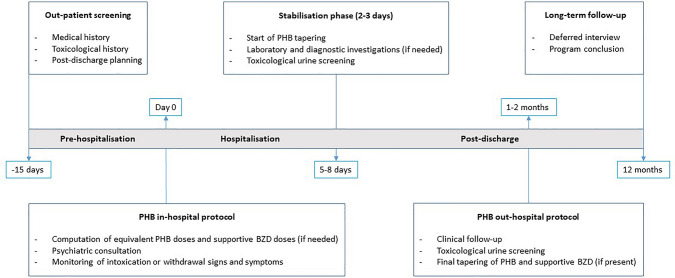
Given the increase in benzodiazepine (BZD) and Z-drug (ZD) use disorder, this study described the use of phenobarbital (PHB) as detoxification in clinical practice. A 15-year observational retrospective study was performed on medical records of BZD-ZD use disorder patients detoxified with PHB at the Toxicology Unit and Poison Centre, Careggi University Hospital, Florence (Italy). A multivariate logistic regression was used to estimate odd ratios (ORs) and related 95% confidence intervals (CI) of “treatment failure” considering demographic and pharmacological characteristics. “Hospitalisation length”, “PHB discharge dose”, and “BZD-ZD free status” at discharge were also calculated. During detoxification, out of 355 patients (57% of men), with a mean age of 42.92 years, only 20 (5.6%) treatment failures were recorded: 19 were discharged against medical advice or due to misbehaviour, and only one for PHB-related non-serious skin rash. Analysis showed a higher probability to be BZD-ZD free at discharge for subjects who reported to be employed (OR 2.29; CI 95% 1.00–5.24), for those who abused oral drops of BZD-ZD (OR 2.16, CI 1.30–3.59), and for those treated with trazodone (OR 2.86, CI 1.14–7.17) during hospital stay. A hospitalisation length of > 7 days was observed for patients with opioid maintenance therapy (OR 2.07, CI 1.20–3.58) for substance use disorder, and for those treated with more than 300 mg/day of PHB equivalents at hospital admission (OR 1.68, CI 1.03–2.72). Our results suggested that PHB can be considered a valuable detoxification option for different types of BZD and ZD use disorder patients.
Overview
The claims and statistics of this paper haven’t been checked yet.
Free: it reads the open-access text and checks the first 5 claims that cite a source we can check. Create a free account to check every claim.
Integrity signals
Registry
Cites
Statistics
Figures
Verification
Claims the paper makes
The claims and statistics of this paper haven’t been checked yet.
Free: it reads the open-access text and checks the first 5 claims that cite a source we can check. Create a free account to check every claim.
Claims other papers make about this one
Each is checked against this paper’s own text: does it say what the citing paper says it does?
The source backs part of the claim, not all of it — or backs it for a different population, condition or comparison.
In the citing paper
“Some limited evidence exists for a loading dose strategy using very long-acting agents that modify responses to gamma-aminobutyric acid (GABA) such as phenobarbital to initiate a BZD taper to discontinuation in patients with BZD use disorder.121”
From Joint Clinical Practice Guideline on Benzodiazepine Tapering: Considerations When Risks Outweigh Benefits (2025) · cites this paper as [121]
Experimental — accuracy not yet measuredThe source backs part of the claim, not all of it — or backs it for a different population, condition or comparison.
In the citing paper
“A more recent chart review by Sartori et al.121 of 355 patients who underwent a 6-day phenobarbital protocol found that no patients experienced seizures, falls, or sedation, although 5% self-discharged from treatment.”
From Joint Clinical Practice Guideline on Benzodiazepine Tapering: Considerations When Risks Outweigh Benefits (2025) · cites this paper as [121]
Experimental — accuracy not yet measuredThe cited source says what the claim attributes to it.
In the citing paper
“Two retrospective studies that cumulatively evaluated outcomes from over 650 patients found phenobarbital-based protocols for tapering in inpatient settings to be safe and effective.121,123”
From Joint Clinical Practice Guideline on Benzodiazepine Tapering: Considerations When Risks Outweigh Benefits (2025) · cites this paper as [121]
Self-check
Percentages, sums and reported differences re-computed from the paper’s own numbers.
The self-check needs the paper’s full text.
Citations
Cites
One Is Not Enough: Understanding and Modeling Polysubstance Use
Crummy, E. A., O’Neal, T. J., Baskin, B. M., & Ferguson, S. M. (2020) · Frontiers in Neuroscience · doi:10.3389/fnins.2020.00569 · Cited by 351
McCance‐Katz, E. F., Sullivan, L. E., & Nallani, S. (2010) · The American Journal on Addictions · doi:10.1111/j.1521-0391.2009.00005.x · Cited by 318 · cited 1×
“In fact, it is well known that PHB induces the cytochrome P450 enzyme, increasing methadone metabolism [17], thus reducing the abuse potential for PHB in this group compared to BZD [16].”
Management of benzodiazepine misuse and dependence
Brett, J., & Murnion, B. (2015) · Australian Prescriber · doi:10.18773/austprescr.2015.055 · Cited by 260 · cited 2×
“1 3 [2], resulting in possible physical dependence, that usually appears in case of abrupt cessation, with life-threatening conditions such as seizures and delirium.”
Benzodiazepine use, misuse, and abuse: A review
Schmitz, A. (2016) · Mental Health Clinician · doi:10.9740/mhc.2016.05.120 · Cited by 186 · cited 1×
“For the above reasons, discontinuing sedativehypnotic medications should be considered after prolonged use, especially if used improperly or abused [5].”
Benzodiazepine Use and Misuse Among Patients in a Methadone Program
Chen, K. W., Berger, C. C., Forde, D. P., D'Adamo, C., Weintraub, E., & Gandhi, D. (2011) · BMC Psychiatry · doi:10.1186/1471-244x-11-90 · Cited by 149 · cited 2×
“Although this occurrence was also observed in our sample with smaller percentages, BZD and/or ZD dependence is a common problem among patients on opioid maintenance therapy [16].”
Milani, S. A., Raji, M. A., Chen, L., & Kuo, Y. (2021) · JAMA Network Open · doi:10.1001/jamanetworkopen.2021.31012 · Cited by 128 · cited 1×
“The COVID-19 pandemic only compounded this as rates of BZD prescriptions increased during this period and continue to remain elevated [4].”
Fluyau, D., Revadigar, N., & Manobianco, B. E. (2018) · Therapeutic Advances in Psychopharmacology · doi:10.1177/2045125317753340 · Cited by 109 · cited 5×
“However, evidence on its efficacy and safety in the treatment of BZD and ZD disorders is scarce, and its use in this clinical context in past years was limited, mainly for potential adverse drug reactions (ADRs) [1, 6].”
InfluentialBenzodiazepines for Alcohol Withdrawal in the Elderly and in Patients With Liver Disease
Peppers, M. P. (1996) · Pharmacotherapy: The Journal of Human Pharmacology and Drug Therapy · doi:10.1002/j.1875-9114.1996.tb02915.x · Cited by 89
Kawasaki, S. S., Jacapraro, J. S., & Rastegar, D. A. (2012) · Journal of Substance Abuse Treatment · doi:10.1016/j.jsat.2011.12.011 · Cited by 46 · cited 3×
“[12], who reviewed the medical records of 310 patients (median age 36 years) treated with a 3-day fixed-dose PHB taper for BZD dependence over a 5-year period.”
InfluentialDetoxification from benzodiazepines: Schedules and strategies
ALEXANDER, B. K., & Perry, P. J. (1991) · Journal of Substance Abuse Treatment · doi:10.1016/0740-5472(91)90022-3 · Cited by 33 · cited 1×
“The current guidelines for BZD and ZD use disorder treatment recommend a long-acting BZD tapering [2, 6, 7], although this method requires long periods of outpatient monitoring and it still carries the chance of precipitating withdrawal symptoms in the final steps of detoxification [6].”
Cited by
Brunner, E., Chen, C.-Y. A., Klein, T., Maust, D., Mazer-Amirshahi, M., Mecca, M., Najera, D., Ogbonna, C., Rajneesh, K. F., Roll, E., et al. (2025) · Journal of General Internal Medicine · doi:10.1007/s11606-025-09499-2 · Cited by 51
“A more recent chart review by Sartori et al. 121 of 355 patients who underwent a 6-day phenobarbital protocol found that no patients experienced seizures, falls, or sedation, although 5% self-discharged from treatment.”
InfluentialCrescioli, G., Bonaiuti, R., Corradetti, R., Mannaioni, G., Vannacci, A., & Lombardi, N. (2022) · Journal of Clinical Medicine · doi:10.3390/jcm11123552 · Cited by 17
Self-citationChronic use of benzodiazepines: the problem that persists
Louie, D. L., Jegede, O. O., & Hermes, G. L. (2023) · The International Journal of Psychiatry in Medicine · doi:10.1177/00912174231166252 · Cited by 13
Mattioli, I., Bettiol, A., Crescioli, G., Bonaiuti, R., Prisco, D., Mannaioni, G., Lombardi, N., Vannacci, A., & the MEREAFaPS Study group (2022) · European Journal of Clinical Pharmacology · doi:10.1007/s00228-022-03354-7 · Cited by 11
“In the near future, clinical pharmacologists and toxicologists should take into account the harmful effects of substance use disorder also associated with BZD and ZD [32].”
BackgroundSelf-citationBrilli, V., Crescioli, G., Missanelli, A., Lanzi, C., Trombini, M., Ieri, A., Gambassi, F., Vannacci, A., Mannaioni, G., & Lombardi, N. (2023) · Journal of Clinical Medicine · doi:10.3390/jcm12010352 · Cited by 9
Self-citation
Metadata
- Authors
- Sartori, S., Crescioli, G., Brilli, V., Traversoni, S., Lanzi, C., Vannacci, A., Mannaioni, G., & Lombardi, N.
- Affiliations
- Azienda Ospedaliero-Universitaria Careggi (IT)
- University of Florence (IT)
- Corresponding author
- Vannacci, Alfredo
- Venue
- Internal and Emergency Medicine
- Published
- 2022-04-12
- Volume
- 17
- Issue
- 6
- Pages
- 1631-1640
- ISSN
- 1828-0447 (ISSN-L)
- 1970-9366
- PMC
- PMC9001824
- OpenAlex
- W4223566578
- Cited by
- 11
- References
- 18
- Citations by year
- 2026: 2 · 2025: 2 · 2024: 2 · 2023: 3 · 2022: 2
- FWCI
- 1.62
- Type
- journal article
- Language
- en
- Open access
- hybrid
- doi.org
- Licence
- cc-by
- creativecommons.org/licenses/by/4.0 (tdm)
- creativecommons.org/licenses/by/4.0 (vor)
- Locations
- Internal and Emergency Medicine (publishedVersion, cc-by)
- PubMed Central (publishedVersion, cc-by)
- PubMed (publishedVersion)
- Florence Research (University of Florence) (submittedVersion, other-oa)
- Topics
- Health Sciences › Medicine › Epidemiology › Substance Abuse Treatment and Outcomes
- Health Sciences › Medicine › Emergency Medicine › Poisoning and overdose treatments
- Health Sciences › Medicine › Public Health, Environmental and Occupational Health › Opioid Use Disorder Treatment
- Keywords
- phenobarbital, benzodiazepine use disorder, benzodiazepine withdrawal, detoxification, treatment failure, trazodone, opioid maintenance treatment, length of hospital stay, benzodiazepine misuse
- MeSH terms
- Adult, Analgesics, Opioid, Benzodiazepines, Humans, Male, Phenobarbital, Retrospective Studies, Substance-Related Disorders
About these checks
Registry, retraction, Cites and statistics results are computed, not judged, with one exception: a printed reference that no index lists is read once by a model before it counts as a citation error. Claims are extracted by a model and kept only when their quote appears verbatim in the text; each cited source is then checked, with a model’s help, for whether it says what the claim relies on. Those verdicts can be wrong — read the claim’s quote and the cited source before relying on one.
Statistics and arithmetic are recomputed, not judged.
Confidence bands are shown only for fields calibrated on our annotated test set. None is calibrated yet, so no band is shown.
What counts as a claim ›How we measure confidence ›How we check this ›
Are you an author, or do you see a problem with this page? Request a review
How to cite
Cite CoChat for the checks on this page, and the paper for its own findings.
- This page
- CoChat. (2026). Citation check: Phenobarbital use in benzodiazepine and z-drug detoxification: a single-centre 15-year observational retrospective study in clinical practice. https://app.cochat.ai/papers/10.1007/s11739-022-02976-0
- The paper
- Sartori, S., Crescioli, G., Brilli, V., Traversoni, S., Lanzi, C., Vannacci, A., Mannaioni, G., & Lombardi, N. (2022). Phenobarbital use in benzodiazepine and z-drug detoxification: a single-centre 15-year observational retrospective study in clinical practice. Internal and Emergency Medicine. https://doi.org/10.1007/s11739-022-02976-0
Data sources
Bibliographic data: Semantic Scholar, OpenAlex, Crossref.
Contains information from the Semantic Scholar Academic Graph Datasets, made available under the ODC Attribution License (ODC-BY 1.0).
Semantic Scholar’s data is described in: Kinney, R., et al. (2023). The Semantic Scholar Open Data Platform. arXiv:2301.10140.
