

Role of the Microbiome and Diet for Response to Cancer Checkpoint Immunotherapy: A Narrative Review of Clinical Trials
Open accessThe DOI matches its Crossref record; 69 of the 69 references it cites were found in a registry or an index.
Abstract
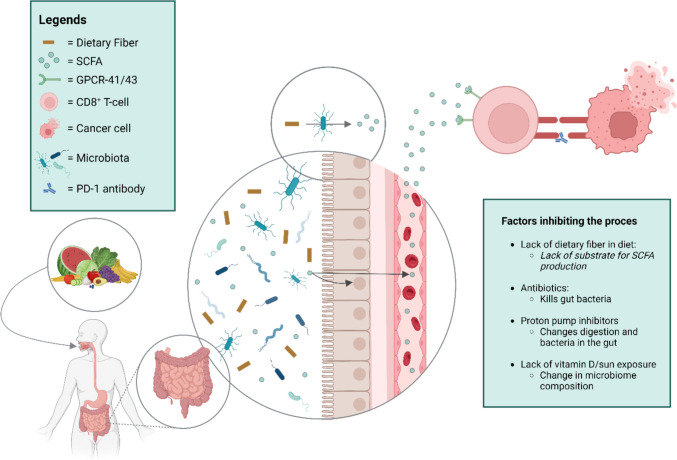
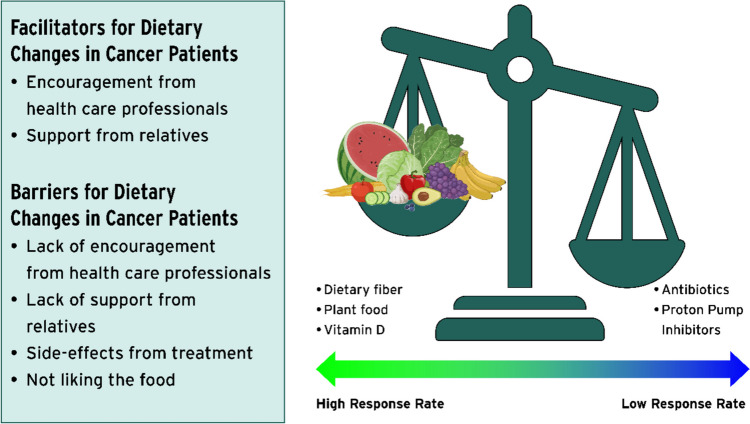
PURPOSE OF REVIEW: The advent of checkpoint immunotherapy has dramatically changed the outcomes for patients with cancer. However, a considerable number of patients have little or no response to therapy. We review recent findings on the connection between the gut microbiota and the immune system, exploring whether this link could enhance the effectiveness of immunotherapy. RECENT FINDINGS: Clinical studies have reported specific types of bacteria in larger quantities at baseline in responders than in non-responders, especially Akkermansia mucinifila, Ruminococcaceae, Faecalibacterium, and Lachnospiraceae. Following the consumption of a high-fiber diet, bacteria in the gut ferment dietary fiber to short-chain fatty acids (SCFAs), like acetate, propionate, and butyrate. Some of the SCFAs nurture intestinal epithelial cells, and some enter the bloodstream. Here SCFAs can activate DC8 + cytotoxic T-cells to induce cancer cell death. High fiber intake in the diet was associated with a reduced risk of progression or death during checkpoint immunotherapy. Recent findings demonstrate that high-fiber plant-based diets such as the Mediterranean Diet positively influence the gut microbiota whereas antibiotics and proton pump inhibitors can negatively influence outcomes of cancer immunotherapy by changing the gut microbiota. This narrative review provides evidence of an association between types of bacteria and their metabolites and favorable responses to checkpoint immunotherapy. Prospective clinical trials are needed to determine if diet interventions can improve treatment outcomes.
Overview
The claims and statistics of this paper haven’t been checked yet.
Free: it reads the open-access text and checks the first 5 claims that cite a source we can check. Create a free account to check every claim.
Integrity signals
Registry
Cites
Statistics
Figures
Verification
Claims the paper makes
The claims and statistics of this paper haven’t been checked yet.
Free: it reads the open-access text and checks the first 5 claims that cite a source we can check. Create a free account to check every claim.
Claims other papers make about this one
Each is checked against this paper’s own text: does it say what the citing paper says it does?
The cited source says what the claim attributes to it.
In the citing paper
“Notably, α-diversity at baseline has been associated with favorable clinical outcomes in ICI therapies.5,147”
From Gut dysbiosis in oncology: a risk factor for immunoresistance (2026) · doi:10.1038/s41422-025-01212-6 · cites this paper as [147]
The cited source says what the claim attributes to it.
In the citing paper
“but this is two to three times the amount consumed today by an average Western person (Gamrath et al., 2025).”
From Microbiota-centered interventions to boost immune checkpoint blockade therapies (2025) · cites this paper as Gamrath et al., 2025
The cited source says what the claim attributes to it.
In the citing paper
“Patients can be motivated to change, and encouragement from family, friends, and healthcare providers can be significant motivating factors (Gamrath et al., 2025).”
From Microbiota-centered interventions to boost immune checkpoint blockade therapies (2025) · cites this paper as Gamrath et al., 2025
The cited source says what the claim attributes to it.
In the citing paper
“Additionally, the American Gut Project—a large-scale, crowdfunded citizen science initiative focused on analyzing the human microbiome—collected samples from 10,000 individuals, which were then correlated with lifestyle, health, and disease questionnaires. Self-reported high-plant consumers exhibited a significantly more diverse gut microbiome (Gamrath et al., 2025).”
From Microbiota-centered interventions to boost immune checkpoint blockade therapies (2025) · cites this paper as Gamrath et al., 2025
In the citing paper
“Increasing the recommendation to 50 g daily should meet the requirements necessary to manipulate gut microbial composition, but this is two to three times the amount consumed today by an average Western person (Gamrath et al., 2025).”
From Microbiota-centered interventions to boost immune checkpoint blockade therapies (2025) · cites this paper as Gamrath et al., 2025
1 more claim about this paper
Create a free account to see every claim other papers make about this one.
Self-check
Percentages, sums and reported differences re-computed from the paper’s own numbers.
The self-check needs the paper’s full text.
Citations
Cites
A human gut microbial gene catalogue established by metagenomic sequencing
MetaHIT Consortium, Qin, J., Li, R., Raes, J., Arumugam, M., Burgdorf, K. S., Manichanh, C., Nielsen, T., Pons, N., Levenez, F., et al. (2010) · Nature · doi:10.1038/nature08821 · Cited by 11,624 · cited 1×
“These cells contain genes that make up the human microbiome [4].”
Hallmarks of Cancer: New Dimensions
Hanahan, D. (2022) · Cancer Discovery · doi:10.1158/2159-8290.cd-21-1059 · Cited by 9,887 · cited 2×
“Additionally, bacteria have been detected within solid tumors [8], but how they are associated with the gut micro-biome and their impact on human survival is still unclear [6].”
Linking long-term dietary patterns with gut microbial enterotypes
Wu, G. D., Chen, J., Hoffmann, C., Bittinger, K., Chen, Y.-Y., Keilbaugh, S. A., Bewtra, M., Knights, D., Walters, W. A., Knight, R., et al. (2011) · Science · doi:10.1126/science.1208344 · Cited by 6,513 · cited 1×
“The bacterium, Prevotella, associated with a high-fiber diet [48], has been reported to correlate with treatment response in some studies [13, 29, 33, 38, 39].”
Gut microbiome influences efficacy of PD-1-based immunotherapy against epithelial tumors
Routy, B., Le Chatelier, E., Derosa, L., Duong, C. P. M., Alou, M. T., Daillère, R., Fluckiger, A., Messaoudene, M., Rauber, C., Roberti, M. P., et al. (2018) · Science · doi:10.1126/science.aan3706 · Cited by 5,671 · cited 6×
“Akkermansia was also overrepresented in patients with progression-free survival (PFS) longer than 3 months compared to those with PFS shorter than 3 months [20].”
InfluentialRevised Estimates for the Number of Human and Bacteria Cells in the Body
Sender, R., Fuchs, S., & Milo, R. (2016) · PLOS Biology · doi:10.1371/journal.pbio.1002533 · Cited by 5,425 · cited 1×
“The human microbiota comprises 38 trillion (38 × 10 12 ) symbiotic microbial cells, primarily bacteria in the gut [3].”
Gut microbiome modulates response to anti-PD-1 immunotherapy in melanoma patients
Gopalakrishnan, V., Spencer, C. N., Nezi, L., Reuben, A., Andrews, M. C., Karpinets, T. V., Prieto, P. A., Vicente, D., Hoffman, K., Wei, S. C., et al. (2018) · Science · doi:10.1126/science.aan4236 · Cited by 4,812 · cited 5×
“However, several studies indicate that baseline bacterial diversity can predict treatment response [12–20]; specific bacteria, such as Akkermansia mucinifila, Ruminococcaceae, Fae-calibacterium, and Lachnospiraceae, are often found in greater quantities at baseline in responders compared to…”
InfluentialGut microbiota in human metabolic health and disease
Fan, Y., & Pedersen, O. (2021) · Nature Reviews Microbiology · doi:10.1038/s41579-020-0433-9 · Cited by 4,724 · cited 1×
“Targeted therapies include bio-engineered commensals, targeted antibiotics, phage therapy, or Clustered Regularly Interspaced Short Palindromic Repeats (CRISPR) [11].”
The commensal microbiome is associated with anti-PD-1 efficacy in metastatic melanoma patients
Matson, V., Fessler, J., Bao, R., Chongsuwat, T., Zha, Y., Alegre, M.-L., Luke, J. J., & Gajewski, T. F. (2018) · Science · doi:10.1126/science.aao3290 · Cited by 3,107
The human tumor microbiome is composed of tumor type–specific intracellular bacteria
Nejman, D., Livyatan, I., Fuks, G., Gavert, N., Zwang, Y., Geller, L. T., Rotter-Maskowitz, A., Weiser, R., Mallel, G., Gigi, E., et al. (2020) · Science · doi:10.1126/science.aay9189 · Cited by 2,464 · cited 1×
“Additionally, bacteria have been detected within solid tumors [8], but how they are associated with the gut micro-biome and their impact on human survival is still unclear [6].”
The role of short chain fatty acids in health and disease
Tan, J., McKenzie, C., Potamitis, M., Thorburn, A. N., Mackay, C. R., & Macia, L. (2014) · Advances in immunology · doi:10.1016/b978-0-12-800100-4.00003-9 · Cited by 2,425 · cited 1×
“They target G-protein-coupled receptors (GPCR) GPCR41, GPCR43, and GPCR109A [53] (Fig.”
Cited by
Gut microbiota–derived metabolites in immunomodulation and gastrointestinal cancer immunotherapy
Luo, W., Li, R., Pan, C., & Luo, C. (2025) · Frontiers in Immunology · doi:10.3389/fimmu.2025.1710880 · Cited by 59
Immune Checkpoint Molecules: A Review on Pathways and Immunotherapy Implications
Rezazadeh‐Gavgani, E., Majidazar, R., Lotfinejad, P., Kazemi, T., & Shamekh, A. (2025) · Immunity Inflammation and Disease · doi:10.1002/iid3.70196 · Cited by 56
Gut microbiota reshapes the TNBC immune microenvironment: Emerging immunotherapeutic strategies
Huang, M., Zhang, Y., Chen, Z., Yu, X., Luo, S., Peng, X., & Li, X. (2025) · Pharmacological Research · doi:10.1016/j.phrs.2025.107726 · Cited by 34
Gut dysbiosis in oncology: a risk factor for immunoresistance
(2026) · doi:10.1038/s41422-025-01212-6 · Cited by 24
“15,77,88,146,147 However, mouse models have highlighted inconsistencies in treatment outcomes following supplementation with SCFAs.”
Microbiota-centered interventions to boost immune checkpoint blockade therapies
Almonte, A. A., Thomas, S., & Zitvogel, L. (2025) · Journal of Experimental Medicine · doi:10.1084/jem.20250378 · Cited by 19
Roznovan, C. N., Marutescu, L. G., & Pîrcălăbioru, G. G. (2025) · International Journal of Molecular Sciences · doi:10.3390/ijms26136177 · Cited by 14
“A key unmet need remains the identification of reliable microbial biomarkers for patient stratification [249].”
de Torres, C. S., Elias, E., Vaghi, C., Gonzalez, N. S., García, A., Alcaráz, A., Rodríguez-Castells, M., Baraibar, I., Ros, J., Salvà, F., et al. (2026) · Cancer Treatment Reviews · doi:10.1016/j.ctrv.2026.103089 · Cited by 10
From Microbiota to Cancer: Role of Extracellular Vesicles in Gut–Lung Axis
Albano, G. D., & Taverna, S. (2025) · Cancers · doi:10.3390/cancers17243946 · Cited by 9
Silva, C. A. C., Almonte, A. A., & Zitvogel, L. (2025) · Biomolecules · doi:10.3390/biom15040504 · Cited by 6
“They are produced through the anaerobic fermentation of non-digestible fibers [1] and act as an energy source for intestinal epithelial cells and signaling molecules in the periphery [46].”
Microbiota-derived metabolites in cancer: Dual roles in pathogenesis and opportunities for therapy
Rajak, M., Dash, D., & Koiri, R. K. (2025) · Medicine in Drug Discovery · doi:10.1016/j.medidd.2025.100245 · Cited by 12
Ruminococcus and prostate cancer: new treatment opportunities on the gut–prostate axis
Liu, Y., Wang, Y., Wu, G., & Tan, Y. (2025) · Medical Oncology · doi:10.1007/s12032-025-02951-7 · Cited by 7
“Studies have shown that SCFA produced by Ruminococaccaceae metabolism can activate CD8 + cytotoxic T cells to induce cancer cell death in cell experiments, thus enhancing the efficacy of ICI [15].”
Nasopharyngeal carcinoma and microbiome: Evidence and implications
Su, Z. Y., Chen, W., Siak, P. Y., Guo, X., & Cheah, S. (2025) · Critical Reviews in Oncology/Hematology · doi:10.1016/j.critrevonc.2025.104986 · Cited by 6
汪正宇, Yuan, H., Liu, M., Yuan, J., & Chen, D. (2026) · Frontiers in Oncology · doi:10.3389/fonc.2026.1804379 · Cited by 8
“Beyond pharmacokinetic interactions, PPIs may also dampen the ef fi cacy of immune checkpoint inhibitors, plausibly through shifts in the gut microbiome that alter antitumor immune responses (141, 142).”
Programming the tumor microenvironment through microbiome-driven mechanisms
Bautista, J., Calderón-Cevallos, S., Salvador-Baquero, A. M., Naranjo-Castillo, X., & López‐Cortés, A. (2026) · Frontiers in Cellular and Infection Microbiology · doi:10.3389/fcimb.2026.1857151 · Cited by 5
Antohi, A. L., Gheorghiță, A. D., Andronic, O., Pîrcălăbioru, G. G., & Treteanu, A. R. (2026) · International Journal of Molecular Sciences · doi:10.3390/ijms27062538 · Cited by 7
Ferroptosis in renal cell carcinoma: integrative multi-omics insights and therapeutic perspectives
Wang, X., Li, J., Zhang, Y., Huang, R., Zhang, P., & Hu, H. (2025) · International Journal of Surgery · doi:10.1097/js9.0000000000004583 · Cited by 8
“Nutritional strategies – whether fiber-laden Mediterranean patterns or ketogenic regimens – alongside targeted probiotics, fecal microbiota transfer, and precision antibiotics are being explored as levers to recalibrate microbial communities and, by extension, tumor-ferroptosis thresholds [ 90 ] .”
Microbiome and cancer: mechanistic insights, diagnostic potential, and therapeutic strategies
Kumar, V., Chaudhary, A., Gautam, M., Verma, P., & Singh, M. (2026) · Frontiers in Cell and Developmental Biology · doi:10.3389/fcell.2026.1844436 · Cited by 3
Bautista, J., & López-Cortés, A. (2026) · Frontiers in Immunology · doi:10.3389/fimmu.2026.1887873 · Cited by 2
“Interpretation of diet – microbiome interactions remains complicated by interindividual variability, differences in dietary adherence, baseline microbiome composition, and heterogeneity across study populations (138, 139).”
Yuan, T., Xing, J., & Liu, P. (2025) · Molecular Diversity · doi:10.1007/s11030-025-11351-y · Cited by 1
Pacheco-Barcía, V., Méndez, A. M., Hernández-Jiménez, E., Jiménez‐Fonseca, P., Martín, A. J. M., Custodio‐Cabello, S., Palka-Kotlowska, M., Gonzalez-Diaz, I., & Cabezón‐Gutiérrez, L. (2025) · World Journal of Clinical Oncology · doi:10.5306/wjco.v16.i10.107877 · Cited by 1
Pardali, E. C., Gkouvi, A., Goulis, D. G., Cholevas, C., Katsiari, C. G., Bogdanos, D. P., & Grammatikopoulou, M. G. (2026) · Clinical Rheumatology · doi:10.1007/s10067-026-08039-5 · Cited by 2
Reyed, R. M., & Prabhakar, P. K. (2026) · Elsevier eBooks · doi:10.1016/b978-0-443-36500-3.00008-8 · Cited by 1
陈, 义. (2026) · Advances in Clinical Medicine · doi:10.12677/acm.2026.162504
Kong, L., & Piao, H. (2026) · Gastrointestinal Disorders · doi:10.3390/gidisord8030032
“Dietary intervention: a high-fiber diet promotes the growth of SCFA-producing bacteria, while a low-fat diet reduces the production of secondary bile acids [105,106].”
O impacto da microbiota no tratamento oncológico
Nunes, D. N., & Dias‐Neto, E. (2026) · Estudos Avançados · doi:10.1590/s0103-4014.2026.40117.008
Musiał, P., Pieczara, S., Stefanik, Z., Drzazga-Wilk, E., Stańko, M., Smagowska, J., Nowicki, W., Urbanowicz, P., Machaj, D., & Rekiel, K. (2026) · International Journal of Innovative Technologies in Social Science · doi:10.31435/ijitss.3(51).2026.5988
Perspective Chapter: Microbiome Predictive Value for Immunotherapy Response
Gales, L. N., Ghencea, I. A., Serban, E. C., & Trifanescu, O. G. (2026) · Pharmaceutical science. · doi:10.5772/intechopen.1017715
Gut microbiome in modulating immune checkpoint inhibitors
Bade, J. D., Shaik, A. R., Nelluri, K. D. D., Nelluri, S., & Alaparthi, B. (2026) · Elsevier eBooks · doi:10.1016/b978-0-443-33206-7.00012-1
Malik, G., Bashir, S., Javeed, S., Dhanawat, M., & Girdhar, J. (2026) · Elsevier eBooks · doi:10.1016/b978-0-443-33206-7.00008-x
Westphal, J. R., Macke, L., Graf, C., & Schulz, C. (2026) · Best Practice & Research Clinical Gastroenterology · doi:10.1016/j.bpg.2026.102154
Metadata
- Authors
- Gamrath, L., Pedersen, T. B., Møller, M. V., Volmer, L. M., Holst-Christensen, L., Vestermark, L. W., & Donskov, F.
- Affiliations
- Hospital South West Jutland (DK)
- Vejle Sygehus (DK)
- University of Southern Denmark (DK)
- Corresponding author
- Donskov, Frede
- ORCID
- Donskov, Frede
- Venue
- Current Oncology Reports
- Published
- 2025-01
- Volume
- 27
- Issue
- 1
- Pages
- 45-58
- ISSN
- 1523-3790 (ISSN-L)
- 1534-6269
- PMC
- PMC11762419
- OpenAlex
- W4406026483
- Cited by
- 30
- References
- 69
- Citations by year
- 2026: 17 · 2025: 13
- FWCI
- 2.66
- Type
- journal article
- Language
- en
- Open access
- hybrid
- doi.org
- Licence
- cc-by-nc-nd
- creativecommons.org/licenses/by-nc-nd/4.0 (tdm)
- creativecommons.org/licenses/by-nc-nd/4.0 (vor, 2 d)
- Locations
- Current Oncology Reports (publishedVersion, cc-by-nc-nd)
- PubMed Central (publishedVersion, cc-by-nc-nd)
- PubMed (publishedVersion)
- University of Southern Denmark Research Portal (University of Southern Denmark) (submittedVersion, cc-by-nc-nd)
- Funders
- Southwest-Southern Denmark Cancer Fund
- Danish Cancer Society, Esbjerg
- Topics
- Life Sciences › Biochemistry, Genetics and Molecular Biology › Molecular Biology › Gut microbiota and health
- Health Sciences › Medicine › Oncology › Cancer Immunotherapy and Biomarkers
- Life Sciences › Agricultural and Biological Sciences › Food Science › Probiotics and Fermented Foods
- Keywords
- gut microbiota, cancer immunotherapy, immune checkpoint inhibitors, treatment response, Ruminococcaceae, Faecalibacterium, Lachnospiraceae, short-chain fatty acids, dietary fiber, high-fiber diet, plant-based diet, Mediterranean diet, antibiotics, proton pump inhibitors, dendritic cells, intestinal epithelium
- MeSH terms
- Gastrointestinal Microbiome, Immune Checkpoint Inhibitors, Bacteria, Clinical Trials as Topic, Diet, Dietary Fiber, Humans, Immunotherapy, Neoplasms, Metabolome
About these checks
Registry, retraction, Cites and statistics results are computed, not judged, with one exception: a printed reference that no index lists is read once by a model before it counts as a citation error. Claims are extracted by a model and kept only when their quote appears verbatim in the text; each cited source is then checked, with a model’s help, for whether it says what the claim relies on. Those verdicts can be wrong — read the claim’s quote and the cited source before relying on one.
Statistics and arithmetic are recomputed, not judged.
Confidence bands are shown only for fields calibrated on our annotated test set. None is calibrated yet, so no band is shown.
What counts as a claim ›How we measure confidence ›How we check this ›
Are you an author, or do you see a problem with this page? Request a review
Data sources
Bibliographic data: Semantic Scholar, OpenAlex, Crossref.
Contains information from the Semantic Scholar Academic Graph Datasets, made available under the ODC Attribution License (ODC-BY 1.0).
Semantic Scholar’s data is described in: Kinney, R., et al. (2023). The Semantic Scholar Open Data Platform. arXiv:2301.10140.
