

Ethical Design in the Internet of Things
Open accessThe DOI matches its Crossref record; 26 of the 26 references it cites were found in a registry or an index.
Abstract
Even though public awareness about privacy risks in the Internet is increasing, in the evolution of the Internet to the Internet of Things (IoT) these risks are likely to become more relevant due to the large amount of data collected and processed by the "Things". The business drivers for exploring ways to monetize such data are one of the challenges identified in this paper for the protection of Privacy in the IoT. Beyond the protection of privacy, this paper highlights the need for new approaches, which grant a more active role to the users of the IoT and which address other potential issues such as the Digital Divide or safety risks. A key facet in ethical design is the transparency of the technology and services in how that technology handles data, as well as providing choice for the user. This paper presents a new approach for users' interaction with the IoT, which is based on the concept of Ethical Design implemented through a policy-based framework. In the proposed framework, users are provided with wider controls over personal data or the IoT services by selecting specific sets of policies, which can be tailored according to users' capabilities and to the contexts where they operate. The potential deployment of the framework in a typical IoT context is described with the identification of the main stakeholders and the processes that should be put in place.
Overview
The claims and statistics of this paper haven’t been checked yet.
Free: it reads the open-access text and checks the first 5 claims that cite a source we can check. Create a free account to check every claim.
Integrity signals
Registry
Cites
Statistics
Figures
Verification
Claims the paper makes
The claims and statistics of this paper haven’t been checked yet.
Free: it reads the open-access text and checks the first 5 claims that cite a source we can check. Create a free account to check every claim.
Claims other papers make about this one
Each is checked against this paper’s own text: does it say what the citing paper says it does?
In the citing paper
“As health data are normally considered as particularly sensitive both in an ethical and legal sense (Baldini et al. 2016), informational privacy is a central concern for the design and deployment of H-IoT, insofar as it contributes to gain control over the spread of information about the user's health status and history.”
From Ethics of the health-related internet of things: a narrative review (2017) · cites this paper as Baldini et al. 2016
Self-check
Percentages, sums and reported differences re-computed from the paper’s own numbers.
The self-check needs the paper’s full text.
Citations
Cites
The Human Condition: Second Edition
Arendt, H., Canovan, M., & Allen, D. (2018) · University of Chicago Press eBooks · doi:10.7208/chicago/9780226586748.001.0001 · Cited by 10,123
Security, privacy and trust in Internet of Things: The road ahead
Sicari, S., Rizzardi, A., Grieco, L. A., & Coen-Porisini, A. (2015) · Computer Networks · doi:10.1016/j.comnet.2014.11.008 · Cited by 2,187
Privacy and rationality in individual decision making
Acquisti, A., & Grossklags, J. (2005) · IEEE Security and Privacy Magazine · doi:10.1109/msp.2005.22 · Cited by 1,123 · cited 1×
“…the Internet and the IoT user’s individual decision process with respect to privacy is affected and hampered by multiple factors, as described in Acquisti and Grossklags (2005): (a) incomplete information on the consequences of an action (e.g., search on a person or introduction of data)…”
The Internet of Things in an Enterprise Context
Haller, S., Karnouskos, S., & Schroth, C. (2009) · Lecture Notes in Computer Science · doi:10.1007/978-3-642-00985-3_2 · Cited by 484 · cited 1×
“In Haller et al. (2009), the Internet of Things is defined as ‘‘a world where physical objects are seamlessly integrated into the information network, and where the physical objects can become active participants in business processes.”
BackgroundInternet of Things: Convenience vs. privacy and secrecy
Weinberg, B. D., Milne, G. R., Andonova, Y. G., & Hajjat, F. M. (2015) · Business Horizons · doi:10.1016/j.bushor.2015.06.005 · Cited by 216 · cited 1×
“See (Weinberg et al. 2015; Article 29 Working Party 2014) for a more detailed analysis of the distinguishing characteristics of the Internet of Things.”
BackgroundA taxonomy for privacy enhancing technologies
Heurix, J., Zimmermann, P., Neubauer, T., & Fenz, S. (2015) · Computers & Security · doi:10.1016/j.cose.2015.05.002 · Cited by 190
Breaking the Cyber-Security Dilemma: Aligning Security Needs and Removing Vulnerabilities
Cavelty, M. D. (2014) · Science and Engineering Ethics · doi:10.1007/s11948-014-9551-y · Cited by 172 · cited 1×
“The need for an ethical approach in the design of the IoT to mitigate the risk of security vulnerabilities has also been highlighted by Cavelty (2014) and we believe that our Ethical design concept goes in the same direction.”
BackgroundAnticipating ethical issues in emerging IT
Brey, P. A. E. (2012) · Ethics and Information Technology · doi:10.1007/s10676-012-9293-y · Cited by 165 · cited 1×
“The concept of Ethical design in the IoT shares some similarities with the concept of ‘‘anticipatory ethics’’ expressed in Brey (2012).”
MethodRespecting Context to Protect Privacy: Why Meaning Matters
Nissenbaum, H. F. (2015) · Science and Engineering Ethics · doi:10.1007/s11948-015-9674-9 · Cited by 134
How internet users' privacy concerns have evolved since 2002
Anton, A. I., Earp, J. B., & Young, J. D. (2010) · IEEE Security & Privacy Magazine · doi:10.1109/msp.2010.38 · Cited by 133 · cited 1×
“In particular, public concern and awareness of privacy implications are growing as to the use of big data analytics on data collected through the Internet and the IoT (Anton et al. 2010).”
BackgroundSecKit: A Model-based Security Toolkit for the Internet of Things
Neisse, R., Steri, G., Fovino, I. N., & Baldini, G. (2015) · Computers & Security · doi:10.1016/j.cose.2015.06.002 · Cited by 125
Self-citationEnforcement of security policy rules for the Internet of Things
Neisse, R., Steri, G., & Baldini, G. (2014) · 2014 IEEE 10th International Conference on Wireless and Mobile Computing, Networking and Communications (WiMob) · doi:10.1109/wimob.2014.6962166 · Cited by 110 · cited 2×
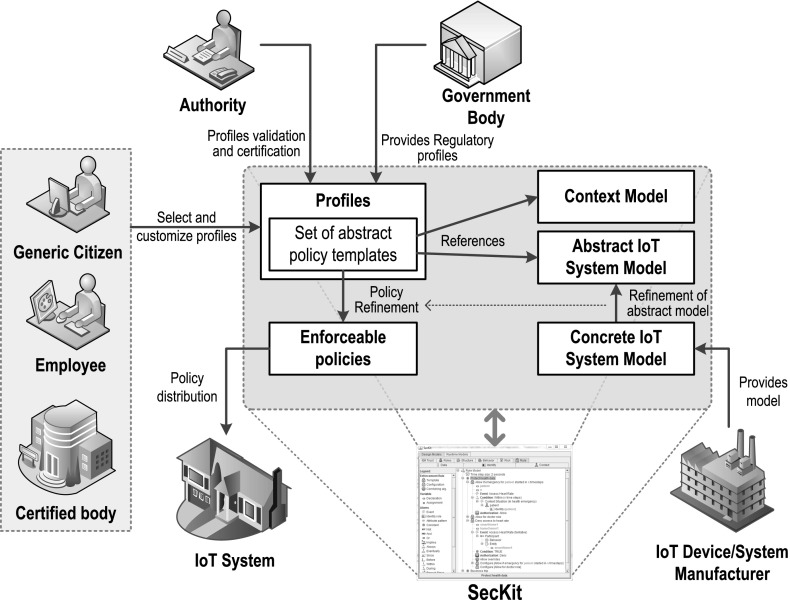
“We propose to implement the Ethical Design concept using the Model-based Security Toolkit (SecKit), which is a sophisticated policy-based framework already introduced in Neisse et al. (2015) and Neisse et al. (2014a).”
MethodSelf-citationSchmidt, E., & Rosenberg, J. (2014) · Medical Entomology and Zoology · Cited by 92
Internet of things – Governance quo vadis?
Weber, R. H. (2013) · Computer law & security review · doi:10.1016/j.clsr.2013.05.010 · Cited by 90 · cited 4×
“In Europe, the EU has proposed a new Data Protection Regulation (DPR) (European Commission 2012), which has the goal to address some of the most pressing data protection issues created by new technologies (e.g., smart phones or cloud computing).”
InfluentialPrivacy and Security of Personal Information
Acquisti, A. (2006) · Kluwer Academic Publishers eBooks · doi:10.1007/1-4020-8090-5_14 · Cited by 73
Raw Personal Data: Providing Access
Lunshof, J. E., Church, G. M., & Prainsack, B. (2014) · Science · doi:10.1126/science.1249382 · Cited by 70
Privacy in pervasive computing environments ~ a contradiction in terms?
Čas, J. (2005) · IEEE Technology and Society Magazine · doi:10.1109/mtas.2005.1407744 · Cited by 62 · cited 1×
“For example, see Cas (2005) for an analysis of privacy tradeoffs in pervasive computing.”
BackgroundShilton, K. (2014) · Science and Engineering Ethics · doi:10.1007/s11948-013-9510-z · Cited by 58
The digital future – A challenge for privacy?
Weber, R. H. (2015) · Computer law & security review · doi:10.1016/j.clsr.2015.01.003 · Cited by 57 · cited 1×
“See also the recent paper from Weber (2015) for a study of the main challenges to guarantee data protection laws and the concept of privacy in an increasingly networked world.”
BackgroundBuilding Trust in the Human?Internet of Things Relationship
Kounelis, I., Baldini, G., Neisse, R., Steri, G., Tallacchini, M., & Pereira, Â. G. (2014) · IEEE Technology and Society Magazine · doi:10.1109/mts.2014.2364020 · Cited by 49 · cited 1×
“For instance, some authors are already arguing that access to raw data should be considered as a moral right (Lunshof et al. 2014).”
BackgroundSelf-citationA Model-Based Security Toolkit for the Internet of Things
Neisse, R., Fovino, I. N., Baldini, G., Stavroulaki, V., Vlacheas, P. T., & Giaffreda, R. (2014) · International Conference on Availability, Reliability and Security (ARES) · doi:10.1109/ares.2014.17 · Cited by 40 · cited 2×
“An important aspect highlighted by Nissenbaum (2015) is that privacy protection should be related to the ‘‘context’’ where the user operates.”
BackgroundMethodSelf-citationModel-based specification and refinement of usage control policies
Neisse, R., & Doerr, J. (2013) · Conference on Privacy, Security and Trust · doi:10.1109/pst.2013.6596051 · Cited by 16 · cited 1×
“In a previous publication (Neisse and Doerr 2013) some of the co-authors propose a set of automated refinement rules that can be used to refine technologyagnostic user policies to enforceable technology-specific policies.”
BackgroundSelf-citationDoes it help or hinder? Promotion of Innovation on the Internet and Citizens’ Right to Privacy
Cave, J. A. K., Bodea, G., Kool, K., & Lieshout, M. (2011) · TNO Repository · Cited by 13
Internet and the flow of knowledge: Which ethical and political challenges will we face?
Gottschalk-Mazouz, N. (2008) · De Gruyter eBooks · doi:10.1515/9783110328486.215 · Cited by 9 · cited 1×
“When new collaborative applications will be deployed in the IoT, the users of the applications may have a limited control on the flow of data or requests (e.g., to participate or register to a specific service) coming to them (Gottschalk-Mazouz 2013).”
BackgroundTowards abundant DiY service creativity
Trappeniers, L., Roelands, M., Godon, M., Criel, J., & Dobbelaere, P. (2009) · International Conference on Intelligence in Next Generation Networks · doi:10.1109/icin.2009.5357076 · Cited by 5
Governance of ICT Security: A Perspective from the JRC
Pereira, Â. G., & Tallacchini, M. (2014) · Joint Research Centre (European Commission) · doi:10.2788/72624 · Cited by 3 · cited 1×
“…in the by-design approach, users are provided with predefined forms of protection, in the in-design approach digital architectures are opened up to users—which also implies a shift in understanding privacy as a ‘‘right’’ rather than a paternalistic legal protection (Pereira and Tallacchini 2014).”
BackgroundSelf-citation
Research works printed but not linked: 2
- Arendt H The human condition 1958 Chicago, IL University of Chicago Press
- European Group on Ethics in Science and New Technologies (EGE) Opinion 28 of the European group on ethics in science and new technologies, Ethics of security and surveillance technologies 2014 Luxembourg Publications Office of the European Union
Cited by
The Internet of Things: Review and theoretical framework
Nord, J. H., Koohang, A., & Paliszkiewicz, J. (2019) · Expert Systems with Applications · doi:10.1016/j.eswa.2019.05.014 · Cited by 476
Access control in the Internet of Things: Big challenges and new opportunities
Ouaddah, A., Mousannif, H., Abou Elkalam, A., & Ait Ouahman, A. (2017) · Computer Networks · doi:10.1016/j.comnet.2016.11.007 · Cited by 454
Modeling the internet of things adoption barriers in food retail supply chains
Kamble, S. S., Gunasekaran, A., Parekh, H., & Joshi, S. (2019) · Journal of Retailing and Consumer Services · doi:10.1016/j.jretconser.2019.02.020 · Cited by 366
IoT Security, Privacy, Safety and Ethics
Atlam, H. F., & Wills, G. B. (2020) · Internet of Things · doi:10.1007/978-3-030-18732-3_8 · Cited by 291
AI in the headlines: the portrayal of the ethical issues of artificial intelligence in the media
Ouchchy, L., Coin, A., & Dubljević, V. (2020) · AI & SOCIETY · doi:10.1007/s00146-020-00965-5 · Cited by 300
Metadata
- Authors
- Baldini, G., Botterman, M., Neisse, R., & Tallacchini, M.
- Affiliations
- European Commission (BE)
- Joint Research Centre (IT)
- Università Cattolica del Sacro Cuore (IT)
- Corresponding author
- Baldini, Gianmarco
- Botterman, Maarten
- Neisse, Ricardo
- Tallacchini, Mariachiara
- ORCID
- Baldini, Gianmarco
- Venue
- Science and Engineering Ethics
- Published
- 2016-01-21
- Volume
- 24
- Issue
- 3
- Pages
- 905-925
- ISSN
- 1353-3452 (ISSN-L)
- 1471-5546
- PMC
- PMC5972157
- OpenAlex
- W2300086073
- Cited by
- 185
- References
- 26
- Citations by year
- 2026: 5 · 2025: 8 · 2024: 26 · 2023: 41 · 2022: 15 · 2021: 21 · 2020: 20 · 2019: 24 · 2018: 13 · 2017: 7 · 2016: 4
- FWCI
- 45.75
- Type
- journal article
- Language
- en
- Open access
- hybrid
- doi.org
- Locations
- Science and Engineering Ethics (publishedVersion, cc-by)
- Europe PMC (PubMed Central) (publishedVersion, cc-by)
- PubMed Central (publishedVersion, cc-by)
- PubMed (publishedVersion)
- Joint Research Centre (European Commission) (submittedVersion, cc-by)
- Funders
- European Commission (BE)
- Topics
- Social Sciences › Sociology and Political Science › Privacy, Security, and Data Protection
- Physical Sciences › Computer Science › Artificial Intelligence › Ethics and Social Impacts of AI
- Physical Sciences › Computer Science › Human-Computer Interaction › Innovative Human-Technology Interaction
- Keywords
- Internet of Things, ethical design, privacy preservation, personal data control, user empowerment, transparency, digital divide, stakeholder process
- MeSH terms
- Information Technology, Stakeholder Participation, Community Participation, Data Collection, Delivery of Health Care, Engineering, Humans, Informed Consent, Morals, Power, Psychological, Technology, Computer Security, Privacy, Internet, Personal Autonomy, Disclosure, Ethics, Business, Policy
About these checks
Registry, retraction, Cites and statistics results are computed, not judged, with one exception: a printed reference that no index lists is read once by a model before it counts as a citation error. Claims are extracted by a model and kept only when their quote appears verbatim in the text; each cited source is then checked, with a model’s help, for whether it says what the claim relies on. Those verdicts can be wrong — read the claim’s quote and the cited source before relying on one.
Statistics and arithmetic are recomputed, not judged.
Confidence bands are shown only for fields calibrated on our annotated test set. None is calibrated yet, so no band is shown.
What counts as a claim ›How we measure confidence ›How we check this ›
Are you an author, or do you see a problem with this page? Request a review
Data sources
Bibliographic data: Semantic Scholar, OpenAlex, Crossref.
Contains information from the Semantic Scholar Academic Graph Datasets, made available under the ODC Attribution License (ODC-BY 1.0).
Semantic Scholar’s data is described in: Kinney, R., et al. (2023). The Semantic Scholar Open Data Platform. arXiv:2301.10140.
