

Seasonal variations in serum 25-hydroxy vitamin D levels in a Swedish cohort
Open accessThe DOI matches its Crossref record; 45 of the 45 references it cites were found in a registry or an index.
Abstract
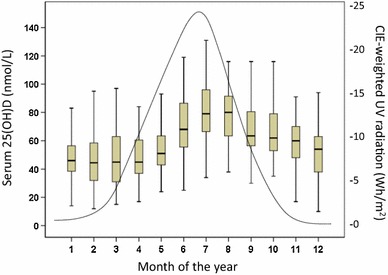
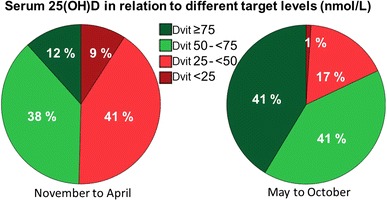
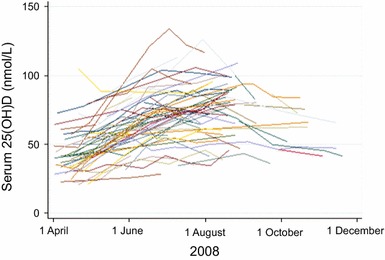
To study seasonal inter-individual and intra-individual variations in serum 25-hydroxy vitamin D (25(OH)D) and to explore parameters associated with 25(OH)D in a healthy Swedish adult population. 540 blood donors (60 % men; mean age 41 ± 13 years) and 75 thrombocyte donors (92 % men, aged 46 ± 11 years) were included. Serum was collected during 12 months and analyzed for 25(OH)D and parathyroid hormone (S-iPTH). The blood donors answered questionnaires concerning vitamin D supplements, smoking, physical activity, sunbed use and sun holidays. Repeated serum samples were collected from the thrombocyte donors to study the intra-individual variations in S-25(OH)D. S-25(OH)D varied greatly over the year correlating with the intensity of the UV-B irradiation (r S = 0.326; p < 0.001). During January-March, a S-25(OH)D level below the thresholds of 50 and 75 nmol/L was observed in 58 and 88 %, respectively, and during July-September in 11 and 50 % (p < 0.001). S-25(OH)D was negatively correlated with body mass index and S-iPTH, but was significantly higher in holiday makers in sunny destinations, sunbed users, non-smokers, and in the physically active. The intra-individual analyses showed a mean increase in S-25(OH)D by 8 nmol/L/month between April and August. Approximately 75 % had serum 25(OH)D values <75 nmol/L during 75 % of the year and 50 % had serum 25(OH)D <50 nmol/L during 50 % of the year. Serum 25(OH)D was strongly associated with parameters related to sun exposure, but only weakly with intake of vitamin D supplements.
Overview
The claims and statistics of this paper haven’t been checked yet.
Free: it reads the open-access text and checks the first 5 claims that cite a source we can check. Create a free account to check every claim.
Integrity signals
Registry
Cites
Statistics
Figures
Verification
Claims the paper makes
The claims and statistics of this paper haven’t been checked yet.
Free: it reads the open-access text and checks the first 5 claims that cite a source we can check. Create a free account to check every claim.
Claims other papers make about this one
Each is checked against this paper’s own text: does it say what the citing paper says it does?
The source backs part of the claim, not all of it — or backs it for a different population, condition or comparison.
In the citing paper
“On the basis of data from a Swedish cohort, which has a similar but not identical latitude to The Netherlands, a 13% seasonal decline would be expected in our study population during this period (Klingberg et al, 2015).”
From Effect of Repeated Low-Dose UVR Exposure on Skin Inflammation Threshold, Skin Biomarkers, and Vitamin D in Healthy Adults (2025) · cites this paper as Klingberg et al, 2015
Experimental — accuracy not yet measured
Self-check
Percentages, sums and reported differences re-computed from the paper’s own numbers.
The self-check needs the paper’s full text.
Citations
Cites
Holick, M. F., Binkley, N. C., Bischoff-Ferrari, H. A., Gordon, C. M., Hanley, D. A., Heaney, R. P., Murad, M. H., & Weaver, C. M. (2011) · The Journal of Clinical Endocrinology & Metabolism · doi:10.1210/jc.2011-0385 · Cited by 10,538
Ross, A. C., Manson, J. E., Abrams, S. A., Aloia, J. F., Brannon, P. M., Clinton, S. K., Durazo-Arvizu, R. A., Gallagher, J. C., Gallo, R. L., Jones, G., et al. (2011) · The Journal of Clinical Endocrinology & Metabolism · doi:10.1210/jc.2010-2704 · Cited by 4,026
Intake of vitamin D and risk of type 1 diabetes: a birth-cohort study
Hyppönen, E., Läärä, E., Reunanen, A., Järvelin, M.-R., & Virtanen, S. M. (2001) · The Lancet · doi:10.1016/s0140-6736(01)06580-1 · Cited by 1,928
Serum 25-Hydroxyvitamin D Levels and Risk of Multiple Sclerosis
Munger, K. L., Levin, L. I., Hollis, B. W., Howard, N. S., & Ascherio, A. (2006) · JAMA · doi:10.1001/jama.296.23.2832 · Cited by 1,897
Acromegaly: An Endocrine Society Clinical Practice Guideline
Katznelson, L., Laws, E. R., Melmed, S., Molitch, M. E., Murad, M. H., Utz, A., & Wass, J. A. H. (2014) · The Journal of Clinical Endocrinology & Metabolism · doi:10.1210/jc.2014-2700 · Cited by 1,786
WEBB, A. R., KLINE, L., & HOLICK, M. F. (1988) · The Journal of Clinical Endocrinology & Metabolism · doi:10.1210/jcem-67-2-373 · Cited by 1,659
Prevalence of Vitamin D Insufficiency in an Adult Normal Population
Chapuy, M.-C., Preziosi, P., Maamer, M., Arnaud, S., Galan, P., Hercberg, S., & Meunier, P. J. (1997) · Osteoporosis International · doi:10.1007/s001980050030 · Cited by 1,441 · cited 2×
“Low levels of 25(OH)D have been observed in significant proportions of the populations around the world and is very common among the institutionalized elderly population [15, 18–22].”
BackgroundVitamin D Status: Measurement, Interpretation, and Clinical Application
Holick, M. F. (2009) · Annals of Epidemiology · doi:10.1016/j.annepidem.2007.12.001 · Cited by 1,286
Drozdzowska, B., Pluskiewicz, W., Halaba, Z. P., Misiołek, H., & Beck, B. R. (2005) · Cited by 984
NILSSEN, O., FØRDE, O. H., & BRENN, T. (1990) · American Journal of Epidemiology · doi:10.1093/oxfordjournals.aje.a115661 · Cited by 815
Cited by
Berger, M. M., Shenkin, A., Schweinlin, A., Amrein, K., Augsburger, M., Biesalski, H.-K., Bischoff, S. C., Casaer, M. P., Gundogan, K., Lepp, H.-L., et al. (2022) · Clinical Nutrition · doi:10.1016/j.clnu.2022.02.015 · Cited by 615
Cesareo, R., Attanasio, R., Caputo, M., Castello, R., Chiodini, I., Falchetti, A., Guglielmi, R., Papini, E., Santonati, A., Scillitani, A., et al. (2018) · Nutrients · doi:10.3390/nu10050546 · Cited by 174
“In a study on Swedish healthy people, approximately 75% of the subjects had serum 25(OH)D values < 30 ng/mL (<75 nmol/L) during 75% of the year and 50% had serum 25(OH)D < 20 ng/mL (<50 nmol/L) during 50% of the year [28].”
BackgroundVitamin D Metabolites: Analytical Challenges and Clinical Relevance
Alonso, N., Zelzer, S., Eibinger, G., & Herrmann, M. (2022) · Calcified Tissue International · doi:10.1007/s00223-022-00961-5 · Cited by 169
“A low biological variability [47, 48] in combination with rather high concentrations in the nM range and a long in vitro half-life make 25(OH)D a robust biomarker that can reliably be measured by clinical laboratories [14, 19, 20].”
BackgroundVitamin D and Infectious Diseases: Simple Bystander or Contributing Factor?
Gois, P. H. F., Ferreira, D., Olenski, S., & Seguro, A. C. (2017) · Nutrients · doi:10.3390/nu9070651 · Cited by 149
“Specifically, VD has been in the spotlight as a potential contributing factor given that it presents with similar seasonal variability [117,119].”
BackgroundVitamin D and Periodontitis: A Systematic Review and Meta-Analysis
Machado, V., Lobo, S., Proença, L., Mendes, J. J., & Botelho, J. (2020) · Nutrients · doi:10.3390/nu12082177 · Cited by 156
“Further, other factors such as seasonal variation [96], race and vitamin D binding protein [97] can also affect 25(OH)D levels.”
BackgroundGhareghani, M., Reiter, R. J., Zibara, K., & Farhadi, N. (2018) · Frontiers in Immunology · doi:10.3389/fimmu.2018.02484 · Cited by 96
“Ultraviolet radiation in Sweden, particularly at northern latitudes, is too low to allow the synthesis of vitamin D during the winter months where the sun is above the horizon (20, 21).”
BackgroundSmoking behavior and circulating vitamin D levels in adults: A meta‐analysis
Yang, L., Zhao, H., Liu, K., Wang, Y., Liu, Q., Sun, T., Chen, S., & Ren, L. (2021) · Food Science & Nutrition · doi:10.1002/fsn3.2488 · Cited by 99
“…et al., 2019; Cutillas- Marco et al., 2012; DíazGómez et al., 2007; Hermann et al., 2000; Jorde et al., 2019; Kassi et al., 2015; Kim et al., 2018; Klingberg et al., 2015; Li et al., 2016; Lokki et al., 2020; Lu et al., 2020; Mulligan et al., 2014; Okan et al., 2020; Richard et al., 2017;…”
Egorova, O., Myte, R., Schneede, J., Hägglöf, B., Bölte, S., Domellöf, E., A’roch, B. I., Elgh, F., Ueland, P. M., & Silfverdal, S. (2020) · Molecular Autism · doi:10.1186/s13229-020-0315-z · Cited by 79
Prevalence and determinants of vitamin D deficiency in healthy French adults: the VARIETE study
Souberbielle, J., Massart, C., Brailly‐Tabard, S., Cavalier, E., & Chanson, P. (2016) · Endocrine · doi:10.1007/s12020-016-0960-3 · Cited by 75
Drivers of Infectious Disease Seasonality: Potential Implications for COVID-19
Kronfeld‐Schor, N., Stevenson, T. J., Nickbakhsh, S., Schernhammer, E. S., Dopico, X. C., Dayan, T., Martinez, M. E., & Helm, B. (2021) · Journal of Biological Rhythms · doi:10.1177/0748730420987322 · Cited by 75
“They tend to be higher during the summer (Klingberg et al., 2015) and could bolster the immune system when fighting viral infections.”
BackgroundHuman Immune System Variation during 1 Year
Lakshmikanth, T., Muhammad, S. A., Olin, A., Chen, Y., Mikeš, J., Fagerberg, L., Gummesson, A., Bergström, G. M. L., Uhlén, M., & Brodin, P. (2020) · Cell Reports · doi:10.1016/j.celrep.2020.107923 · Cited by 66
Serdar, M. A., Can, B. B., Kilercik, M., Durer, Z. A. O., Aksungar, F. B., Serteser, M., Coşkun, A., Özpınar, A., & Ünsal, İ. (2017) · Journal of Medical Biochemistry · doi:10.1515/jomb-2017-0002 · Cited by 67
EMAS position statement: Vitamin D and menopausal health
Anagnostis, P. G., Livadas, S., Goulis, D. G., Bretz, S., Ceauşu, I., Durmuşoğlu, F., Erkkola, R. U., Fistonić, I., Gambacciani, M., Geukes, M., et al. (2022) · Maturitas · doi:10.1016/j.maturitas.2022.12.006 · Cited by 61
“Finally, the potential interaction of seasonal changes in 25(OH)D concentrations with skeletal and non-skeletal outcomes may be another confounder [92].”
BackgroundElizondo‐Montemayor, L., Castillo, E. C., López, C. E. R., Villarreal-Calderón, J. R., Gómez-Carmona, M., Tenorio-Martínez, S., Nieblas, B., & García‐Rivas, G. (2017) · Mediators of Inflammation · doi:10.1155/2017/5719461 · Cited by 60
“BMI and WC in particular have been negatively associated with vitamin D levels and greater prevalence of deficiency [18, 24, 25].”
Backgroundon behalf of the Heinz Nixdorf Recall Study Group, Schramm, S. H., Lahner, H., Jöckel, K., Erbel, R., Führer, D., & Moebus, S. (2017) · Endocrine · doi:10.1007/s12020-017-1292-7 · Cited by 58
Skaaby, T., Husemoen, L. L. N., Thuesen, B. H., Pisinger, C. H., Hannemann, A., Jørgensen, T., & Linneberg, A. R. (2015) · Endocrine · doi:10.1007/s12020-015-0641-7 · Cited by 54
Khanna, T., Shraim, R., Žarković, M., van Weele, M., van Geffen, J. H. G. M., & Zgaga, L. (2022) · Nutrients · doi:10.3390/nu14235189 · Cited by 49
“Vitamin D has a reasonably long half-life in the body (1 to 2 months) [39], which explains why there is a 2-month lag between peak/trough UVB radiation and peak/trough vitamin D concentration [20].”
BackgroundOleröd, G., Hultén, L. M., Hammarsten, O., & Klingberg, E. (2017) · Endocrine Connections · doi:10.1530/ec-16-0078 · Cited by 54
Self-citationValuing the Diversity of Research Methods to Advance Nutrition Science
Mattes, R. D., Rowe, S. B., Ohlhorst, S. D., Brown, A. W., Hoffman, D. J., Liska, D. J., Feskens, E. J. M., Dhillon, J., Tucker, K. L., Epstein, L. H., et al. (2022) · Advances in Nutrition · doi:10.1093/advances/nmac043 · Cited by 55
Walrand, S. (2021) · Scientific Reports · doi:10.1038/s41598-021-81419-w · Cited by 51
Winter Exercise Reduces Allergic Airway Inflammation: A Randomized Controlled Study
Proßegger, J., Huber, D., Grafetstätter, C., Pichler, C., Braunschmid, H., Weisböck-Erdheim, R., & Hartl, A. J. (2019) · International Journal of Environmental Research and Public Health · doi:10.3390/ijerph16112040 · Cited by 49
“Vitamin D deficiency is still common among adults, especially during the winter months [22,23], and vitamin D seems to play a crucial role in the prevention and treatment of allergic rhinitis and/or asthma [24,25].”
BackgroundŞahin, Ö. N., Serdar, M. A., Serteser, M., Ünsal, İ., & Özpınar, A. (2018) · The Italian Journal of Pediatrics/Italian journal of pediatrics · doi:10.1186/s13052-018-0479-8 · Cited by 45
Padhi, S., Suvankar, S., Panda, V. K., Pati, A., & Panda, A. K. (2020) · International Immunopharmacology · doi:10.1016/j.intimp.2020.107001 · Cited by 41
Correlates of vitamin D in psychotic disorders: A comprehensive systematic review
Adamson, J., Lally, J., Gaughran, F., Krivoy, A., Allen, L., & Stubbs, B. (2017) · Psychiatry Research · doi:10.1016/j.psychres.2016.12.052 · Cited by 45
“In one healthy sample participants were 55% deficient during January to March but the same sample was only 11% deficient between July and September, ( p .001) (Klingberg et al., 2015).”
Saberi, B., Dadabhai, A. S., Nanavati, J., Wang, L., Shinohara, R. T., & Mullin, G. E. (2018) · World Journal of Hepatology · doi:10.4254/wjh.v10.i1.142 · Cited by 41
Vitamin D 3 supplementation does not enhance the effects of resistance training in older adults
Mølmen, K. S., Hammarström, D., Pedersen, K. K., Lie, A. C. L., Steile, R. B., Nygaard, H., Khan, Y., Hamarsland, H., Koll, L., Hanestadhaugen, M., et al. (2021) · Journal of Cachexia Sarcopenia and Muscle · doi:10.1002/jcsm.12688 · Cited by 43
“in the human population, both in an annual cycle, and between individuals and groups of individuals.(26,27) Vitamin D insufficiency is particularly prevalent in older adults, measured as 25-hydroxyvitamin D (25(OH)D) levels <50 nmol/L, and especially in older adults living in the Northern Hemisphere,(27,28) where cuta…”
BackgroundAssessing vitamin D metabolism – four decades of experience
Herrmann, M. (2023) · Clinical Chemistry and Laboratory Medicine (CCLM) · doi:10.1515/cclm-2022-1267 · Cited by 42
The Association between Serum Vitamin D Levels and Helicobacter pylori Presence and Eradication
Shafrir, A., Shauly‐Aharonov, M., Katz, L. H., Paltiel, O., Pickman, Y., & Ackerman, Z. (2021) · Nutrients · doi:10.3390/nu13010278 · Cited by 39
“It is well known that serum vitamin D levels vary according to season, being higher in the hot and sunny seasons [18].”
BackgroundBuonomo, A. R., Zappulo, E., Scotto, R., Pinchera, B., Perruolo, G., Formisano, P., Borgia, G., & Gentile, I. (2017) · International Journal of Infectious Diseases · doi:10.1016/j.ijid.2017.07.026 · Cited by 36
Meyer, V., Saccone, D. S., Tugizimana, F., Asani, F. F., Jeffery, T. J., & Bornman, L. (2017) · Frontiers in Immunology · doi:10.3389/fimmu.2017.01048 · Cited by 38
“Seasonal variation in ultraviolet index (UVI) further correlates with circulating vitamin D (23).”
BackgroundGrant, W. B., Fakhoury, H. M. A., Karras, S. Ν., Anouti, F. A., & Bhattoa, H. P. (2019) · Nutrients · doi:10.3390/nu11092065 · Cited by 41
“7◦ 28–54 325 M 215 F Oct 2009 Sep 2010 ? 81 ± 27 M + F 48 ± 20 M + F [37]”
Bauer, J. M., Mikušová, L., Verlaan, S., Bautmans, I., Brandt, K., Donini, L. M., Maggio, M. G., Mets, T. F., Wijers, S. L. J., Garthoff, J. A., et al. (2020) · Aging Clinical and Experimental Research · doi:10.1007/s40520-020-01519-x · Cited by 35
Shen, M., Li, Z., Lv, D., Yang, G., Wu, R., Pan, J., Wang, S., Li, Y., & Xu, S. (2020) · Journal of Cellular and Molecular Medicine · doi:10.1111/jcmm.15330 · Cited by 34
Infante, M., Sears, B., Rizzo, A. M., Cerati, D. M., Caprio, M., Ricordi, C., & Fabbri, A. (2018) · Nutritional Neuroscience · doi:10.1080/1028415x.2018.1557385 · Cited by 35
Nälsén, C., Becker, W., Pearson, M., Ridefelt, P., Lindroos, A. K., Kotova, N., & Mattisson, I. (2020) · Journal of Nutritional Science · doi:10.1017/jns.2020.40 · Cited by 34
Vitamin D and vitamin B12 deficiencies are common in patients with midgut carcinoid (SI-NET)
Lind, A., Wängberg, B., & Ellegård, L. (2016) · European Journal of Clinical Nutrition · doi:10.1038/ejcn.2016.40 · Cited by 33
Cannistraci, C. V., Nieminen, T. V. M., Nishi, M., Khachigian, L. M., Viikilä, J., Laine, M., Cianflone, D., Maseri, A., Yeo, K. K., Bhindi, R., et al. (2018) · Journal of the American Heart Association · doi:10.1161/jaha.117.006878 · Cited by 30
“71 between the bimonthly D% in the overall Finnish cohort and the average bimonthly levels of serum vitamin D in a reference Swedish cohort.(25) The monthly D% in the overall Finnish cohort presented noise (see Figure 5) that affected the estimation of the bimonthly D% trend used to compute the correlation with bimont…”
MethodResultSeason and region of birth as risk factors for coeliac disease a key to the aetiology?
Namatovu, F., Lindkvist, M., Olsson, C., Ivarsson, A., & Sandström, O. (2016) · Archives of Disease in Childhood · doi:10.1136/archdischild-2015-310122 · Cited by 29
Alzoubi, A., Mahdi, H., Bashir, S. A., Halalsheh, O., Ebbini, M. A., Alzarir, M., Al-Ahmar, K., Alfaqih, M., & Al-Hadidi, A. H. (2017) · Acta Endocrinologica (Bucharest) · doi:10.4183/aeb.2017.180 · Cited by 28
“Unfortunately, we were unable to avoid the well-documented seasonal variations of vitamin D levels (29); a problem we would take into consideration in our subsequent long-term cohort.”
BackgroundMüller, M. J., Stokes, C. S., & Volmer, D. A. (2016) · Talanta · doi:10.1016/j.talanta.2016.12.081 · Cited by 26
Abouzid, M., Karaźniewicz‐Łada, M., Pawlak, K., Burchardt, P., Kruszyna, Ł., & Główka, F. K. (2020) · Journal of Chromatography B · doi:10.1016/j.jchromb.2020.122350 · Cited by 27
Islam, M. T. (2020) · FARMACIA · doi:10.31925/farmacia.2020.6.3 · Cited by 26
“Studies suggest that Vit-D levels increase in summer and decrease in winter [59].”
BackgroundAnitua, E., Tierno, R., & Alkhraisat, M. H. (2022) · Clinical Nutrition · doi:10.1016/j.clnu.2022.01.029 · Cited by 25
Clinical role of vitamin D in prognosis of otitis media with effusion
Akcan, F. A., Dündar, Y., Akcan, H. B., Uluat, A., Cebeci, D., Sungur, M. A., & Ünlü, İ. (2017) · International Journal of Pediatric Otorhinolaryngology · doi:10.1016/j.ijporl.2017.11.030 · Cited by 26
Nylén, H., Habtewold, A., Makonnen, E., Yimer, G., Bertilsson, L., Burhenne, J., Diczfalusy, U., & Aklillu, E. (2016) · Medicine · doi:10.1097/md.0000000000004631 · Cited by 23
Carlsson, M., Brudin, L. H., & Wanby, P. (2017) · Eating and Weight Disorders - Studies on Anorexia Bulimia and Obesity · doi:10.1007/s40519-017-0392-y · Cited by 25
Klingberg, E., Oleröd, G., Hammarsten, O., & Forsblad‐d’Elia, H. (2016) · Osteoporosis International · doi:10.1007/s00198-016-3489-7 · Cited by 25
“Healthy blood donors resident in Gothenburg, Sweden (57°41′N, 11°59′E), who had participated in a larger study on seasonal variations in the vitamin D levels in the general population were used as controls [14].”
MethodSelf-citationBeck, C., Blue, N. R., Silver, R. M., Na, M., Grobman, W. A., Steller, J. G., Parry, S. I., Scifres, C., & Gernand, A. D. (2024) · American Journal of Clinical Nutrition · doi:10.1016/j.ajcnut.2024.11.018 · Cited by 26
KING, L. E., Dear, K. B. G., Harrison, S. L., van der Mei, I. A. F., Brodie, A. M., Kimlin, M. G., & Lucas, R. M. (2016) · BMC Public Health · doi:10.1186/s12889-016-3582-z · Cited by 21
“68 in Swedish blood donors [9]), there was substantial inter-individual variation in the seasonal pattern.”
Grigoriou, E., Trovas, G., Παπαϊωάννου, Ν., Makras, P., Kokkoris, P., Dontas, I. A., Makris, K., Tournis, S., & Dedoussis, G. V. (2018) · Archives of Osteoporosis · doi:10.1007/s11657-018-0526-5 · Cited by 24
Jun, J. C., Yoon, H., Choi, Y. J., Shin, C. M., Park, Y. S., Kim, N., Lee, D. H., & Kim, J. S. (2018) · Intestinal Research · doi:10.5217/ir.2018.00081 · Cited by 21
“In the winter, fewer UV rays lead to lower vitamin D levels in both the patients and the healthy population.(24,25) This study has several limitations.”
BackgroundAnalysis of the Seasonal Fluctuation of γδ T Cells and Its Potential Relation with Vitamin D3
Bernicke, B., Engelbogen, N., Klein, K., Franzenburg, J., Borzikowsky, C., Peters, C., Janßen, O., Junker, R., Serrano, R., & Kabelitz, D. (2022) · Cells · doi:10.3390/cells11091460 · Cited by 20
“Serum levels of 25(OH)D3 (the immediate precursor of 1,25(OH)2D3) vary considerably, with higher levels measured in summer when sun exposure is more intensive compared with winter [44].”
BackgroundJarrar, Y. B., Alhammadin, G., & Lee, S. (2025) · Journal of Personalized Medicine · doi:10.3390/jpm15040128 · Cited by 19
“D levels [48].”
Videhult, F. K., Öhlund, I., Hernell, O., & West, C. E. (2016) · Food & Nutrition Research · doi:10.3402/fnr.v60.30045 · Cited by 22
“Plausible explanations are that only one child had S-25[OH]D B30 nmol/L, which is suggested to be a cut-off level for risk of poor bone health, that is, rickets and osteomalacia (6) and that there is a seasonal variation in vitamin D status (26).”
BackgroundSmith, T. J., Tripkovic, L., Lanham-New, S. A., & Hart, K. H. (2017) · Proceedings of The Nutrition Society · doi:10.1017/s0029665117004104 · Cited by 21
“Season and latitude dramatically affect vitamin D3 synthesis, and at high latitudes >40°N during the winter time (October–March), there are marked decreases in endogenous vitamin D3 production, giving rise to striking seasonal variations in vitamin D status throughout the year((3,5,6)).”
BackgroundLipplaa, A., Fernandes, R., Marshall, A., Lorigan, P. C., Dunn, J., Myers, K. A., Barker, E., Newton‐Bishop, J., Middleton, M. R., & Corrie, P. G. (2018) · British Journal of Cancer · doi:10.1038/s41416-018-0179-6 · Cited by 17
Vitamin D Levels of Out-Patients in Lithuania: Deficiency and Hypervitaminosis
Bleizgys, A., & Kurovskij, J. (2018) · Medicina · doi:10.3390/medicina54020025 · Cited by 17
“In contrast, studies in Poland and Sweden showed that women had higher mean VitD levels than men [23,24], and studies in Denmark and Germany showed no significant differences between the sexes [22,25].”
ResultVitamin D in Cardiovascular Medicine: From Molecular Mechanisms to Clinical Translation
Varzideh, F., Mone, P., Kansakar, U., & Santulli, G. (2026) · Nutrients · doi:10.3390/nu18030499 · Cited by 19
“…events such as MI and stroke, which peak in colder months and decline in warmer months; however, other co-varying factors such as ambient temperature, infectious disease prevalence, and physical activity also shift seasonally and likely contribute to observed CVD risk patterns [289–291].”
Heusschen, L., Berendsen, A. A. M., Deden, L. N., Hazebroek, E. J., & Aarts, E. O. (2022) · Obesity Surgery · doi:10.1007/s11695-022-06256-w · Cited by 16
“This could have been caused by seasonal differences in the timing of follow-up measurements as vitamin D levels are highly influenced by the amount of sun exposure [21].”
BackgroundPrevalence of Vitamin D Deficiency in Patients With Talar Osteochondral Lesions
Telleria, J. J. M., Ready, L. V., Bluman, E. M., Chiodo, C. P., & Smith, J. T. (2018) · Foot & Ankle International · doi:10.1177/1071100717745501 · Cited by 16
Loo, E. X. L., Tham, E. H., Phang, K. W., Goh, A. E. N., Teoh, O. H., Chong, Y. S., Gluckman, P. D., Godfrey, K. M., Bever, H. V., Lee, B. W., et al. (2018) · Pediatric Allergy and Immunology · doi:10.1111/pai.12995 · Cited by 16
Seasonally variant gene expression in full‐term human placenta
Clarkson-Townsend, D. A., Kennedy, E. M., Everson, T. M., Deyssenroth, M. A., Burt, A., Hao, K., Chen, J., Pardue, M. T., & Marsit, C. J. (2020) · The FASEB Journal · doi:10.1096/fj.202000291r · Cited by 16
“outdoor light exposure for illumination; however, the amount of UV light exposure and blood levels of the hormone Vitamin D fluctuate with photoperiod(16), with a peak in the summer and”
BackgroundHolmberg, S., Rignell‐Hydbom, A., Lindh, C. H., Jönsson, B., Thelin, A. G., & Rylander, L. (2017) · Annals of Agricultural and Environmental Medicine · doi:10.5604/12321966.1235176 · Cited by 17
Gazibara, T. M., Elbert, N. J., den Dekker, H. T., de Jongste, J. C., Reiss, I. K. M., McGrath, J. J., Eyles, D. W., Burne, T. H. J., Tiemeier, H. W., Jaddoe, V. W. V., et al. (2015) · Pediatric Allergy and Immunology · doi:10.1111/pai.12530 · Cited by 14
“Also, exposure to higher ultraviolet (UV) levels seems associated with higher 25-hydroxy vitamin D levels (35) and lower prevalence of eczema compared with exposure to lower UV levels (36).”
BackgroundThe seasonal behaviour of COVID-19 and its galectin-like culprit of the viral spike
Caetano-Anollés, K., Hernandez, N., Mughal, F., Tomaszewski, T., & Caetano‐Anollés, G. (2022) · Methods in microbiology · doi:10.1016/bs.mim.2021.10.002 · Cited by 17
Do extreme summers increase blood vitamin D (25-hydroxyvitamin D) levels?
Kraus, F. B., Medenwald, D., & Ludwig‐Kraus, B. (2020) · PLoS ONE · doi:10.1371/journal.pone.0242230 · Cited by 13
“While this prediction seems plausible and seasonal fluctuations of 25(OH)D levels have been described [11, 26, 27], to our knowledge, no direct observations of such an effect have been reported so far.”
BackgroundCarlsson, M., Wanby, P., Brudin, L. H., Lexne, E., Mathold, K., Nobin, R., Ericson, L., Nordqvist, O., & Petersson, G. (2016) · Nutrients · doi:10.3390/nu8110717 · Cited by 14
“Studies in healthy blood donors in Sweden (18–65 years of age) have shown that serum 25-hydroxy vitamin D (S-25(OH)D) levels vary greatly over the year, and correlate with the intensity of UVB irradiation [9].”
BackgroundResultNisio, A. D., Toni, L. D., D'Addato, E., Pizzo, M. R., Sabatino, P., & Foresta, C. (2015) · Endocrine · doi:10.1007/s12020-015-0725-4 · Cited by 12
Effects of weather and season on human brain volume
Book, G. A., Meda, S. A., Janssen, R. J., Dager, A. D., Poppe, A. B., Stevens, M. C. G., Assaf, M., Glahn, D. C., & Pearlson, G. D. (2021) · PLoS ONE · doi:10.1371/journal.pone.0236303 · Cited by 12
“Subjects with lower levels of vitamin-D showed larger intracranial and white-matter volumes [36], and lower levels of vitamin-D are found in winter [37].”
BackgroundHektoen, H. H., Robsahm, T. E., Stenehjem, J. S., Axcrona, K., Babigumira, R., Mondul, A. M., Gislefoss, R. E., & Andreassen, B. K. (2021) · Cancer Medicine · doi:10.1002/cam4.3960 · Cited by 13
Jain, S. K., Margret, J. J., Abrams, S. A., Levine, S. N., & Bhusal, K. (2024) · Nutrients · doi:10.3390/nu16132004 · Cited by 14
Serum Vitamin D and Depressive Symptomatology among Boston-Area Puerto Ricans
Sahasrabudhe, N. M., Lee, J. S., Scott, T. M., Punnett, L., Tucker, K. L., & Palacios, N. (2020) · Journal of Nutrition · doi:10.1093/jn/nxaa253 · Cited by 12
“We adjusted for season of blood collection due to its well-documented association with vitamin D status (90) and depression, especially seasonal affective disorder (91, 92).”
MethodLee, J., Bae, E. H., Kim, S. W., Chung, W., Kim, Y. H., Oh, Y. K., Kim, Y., Oh, K., & Park, S. K. (2023) · Frontiers in Medicine · doi:10.3389/fmed.2023.1017459 · Cited by 12
“First, serum vitamin D levels are generally affected by seasonal variation and the extent of UV exposure should be considered (43).”
BackgroundYoon, T., Ahn, S. S., Pyo, J. Y., Song, J. J., Park, Y.-B., & Lee, S. (2020) · Zeitschrift für Rheumatologie · doi:10.1007/s00393-020-00949-2 · Cited by 11
Vitamin D Supplementation during Winter: Effects on Stress Resilience in a Randomized Control Trial
Hansen, A. L., Ambroziak, G., Thornton, D. M., Mundt, J. C., Kahn, R. E., Dahl, L., Waage, L., Kattenbraker, D., Araujo, P. W., Murison, R. C. C., et al. (2020) · Nutrients · doi:10.3390/nu12113258 · Cited by 14
“Vitamin D status has its nadir in April as a consequence of the absence of sufficient sun exposure, especially in the Northern hemisphere [22,23].”
BackgroundThe impact of seasonal variation of 25-hydroxyvitamin D and parathyroid hormone on calcium levels
Piirainen, R., Englund, E., & Henriksson, A. E. (2016) · Clinical Biochemistry · doi:10.1016/j.clinbiochem.2016.06.009 · Cited by 10
Yoo, T., Choi, W., Hong, J.-H., Lee, J., Kim, J., Shin, I., Yang, S. J., Amminger, G. P., Berk, M., Yoon, J., et al. (2018) · Psychiatry Investigation · doi:10.30773/pi.2017.08.30 · Cited by 11
Mauck, M. C., Linnstaedt, S. D., Bortsov, A. V., Kurz, M. C., Hendry, P. L., Lewandowski, C., Velilla, M., Datner, E. M., Pearson, C., Domeier, R. M., et al. (2019) · Pain · doi:10.1097/j.pain.0000000000001728 · Cited by 10
“This leads to seasonal variation in vitamin D levels.(33) Vitamin D levels are also influenced by intake from natural and fortified foods.”
BackgroundViana, R. S., Ferreira, M. V. N., Schaan, B. D., Bloch, K. V., de Carvalho, K. M. B., Cureau, F. V., & de Moraes, A. C. F. (2024) · Children · doi:10.3390/children11060620 · Cited by 10
“This could be explained by the variation in latitude between these cities contributing to differences in seasonality, intensity of available ultraviolet B (UVB) radiation, and environmental conditions (climate/weather) [54,55].”
BackgroundChen, L., Dong, Y., Chen, J., Huang, Y., & Zhu, H. (2019) · Molecular Nutrition & Food Research · doi:10.1002/mnfr.201900738 · Cited by 9
Gocho, Y., Tanaka, M., Sugawara, H., Furuhashi, M., Moniwa, N., Yamashita, T., Takizawa, H., Mukai, H., Ohno, K., Maeda, T., et al. (2021) · Clinical and Experimental Nephrology · doi:10.1007/s10157-021-02104-w · Cited by 9
“Levels of 25(OH)D in healthy subjects seem to be lower in Japan [11] and Mongolia [14] than in Canada [10] and European countries [11, 13, 15, 16].”
BackgroundKarppinen, T. T., Ala-Houhala, M. J., Ylianttila, L., Kautiainen, H., Lakkala, K., Hannula, H.-R., Turunen, E., Viljakainen, H. T., Reunala, T. L., & Snellman, E. (2017) · International Journal of Circumpolar Health · doi:10.1080/22423982.2016.1272790 · Cited by 10
“In a Norwegian study (68°N) exposure of the facial area to UVR between 8 February and 12 April yielded no increase in mean S-25(OH)D levels [9], being in agreement with our findings.”
ResultWechsung, K., Schnabel, D., & Wiegand, S. (2024) · BMC Pediatrics · doi:10.1186/s12887-024-04823-x · Cited by 8
“This seasonal (and geographical) effect on observed 25-OH-D 3 levels is a major confounder in vitamin D studies [24].”
BackgroundRisk of hypercalcemia in patients with very high serum 25‐OH vitamin D levels
Batman, A., Saygılı, E. S., Yıldız, D., Şen, E. Ç., Erol, R. S., Canat, M. M., Öztürk, F. Y., & Altuntaş, Y. (2021) · International Journal of Clinical Practice · doi:10.1111/ijcp.14181 · Cited by 9
Vitamin D status and dietary intake in young university students in the UK
Dong, H., Asmolovaite, V., Marseal, N., & Mearbon, M. (2021) · Nutrition & Food Science · doi:10.1108/nfs-07-2021-0201 · Cited by 9
Leukocyte telomere length as a compensatory mechanism in vitamin D metabolism
Ağırbaşlı, D., Kalyoncu, M., Müftüoğlu, M., Aksungar, F. B., & Ağırbaşlı, M. A. (2022) · PLoS ONE · doi:10.1371/journal.pone.0264337 · Cited by 8
“1,25 (OH)2D levels are lower in obese and elderly persons [32].”
BackgroundJeon, Y.-D., Cho, S.-D., Youm, Y.-S., Song, J.-Y., Lee, K., & Park, K. (2022) · Archives of Osteoporosis · doi:10.1007/s11657-022-01097-7 · Cited by 8
Changes in Vitamin D Status in Korean Adults during the COVID-19 Pandemic
Kwon, J.-Y., & Kang, S. G. (2022) · Nutrients · doi:10.3390/nu14224863 · Cited by 9
Mudri, D., Kizivat, T., Smolić, M., Mihaljević, I., Smolić, R., Lučić, N. R., & Bilić-Ćurčić, I. (2022) · Acta Clinica Croatica · doi:10.20471/acc.2022.61.03.15 · Cited by 9
24. Cholesterol and vitamin D: how the ‘mother’ and ‘daughter’ molecules interact
Nkooyeh, B., & Neyestani, T. R. (2016) · Wageningen Academic Publishers eBooks · doi:10.3920/978-90-8686-821-6_24 · Cited by 9
Vitamin D status and supplementation in Antarctica: a systematic review and meta- analysis
Cabalín, C., Iturriaga, C., Pérez‐Mateluna, G., Echeverría, D., Camargo, C. A., & Borzutzky, A. (2021) · International Journal of Circumpolar Health · doi:10.1080/22423982.2021.1926133 · Cited by 9
“Several studies about seasonal variation analyses demonstrated that serum 25(OH)D levels were lower in winter than in summer in high latitudes [41,42].”
BackgroundEffect of Vitamin D Deficiency on COVID-19 Status: A Systematic Review
Das, P., Samad, N., Ahinkorah, B. O., Hagan, J. E., Peprah, P., Mohammed, A., & Seidu, A. (2021) · COVID · doi:10.3390/covid1010008 · Cited by 9
Voutilainen, A., Virtanen, J. K., Hantunen, S., Nurmi, T., Kokko, P., & Tuomainen, T. (2022) · Andrologia · doi:10.1111/and.14410 · Cited by 8
Missailidis, C., Höijer, J., Johansson, M., Ekström, L., Bratt, G., Hejdeman, B., & Bergman, P. (2015) · Scandinavian Journal of Immunology · doi:10.1111/sji.12299 · Cited by 8
Lundström, P., Caidahl, K., Eriksson, M. J., Fritz, T., Krook, A., Zierath, J. R., & Rickenlund, A. (2019) · Journal of Nutrition and Metabolism · doi:10.1155/2019/1840374 · Cited by 8
“at 57°N compared with their counterparts at 51°N [19], while other studies have found that exposure to sun at higher latitudes in dierent populations is sucient to increase and maintain vitamin D status to within the recommended range [20, 21].”
BackgroundFrankling, M. H., Klasson, C., & Björkhem‐Bergman, L. (2022) · Nutrients · doi:10.3390/nu14030602 · Cited by 7
“Still, there is a significant seasonal variation in vitamin D levels [29–31], and 50% of healthy Swedish adults have vitamin D levels below 50 nmol/L during winter [29,31,32].”
BackgroundResultMcCourt, A. F., Mulrooney, S. L., O’Neill, G. J., O’Riordan, D., & O’Sullivan, A. M. (2023) · British Journal Of Nutrition · doi:10.1017/s0007114523000636 · Cited by 7
“year-round 25(OH)D concentrations to support the extra-skeletal functions of vitaminD for all(1,32).”
BackgroundCruijsen, E., van Pijkeren, C. S., Evers, I., Visseren, F. L. J., & Geleijnse, J. M. (2024) · European Journal of Preventive Cardiology · doi:10.1093/eurjpc/zwae359 · Cited by 6
Georgakis, M. K., Ntinopoulou, E., Chatzopoulou, D., & Petridou, E. T. (2017) · Annals of Epidemiology · doi:10.1016/j.annepidem.2017.08.016 · Cited by 8
Michaëlsson, K., Byberg, L., Svennblad, B., Larsson, S. C., Baron, J. A., & Melhus, H. (2020) · Journal of Bone and Mineral Research · doi:10.1002/jbmr.4400 · Cited by 6
“(37,38) Although we studied only White women in Sweden, similar seasonal variations in S-25OHD have previously been reported in fair-skinned individuals of both sexes in other countries, and therefore our results are likely to have general implications.”
Metadata
- Authors
- Klingberg, E., Oleröd, G., Konar, J., Petzold, M., & Hammarsten, O.
- Affiliations
- University of Gothenburg (SE)
- Corresponding author
- Klingberg, Eva
- Venue
- Endocrine
- Published
- 2015-02-14
- Volume
- 49
- Issue
- 3
- Pages
- 800-808
- ISSN
- 0969-711X (ISSN-L)
- 1355-008X
- 1559-0100
- PMC
- PMC4512566
- OpenAlex
- W2014623158
- Cited by
- 185
- References
- 45
- Citations by year
- 2026: 6 · 2025: 14 · 2024: 17 · 2023: 14 · 2022: 24 · 2021: 22 · 2020: 23 · 2019: 12 · 2018: 16 · 2017: 21 · 2016: 12 · 2015: 4
- FWCI
- 14.02
- Type
- journal article
- Language
- en
- Open access
- hybrid
- doi.org
- Locations
- Endocrine (publishedVersion, cc-by)
- Europe PMC (PubMed Central) (publishedVersion, cc-by)
- PubMed Central (publishedVersion, cc-by)
- PubMed (publishedVersion)
- Funders
- Cancerfonden
- Vetenskapsrådet
- Sahlgrenska Universitetssjukhuset
- Topics
- Health Sciences › Medicine › Endocrinology, Diabetes and Metabolism › Vitamin D Research Studies
- Health Sciences › Medicine › Dermatology › Skin Protection and Aging
- Health Sciences › Medicine › Nephrology › Parathyroid Disorders and Treatments
- Keywords
- 25-hydroxyvitamin D, seasonal variation, vitamin D status, UVB irradiation, sun exposure, within-person variability, parathyroid hormone, vitamin D supplementation, sunbed use, physical activity, smoking, body mass index, healthy adults
- MeSH terms
- Adult, Aged, Blood Donors, Female, Humans, Life Style, Male, Middle Aged, Parathyroid Hormone, Seasons, Smoking, Sunlight, Sweden, Ultraviolet Rays, Vitamin D, Cohort Studies, Body Mass Index, Sunbathing
About these checks
Registry, retraction, Cites and statistics results are computed, not judged, with one exception: a printed reference that no index lists is read once by a model before it counts as a citation error. Claims are extracted by a model and kept only when their quote appears verbatim in the text; each cited source is then checked, with a model’s help, for whether it says what the claim relies on. Those verdicts can be wrong — read the claim’s quote and the cited source before relying on one.
Statistics and arithmetic are recomputed, not judged.
Confidence bands are shown only for fields calibrated on our annotated test set. None is calibrated yet, so no band is shown.
What counts as a claim ›How we measure confidence ›How we check this ›
Are you an author, or do you see a problem with this page? Request a review
Data sources
Bibliographic data: Semantic Scholar, OpenAlex, Crossref.
Contains information from the Semantic Scholar Academic Graph Datasets, made available under the ODC Attribution License (ODC-BY 1.0).
Semantic Scholar’s data is described in: Kinney, R., et al. (2023). The Semantic Scholar Open Data Platform. arXiv:2301.10140.
