

SoundSight: a mobile sensory substitution device that sonifies colour, distance, and temperature
Open accessThe DOI matches its Crossref record; 58 of the 58 references it cites were found in a registry or an index.
Abstract
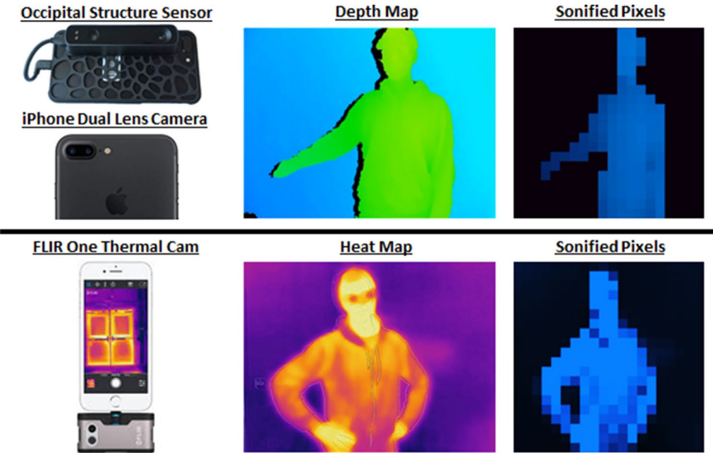
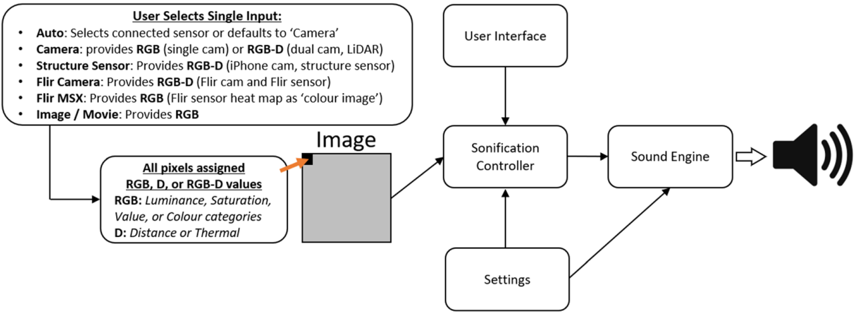
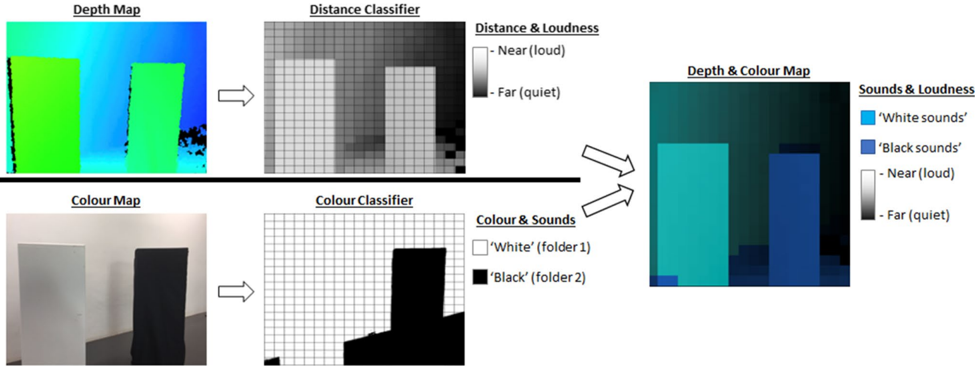
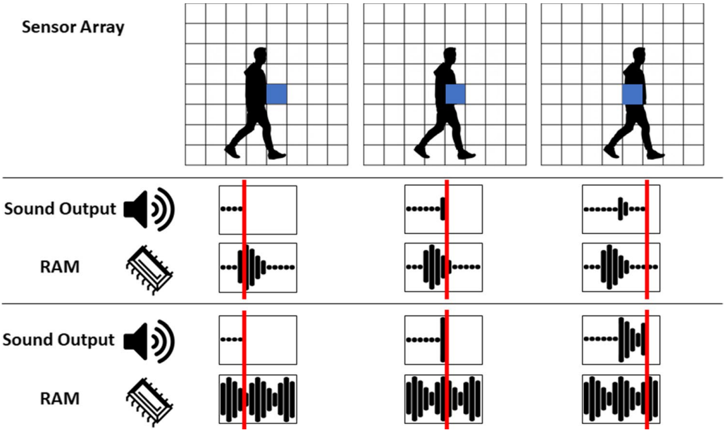
Depth, colour, and thermal images contain practical and actionable information for the blind. Conveying this information through alternative modalities such as audition creates new interaction possibilities for users as well as opportunities to study neuroplasticity. The ‘SoundSight’ App (www.SoundSight.co.uk) is a smartphone platform that allows 3D position, colour, and thermal information to directly control thousands of high-quality sounds in real-time to create completely unique and responsive soundscapes for the user. Users can select the specific sensor input and style of auditory output, which can be based on anything—tones, rainfall, speech, instruments, or even full musical tracks. Appropriate default settings for image-sonification are given by designers, but users still have a fine degree of control over the timing and selection of these sounds. Through utilising smartphone technology with a novel approach to sonification, the SoundSight App provides a cheap, widely accessible, scalable, and flexible sensory tool. In this paper we discuss common problems encountered with assistive sensory tools reaching long-term adoption, how our device seeks to address these problems, its theoretical background, its technical implementation, and finally we showcase both initial user experiences and a range of use case scenarios for scientists, artists, and the blind community.
Overview
The claims and statistics of this paper haven’t been checked yet.
Free: it reads the open-access text and checks the first 5 claims that cite a source we can check. Create a free account to check every claim.
Integrity signals
Registry
Cites
Statistics
Figures

Verification
Claims the paper makes
The claims and statistics of this paper haven’t been checked yet.
Free: it reads the open-access text and checks the first 5 claims that cite a source we can check. Create a free account to check every claim.
Claims other papers make about this one
Each is checked against this paper’s own text: does it say what the citing paper says it does?
The cited source says what the claim attributes to it.
In the citing paper
“Behavioral studies on visual-auditory SSDs investigated the level of task performance to estimate the progress of visual perception in specific goal-related behaviors such as object recognition [2], localization [8], and navigation [9].”
From Deep Learning-Based Optimization of Visual–Auditory Sensory Substitution (2023) · cites this paper as [2]
Self-check
Percentages, sums and reported differences re-computed from the paper’s own numbers.
The self-check needs the paper’s full text.
Citations
Cites
Spatial hearing: the psychophysics of human sound localization
(1997) · Choice Reviews Online · doi:10.5860/choice.35-0346 · Cited by 2,304
An experimental system for auditory image representations
Meijer, P. B. L. (1992) · IEEE Transactions on Biomedical Engineering · doi:10.1109/10.121642 · Cited by 900 · cited 2×
“For instance, the vOICe reduces information presented to the user by disregarding chromatic information and by sonifying a snapshot image, column-by-column over time [13].”
BackgroundInfluence of musical and psychoacoustical training on pitch discrimination
Micheyl, C., Delhommeau, K., Perrot, X., & Oxenham, A. J. (2006) · Hearing Research · doi:10.1016/j.heares.2006.05.004 · Cited by 535 · cited 1×
“In addition, there should be a consideration of the end user’s perceptual discrimination abilities, as these are altered by a wide range of factors including musical-training, blindness, and age [42–44].”
BackgroundShape conveyed by visual-to-auditory sensory substitution activates the lateral occipital complex
Amedi, A., Stern, W. M., Camprodon, J. A., Bermpohl, F., Merabet, L., Rotman, S., Hemond, C., Meijer, P., & Pascual-Leone, A. (2007) · Nature Neuroscience · doi:10.1038/nn1912 · Cited by 451 · cited 1×
“The vOICe’s approach is intuitive for simple visual images and patterns in highly constrained experimental settings [14], and has been used to explore shifts in behaviour, perception, and neural functioning for both sighted and visually-impaired users [15–18].”
The Timbre Toolbox: Extracting audio descriptors from musical signals
Peeters, G., Giordano, B. L., Susini, P., Misdariis, N., & McAdams, S. (2011) · The Journal of the Acoustical Society of America · doi:10.1121/1.3642604 · Cited by 400 · cited 1×
“If audio designers wish to increase the distinctiveness of specific visual attributes, sounds can be chosen for each of these properties that are perceptually dissimilar from one another [50].”
BackgroundFoundations of modern auditory theory
Thornton, A. R. D. (1972) · Journal of Sound and Vibration · doi:10.1016/0022-460x(72)90489-0 · Cited by 373
Frequency difference limens for short-duration tones
Moore, B. C. J. (1973) · The Journal of the Acoustical Society of America · doi:10.1121/1.1913640 · Cited by 369 · cited 1×
“3% in the range of 250-4000 Hz and get increasingly insensitive above 4 kHz [37].”
BackgroundKolarik, A. J., Moore, B. C. J., Zahorik, P., Cirstea, S., & Pardhan, S. (2016) · Attention, Perception, & Psychophysics · doi:10.3758/s13414-015-1015-1 · Cited by 297 · cited 1×
“underestimate them in extrapersonal space, and so reweighing these to suit listener bias’ may result in better user accuracy [46, 49].”
BackgroundAuvray, M., Hanneton, S., & O'Regan, J. K. (2007) · Perception · doi:10.1068/p5631 · Cited by 268 · cited 1×
“In this approach, basic shapes and textures remain intuitive for users [14, 16], but users can have difficulty in counting and tracking multiple simultaneous frequencies in a soundscape [14, 30, 31].”
BackgroundNatural auditory scene statistics shapes human spatial hearing
Parise, C. V., Knorre, K., & Ernst, M. O. (2014) · Proceedings of the National Academy of Sciences · doi:10.1073/pnas.1322705111 · Cited by 256 · cited 1×
“Discrimination of auditory elevation requires the use of broadband sounds that can have their spectral content differentially affected by factors such as listener’s pinnae shape [39], with higher frequencies preserved in sounds above the listener, and dampened in those below [40].”
Background
Research works printed but not linked: 1
- 1. Kristjansson A, Moldoveanu A, Johannesson OI, Balan O, Spag- nol S, Valgeirsdottir VV et al (2016) Designing sensory-substi- tution devices: principles, pitfalls and potential. Restor Neurol Neurosci 34(5):769-787
Cited by
Kilian, J., Neugebauer, A., Scherffig, L., & Wahl, S. (2022) · Sensors · doi:10.3390/s22051859 · Cited by 59
“In recent years, however, papers have been published (most of them using sound as an output) that actually proposed and tested applied 3D systems [97–107].”
BackgroundA Critical Evaluation of A Recent Cybersecurity Attack on iTunes Software Updater
Aljaidi, M., Alsarhan, A., Samara, G., AL-Khassawneh, Y. A., Al-Gumaei, Y. A., Aljawawdeh, H., & Alqammaz, A. (2022) · International Engineering Conference on Electrical, Energy, and Artificial Intelligence (EICEEAI) · doi:10.1109/eiceeai56378.2022.10050464 · Cited by 33
“When the pairing occurs, the computer gains access to the iPhone device, allowing it to extract, and get access to personal private data, and download or remove iPhone applications [27], [28].”
MethodClimb-o-Vision: A Computer Vision Driven Sensory Substitution Device for Rock Climbing
Richardson, M., Petrini, K., & Proulx, M. J. (2022) · CHI Conference Extended Abstracts on Human Factors in Computing Systems (CHI EA) · doi:10.1145/3491101.3519680 · Cited by 22
Maimon, A., Yizhar, O., Buchs, G., Heimler, B., & Amedi, A. (2022) · Neuropsychologia · doi:10.1016/j.neuropsychologia.2022.108305 · Cited by 20
“Such research is paving the way for SSDs that incorporate dimensions of color such as the EyeMusic, and the SoundSight, another up and coming SSD (Hamilton-Fletcher et al., 2021).”
MethodVisual Echolocation Concept for the Colorophone Sensory Substitution Device Using Virtual Reality
Bizoń-Angov, P., Osiński, D., Wierzchoń, M., & Konieczny, J. (2021) · Sensors · doi:10.3390/s21010237 · Cited by 15
“[22] introduced a novel SSD implemented on an iPhone.”
BackgroundDeep Learning-Based Optimization of Visual–Auditory Sensory Substitution
Kim, M., Park, Y., Moon, K., & Jeong, C. Y. (2023) · IEEE Access · doi:10.1109/access.2023.3243641 · Cited by 12
“…could enable visually impaired and partially sighted people to recognize colors or The associate editor coordinating the review of this manuscript and approving it for publication was Felix Albu . objects [1], [2], navigate and avoid obstacles [3], [4], and even identify facial expressions [5].”
BackgroundHamilton-Fletcher, G., Liu, M., Sheng, D., Feng, C., Hudson, T. E., Rizzo, J., & Chan, K. C. (2024) · IEEE Open Journal of Engineering in Medicine and Biology · doi:10.1109/ojemb.2024.3358562 · Cited by 12
“Recent iPhone Apps like ‘LiDAR Sense’, ‘Super Lidar’, Apple’s ‘Magnifier’ and ‘SoundSight’ convey distances for PBLV – for either a single pixel, object or person, or for conveying an entire depth map respectively [7].”
Self-citationA review of sonification solutions in assistive systems for visually impaired people
Lăpușteanu, A., Morar, A., Moldoveanu, A. D. B., Băluțoiu, M.-A., & Moldoveanu, F. (2024) · Disability and Rehabilitation Assistive Technology · doi:10.1080/17483107.2024.2326590 · Cited by 12
Evaluation of Short-Range Depth Sonifications for Visual-to-Auditory Sensory Substitution
Commère, L., & Rouat, J. (2023) · IEEE Transactions on Human-Machine Systems · doi:10.1109/thms.2023.3265972 · Cited by 10
“A new generation of SSVA devices takes advantage of the rapid development of 3D sensors to explicitly sonify depth [9]–[22].”
BackgroundAnalysis and Validation of Cross-Modal Generative Adversarial Network for Sensory Substitution
Kim, M., Park, Y., Moon, K., & Jeong, C. Y. (2021) · International Journal of Environmental Research and Public Health · doi:10.3390/ijerph18126216 · Cited by 8
Łukowska, M., Kałwak, W., Osiński, D., Janik, J., & Wierzchoń, M. (2022) · International Journal of Human-Computer Studies · doi:10.1016/j.ijhcs.2022.102925 · Cited by 11
Kim, M., Park, Y., Moon, K.-D., & Jeong, C. Y. (2024) · IEEE Access · doi:10.1109/access.2024.3419102 · Cited by 7
“For example, using visual-auditory SSDs, those with visual impairments or partial sight can effectively identify objects [1], [2], detect and evade obstacles [3], extract depth cues and estimate distance to object [4], [5], [6], perform navigation task [7], [8], [9] and even recognize facial…”
Ruan, L., Hamilton-Fletcher, G., Beheshti, M., Hudson, T. E., Porfiri, M., & Rizzo, J. (2025) · Disability and Rehabilitation Assistive Technology · doi:10.1080/17483107.2025.2463541 · Cited by 10
“…for end users include the sonification of color, depth maps, and thermal images, as seen in the synaestheatre, Depth-vOice, and soundsight [46,47]. here the contrasts produced by these forms of visuospatial information better align with specific tasks such as object identification, obstacle…”
Self-citationHamilton-Fletcher, G., & Chan, K. C. (2021) · Annual International Conference of the IEEE Engineering in Medicine and Biology Society (EMBC) · doi:10.1109/embc46164.2021.9630296 · Cited by 11
“These ASA-inspired sonifications can be directly implemented into related SSDs like the SoundSight [22], which can sonify silhouettes from depth and thermal images.”
BackgroundSelf-citationDini, S., Ludovico, L. A., & Gisbert, M. J. V. (2024) · Color Research & Application · doi:10.1002/col.22942 · Cited by 7
Butorovа, A. S., & Sergeev, A. (2025) · The European Physical Journal Special Topics · doi:10.1140/epjs/s11734-025-01596-x · Cited by 3
“…Musical Vision [60] Topo-Speech [61, 62] Easy-Access SoundView (EASV) [63] 2 algorithms based on MeloSee [64] Colorophone vs VR [65] SoundSight [66] Real-Time Color Recognition System [67] Short-Range Depth Sonifications [68] TopoLanguageDepth [69] Table 3 Visual-to-auditory sensory…”
ThermalSense: A Sensory Substitution System for Enabling Perception of Thermal Information
Wald, I. Y., Bronstein, Y., Maimon, A., & Amedi, A. (2025) · Proceedings of the ACM on Human-Computer Interaction · doi:10.1145/3733048 · Cited by 4
“For using a diverse color scheme, other algorithms that can be used include: ColEnViSon[8], Colorphone [48], and SoundSight (who also presented a similar implementation)[21].”
Bordeau, C., Scalvini, F., Migniot, C., Dubois, J., & Ambard, M. (2025) · Attention Perception & Psychophysics · doi:10.3758/s13414-025-03065-y · Cited by 3
“…al., 2012; Richardson et al., 2019; Spagnol et al., 2017; Ton et al., 2018), with many SSDs combining both cues (Abboud et al., 2014; Ambard et al., 2015; Bordeau et al., 2023; Hamilton-Fletcher et al., 2016; Hamilton-Fletcher et al., 2022; Hanneton et al., 2010; Meijer, 1992; Stoll et al., 2015).”
Rassia, K. E. K., Liapi, L., & Pezaris, J. S. (2026) · Progress in Retinal and Eye Research · doi:10.1016/j.preteyeres.2026.101494 · Cited by 2
Jin, R., Petoe, M. A., McCarthy, C. D., Serra, J. R., Starkey, S. C., McGinley, J. L., & Ayton, L. N. (2024) · British Journal of Visual Impairment · doi:10.1177/02646196241285098 · Cited by 2
“By further example, SoundSight integrates computer vision and mobile computing to highlight salient objects and deliver information on depth, colour, or thermal profile (Hamilton-Fletcher et al., 2022).”
Marko Nardini, A., Scheller, M., Ramsay, M., Kristiansen, O., & Allen, C. (2024) · Augmented Human Research · doi:10.1007/s41133-024-00075-7 · Cited by 1
Butorovа, A. S., Khomenko, N. M., Kuzmin, S. E., & Sergeev, A. (2025) · Ural Symposium on Biomedical Engineering, Radioelectronics and Information Technology (USBEREIT) · doi:10.1109/usbereit65494.2025.11054174 · Cited by 1
Guo, X.-F., & Wang, S. (2020) · European Journal of Horticultural Science · doi:10.17660/ejhs.2020/85.6.2 · Cited by 1
Video Sonification to Support Visually Impaired People: The VISaVIS Approach
Onofrei, M. G., Castellini, F., Pravadelli, G., Drioli, C., & Setti, F. (2023) · Lecture notes in computer science · doi:10.1007/978-3-031-43153-1_42 · Cited by 2
Sensory Profiles and Technological Deficits: Classification, Relevance, and Gaps
Hutson, J., Hutson, P., & Harper-Nichols, M. (2024) · Springer eBooks · doi:10.1007/978-3-031-58045-1_3 · Cited by 1
Sensory-driven micro-interventions for improved health and wellbeing
Abdalla, Y., Gatti, E., Orlu, M., & Obrist, M. (2025) · Digital Health · doi:10.1177/20552076251408522 · Cited by 1
“Despite this promising work, micro-interventions remain under-researched in healthcare and wellbeing, and do not leverage the potential inherent in sensory interaction and perception.”
Self-citationTowards Affective Sensory Substitution
Cenerini, C. (2024) · International Conference on Affective Computing and Intelligent Interaction Workshops and Demos (ACIIW) · doi:10.1109/aciiw63320.2024.00019
The Visual Echolocation System with an Integrated 3D CameraPreprint
Bizoń-Angov, P., Osiński, D., Wierzchoń, M., & Konieczny, J. (2025) · doi:10.36227/techrxiv.175756652.28904908/v1
ThermalWave: A Wearable Thermal-to-Audio Sensory Substitution Device
Maimon, A., Wald, I. Y., & Lanir, J. (2026) · CHI Conference Extended Abstracts on Human Factors in Computing Systems (CHI EA) · doi:10.1145/3772363.3798941
Metadata
- Authors
- Hamilton-Fletcher, G., Alvarez, J., Obrist, M., & Ward, J.
- Affiliations
- University of Sussex (GB)
- Corresponding author
- Hamilton-Fletcher, Giles
- Venue
- Journal on Multimodal User Interfaces
- Published
- 2021-07-02
- Volume
- 16
- Issue
- 1
- Pages
- 107-123
- ISSN
- 1783-7677 (ISSN-L)
- 1783-8738
- OpenAlex
- W3165483460
- Cited by
- 28
- References
- 58
- Citations by year
- 2026: 2 · 2025: 6 · 2024: 8 · 2023: 3 · 2022: 5 · 2021: 3
- FWCI
- 2.50
- Type
- journal article
- Language
- en
- Open access
- hybrid
- doi.org
- Licence
- cc-by
- creativecommons.org/licenses/by/4.0 (tdm)
- creativecommons.org/licenses/by/4.0 (vor)
- Locations
- Journal on Multimodal User Interfaces (publishedVersion, cc-by)
- Figshare (submittedVersion, cc-by)
- PsyArXiv (OSF Preprints) (submittedVersion)
- PsyArXiv (OSF Preprints) (submittedVersion, cc-by)
- Topics
- Life Sciences › Neuroscience › Cognitive Neuroscience › Tactile and Sensory Interactions
- Health Sciences › Health Professions › Occupational Therapy › Assistive Technology in Communication and Mobility
- Social Sciences › Arts and Humanities › Music › Music Technology and Sound Studies
- Keywords
- sensory substitution, sonification, blind users, mobile application, auditory display, depth perception, color perception, infrared thermography, assistive technology, user adoption, soundscape, neuroplasticity
About these checks
Registry, retraction, Cites and statistics results are computed, not judged, with one exception: a printed reference that no index lists is read once by a model before it counts as a citation error. Claims are extracted by a model and kept only when their quote appears verbatim in the text; each cited source is then checked, with a model’s help, for whether it says what the claim relies on. Those verdicts can be wrong — read the claim’s quote and the cited source before relying on one.
Statistics and arithmetic are recomputed, not judged.
Confidence bands are shown only for fields calibrated on our annotated test set. None is calibrated yet, so no band is shown.
What counts as a claim ›How we measure confidence ›How we check this ›
Are you an author, or do you see a problem with this page? Request a review
Data sources
Bibliographic data: Semantic Scholar, OpenAlex, Crossref.
Contains information from the Semantic Scholar Academic Graph Datasets, made available under the ODC Attribution License (ODC-BY 1.0).
Semantic Scholar’s data is described in: Kinney, R., et al. (2023). The Semantic Scholar Open Data Platform. arXiv:2301.10140.
