

The DOI matches its Crossref record; 27 of the 27 references it cites were found in a registry or an index; 3 of the 11 sources its claims cite were checked for support.
Automating assist identification in football (soccer): a machine learning approach using event and tracking data
Open accessAbstract
Assists—the number of last passes before a goal—have been a predominant metric to evaluate offensive players contribution in association football. This poses two major limitations: first, assist definitions differ across data collection vendors, and second, the focus on passes leading to goals creates a strong dependency on the player taking the shot. We introduce the term potential assists comprising all actions, that prepare a teammate’s shot regardless of conversion. Additionally, we use expert-knowledge to derive an objective definition for potential assists and show that it can be detected with a substantial inter-rater reliability (Fleiss’ $$\kappa =0.63$$ , $$n=5$$ ). Using this definition, we utilize video footage to label 500 assists manually and train multiple supervised machine learning models to classify potential assists based on 29 features derived from positional and event data. We apply our automated detection approach on 105 DFB-Pokal matches and demonstrate a scalable method to enhance automatic event detection and improve the comparability of assist statistics for application in player assessment and scouting.
Overview
AI snapshot
Written from the paper’s full text.
TL;DR
The paper develops and evaluates a machine-learning framework to identify potential football assists from synchronized event and tracking data, using an expert-derived assist definition and hand-labeled DFB-Pokal shot scenarios. Ensemble models (Random Forest and XGBoost) performed best, with a best F1 score of 0.94, though the authors caution that human labeling agreement (Fleiss’ κ = 0.63) and limited annotated matches constrain interpretation.
Key findings
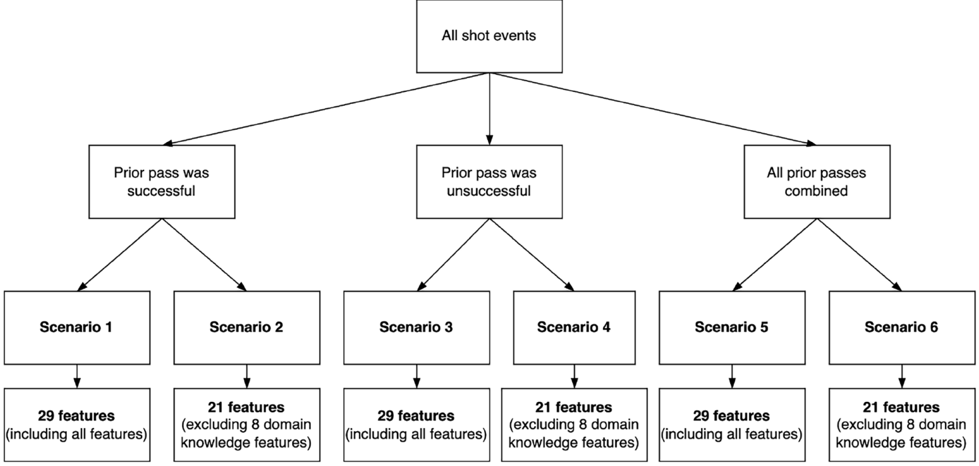
- Across 105 DFB-Pokal matches from 2023/24 and 2024/25 (up to 31 October 2024; 2972 shots and 436 goals), the final dataset contained 422 shots: 344 with prior successful passes and 78 with unsuccessful prior passes. Expert labeling showed Fleiss’ κ = 0.37 on 50 initial scenes, κ = 0.66 on the remaining 450 clips, and total IRR = 0.63 across all scenarios.
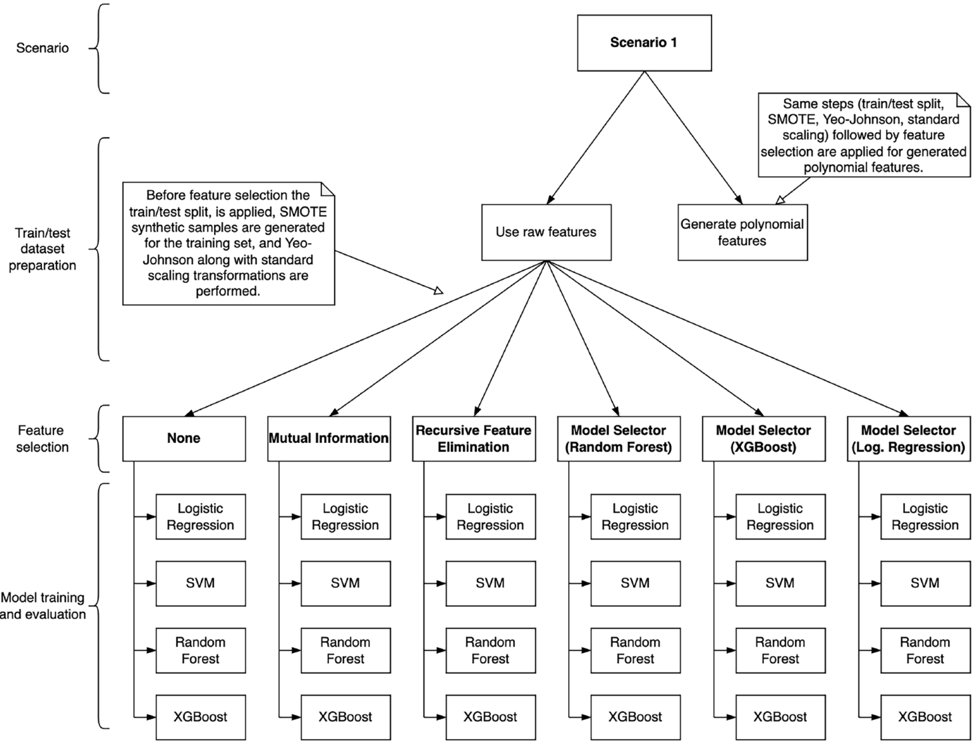
- Four models (LR, SVM, RF, XGB) were trained across six scenarios and 12 feature configurations, resulting in 288 models. Ensemble models (RF and XGB) achieved the highest F1 scores in five out of six scenarios, with a best F1 score of 0.94.
- In Scenario 5, RF achieved F1 = 0.94, precision = 0.92, recall = 0.97, ROC-AUC = 0.94, and log loss = 0.29; XGB achieved F1 = 0.92, precision = 0.89, recall = 0.96, ROC-AUC = 0.97, and log loss = 0.26. In Scenario 6, RF achieved F1 = 0.94, precision = 0.91, recall = 0.98, ROC-AUC = 0.94, and log loss = 0.28; XGB achieved F1 = 0.92, precision = 0.88, recall = 0.96, ROC-AUC = 0.96, and log loss = 0.29.
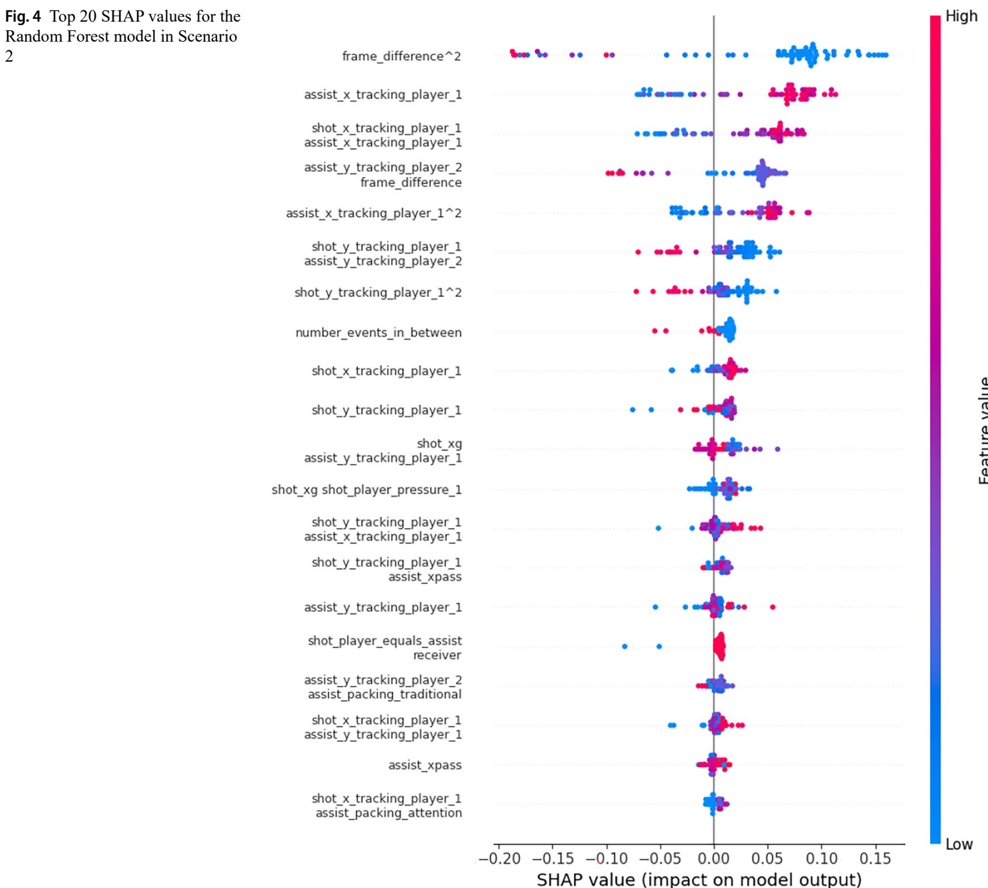
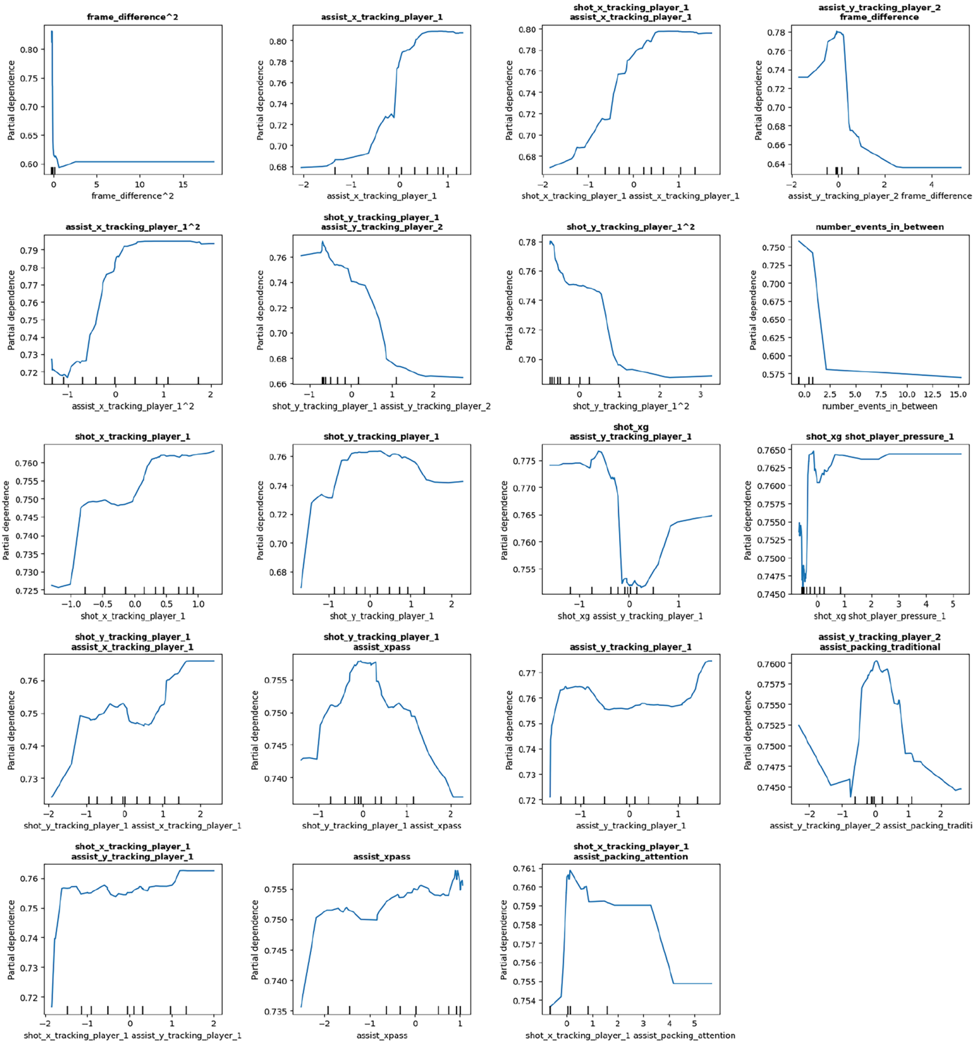
- SHAP analysis found the squared interval between pass and shot (`frame_difference^2`) had the greatest influence, with lower values increasing assist likelihood; proximity to the opponent’s goal (`assist_x_tracking_player_1` and its interaction with `shot_x_tracking_player_1`) positively affected assist probability, while `number_of_events` had a minor positive influence. Domain knowledge features improved Scenarios 3 and 4 but slightly decreased performance in Scenarios 1 and 2 by up to 0.03 points.
Methods
- Design: A nine-step pipeline was followed: defining an assist, selecting 500 shot scenarios, expert labeling, data preprocessing, domain-specific feature engineering, dataset creation, feature selection, model training, and validation. The assist definition was synthesized from literature and vendor definitions in consultation with experts; five domain experts (average 9 years experience, all holding UEFA A-Level or B-Level licenses) labeled the scenarios.
- Data: Synchronized event data from Sportec Solutions and tracking data from Tracab covered 105 DFB-Pokal matches, with 2972 shots and 436 goals. After excluding type 4 shots and edge cases, the final dataset comprised 422 shots.
- Analysis: Four supervised models (LR, SVM, RF, XGB) were trained across six scenarios and 12 feature configurations (288 models). An 80/20 train/test split was used, with Yeo-Johnson transformation, standard scaling, SMOTE for class imbalance, feature selection (Mutual Information, Recursive Feature Elimination, and model selectors), and halving random search with cross-validation. Evaluation used F1, accuracy, precision, recall, ROC-AUC, and log loss; SHAP values and partial dependence plots were used for interpretation.
Limitations
- Stated in the paper: The assist definition lacks concrete boundaries and requires a dedicated study; performance above 0.9 must be interpreted considering the IRR of 0.63; the small sample size raises overfitting and limited generalization concerns; Scenarios 3 and 4 were limited by smaller, biased samples; Scenarios 5 and 6 faced imbalance between successful and unsuccessful passes; missing or noisy data reduced training quality; frame-based time differences assumed defaults for miscellaneous events; the rule-based preselection struggles with complex events such as corner kicks; SMOTE may generate synthetic examples that do not fully reflect real-world football situations; and the model’s application to entirely new scenarios must be observed.
- Evident from the text: The paper’s own results show that unsuccessful passes remained challenging for all models, and domain knowledge features slightly decreased performance in Scenarios 1 and 2 (by up to 0.03 points), indicating context-dependent feature utility.
Model-written summary. Check it against the paper before relying on it.
Integrity signals
Registry
Cites
Statistics
Figures
Verification
Claims the paper makes
29 Own result · 18 Own interpretation · 8 Own method · 7 No basis given · 2 Sources not found · 1 Supported · 1 Supported so far · 1 No full text of the sources · 1 Not checked yet
A result the paper reports from its own data — it cites no other source for it, so there is none to check. The quote shows it is in the paper.
In the paper
“A comparable pattern is seen in the interaction between the assist and shot players' x-positions (shot_x_ tracking_player_1 assist_x_track-ing_player_1).”
§ Automating assist identification in football (soccer): a machine learning approach using event and tracking data > 6 Discussion
plaincorrelational- Asserted: passes — The authors put it forward as true.
- Checkable: passes — It can be checked against evidence.
- Load-bearing: unclear — It is unclear whether the paper’s conclusions depend on it.
- Based: passes — The paper gives a reason why it holds.
A result the paper reports from its own data — it cites no other source for it, so there is none to check. The quote shows it is in the paper.
In the paper
“Yet, unsuccessful passes proved challenging for all models, highlighting the importance of feature engineering and expert knowledge and the differentiation in assist formation.”
§ Automating assist identification in football (soccer): a machine learning approach using event and tracking data > 6 Discussion
plain- Asserted: passes — The authors put it forward as true.
- Checkable: passes — It can be checked against evidence.
- Load-bearing: passes — The paper’s conclusions depend on it.
- Based: passes — The paper gives a reason why it holds.
A result the paper reports from its own data — it cites no other source for it, so there is none to check. The quote shows it is in the paper.
In the paper
“Proximity to the opponent's goal (via assist_x_tracking_player_1 and its interaction with shot_x_tracking_player_1) positively affected assist probability.”
§ Automating assist identification in football (soccer): a machine learning approach using event and tracking data > 4.6 Training and validation
plaindirect- Asserted: passes — The authors put it forward as true.
- Checkable: passes — It can be checked against evidence.
- Load-bearing: unclear — It is unclear whether the paper’s conclusions depend on it.
- Based: passes — The paper gives a reason why it holds.
- Rests on an assumption: The expert consensus labels used as ground truth correctly represent whether an assist occurred.
- Rests on an assumption: The rule-based system correctly identifies the preceding potential assist event.
- Rests on an assumption: The tracking and event data are accurately synchronized.
A result the paper reports from its own data — it cites no other source for it, so there is none to check. The quote shows it is in the paper.
In the paper
“Ensemble methods outperformed simpler models like LR and SVM, obtaining the strongest trade-off between precision and recall for the highest F1 scores.”
§ Automating assist identification in football (soccer): a machine learning approach using event and tracking data > 4.6 Training and validation
plaindirect- Asserted: passes — The authors put it forward as true.
- Checkable: passes — It can be checked against evidence.
- Load-bearing: passes — The paper’s conclusions depend on it.
- Based: passes — The paper gives a reason why it holds.
The paper states this without a source or data behind it here, so there is nothing to check it against. The quote shows it is in the paper.
In the paper
“The models were more conservative in the challenging Scenarios 3 and 4.”
§ Automating assist identification in football (soccer): a machine learning approach using event and tracking data > 4.6 Training and validation
plaincorrelational- Asserted: passes — The authors put it forward as true.
- Checkable: passes — It can be checked against evidence.
- Load-bearing: unclear — It is unclear whether the paper’s conclusions depend on it.
- Based: passes — The paper gives a reason why it holds.
A result the paper reports from its own data — it cites no other source for it, so there is none to check. The quote shows it is in the paper.
In the paper
“In particular, 23 of the top 26 models incorporated feature selection, highlighting its role in improving classification, reducing complexity, and improving interpretability.”
§ Automating assist identification in football (soccer): a machine learning approach using event and tracking data > 4.6 Training and validation
plain- Asserted: passes — The authors put it forward as true.
- Checkable: passes — It can be checked against evidence.
- Load-bearing: unclear — It is unclear whether the paper’s conclusions depend on it.
- Based: passes — The paper gives a reason why it holds.
In the paper
“Although this definition does not establish concrete boundaries for inclusion or exclusion (e.g., point 3), we show that human experts are capable of classifying scenes with substantial agreement (Fleiss' κ = 0.63; see [28]).”
§ Automating assist identification in football (soccer): a machine learning approach using event and tracking data > 4.4.2 Feature engineering
What the sources say
- Not checked — no full text of the sourcecites [28] Landis JR, Koch GG (1977) The measurement of observer agreement for categorical data. Biometrics 33(1):159–174. https://doi.org/10.2307/2529310 source
plain- Asserted: passes — The authors put it forward as true.
- Checkable: passes — It can be checked against evidence.
- Load-bearing: unclear — It is unclear whether the paper’s conclusions depend on it.
- Based: passes — The paper gives a reason why it holds.
A result the paper reports from its own data — it cites no other source for it, so there is none to check. The quote shows it is in the paper.
In the paper
“In contrast, tracking values of the shot player, including x-and y-positions, had ambiguous or non-linear impacts.”
§ Automating assist identification in football (soccer): a machine learning approach using event and tracking data > 4.6 Training and validation
plaincorrelational- Asserted: passes — The authors put it forward as true.
- Checkable: passes — It can be checked against evidence.
- Load-bearing: unclear — It is unclear whether the paper’s conclusions depend on it.
- Based: passes — The paper gives a reason why it holds.
- Rests on an assumption: The expert consensus labels used as ground truth correctly represent whether an assist occurred.
- Rests on an assumption: The rule-based system correctly identifies the preceding potential assist event.
- Rests on an assumption: The tracking and event data are accurately synchronized.
A result the paper reports from its own data — it cites no other source for it, so there is none to check. The quote shows it is in the paper.
In the paper
“This pattern was also observed in Scenarios 1 and 3, where SVM's aggressive recall was offset by increased false positives (precision 0.85).”
§ Automating assist identification in football (soccer): a machine learning approach using event and tracking data > 4.6 Training and validation
plaindirect- Asserted: passes — The authors put it forward as true.
- Checkable: passes — It can be checked against evidence.
- Load-bearing: unclear — It is unclear whether the paper’s conclusions depend on it.
- Based: passes — The paper gives a reason why it holds.
The paper states this without a source or data behind it here, so there is nothing to check it against. The quote shows it is in the paper.
In the paper
“The squared interval (frame_difference ∧ 2), for instance, shows higher influence at very low values (< 1), stabilizing around 2.5.”
§ Automating assist identification in football (soccer): a machine learning approach using event and tracking data > 6 Discussion
plaincorrelational- Asserted: passes — The authors put it forward as true.
- Checkable: passes — It can be checked against evidence.
- Load-bearing: unclear — It is unclear whether the paper’s conclusions depend on it.
- Based: passes — The paper gives a reason why it holds.
A result the paper reports from its own data — it cites no other source for it, so there is none to check. The quote shows it is in the paper.
In the paper
“Features like xG, tracking, and packing values showed no single dominant influence, thus SHAP values reveal sensitivity to feature”
§ Automating assist identification in football (soccer): a machine learning approach using event and tracking data > 4.6 Training and validation
plain- Asserted: passes — The authors put it forward as true.
- Checkable: passes — It can be checked against evidence.
- Load-bearing: unclear — It is unclear whether the paper’s conclusions depend on it.
- Based: passes — The paper gives a reason why it holds.
- Rests on an assumption: The expert consensus labels used as ground truth correctly represent whether an assist occurred.
- Rests on an assumption: The rule-based system correctly identifies the preceding potential assist event.
- Rests on an assumption: The tracking and event data are accurately synchronized.
The paper states this without a source or data behind it here, so there is nothing to check it against. The quote shows it is in the paper.
In the paper
“The x-position of the passing player (assist_x_tracking_player_1) shows a rising impact, with a noticeable increase near the mean before plateauing.”
§ Automating assist identification in football (soccer): a machine learning approach using event and tracking data > 6 Discussion
plaindirect- Asserted: passes — The authors put it forward as true.
- Checkable: passes — It can be checked against evidence.
- Load-bearing: unclear — It is unclear whether the paper’s conclusions depend on it.
- Based: passes — The paper gives a reason why it holds.
A result the paper reports from its own data — it cites no other source for it, so there is none to check. The quote shows it is in the paper.
In the paper
“The performance drops in Scenarios 3 and 4 suggest the need for further data augmentation and additional features.”
§ Automating assist identification in football (soccer): a machine learning approach using event and tracking data > 6 Discussion
hedged- Asserted: passes — The authors put it forward as true.
- Checkable: passes — It can be checked against evidence.
- Load-bearing: passes — The paper’s conclusions depend on it.
- Based: passes — The paper gives a reason why it holds.
A result the paper reports from its own data — it cites no other source for it, so there is none to check. The quote shows it is in the paper.
In the paper
“SVM achieved the highest recall (0.98), permissively capturing nearly all true assists, albeit at the expense of lower precision.”
§ Automating assist identification in football (soccer): a machine learning approach using event and tracking data > 4.6 Training and validation
plain- Asserted: passes — The authors put it forward as true.
- Checkable: passes — It can be checked against evidence.
- Load-bearing: unclear — It is unclear whether the paper’s conclusions depend on it.
- Based: passes — The paper gives a reason why it holds.
A result the paper reports from its own data — it cites no other source for it, so there is none to check. The quote shows it is in the paper.
In the paper
“Additional non-linear effects appear in features such as shot_y_tracking_player_1, shot_xg assist_y_tracking_player_1, and shot_y_tracking_player_1 assist_x_passhighlighting the model's ability to capture complex feature interdependencies.”
§ Automating assist identification in football (soccer): a machine learning approach using event and tracking data > 6 Discussion
hedgedcorrelational- Asserted: passes — The authors put it forward as true.
- Checkable: passes — It can be checked against evidence.
- Load-bearing: unclear — It is unclear whether the paper’s conclusions depend on it.
- Based: passes — The paper gives a reason why it holds.
The paper states this without a source or data behind it here, so there is nothing to check it against. The quote shows it is in the paper.
In the paper
“Performance in Scenarios 3 and 4 may be limited by the smaller sample size, that was also biased due to the selection process explained in Table 1 while Scenarios 5 and 6 faced imbalance in the ratio of successful to unsuccessful passes.”
§ Automating assist identification in football (soccer): a machine learning approach using event and tracking data > 6 Discussion
plain- Asserted: passes — The authors put it forward as true.
- Checkable: passes — It can be checked against evidence.
- Load-bearing: unclear — It is unclear whether the paper’s conclusions depend on it.
- Based: passes — The paper gives a reason why it holds.
A result the paper reports from its own data — it cites no other source for it, so there is none to check. The quote shows it is in the paper.
In the paper
“A similar effect was observed between Scenarios 1 and 2, where removing domain knowledge reduced predictive power.”
§ Automating assist identification in football (soccer): a machine learning approach using event and tracking data > 4.6 Training and validation
plaindirect- Asserted: passes — The authors put it forward as true.
- Checkable: passes — It can be checked against evidence.
- Load-bearing: unclear — It is unclear whether the paper’s conclusions depend on it.
- Based: passes — The paper gives a reason why it holds.
A conclusion the paper draws from its own results — it cites no other source for it, so there is none to check. The quote shows it is in the paper.
In the paper
“Additional non-linear effects appear in features such as shot_y_tracking_player_1, shot_xg assist_y_tracking_player_1, and shot_y_tracking_player_1 assist_x_passhighlighting the model's ability to capture complex feature interdependencies.”
§ Automating assist identification in football (soccer): a machine learning approach using event and tracking data > 6 Discussion
hedged- Asserted: passes — The authors put it forward as true.
- Checkable: passes — It can be checked against evidence.
- Load-bearing: unclear — It is unclear whether the paper’s conclusions depend on it.
- Based: passes — The paper gives a reason why it holds.
None of the sources cited for this claim could be matched to a paper in Crossref, so there is nothing to check it against.
In the paper
“The literature, thus, reveals a gap in an established and objective definition for (potential) assists as well as the automatic detection of such.”
§ Automating assist identification in football (soccer): a machine learning approach using event and tracking data > 1 Introduction
What the sources say
- Not matchedcites [8][9][10][11][12][13][14][15][16][17][18]
Couldn’t be matched to a paper in Crossref, so it can’t be checked.
- Not matchedcites [19][20][21][22][23][24][25]
Couldn’t be matched to a paper in Crossref, so it can’t be checked.
plain- Asserted: passes — The authors put it forward as true.
- Checkable: passes — It can be checked against evidence.
- Load-bearing: passes — The paper’s conclusions depend on it.
- Based: passes — The paper gives a reason why it holds.
- Not matched
A conclusion the paper draws from its own results — it cites no other source for it, so there is none to check. The quote shows it is in the paper.
In the paper
“Incorporating domain knowledge, targeted feature engineering and selection, as well as hyperparameter tuning proved essential for achieving robust performance.”
§ Automating assist identification in football (soccer): a machine learning approach using event and tracking data > 7 Conclusion
plaindirect- Asserted: passes — The authors put it forward as true.
- Checkable: passes — It can be checked against evidence.
- Load-bearing: passes — The paper’s conclusions depend on it.
- Based: passes — The paper gives a reason why it holds.
None of the sources cited for this claim could be matched to a paper in Crossref, so there is nothing to check it against.
In the paper
“Assist identification remains unaddressed by automated event detection and pass evaluation studies, showing that the literature review reveals a gap of potential assist identification in prior research.”
§ Automating assist identification in football (soccer): a machine learning approach using event and tracking data > 2 Related work
What the sources say
- Not matchedcites [8][9][10][11][12][13][14][15][16][17][18]
Couldn’t be matched to a paper in Crossref, so it can’t be checked.
- Not matchedcites [19][20][21][22][23][24][25]
Couldn’t be matched to a paper in Crossref, so it can’t be checked.
plain- Asserted: passes — The authors put it forward as true.
- Checkable: passes — It can be checked against evidence.
- Load-bearing: passes — The paper’s conclusions depend on it.
- Based: passes — The paper gives a reason why it holds.
- Not matched
A conclusion the paper draws from its own results — it cites no other source for it, so there is none to check. The quote shows it is in the paper.
In the paper
“The presented findings demonstrate successful classification of potential assists using validated assist labels across different scenarios.”
§ Automating assist identification in football (soccer): a machine learning approach using event and tracking data > 6 Discussion
boosted- Asserted: passes — The authors put it forward as true.
- Checkable: passes — It can be checked against evidence.
- Load-bearing: passes — The paper’s conclusions depend on it.
- Based: passes — The paper gives a reason why it holds.
- Rests on an assumption: The human-labeled assist labels are a valid ground truth for training and evaluating the models.
A conclusion the paper draws from its own results — it cites no other source for it, so there is none to check. The quote shows it is in the paper.
In the paper
“To our knowledge, this is the first study focused on the automatic detection of assists, making it a novel contribution to the field.”
§ Automating assist identification in football (soccer): a machine learning approach using event and tracking data > 6 Discussion
hedged- Asserted: passes — The authors put it forward as true.
- Checkable: passes — It can be checked against evidence.
- Load-bearing: passes — The paper’s conclusions depend on it.
- Based: unclear — It is unclear why the paper says it holds.
A conclusion the paper draws from its own results — it cites no other source for it, so there is none to check. The quote shows it is in the paper.
In the paper
“Although the model closely approximates the labeled data, the IRR indicates the inherent difficulty and complexity of the classification task also for humans.”
§ Automating assist identification in football (soccer): a machine learning approach using event and tracking data > 6 Discussion
hedgeddirect- Asserted: passes — The authors put it forward as true.
- Checkable: passes — It can be checked against evidence.
- Load-bearing: passes — The paper’s conclusions depend on it.
- Based: passes — The paper gives a reason why it holds.
- It may state two separate claims as one. 37
- Probably not a substantial claim. 16
Every source the paper cites for this claim was checked and supports it.
In the paper
“For example, [37] analyze player involvement in chance creation but do not specifically identify potential assists.”
§ Automating assist identification in football (soccer): a machine learning approach using event and tracking data > 6 Discussion
What the sources say
- Supportedcites [37] Bransen L, Van Haaren J (2019) Measuring football players’ on-the-ball contributions from passes during games. Machine learning and data mining for sports analytics. Springer, Berlin, pp 3–15. https://doi.org/10.1007/978-3-030-17274-9_1 source
The Approach (p. 2) measures each pass by the goals expected to arise from it, supporting the description of analyzing players’ contributions to chance creation. The Conclusion (p. 12) describes pass values based on a possession sequence’s likelihood of yielding a goal; the paper does not specifically identify potential assists. (LLM, conf=0.88)
plain- Asserted: passes — The authors put it forward as true.
- Checkable: passes — It can be checked against evidence.
- Load-bearing: passes — The paper’s conclusions depend on it.
- Based: passes — The paper gives a reason why it holds.
It may state two separate claims as one.
- Supported
The sources with a verdict support this claim; the rest weren’t checked yet, have no full text we could read, or their verdicts aren’t rated yet.
In the paper
“Recent studies on pass quality assess factors like complexity, risk-reward, or expected impact on scoring [19, 20, 37].”
§ Automating assist identification in football (soccer): a machine learning approach using event and tracking data > 6 Discussion
What the sources say
- Supportedcites [19] Anzer G, Bauer P (2022) Expected passes. Data Min Knowl Disc 36(1):1–23. https://doi.org/10.1007/s10618-021-00810-3 source
The Introduction says that evaluating pass decisions requires considering both risk and reward, and describes pass difficulty as a factor neglected by simple completion rates. It also reports that studies of pass reward typically measure how much a successful pass would increase the chance of scoring. (LLM, conf=0.92)
- Not checked — no full text of the sourcecites [20] Power P, Ruiz H, Wei X et al (2017) Not all passes are created equal: Objectively measuring the risk and reward of passes in soccer from tracking data. In: Proceedings of the 23rd ACM SIGKDD international conference on knowledge discovery and data mining. Association for computing machinery, Halifax NS Canada, pp.1605–1613, https://doi.org/10.1145/3097983.3098051 source
- Supportedcites [37] Bransen L, Van Haaren J (2019) Measuring football players’ on-the-ball contributions from passes during games. Machine learning and data mining for sports analytics. Springer, Berlin, pp 3–15. https://doi.org/10.1007/978-3-030-17274-9_1 source
The introduction (p. 2) says this study measures the expected impact of each pass on the scoreline. That supports the expected-scoring-impact example in the collectively cited sentence; the Related work section (p. 12) also describes research measuring pass risk and reward. (LLM, conf=0.92)
plain- Asserted: passes — The authors put it forward as true.
- Checkable: passes — It can be checked against evidence.
- Load-bearing: fails — The paper’s conclusions may not depend on it.
- Based: passes — The paper gives a reason why it holds.
Probably not a substantial claim. The paper’s conclusions may not depend on it.
- Supported
The paper states this without a source or data behind it here, so there is nothing to check it against. The quote shows it is in the paper.
In the paper
“The rule-based approach works well for patterns (e.g.successful pass to shooter) but struggles with more complex events, such as those involving multiple actions (e.g.corner kicks).”
§ Automating assist identification in football (soccer): a machine learning approach using event and tracking data > 6 Discussion
plaindirect- Asserted: passes — The authors put it forward as true.
- Checkable: passes — It can be checked against evidence.
- Load-bearing: passes — The paper’s conclusions depend on it.
- Based: passes — The paper gives a reason why it holds.
It may state two separate claims as one.
A result the paper reports from its own data — it cites no other source for it, so there is none to check. The quote shows it is in the paper.
In the paper
“The number_of_ events feature showed a minor positive influence, indicating fewer intervening actions increase pass significance.”
§ Automating assist identification in football (soccer): a machine learning approach using event and tracking data > 4.6 Training and validation
hedgeddirect- Asserted: passes — The authors put it forward as true.
- Checkable: passes — It can be checked against evidence.
- Load-bearing: unclear — It is unclear whether the paper’s conclusions depend on it.
- Based: passes — The paper gives a reason why it holds.
It may state two separate claims as one.
- Rests on an assumption: The expert consensus labels used as ground truth correctly represent whether an assist occurred.
- Rests on an assumption: The rule-based system correctly identifies the preceding potential assist event.
- Rests on an assumption: The tracking and event data are accurately synchronized.
A result the paper reports from its own data — it cites no other source for it, so there is none to check. The quote shows it is in the paper.
In the paper
“Differences between the two ensembles were marginal, while LR and SVM generally had higher log loss and lower precision.”
§ Automating assist identification in football (soccer): a machine learning approach using event and tracking data > 4.6 Training and validation
plain- Asserted: passes — The authors put it forward as true.
- Checkable: passes — It can be checked against evidence.
- Load-bearing: unclear — It is unclear whether the paper’s conclusions depend on it.
- Based: passes — The paper gives a reason why it holds.
It may state two separate claims as one.
- Rests on an assumption: The expert consensus labels used as ground truth correctly represent whether an assist occurred.
- Rests on an assumption: The rule-based system correctly identifies the preceding potential assist event.
- Rests on an assumption: The tracking and event data are accurately synchronized.
A result the paper reports from its own data — it cites no other source for it, so there is none to check. The quote shows it is in the paper.
In the paper
“The squared interval between pass and shot (frame_ difference ∧ 2) had the greatest influence, with lower values increasing the likelihood of an assist.”
§ Automating assist identification in football (soccer): a machine learning approach using event and tracking data > 4.6 Training and validation
plaindirect- Asserted: passes — The authors put it forward as true.
- Checkable: passes — It can be checked against evidence.
- Load-bearing: unclear — It is unclear whether the paper’s conclusions depend on it.
- Based: passes — The paper gives a reason why it holds.
It may state two separate claims as one.
- Rests on an assumption: The expert consensus labels used as ground truth correctly represent whether an assist occurred.
- Rests on an assumption: The rule-based system correctly identifies the preceding potential assist event.
- Rests on an assumption: The tracking and event data are accurately synchronized.
The paper states this without a source or data behind it here, so there is nothing to check it against. The quote shows it is in the paper.
In the paper
“The final dataset comprised 422 randomly selected shot scenarios.”
§ Automating assist identification in football (soccer): a machine learning approach using event and tracking data > 6 Discussion
plain- Asserted: passes — The authors put it forward as true.
- Checkable: passes — It can be checked against evidence.
- Load-bearing: passes — The paper’s conclusions depend on it.
- Based: passes — The paper gives a reason why it holds.
Probably not a substantial claim.
A result the paper reports from its own data — it cites no other source for it, so there is none to check. The quote shows it is in the paper.
In the paper
“The F1 score was only marginally affected, and model rankings remained largely unchanged.”
§ Automating assist identification in football (soccer): a machine learning approach using event and tracking data > 4.6 Training and validation
plain- Asserted: passes — The authors put it forward as true.
- Checkable: passes — It can be checked against evidence.
- Load-bearing: unclear — It is unclear whether the paper’s conclusions depend on it.
- Based: passes — The paper gives a reason why it holds.
It may state two separate claims as one.
A result the paper reports from its own data — it cites no other source for it, so there is none to check. The quote shows it is in the paper.
In the paper
“As in Scenario 5, RF achieved the highest F1 score (0.94), with a precision of 0.91 and a recall of 0.98.”
§ Automating assist identification in football (soccer): a machine learning approach using event and tracking data > 4.6 Training and validation
plain- Asserted: passes — The authors put it forward as true.
- Checkable: passes — It can be checked against evidence.
- Load-bearing: unclear — It is unclear whether the paper’s conclusions depend on it.
- Based: passes — The paper gives a reason why it holds.
It may state two separate claims as one.
A result the paper reports from its own data — it cites no other source for it, so there is none to check. The quote shows it is in the paper.
In the paper
“The results showed that ensemble models, particularly Random Forest and XGBoost, consistently outperformed simpler baselines and achieved reliable classification of potential assists across the defined scenarios (best F1 = 0.94).”
§ Automating assist identification in football (soccer): a machine learning approach using event and tracking data > 7 Conclusion
plaindirect- Asserted: passes — The authors put it forward as true.
- Checkable: passes — It can be checked against evidence.
- Load-bearing: passes — The paper’s conclusions depend on it.
- Based: passes — The paper gives a reason why it holds.
It may state two separate claims as one.
A result the paper reports from its own data — it cites no other source for it, so there is none to check. The quote shows it is in the paper.
In the paper
“In Phase 4: Full Expert Labeling, the remaining 450 clips were labeled using the revised criteria, resulting in a substantial IRR of 0.66 (total IRR for all scenarios = 0.63).”
§ Automating assist identification in football (soccer): a machine learning approach using event and tracking data > 4.1 Assist definition
plaindirect- Asserted: passes — The authors put it forward as true.
- Checkable: passes — It can be checked against evidence.
- Load-bearing: unclear — It is unclear whether the paper’s conclusions depend on it.
- Based: passes — The paper gives a reason why it holds.
It may state two separate claims as one.
A result the paper reports from its own data — it cites no other source for it, so there is none to check. The quote shows it is in the paper.
In the paper
“Excluding domain knowledge features as shown in Table 5 reduced SVM (e.g.F1 score from 0.91 to 0.88, precision from 0.85 to 0.82) and XGB (e.g.L log loss from 0.26 to 0.29) performance.”
§ Automating assist identification in football (soccer): a machine learning approach using event and tracking data > 4.6 Training and validation
plaindirect- Asserted: passes — The authors put it forward as true.
- Checkable: passes — It can be checked against evidence.
- Load-bearing: unclear — It is unclear whether the paper’s conclusions depend on it.
- Based: passes — The paper gives a reason why it holds.
It may state two separate claims as one.
A result the paper reports from its own data — it cites no other source for it, so there is none to check. The quote shows it is in the paper.
In the paper
“Overall, performance was stable with similar F1 scores across scenarios, with a suitable model identified in each.”
§ Automating assist identification in football (soccer): a machine learning approach using event and tracking data > 4.6 Training and validation
plain- Asserted: passes — The authors put it forward as true.
- Checkable: passes — It can be checked against evidence.
- Load-bearing: passes — The paper’s conclusions depend on it.
- Based: passes — The paper gives a reason why it holds.
It may state two separate claims as one.
- Rests on an assumption: The expert consensus labels used as ground truth correctly represent whether an assist occurred.
- Rests on an assumption: The rule-based system correctly identifies the preceding potential assist event.
- Rests on an assumption: The tracking and event data are accurately synchronized.
A result the paper reports from its own data — it cites no other source for it, so there is none to check. The quote shows it is in the paper.
In the paper
“Domain knowledge features slightly decreased performance in Scenarios 1 and 2 (metrics have deteriorated by up to 0.03 points) but improved results in Scenarios 3 and 4, emphasizing their value in more complex cases.”
§ Automating assist identification in football (soccer): a machine learning approach using event and tracking data > 4.6 Training and validation
plaindirect- Asserted: passes — The authors put it forward as true.
- Checkable: passes — It can be checked against evidence.
- Load-bearing: passes — The paper’s conclusions depend on it.
- Based: passes — The paper gives a reason why it holds.
It may state two separate claims as one.
A result the paper reports from its own data — it cites no other source for it, so there is none to check. The quote shows it is in the paper.
In the paper
“However, some low values corresponded to negative SHAP values, showing no strictly linear relationship.”
§ Automating assist identification in football (soccer): a machine learning approach using event and tracking data > 4.6 Training and validation
plain- Asserted: passes — The authors put it forward as true.
- Checkable: passes — It can be checked against evidence.
- Load-bearing: unclear — It is unclear whether the paper’s conclusions depend on it.
- Based: passes — The paper gives a reason why it holds.
It may state two separate claims as one.
- Rests on an assumption: The expert consensus labels used as ground truth correctly represent whether an assist occurred.
- Rests on an assumption: The rule-based system correctly identifies the preceding potential assist event.
- Rests on an assumption: The tracking and event data are accurately synchronized.
A result the paper reports from its own data — it cites no other source for it, so there is none to check. The quote shows it is in the paper.
In the paper
“highest F1 score (0.94) and precision (0.92), indicating few false positives.”
§ Automating assist identification in football (soccer): a machine learning approach using event and tracking data > 4.6 Training and validation
plain- Asserted: passes — The authors put it forward as true.
- Checkable: passes — It can be checked against evidence.
- Load-bearing: unclear — It is unclear whether the paper’s conclusions depend on it.
- Based: passes — The paper gives a reason why it holds.
It may state two separate claims as one.
A result the paper reports from its own data — it cites no other source for it, so there is none to check. The quote shows it is in the paper.
In the paper
“In Scenario 6, the RF model achieved an F1 score of 0.94, balancing precision and recall, while it scored 0.93 and 0.89 in Scenarios 1 and 3, highlighting the benefits of separating pass outcomes.”
§ Automating assist identification in football (soccer): a machine learning approach using event and tracking data > 6 Discussion
plain- Asserted: passes — The authors put it forward as true.
- Checkable: passes — It can be checked against evidence.
- Load-bearing: passes — The paper’s conclusions depend on it.
- Based: passes — The paper gives a reason why it holds.
It may state two separate claims as one.
A result the paper reports from its own data — it cites no other source for it, so there is none to check. The quote shows it is in the paper.
In the paper
“XGB (F1 score of 0.92, precision of 0.89), that showed the highest AUC (0.97) and lowest Log Loss (0.26) implying the best distinction and calibration.”
§ Automating assist identification in football (soccer): a machine learning approach using event and tracking data > 4.6 Training and validation
plain- Asserted: passes — The authors put it forward as true.
- Checkable: passes — It can be checked against evidence.
- Load-bearing: unclear — It is unclear whether the paper’s conclusions depend on it.
- Based: passes — The paper gives a reason why it holds.
It may state two separate claims as one.
A result the paper reports from its own data — it cites no other source for it, so there is none to check. The quote shows it is in the paper.
In the paper
“After comparing different assist-definitions from literature and data-providers, we suggest an objective definition for assists.The objectivity is backed by an interrater-reliability study using video footage.”
§ Automating assist identification in football (soccer): a machine learning approach using event and tracking data > 1 Introduction
plaindirect- Asserted: passes — The authors put it forward as true.
- Checkable: passes — It can be checked against evidence.
- Load-bearing: passes — The paper’s conclusions depend on it.
- Based: passes — The paper gives a reason why it holds.
Probably not a substantial claim. It may state two separate claims as one.
A result the paper reports from its own data — it cites no other source for it, so there is none to check. The quote shows it is in the paper.
In the paper
“Ensemble models (RF and XGB) achieved the highest F1 scores in five out of six scenarios and showed the lowest log loss, indicating strong predictive confidence.”
§ Automating assist identification in football (soccer): a machine learning approach using event and tracking data > 4.6 Training and validation
plaincorrelational- Asserted: passes — The authors put it forward as true.
- Checkable: passes — It can be checked against evidence.
- Load-bearing: passes — The paper’s conclusions depend on it.
- Based: passes — The paper gives a reason why it holds.
It may state two separate claims as one.
- Rests on an assumption: The expert consensus labels used as ground truth correctly represent whether an assist occurred.
- Rests on an assumption: The rule-based system correctly identifies the preceding potential assist event.
- Rests on an assumption: The tracking and event data are accurately synchronized.
A result the paper reports from its own data — it cites no other source for it, so there is none to check. The quote shows it is in the paper.
In the paper
“Ensemble methods like RF and XGB outperformed simpler models (LR and SVM) in capturing complex assist patterns, underlined by RF excelling in five out of six scenarios, particularly in Scenarios 1, 2, 5, and 6.”
§ Automating assist identification in football (soccer): a machine learning approach using event and tracking data > 6 Discussion
plaindirect- Asserted: passes — The authors put it forward as true.
- Checkable: passes — It can be checked against evidence.
- Load-bearing: passes — The paper’s conclusions depend on it.
- Based: passes — The paper gives a reason why it holds.
It may state two separate claims as one.
A conclusion the paper draws from its own results — it cites no other source for it, so there is none to check. The quote shows it is in the paper.
In the paper
“This work combines automatic event detection with pass quality evaluation to identify assist events, including successful and failed passes, and other ball actions.”
§ Automating assist identification in football (soccer): a machine learning approach using event and tracking data > 6 Discussion
plaindirect- Asserted: passes — The authors put it forward as true.
- Checkable: passes — It can be checked against evidence.
- Load-bearing: passes — The paper’s conclusions depend on it.
- Based: passes — The paper gives a reason why it holds.
It may state two separate claims as one.
A conclusion the paper draws from its own results — it cites no other source for it, so there is none to check. The quote shows it is in the paper.
In the paper
“Given the relatively small sample size, the high F1 scores may indicate that the features are both informative and wellengineered.”
§ Automating assist identification in football (soccer): a machine learning approach using event and tracking data > 6 Discussion
hedgedconditional- Asserted: passes — The authors put it forward as true.
- Checkable: passes — It can be checked against evidence.
- Load-bearing: fails — The paper’s conclusions may not depend on it.
- Based: passes — The paper gives a reason why it holds.
Probably not a substantial claim. The paper’s conclusions may not depend on it.
A conclusion the paper draws from its own results — it cites no other source for it, so there is none to check. The quote shows it is in the paper.
In the paper
“To address class imbalance in the training set, SMOTE was applied, which introduces the potential limitation of generating synthetic examples that may not fully reflect real-world football situations.”
§ Automating assist identification in football (soccer): a machine learning approach using event and tracking data > 6 Discussion
hedgedconditional- Asserted: passes — The authors put it forward as true.
- Checkable: passes — It can be checked against evidence.
- Load-bearing: fails — The paper’s conclusions may not depend on it.
- Based: passes — The paper gives a reason why it holds.
Probably not a substantial claim. The paper’s conclusions may not depend on it.
What the paper did — it cites no source for this, so there is none to check. The quote shows it is in the paper.
In the paper
“However, the approach remains constrained by the quality and consistency of human-labeled training data (Fleiss' κ = 0.63) and by the limited number of annotated matches.”
§ Automating assist identification in football (soccer): a machine learning approach using event and tracking data > 7 Conclusion
plaindirect- Asserted: passes — The authors put it forward as true.
- Checkable: passes — It can be checked against evidence.
- Load-bearing: passes — The paper’s conclusions depend on it.
- Based: passes — The paper gives a reason why it holds.
It may state two separate claims as one.
What the paper did — it cites no source for this, so there is none to check. The quote shows it is in the paper.
In the paper
“Time differences between the assist and shot were calculated using frames, though defaults were assumed for miscellaneous events, potentially impairing accuracy.”
§ Automating assist identification in football (soccer): a machine learning approach using event and tracking data > 6 Discussion
hedgedconditional- Asserted: passes — The authors put it forward as true.
- Checkable: passes — It can be checked against evidence.
- Load-bearing: fails — The paper’s conclusions may not depend on it.
- Based: passes — The paper gives a reason why it holds.
Probably not a substantial claim. The paper’s conclusions may not depend on it. It may state two separate claims as one.
What the paper did — it cites no source for this, so there is none to check. The quote shows it is in the paper.
In the paper
“To address class imbalance in the training set, SMOTE was applied, which introduces the potential limitation of generating synthetic examples that may not fully reflect real-world football situations.”
§ Automating assist identification in football (soccer): a machine learning approach using event and tracking data > 6 Discussion
plaindirect- Asserted: passes — The authors put it forward as true.
- Checkable: passes — It can be checked against evidence.
- Load-bearing: fails — The paper’s conclusions may not depend on it.
- Based: passes — The paper gives a reason why it holds.
Probably not a substantial claim. The paper’s conclusions may not depend on it.
A conclusion the paper draws from its own results — it cites no other source for it, so there is none to check. The quote shows it is in the paper.
In the paper
“However, this also raises the risk of overfitting, and the model's ability to generalize may be limited”
§ Automating assist identification in football (soccer): a machine learning approach using event and tracking data > 6 Discussion
hedgedconditional- Asserted: passes — The authors put it forward as true.
- Checkable: passes — It can be checked against evidence.
- Load-bearing: unclear — It is unclear whether the paper’s conclusions depend on it.
- Based: passes — The paper gives a reason why it holds.
It may state two separate claims as one.
What the paper did — it cites no source for this, so there is none to check. The quote shows it is in the paper.
In the paper
“Nevertheless, performance above 0.9 must be interpreted considering the IRR of 0.63.”
§ Automating assist identification in football (soccer): a machine learning approach using event and tracking data > 6 Discussion
plain- Asserted: passes — The authors put it forward as true.
- Checkable: passes — It can be checked against evidence.
- Load-bearing: passes — The paper’s conclusions depend on it.
- Based: passes — The paper gives a reason why it holds.
Probably not a substantial claim.
A conclusion the paper draws from its own results — it cites no other source for it, so there is none to check. The quote shows it is in the paper.
In the paper
“This research lays a solid foundation and shows, that automatic identification of potential assists is possible, however, further validation and refinement of the model are required.”
§ Automating assist identification in football (soccer): a machine learning approach using event and tracking data > 6 Discussion
hedged- Asserted: passes — The authors put it forward as true.
- Checkable: unclear — It is unclear whether it could be checked against evidence.
- Load-bearing: passes — The paper’s conclusions depend on it.
- Based: passes — The paper gives a reason why it holds.
It may state two separate claims as one.
A conclusion the paper draws from its own results — it cites no other source for it, so there is none to check. The quote shows it is in the paper.
In the paper
“Missing or noisy data reduced training quality but could improve generalizability.”
§ Automating assist identification in football (soccer): a machine learning approach using event and tracking data > 6 Discussion
hedgeddirect- Asserted: passes — The authors put it forward as true.
- Checkable: passes — It can be checked against evidence.
- Load-bearing: fails — The paper’s conclusions may not depend on it.
- Based: fails — The paper may give no reason why it holds.
Probably not a substantial claim. The paper’s conclusions may not depend on it. The paper may give no reason why it holds. It may state two separate claims as one.
What the paper did — it cites no source for this, so there is none to check. The quote shows it is in the paper.
In the paper
“Event data categorized four types (pass, shot, miscellaneous, referee), but differing event types from various providers might complicate assist mapping.”
§ Automating assist identification in football (soccer): a machine learning approach using event and tracking data > 6 Discussion
hedgedconditional- Asserted: passes — The authors put it forward as true.
- Checkable: passes — It can be checked against evidence.
- Load-bearing: fails — The paper’s conclusions may not depend on it.
- Based: passes — The paper gives a reason why it holds.
Probably not a substantial claim. The paper’s conclusions may not depend on it. It may state two separate claims as one.
What the paper did — it cites no source for this, so there is none to check. The quote shows it is in the paper.
In the paper
“However, this risk is mitigated by the use of abstract, engineered features and validation on authentic examples.”
§ Automating assist identification in football (soccer): a machine learning approach using event and tracking data > 6 Discussion
plaindirect- Asserted: passes — The authors put it forward as true.
- Checkable: passes — It can be checked against evidence.
- Load-bearing: fails — The paper’s conclusions may not depend on it.
- Based: fails — The paper may give no reason why it holds.
Probably not a substantial claim. The paper’s conclusions may not depend on it. The paper may give no reason why it holds.
A conclusion the paper draws from its own results — it cites no other source for it, so there is none to check. The quote shows it is in the paper.
In the paper
“The work contributes to the broader field of automatic event detection and supports data-driven player performance evaluation.”
§ Automating assist identification in football (soccer): a machine learning approach using event and tracking data > 7 Conclusion
plain- Asserted: passes — The authors put it forward as true.
- Checkable: fails — It may be too vague to check against evidence.
- Load-bearing: fails — The paper’s conclusions may not depend on it.
- Based: passes — The paper gives a reason why it holds.
Probably not a substantial claim. It may be too vague to check against evidence. The paper’s conclusions may not depend on it. It may state two separate claims as one.
None of the sources cited for this claim have been checked yet.
In the paper
“Others have automatically identified basic events like passes or ball touches [11,14], but typically focus on simple events without addressing more complex concepts like assists.”
§ Automating assist identification in football (soccer): a machine learning approach using event and tracking data > 6 Discussion
What the sources say
- Not matchedcites [11] Richly K, Moritz F, Schwarz C (2017) Utilizing artificial neural networks to detect compound events in spatio-temporal soccer data. In: Proceedings of the 2017 SIGKDD workshop MiLeTS, pp 13–17
Couldn’t be matched to a paper in Crossref, so it can’t be checked.
- Not checked — no full text of the sourcecites [14] Richly K, Bothe M, Rohloff T et al (2016) Recognizing compound events in spatio-temporal football data. In: IoTBD 2016—international conference on internet of things and big data, pp 27–35, https://doi.org/10.5220/0005877600270035 source
plain- Asserted: passes — The authors put it forward as true.
- Checkable: passes — It can be checked against evidence.
- Load-bearing: passes — The paper’s conclusions depend on it.
- Based: passes — The paper gives a reason why it holds.
It may state two separate claims as one.
- Not matched
A conclusion the paper draws from its own results — it cites no other source for it, so there is none to check. The quote shows it is in the paper.
In the paper
“Although unsuccessful passes posed challenges for all models, the Random Forest model adapted best, demonstrating effectiveness across event scenarios.”
§ Automating assist identification in football (soccer): a machine learning approach using event and tracking data > 4.6 Training and validation
boostedcorrelational- Asserted: passes — The authors put it forward as true.
- Checkable: passes — It can be checked against evidence.
- Load-bearing: unclear — It is unclear whether the paper’s conclusions depend on it.
- Based: passes — The paper gives a reason why it holds.
It may state two separate claims as one.
A conclusion the paper draws from its own results — it cites no other source for it, so there is none to check. The quote shows it is in the paper.
In the paper
“In particular, 23 of the top 26 models incorporated feature selection, highlighting its role in improving classification, reducing complexity, and improving interpretability.”
§ Automating assist identification in football (soccer): a machine learning approach using event and tracking data > 4.6 Training and validation
plaindirect- Asserted: passes — The authors put it forward as true.
- Checkable: passes — It can be checked against evidence.
- Load-bearing: passes — The paper’s conclusions depend on it.
- Based: passes — The paper gives a reason why it holds.
It may state two separate claims as one.
A conclusion the paper draws from its own results — it cites no other source for it, so there is none to check. The quote shows it is in the paper.
In the paper
“SHAP values provided interpretability, revealing key features for assist detection, while Partial Dependency Plots highlighted non-trivial patterns for detailed event analysis.”
§ Automating assist identification in football (soccer): a machine learning approach using event and tracking data > 6 Discussion
plaindirect- Asserted: passes — The authors put it forward as true.
- Checkable: passes — It can be checked against evidence.
- Load-bearing: unclear — It is unclear whether the paper’s conclusions depend on it.
- Based: passes — The paper gives a reason why it holds.
It may state two separate claims as one.
What the paper did — it cites no source for this, so there is none to check. The quote shows it is in the paper.
In the paper
“To address this, and to capture a wide variety of potential assist situations, the scenario categories listed in Table 1 were deliberately chosen to ensure broader representativeness and reduce the risk of bias.”
§ Automating assist identification in football (soccer): a machine learning approach using event and tracking data > 6 Discussion
plaindirect- Asserted: passes — The authors put it forward as true.
- Checkable: fails — It may be too vague to check against evidence.
- Load-bearing: passes — The paper’s conclusions depend on it.
- Based: passes — The paper gives a reason why it holds.
Probably not a substantial claim. It may be too vague to check against evidence. It may state two separate claims as one.
The paper states this without a source or data behind it here, so there is nothing to check it against. The quote shows it is in the paper.
In the paper
“Detecting assists requires not only identifying a pass, but also evaluating the context that qualifies it as a goal-creating action.”
§ Automating assist identification in football (soccer): a machine learning approach using event and tracking data > 6 Discussion
plain- Asserted: passes — The authors put it forward as true.
- Checkable: passes — It can be checked against evidence.
- Load-bearing: passes — The paper’s conclusions depend on it.
- Based: fails — The paper may give no reason why it holds.
Probably not a substantial claim. The paper may give no reason why it holds. It may state two separate claims as one.
A conclusion the paper draws from its own results — it cites no other source for it, so there is none to check. The quote shows it is in the paper.
In the paper
“Performance in Scenarios 3 and 4 may be limited by the smaller sample size, that was also biased due to the selection process explained in Table 1 while Scenarios 5 and 6 faced imbalance in the ratio of successful to unsuccessful passes.”
§ Automating assist identification in football (soccer): a machine learning approach using event and tracking data > 6 Discussion
hedgedconditional- Asserted: passes — The authors put it forward as true.
- Checkable: passes — It can be checked against evidence.
- Load-bearing: unclear — It is unclear whether the paper’s conclusions depend on it.
- Based: passes — The paper gives a reason why it holds.
It may state two separate claims as one.
A conclusion the paper draws from its own results — it cites no other source for it, so there is none to check. The quote shows it is in the paper.
In the paper
“The findings advance football analytics by demonstrating that automatic assist detection can enhance the comparability of assist-related metrics across competitions and data vendors, supporting more objective assessment of offensive contributions.”
§ Automating assist identification in football (soccer): a machine learning approach using event and tracking data > 7 Conclusion
boosteddirect- Asserted: passes — The authors put it forward as true.
- Checkable: fails — It may be too vague to check against evidence.
- Load-bearing: passes — The paper’s conclusions depend on it.
- Based: passes — The paper gives a reason why it holds.
Probably not a substantial claim. It may be too vague to check against evidence. It may state two separate claims as one.
A conclusion the paper draws from its own results — it cites no other source for it, so there is none to check. The quote shows it is in the paper.
In the paper
“Our findings demonstrate a well-performing automatic assist detection using event and tracking data, offering a foundation for improved player performance evaluation.”
§ Automating assist identification in football (soccer): a machine learning approach using event and tracking data > 6 Discussion
boosted- Asserted: passes — The authors put it forward as true.
- Checkable: passes — It can be checked against evidence.
- Load-bearing: passes — The paper’s conclusions depend on it.
- Based: passes — The paper gives a reason why it holds.
It may state two separate claims as one.
What the paper did — it cites no source for this, so there is none to check. The quote shows it is in the paper.
In the paper
“This study used secondary match data provided by the German Football Association (DFB).No human participants or personally identifiable information were involved; therefore, formal ethical approval was not required.”
§ Automating assist identification in football (soccer): a machine learning approach using event and tracking data > Additional information
plaindirect- Asserted: passes — The authors put it forward as true.
- Checkable: passes — It can be checked against evidence.
- Load-bearing: fails — The paper’s conclusions may not depend on it.
- Based: passes — The paper gives a reason why it holds.
Probably not a substantial claim. The paper’s conclusions may not depend on it. It may state two separate claims as one.
The paper relies on this without support.
The expert consensus labels used as ground truth correctly represent whether an assist occurred.
“Finally, Phase 5: Final Label Creation aggregated expert inputs into a single label by rounding the average.”
The paper relies on this without support.
The rule-based system correctly identifies the preceding potential assist event.
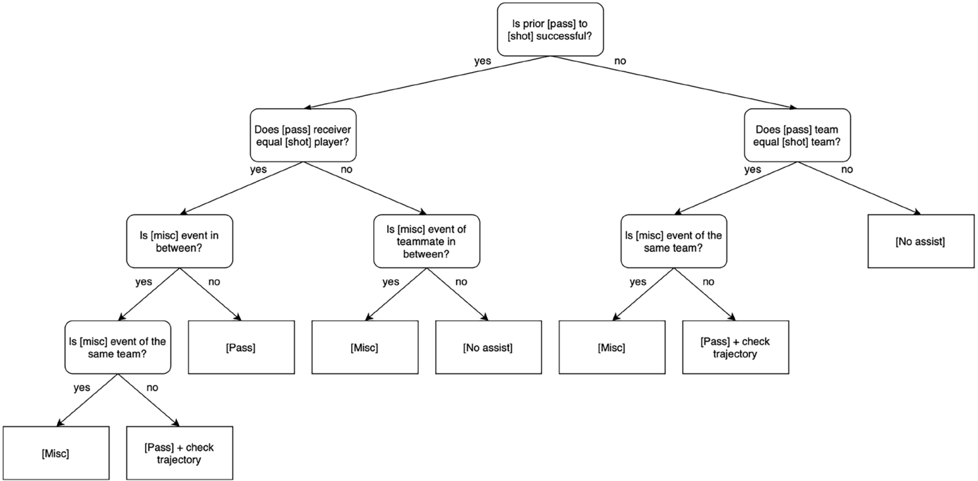
“A rule-based system identified the preceding potential assist event, resulting in four assist types across various game situations, as shown in Fig. 1: (1) direct passes (pass event), (2) deflected but successful passes (pass + trajectory check), (3) interjacent teammate touches (miscellaneous), and (4) no valid assist (no assist).”
The paper relies on this without support.
The tracking and event data are accurately synchronized.
“The tracking and event data are synchronized providing passes, shots, referee actions, and miscellaneous occurrences covering all remaining events as described by the authors of [19,26,27] .”
The paper relies on this without support.
The human-labeled assist labels are a valid ground truth for training and evaluating the models.
“The presented findings demonstrate successful classification of potential assists using validated assist labels across different scenarios.”
The paper relies on this without support.
The expert-developed assist definition adequately captures assist situations for labeling.
“A common, practical definition of an assist was developed by integrating existing definitions, highlighting the challenges of standardizing assist criteria across the football world.”
Self-check
Percentages, sums and reported differences re-computed from the paper’s own numbers.
Each contradiction between two passages listed here was confirmed by an independent check.
Rated minor: it would not touch a result — a value no result rests on, a p-value that stays on the same side of the significance level, or a conflict that is clerical, resolved elsewhere in the paper, or outside its own findings.
In the paper
§ Automating assist identification in football (soccer): a machine learning approach using event and tracking data > 4.6 Training and validation
“• Monotonic decrease: Increasing values reduce the assist probability (e.g.shot_y_tracking_player_1, number_events_inbetween).”
§ Automating assist identification in football (soccer): a machine learning approach using event and tracking data > 4.6 Training and validation
“• Peak at the mean Values climb up to the mean, followed by a decline (e.g.shot_y_tracking_player_1, assist_packing_attention).”
Citations
Cites
The Measurement of Observer Agreement for Categorical Data
Landis, J. R., & Koch, G. G. (1977) · Biometrics · doi:10.2307/2529310 · Cited by 81,148
A review of feature selection techniques in bioinformatics
Saeys, Y., Inza, I., & Larrañaga, P. (2007) · Bioinformatics · doi:10.1093/bioinformatics/btm344 · Cited by 5,389
SMOTE for Learning from Imbalanced Data: Progress and Challenges, Marking the 15-year Anniversary
Fernández, A., García, S., Herrera, F., & Chawla, N. V. (2018) · Journal of Artificial Intelligence Research · doi:10.1613/jair.1.11192 · Cited by 2,416
Efficient Feature Selection via Analysis of Relevance and Redundancy
Yu, L., & Liu, H. (2004) · doi:10.5555/1005332.1044700 · Cited by 1,981
A Review of Feature Selection and Its Methods
Venkatesh, B., & Anuradha, J. (2019) · Cybernetics and Information Technologies · doi:10.2478/cait-2019-0001 · Cited by 638
A survey on feature selection approaches for clustering
Hançer, E., Xue, B., & Zhang, M. (2020) · Artificial Intelligence Review · doi:10.1007/s10462-019-09800-w · Cited by 217 · cited 1×
“…Correlation filtering Eliminate highly correlated features to reduce redundancy and multicollinearity (6) Polynomial feature expansion (optional) Introduce interaction and higher-order terms to capture non-linear effects (7) embedded—offer trade-offs in speed, complexity, and accu - racy [30, 34].”
Anzer, G., & Bauer, P. (2021) · Frontiers in Sports and Active Living · doi:10.3389/fspor.2021.624475 · Cited by 136 · cited 1×
“The tracking and event data are synchronized providing passes, shots, referee actions, and miscellaneous occurrences covering all remaining events as described by the authors of [19, 26, 27] .”
Self-citationPower, P., Ruiz, H., Wei, X., & Lucey, P. (2017) · Proceedings of the 23rd ACM SIGKDD International Conference on Knowledge Discovery and Data Mining · doi:10.1145/3097983.3098051 · Cited by 131
Detecting semantic events in soccer games: towards a complete solution
Tovinkere, V., & Qian, R. J. (2001) · IEEE International Conference on Multimedia and Expo (ICME) · doi:10.1109/icme.2001.1237851 · Cited by 128 · cited 2×
“Automating event collection has been a research topic for over two decades—primarily focusing on events such as shots, passes, and corner kicks—yet potential assists have remained largely unaddressed [8–18].”
Classification of Passes in Football Matches Using Spatiotemporal Data
Chawla, S., Estephan, J., Gudmundsson, J., & Horton, M. (2017) · ACM Transactions on Spatial Algorithms and Systems · doi:10.1145/3105576 · Cited by 112
Research works printed but not linked: 4
- Richly K, Moritz F, Schwarz C (2017) Utilizing artificial neural networks to detect compound events in spatio-temporal soccer data. In: Proceedings of the 2017 SIGKDD workshop MiLeTS, pp 13–17
- Gudmundsson J, Wolle T (2010) Towards automated football analysis: Algorithms and data structures. In: Proceedings of the 10th Australasian conference on mathematics and computers in sport. MathSport (ANZIAM), Darwin, Australia, https://api.semanticscholar.org/CorpusID:15369923
- Decroos T, Van Haaren J, Dzyuba V et al (2017) Starss: a spatio-temporal action rating system for soccer. Machine learning and data mining for sports analytics ECML/PKDD 2017 workshop. Springer, pp 11–20
- Neter J, Kutner MH, Nachtsheim CJ et al (1996) Applied linear statistical models, 4th edn. WCB McGraw-Hill, New York
Cited by
Sorted by citations
A Dynamic Framework for Defensive Pressure Assessment in Football
Catalán, C., Calabuig, J. M., Raffi, L. M. G., et al. (2026) · AppliedMath · doi:10.3390/appliedmath6060082
“Recently, Klemmer et al. [16] introduced an automatic, machine-learning-based approach to detect (potential) assists from event and tracking data.”
Metadata
- Authors
- Klemmer, M., Arnsmeyer, K., Bauer, P., & Bücker, M.
- Affiliations
- FH Münster University of Applied Sciences (DE)
- Saarland University (DE)
- Corresponding author
- Klemmer, Maike
- Venue
- Sports Engineering
- Published
- 2026-01-09
- Volume
- 29
- Issue
- 1
- ISSN
- 1369-7072 (ISSN-L)
- 1460-2687
- OpenAlex
- W7119509037
- Semantic Scholar
- d0c5a5e5a3c6aee39a49240fc62b2771097af926
- Cited by
- 1
- References
- 25
- Citations by year
- 2026: 1
- FWCI
- 6.45
- Type
- journal article
- Language
- en
- Open access
- hybrid
- doi.org
- Locations
- Sports Engineering (publishedVersion, cc-by)
- Funders
- FH Münster
- Topics
- Health Sciences › Medicine › Orthopedics and Sports Medicine › Sports Performance and Training
- Social Sciences › Economics, Econometrics and Finance › Economics and Econometrics › Sports Analytics and Performance
- Physical Sciences › Computer Science › Computer Vision and Pattern Recognition › Video Analysis and Summarization
- Keywords
- football, soccer, player performance evaluation, event detection, player tracking data, video annotation, inter-rater reliability, player scouting
About these checks
Registry, retraction, Cites and statistics results are computed, not judged, with one exception: a printed reference that no index lists is read once by a model before it counts as a citation error. Claims are extracted by a model and kept only when their quote appears verbatim in the text; each cited source is then checked, with a model’s help, for whether it says what the claim relies on. Those verdicts can be wrong — read the claim’s quote and the cited source before relying on one.
A language model drew the claims from the paper on 2026-10-17, under version 3 of the claim definition (model deepseek-v4.1-flash, prompt extract-v3).
A second model labelled each claim on 2026-10-17 (model jev-1.13-20260917, definition revision gold-guideline-v0.2).
Cited sources are checked with a language model’s help (gpt-6-sol).
Statistics and arithmetic are recomputed, not judged.
Confidence bands are shown only for fields calibrated on our annotated test set. None is calibrated yet, so no band is shown.
What counts as a claim ›How we measure confidence ›How we check this ›
Are you an author, or do you see a problem with this page? Request a review
