

A method for the experimental characterisation of novel drag-reducing materials for very low Earth orbits using the Satellite for Orbital Aerodynamics Research (SOAR) mission
Open accessThe DOI matches its Crossref record; 52 of the 52 references it cites were found in a registry or an index.
Abstract
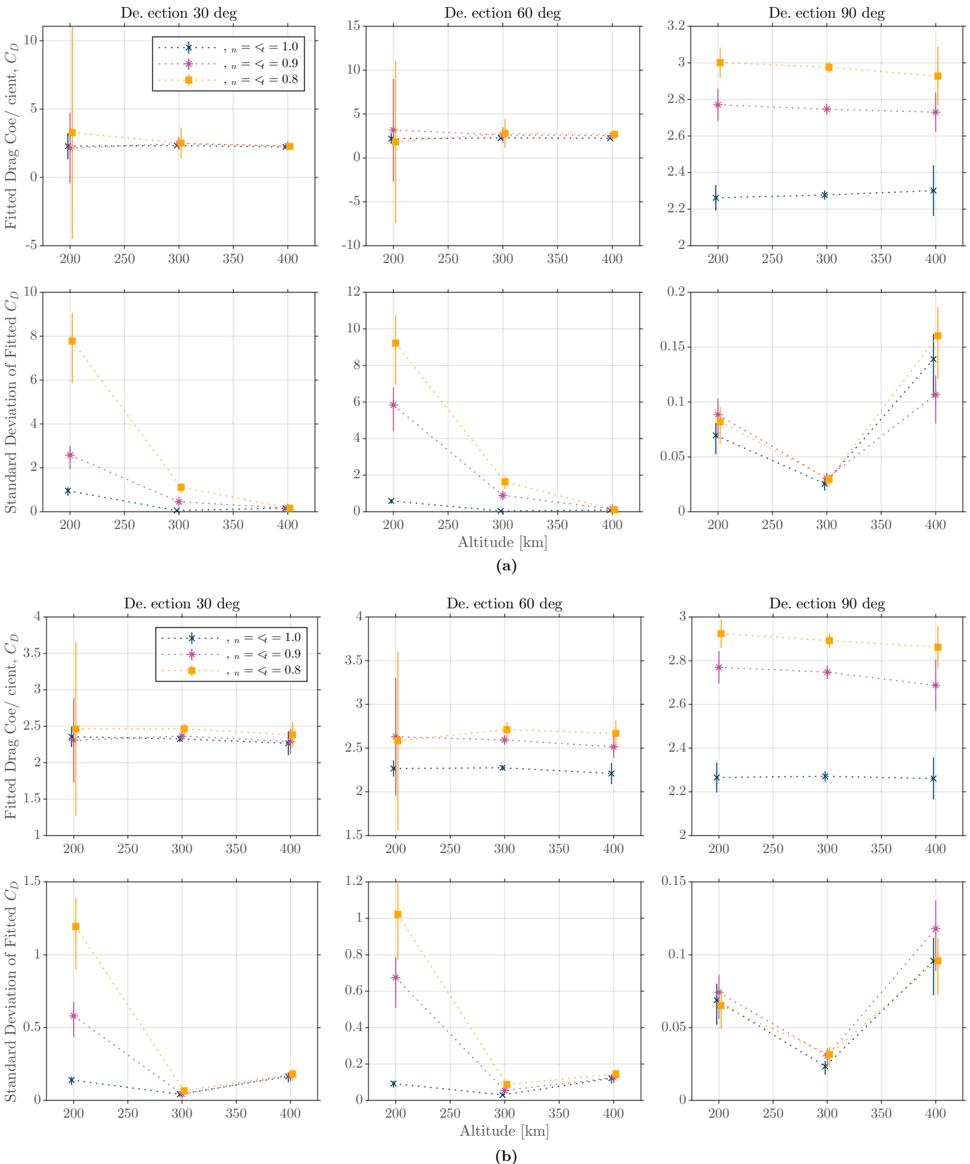
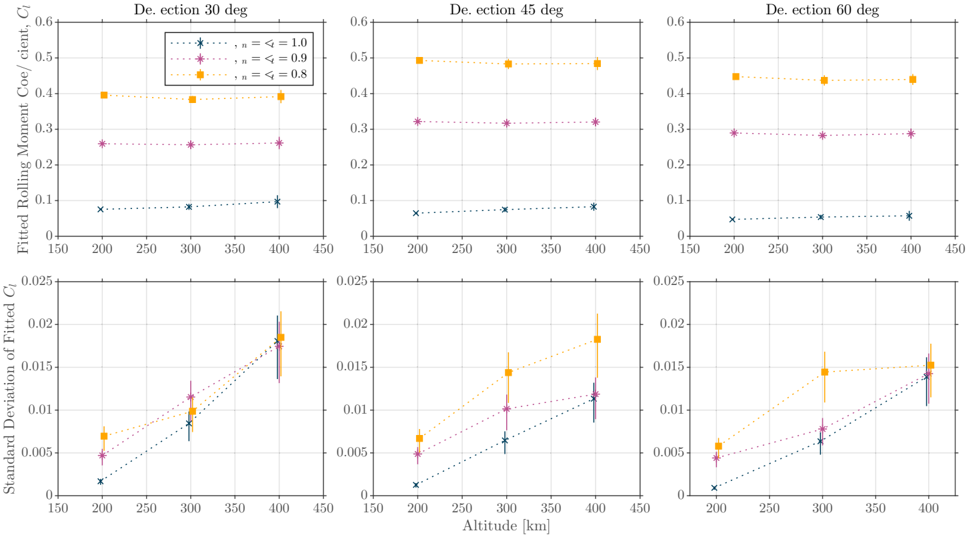
The Satellite for Orbital Aerodynamics Research (SOAR) is a 3U CubeSat mission that aims to investigate the gas–surface interactions (GSIs) of different materials in the very low Earth orbit environment (VLEO), i.e. below 450 km. Improving the understanding of these interactions is critical for the development of satellites that can operate sustainably at these lower orbital altitudes, with particular application to future Earth observation and communications missions. SOAR has been designed to perform the characterisation of the aerodynamic coefficients of four different materials at different angles of incidence with respect to the flow and at different altitudes in the VLEO altitude range. Two conventional and erosion-resistant materials (borosilicate glass and sputter-coated gold) have first been selected to support the validation of the ground-based Rarefied Orbital Aerodynamics Research (ROAR) facility. Two further, novel materials have been selected for their potential to reduce the drag experienced in orbit whilst also remaining resistant to the detrimental effects of atomic oxygen erosion in VLEO. In this paper, the uncertainty associated with the experimental method for determining the aerodynamic coefficients of satellite with different configurations of the test materials from on-orbit data is estimated for different assumed gas–surface interaction properties. The presented results indicate that for reducing surface accommodation coefficients the experimental uncertainty on the drag coefficient determination generally increases, a result of increased aerodynamic attitude perturbations. This effect is also exacerbated by the high atmospheric density at low orbital altitude (i.e. 200 km), resulting in high experimental uncertainty. Co-rotated steerable fin configurations are shown to provide generally lower experimental uncertainty than counter-rotated configurations, with the lowest uncertainties expected in the mid-VLEO altitudes ($$\sim$$ ∼ 300 km). For drag coefficient experiments, configurations with two fins oriented at 90$$^{\circ }$$ ∘ were found to allow the best differentiation between surfaces with different GSI performance. In comparison, the determination of the lift coefficient is found to be improve as the altitude is reduced from 400 to 200 km. These experiments were also found to show the best expected performance in determining the GSI properties of different materials. SOAR was deployed into an orbit of 421 km $$\times$$ × 415 km with 51.6$$^{\circ }$$ ∘ inclination on 14 June 2021. This orbit will naturally decay allowing access to different altitudes over the lifetime of the mission. The results presented in this paper will be used to plan the experimental schedule for this mission and to maximise the scientific output.
Overview
The claims and statistics of this paper haven’t been checked yet.
Free: it reads the open-access text and checks the first 5 claims that cite a source we can check. Create a free account to check every claim.
Integrity signals
Registry
Cites
Statistics
Figures

Verification
Claims the paper makes
The claims and statistics of this paper haven’t been checked yet.
Free: it reads the open-access text and checks the first 5 claims that cite a source we can check. Create a free account to check every claim.
Claims other papers make about this one
Each is checked against this paper’s own text: does it say what the citing paper says it does?
The cited source says what the claim attributes to it.
In the citing paper
“However, apart from recent JAXA's SLATS (Fujita and Noda [11]), ESA's GOCE (Drinkwater et al. [6]) and SOAR (Crisp et al. [12]) missions, Fig. 1, satellites do not usually operate in VLEO.”
From A review of air-breathing electric propulsion: from mission studies to technology verification (2022) · cites this paper as [12]
Self-check
Percentages, sums and reported differences re-computed from the paper’s own numbers.
The self-check needs the paper’s full text.
Citations
Cites
NRLMSISE‐00 empirical model of the atmosphere: Statistical comparisons and scientific issues
Picone, J. M., Hedin, A. E., Drob, D. P., & Aikin, A. C. (2002) · Journal of Geophysical Research: Space Physics · doi:10.1029/2002ja009430 · Cited by 3,749 · cited 1×
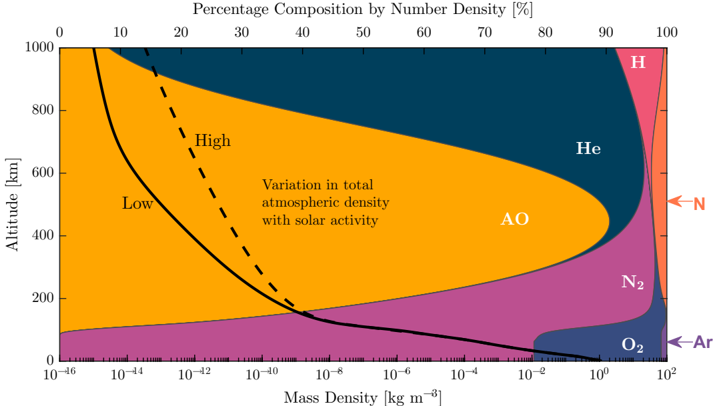
“1 Representative variation of atmospheric density and composition with altitude in LEO, calculated using the NRLMSISE-00 model [4].”
MethodGas–surface interactions and satellite drag coefficients
Moe, K., & Moe, M. M. (2005) · Planetary and Space Science · doi:10.1016/j.pss.2005.03.005 · Cited by 297 · cited 1×
“Above VLEO altitudes, the general reduction in density and AO concentration has been linked to a reduction in surface adsorption and therefore accommodation [18].”
BackgroundThermospheric mass density: A review
Emmert, J. T. (2015) · Advances in Space Research · doi:10.1016/j.asr.2015.05.038 · Cited by 277 · cited 1×
“NRLMSISE-00, JB2008, DTM2009 [15]) significant uncertainty remains regarding true atmospheric conditions (principally density, composition, and temperature) due to the complexity of the thermospheric/ionospheric system and lack of both spatially and temporally distributed measurements by both in situ and remote sensin…”
BackgroundThe benefits of very low earth orbit for earth observation missions
Crisp, N. H., Roberts, P. C. E., Livadiotti, S., Oiko, V. T. A., Edmondson, S., Haigh, S. J., Huyton, C., Sinpetru, L. A., Smith, K. L., Worrall, S. D., et al. (2020) · Progress in Aerospace Sciences · doi:10.1016/j.paerosci.2020.100619 · Cited by 255 · cited 1×
“A reduction in the operational orbit altitude of spacecraft has been linked to a number of benefits to their design, particularly for Earth observation (EO) [1] and communications missions [2].”
BackgroundSelf-citationA critical assessment of satellite drag and atmospheric density modeling
Vallado, D. A., & Finkleman, D. (2014) · Acta Astronautica · doi:10.1016/j.actaastro.2013.10.005 · Cited by 244 · cited 4×
“A similar effect will also be presented due to atmospheric variations with latitude, shorter-term seasonal and diurnal cycles, and local-solar time [15, 17].”
BackgroundInfluentialBallistic molecular transport through two-dimensional channels
Keerthi, A., Geim, A. K., Janardanan, A., Rooney, A. P., Esfandiar, A., Hu, S., Dar, S. A., Grigorieva, I. V., Haigh, S. J., Wang, F. C., et al. (2018) · Nature · doi:10.1038/s41586-018-0203-2 · Cited by 222 · cited 1×
“Study of nanofluidic channel flows, with a similar Knudsen number to that in VLEO, has also highlighted the existence of 2D materials exhibiting non-diffuse reflection behaviour [47].”
BackgroundThermospheric Density and Wind Determination from Satellite Dynamics
Doornbos, E. (2012) · Springer Theses · doi:10.1007/978-3-642-25129-0 · Cited by 217
FREE MOLECULE FLOW THEORY AND ITS APPLICATION TO THE DETERMINATION OF AERODYNAMIC FORCES
SENTMAN, L. H. (1961) · doi:10.21236/ad0265409 · Cited by 200 · cited 1×
“Sentman’s model [24] is based on complete diffuse reemission and accounts for the random thermal motion of the incoming particles.”
BackgroundThe recombination of oxygen atoms at surfaces
Greaves, J. C., & Linnett, J. W. (1958) · Transactions of the Faraday Society · doi:10.1039/tf9585401323 · Cited by 148 · cited 1×
“1 3 cross sections [60, 61] and have therefore been selected with the intention to provide breadth in GSI performance for previously characterised and well-known materials, i.”
BackgroundFormula for Thermal Accommodation Coefficients
Goodman, F. O., & Wachman, H. Y. (1967) · The Journal of Chemical Physics · doi:10.1063/1.1841046 · Cited by 141 · cited 1×
“This model is often used with Goodman’s model for energy accommodation coefficient [23].”
MethodSemiempirical Model for Satellite Energy-Accommodation Coefficients
Pilinski, M. D., Argrow, B. M., & Palo, S. E. (2010) · Journal of Spacecraft and Rockets · doi:10.2514/1.49330 · Cited by 134 · cited 1×
“[30] subsequently developed a relationship between AO adsorption and energy accommodation for different altitudes based on the Langmuir isotherm, a function that relates the surface adsorption by a given gas species to its the partial pressure.”
BackgroundNew density estimates derived using accelerometers on board the CHAMP and GRACE satellites
Mehta, P. M., Walker, A. C., Sutton, E. K., & Godinez, H. C. (2017) · Space Weather · doi:10.1002/2016sw001562 · Cited by 133 · cited 2×
“This response surface method has subsequently been implemented using TPMC to improve computational efficiency, and for a number of further satellite geometries [36, 37].”
BackgroundMethodGreaves, J. C., & Linnett, J. W. (1959) · Transactions of the Faraday Society · doi:10.1039/tf9595501355 · Cited by 124
Mostaza Prieto, D., Graziano, B. P., & Roberts, P. C. E. (2014) · Progress in Aerospace Sciences · doi:10.1016/j.paerosci.2013.09.001 · Cited by 121 · cited 2×
“Panel methods are therefore only suitable for the analysis of generally convex geometries with simple external features, but due to their analytical basis can be executed very quickly for different orientations and environmental conditions [6].”
BackgroundSelf-citationDrag and energy accommodation coefficients during sunspot maximum
Pardini, C., Anselmo, L., Moe, K., & Moe, M. M. (2009) · Advances in Space Research · doi:10.1016/j.asr.2009.08.034 · Cited by 121 · cited 2×
“At increased solar activity conditions, the expanding atmosphere and, therefore, expectation for increased accommodation will generally result in a reduction in the force coefficients [13, 29].”
BackgroundResultNormalized Force Coefficients for Satellites with Elongated Shapes
Sutton, E. K. (2009) · Journal of Spacecraft and Rockets · doi:10.2514/1.40940 · Cited by 109 · cited 1×
“This modification is also known as the Diffuse Reflection with Incomplete Accommodation (DRIA) model [10].”
BackgroundSchaaf, S. A., & Chambré, P. L. (1958) · Princeton University Press eBooks · doi:10.1515/9781400877539-010 · Cited by 107
Semi-Empirical Satellite Accommodation Model for Spherical and Randomly Tumbling Objects
Pilinski, M. D., Argrow, B., Palo, S. E., & Bowman, B. R. (2013) · Journal of Spacecraft and Rockets · doi:10.2514/1.a32348 · Cited by 106 · cited 1×
“This method was later modified [31] to incorporate a lower bound on the energy accommodation in the absence of AO based on Goodman’s physical interaction model [32].”
MethodThe scattering of hydrogen, deuterium, and the rare gases from silver (111) single crystals
Sau, R., & Merrill, R. P. (1973) · Surface Science · doi:10.1016/0039-6028(73)90119-2 · Cited by 106
Bernasek, S. L., Siekhaus, W. J., & Somorjai, G. A. (1973) · Physical Review Letters · doi:10.1103/physrevlett.30.1202 · Cited by 104
Improved Satellite Drag Coefficient Calculations from Orbital Measurements of Energy Accommodation
Moe, K., Moe, M. M., & Wallace, S. D. (1998) · Journal of Spacecraft and Rockets · doi:10.2514/2.3350 · Cited by 97 · cited 2×
“[8, 11] showed that below 200 km accommodation was almost complete and associated with diffuse re-emission behaviour.”
BackgroundA review of gas-surface interaction models for orbital aerodynamics applications
Livadiotti, S., Crisp, N. H., Roberts, P. C. E., Worrall, S. D., Oiko, V. T. A., Edmondson, S., Haigh, S. J., Huyton, C., Smith, K. L., Sinpetru, L. A., et al. (2020) · Progress in Aerospace Sciences · doi:10.1016/j.paerosci.2020.100675 · Cited by 95 · cited 1×
“As a result, these gas–surface interactions (GSIs) are predominantly responsible for the aerodynamic forces experienced by surfaces in VLEO [6, 7].”
BackgroundSelf-citationIntake design for an Atmosphere-Breathing Electric Propulsion System (ABEP)
Romano, F., Espinosa-Orozco, J., Pfeiffer, M., Herdrich, G., Crisp, N. H., Roberts, P. C. E., Holmes, B. E. A., Edmondson, S., Haigh, S., Livadiotti, S., et al. (2021) · Acta Astronautica · doi:10.1016/j.actaastro.2021.06.033 · Cited by 95 · cited 1×
“The development of such materials also has significance for the development of atmospheric intakes with greater efficiency [49].”
BackgroundSelf-citationRomano, F., Chan, Y.-A., Herdrich, G., Traub, C., Fasoulas, S., Roberts, P. C. E., Smith, K., Edmondson, S., Haigh, S., Crisp, N. H., et al. (2020) · Acta Astronautica · doi:10.1016/j.actaastro.2020.07.008 · Cited by 87
Self-citationAccommodation coefficient of tangential momentum on atomically clean and contaminated surfaces
Sazhin, O. V., Borisov, S. F., & Sharipov, F. (2001) · Journal of Vacuum Science & Technology A Vacuum Surfaces and Films · doi:10.1116/1.1388622 · Cited by 85 · cited 1×
“More specifically, whilst n is considered a variable parameter, t is commonly assumed to be unity leading to diffuse re-emission behaviour [37, 41].”
BackgroundLower-thermosphere–ionosphere (LTI) quantities: current status of measuring techniques and models
Palmroth, M., Grandin, M., Sarris, T. E., Doornbos, E. N., Tourgaidis, S., Aikio, A., Buchert, S. C., Clilverd, M. A., Dandouras, I., Heelis, R. A., et al. (2021) · Annales Geophysicae · doi:10.5194/angeo-39-189-2021 · Cited by 84
Modeling satellite drag coefficients with response surfaces
Mehta, P. M., Walker, A., Lawrence, E., Linares, R., Higdon, D., & Koller, J. (2014) · Advances in Space Research · doi:10.1016/j.asr.2014.06.033 · Cited by 78 · cited 1×
“This response surface method has subsequently been implemented using TPMC to improve computational efficiency, and for a number of further satellite geometries [36, 37].”
MethodDrag Coefficient Model Using the Cercignani–Lampis–Lord Gas–Surface Interaction Model
Walker, A., Mehta, P., & Koller, J. (2014) · Journal of Spacecraft and Rockets · doi:10.2514/1.a32677 · Cited by 78 · cited 3×
“[28] uses the Langmuir isotherm to determine the fractional surface coverage by AO which is then applied as a weighting factor to combine drag coefficients calculated for clean and fully adsorbed surfaces.”
MethodInfluentialMarch, G., Doornbos, E. N., & Visser, P. N. A. M. (2019) · Advances in Space Research · doi:10.1016/j.asr.2018.07.009 · Cited by 75
Goodman, F. O. (1967) · Surface Science · doi:10.1016/0039-6028(67)90029-5 · Cited by 73
A Review of Gas-Surface Interaction Models for Orbital Aerodynamics Applications
Livadiotti, S., Crisp, N., Roberts, P., Worrall, S. D., Oiko, V., Edmondson, S., Haigh, S. J., Huyton, C., Smith, K., Sinpetru, L., et al. (2020) · Research Explorer (The University of Manchester) · Cited by 65
Self-citationAerodynamic Disturbances on Spacecraft in Free-Molecular Flow
Storch, J. A. (2002) · doi:10.21236/ada410696 · Cited by 57 · cited 1×
“Closed-form solutions for this model are given by Storch [27].”
MethodDrag coefficient modeling for grace using Direct Simulation Monte Carlo
Mehta, P. M., McLaughlin, C. A., & Sutton, E. K. (2013) · Advances in Space Research · doi:10.1016/j.asr.2013.08.033 · Cited by 56 · cited 2×
“[35] implemented a Gaussian process based approach using DSMC results for the Grace spacecraft whilst also incorporating the fractional coverage method for surface accommodation.”
BackgroundMethodMurray, V. J., Pilinski, M. D., Smoll, E. J., Qian, M., Minton, T. K., Madzunkov, S. M., & Darrach, M. R. (2017) · The Journal of Physical Chemistry C · doi:10.1021/acs.jpcc.7b00456 · Cited by 56 · cited 1×
“Recent experiments on the scattering properties of AO from different surfaces has demonstrated more specular reflection behaviour of silicon dioxide and highly orientated pyrolitic graphite (HOPG) [45], leading to investigation of further materials with AO erosion resistance for use in VLEO [46].”
BackgroundCrisp, N. H., Roberts, P. C. E., Livadiotti, S., Macario Rojas, A., Oiko, V. T. A., Edmondson, S., Haigh, S. J., Holmes, B. E. A., Sinpetru, L. A., Smith, K. L., et al. (2021) · Acta Astronautica · doi:10.1016/j.actaastro.2020.12.024 · Cited by 56 · cited 8×
“The Satellite for Orbital Aerodynamics Research (SOAR) has been designed to perform in situ characterisation of the aerodynamic performance of different materials at varying altitude and incidence angle in the VLEO environment [55], taking heritage from the previous ΔDsat mission concept [56].”
BackgroundMethodInfluentialSelf-citationOn the Utility of Coated POSS-Polyimides for Vehicles in Very Low Earth Orbit
Minton, T. K., Schwartzentruber, T. E., & Xu, C. (2021) · ACS Applied Materials & Interfaces · doi:10.1021/acsami.1c14196 · Cited by 55
Drag Coefficients of Satellites with Concave Geometries: Comparing Models and Observations
Pilinski, M. D., Argrow, B. M., & Palo, S. E. (2011) · Journal of Spacecraft and Rockets · doi:10.2514/1.50915 · Cited by 54
Drag reduction through shape optimisation for satellites in Very Low Earth Orbit
Walsh, J., Berthoud, L., & Allen, C. (2021) · Acta Astronautica · doi:10.1016/j.actaastro.2020.09.018 · Cited by 44 · cited 1×
“Drag mitigation can also be performed with the aim of reducing the magnitude of the drag experienced, principally by considering the design of the geometry of the spacecraft and the interaction of the external surfaces with the oncoming atmospheric flow [3].”
BackgroundGas-surface interactions modelling influence on satellite aerodynamics and thermosphere mass density
March, G., van den IJssel, J., Siemes, C., Visser, P. N. A. M., Doornbos, E. N., & Pilinski, M. (2021) · Journal of Space Weather and Space Climate · doi:10.1051/swsc/2021035 · Cited by 43 · cited 1×
“82 were proposed for the CHAMP and GOCE satellites respectively using the DRIA GSI model [39, 40].”
MethodRefinements in determining satellite drag coefficients - Method for resolving density discrepancies
Moe, M. M., Wallace, S., & Moe, K. (1993) · Journal of Guidance Control and Dynamics · doi:10.2514/3.21029 · Cited by 41 · cited 2×
“However, despite this range of parameters, historical analysis of spacecraft orbiting in LEO has suggested that diffuse re-emission characteristics are dominant, particularly for for spacecraft surfaces below 200 km in altitude [11, 12].”
BackgroundSimultaneous Analysis of Multi-Instrument Satellite Measurements of Atmospheric Density
Moe, K., Moe, M. M., & Rice, C. J. (2004) · Journal of Spacecraft and Rockets · doi:10.2514/1.2090 · Cited by 41
CHAMP and GOCE thermospheric wind characterization with improved gas-surface interactions modelling
March, G., Visser, T., Visser, P. N. A. M., & Doornbos, E. N. (2019) · Advances in Space Research · doi:10.1016/j.asr.2019.06.023 · Cited by 41 · cited 1×
“82 were proposed for the CHAMP and GOCE satellites respectively using the DRIA GSI model [39, 40].”
MethodThe impact of satellite altitude on the performance of LEOS based communication systems
Gavish, B., & Kalvenes, J. (1998) · Wireless Networks · doi:10.1023/a:1019151905814 · Cited by 40 · cited 1×
“A reduction in the operational orbit altitude of spacecraft has been linked to a number of benefits to their design, particularly for Earth observation (EO) [1] and communications missions [2].”
BackgroundADBSat: Methodology of a novel panel method tool for aerodynamic analysis of satellites
Sinpetru, L. A., Crisp, N. H., Mostaza-Prieto, D., Livadiotti, S., & Roberts, P. C. E. (2022) · Computer Physics Communications · doi:10.1016/j.cpc.2022.108326 · Cited by 36 · cited 2×
“Shadowing or shielding effects are also difficult to accurately account for due to the independent treatment of the surface elements, though ray-tracing approaches can be implemented, for example in ADBSat [34].”
MethodSelf-citationA free molecule aerodynamic investigation using multiple satellite analysis
Harrison, I. K., & Swinerd, G. G. (1996) · Planetary and Space Science · doi:10.1016/0032-0633(95)00077-1 · Cited by 35 · cited 2×
“Analysis of satellites at 800–1000 km by Harrison and Swinerd [20, 21] has also indicated a reduction in surface accommodation and the presence of quasi-specular reflection behaviour.”
BackgroundWest, L. A., & Somorjai, G. A. (1971) · The Journal of Chemical Physics · doi:10.1063/1.1675266 · Cited by 28
Evidence for Drag Coefficient Modeling Errors near and Above the Oxygen-to-Helium Transition
Bernstein, V., Pilinski, M. D., & Knipp, D. J. (2020) · Journal of Spacecraft and Rockets · doi:10.2514/1.a34740 · Cited by 15 · cited 2×
“m m , satellites at or above 500 km altitude, the transition from AO predominance to helium has been linked to drag modelling errors, attributed to assumptions in typical aerodynamic coefficient modelling and the reduction in molecular mass and surface adsorption of AO with altitude [19].”
BackgroundΔDsat , a QB50 CubeSat mission to study rarefied-gas drag modelling
Virgili-Llop, J., & Roberts, P. C. E. (2013) · Acta Astronautica · doi:10.1016/j.actaastro.2013.04.006 · Cited by 13
Self-citationAnalysis of satellite laser ranging data to investigate satellite aerodynamics
Harrison, I. K., & Swinerd, G. G. (1995) · Planetary and Space Science · doi:10.1016/0032-0633(95)00010-3 · Cited by 10 · cited 2×
“Analysis of satellites at 800–1000 km by Harrison and Swinerd [20, 21] has also indicated a reduction in surface accommodation and the presence of quasi-specular reflection behaviour.”
BackgroundDISCOVERER – Making Commercial Satellite Operations in Very Low Earth Orbit a Reality
Roberts, P. C. E., Crisp, N. H., Oiko, V. T. A., Edmondson, S., Haigh, S. J., Huyton, C., Livadiotti, S., Lyons, R., Smith, K., Sinpetru, L. A., et al. (2019) · UCL Discovery (University College London) · Cited by 10
Self-citationInternational Astronautical Federation (IAF)
(2014) · International Year Book and Statesmen's Who's Who · doi:10.1163/1570-6664_iyb_sim_org_39037 · Cited by 9
Using the attitude response of aerostable spacecraft to measure thermospheric wind
Virgili-Llop, J., Roberts, P. C. E., & Hao, Z. (2017) · CEAS Space Journal · doi:10.1007/s12567-017-0153-9 · Cited by 3
Self-citation
Research works printed but not linked: 5
- Bowman, B.R., Moe, K.: Drag coefficient variability at 175-500 km from the orbit decay analyses of spheres. In: AAS/AIAA Astrodynamics Specialists Conference, pp. 1-20, Lake Tahoe, CA (2005). American Astronautical Society (AAS)
- Moe, K., Bowman, B.R.: The effects of surface composition and treatment on drag coefficient of spherical satellites. In: AAS/ AIAA Astrodynamics Specialists Conference, Lake Tahoe, CA, pp. 1-16 (2005). American Astronautical Society (AAS). ISBN 087703527X
- Walker, A.C., Mehta, P.M., Koller, J.: The effect of different adsorption models on satellite drag coefficients. Adv. Astronaut. Sci. 150, 675-686 (2014b). ((ISSN 00653438))
- Oiko, V.T.A., Roberts, P.C.E., Edmondson, S., Worrall, S.D., Kataria, D., Outlaw, R., Haigh, S., Crisp, N.H., Lyons, R.E., Liva- diotti, S., Huyton, C., Sinpetru, L.A., Becedas, J., González, G., Dominguez, R.M., González, D., Ghizoni, L., Jungnell, V., Bay, K., Morsbøl, J., Herdrich, G.H., Romano, F., Binder, T., Box- berger, A., Fasoulas S., Traub, C., Garcia-Almiñana, D., Rodri- guez-Donaire S., Sureda, M., Villain, R., Perez, J.S., Conte, A., Belkouchi, B., Schwalber, A., Heißerer, B.: Design and develop- ment of a hyper-thermal atomic oxygen wind tunnel facility. In: 14th ISMSE and 12th ICPMSE, Biarritz, France (2018), pp. 1-6. https:// doi. org/ 10. 1299/ jsmem ag. 121. 119842 · doi:10.1299/jsmemag.121.119842
- Oiko, V.T.A., Roberts, P.C.E., Worrall, S.D., Edmondson, S., Haigh, S.J., Crisp, N.H., Livadiotti, S., Huyton, C., Lyons, R.E., Smith, K.L., Sinpetru, L.A., Holmes, B.E., Becedas, J., Domínguez, R.M., González, D., Cañas, V., Hanessian, V., Møl- gaard, A., Nielsen, J., Bisgaard, M., Boxberger, A., Chan, Y.-A., Herdrich, G.H., Romano, F., Fasoulas, S., Traub, C., Garcia-Almi- ñana, D., Rodriguez-Donaire, S., Sureda, M., Kataria, D., Outlaw, R., Belkouchi, B., Conte, A., Perez, J.S., Villain, R., Heißerer, B., Schwalber, A.: A ground-based experimental facility for orbital aerodynamics research. In: 70th International Astronautical Con- gress, Washington, DC, 2019, pp. 1-7. International Astronautical Federation (IAF)
Cited by
A review of air-breathing electric propulsion: from mission studies to technology verification
Andreussi, T., Ferrato, E., & Giannetti, V. (2022) · Journal of Electric Propulsion · doi:10.1007/s44205-022-00024-9 · Cited by 94
“Even if the intake performance can change significantly with the accommodation coefficient, the uncertainty associated with this parameter can be tackled by performing simulations that encompass the whole range of possible values [21, 54, 84], or by performing dedicated on-ground or in-orbit experiments [12].”
BackgroundMethodFilatyev, A. S., Golikov, A. A., Erofeev, A. I., Khartov, S. A., Lovtsov, A. S., Padalitsa, D. I., Skvortsov, V. V., & Yanova, O. V. (2022) · Progress in Aerospace Sciences · doi:10.1016/j.paerosci.2022.100877 · Cited by 58
Moon, G., Yi, M., Park, K., Kim, Y., Yoon, H., & Jun, E. (2023) · Vacuum · doi:10.1016/j.vacuum.2023.112066 · Cited by 28
Sannino, A., Pessina, V., Savino, R., & Schein, J. (2025) · Physics of Fluids · doi:10.1063/5.0252316 · Cited by 11
Plasma plume simulation of an atomic oxygen-fed ion thruster in very-low-earth-orbit
Moon, G., Choe, W., & Jun, E. (2023) · Plasma Sources Science and Technology · doi:10.1088/1361-6595/ad15b0 · Cited by 13
Metadata
- Authors
- Crisp, N. H., Roberts, P. C. E., Hanessian, V., Sulliotti-Linner, V., Herdrich, G. H., García-Almiñana, D., Kataria, D., & Seminari, S.
- Affiliations
- University of Manchester (GB)
- Deimos (Spain) (ES)
- University of Stuttgart (DE)
- Universitat Politècnica de Catalunya (ES)
- University College London (GB)
- Corresponding author
- Crisp, Nicholas H.
- ORCID
- Venue
- CEAS Space Journal
- Published
- 2022-04-07
- Volume
- 14
- Issue
- 4
- Pages
- 655-674
- ISSN
- 1868-2502 (ISSN-L)
- 1868-2510
- OpenAlex
- W4225501714
- Cited by
- 23
- References
- 52
- Citations by year
- 2026: 10 · 2025: 8 · 2024: 1 · 2023: 2 · 2022: 2
- FWCI
- 1.45
- Type
- journal article
- Language
- en
- Open access
- hybrid
- doi.org
- Licence
- cc-by
- creativecommons.org/licenses/by/4.0 (tdm)
- creativecommons.org/licenses/by/4.0 (vor)
- Locations
- CEAS Space Journal (publishedVersion, cc-by)
- Research Explorer (The University of Manchester) (publishedVersion, cc-by)
- UPCommons institutional repository (Universitat Politècnica de Catalunya) (submittedVersion, cc-by)
- Funders
- Horizon 2020 Framework Programme (737183)
- Topics
- Physical Sciences › Engineering › Aerospace Engineering › Spacecraft Design and Technology
- Physical Sciences › Engineering › Aerospace Engineering › Space Satellite Systems and Control
- Physical Sciences › Mathematics › Applied Mathematics › Gas Dynamics and Kinetic Theory
- Keywords
- very low Earth orbit, gas-surface interaction, drag reduction, atomic oxygen erosion, aerodynamic coefficients, experimental uncertainty, drag coefficient, lift coefficient, borosilicate glass, orbital decay, air density
About these checks
Registry, retraction, Cites and statistics results are computed, not judged, with one exception: a printed reference that no index lists is read once by a model before it counts as a citation error. Claims are extracted by a model and kept only when their quote appears verbatim in the text; each cited source is then checked, with a model’s help, for whether it says what the claim relies on. Those verdicts can be wrong — read the claim’s quote and the cited source before relying on one.
Statistics and arithmetic are recomputed, not judged.
Confidence bands are shown only for fields calibrated on our annotated test set. None is calibrated yet, so no band is shown.
What counts as a claim ›How we measure confidence ›How we check this ›
Are you an author, or do you see a problem with this page? Request a review
Data sources
Bibliographic data: Semantic Scholar, OpenAlex, Crossref.
Contains information from the Semantic Scholar Academic Graph Datasets, made available under the ODC Attribution License (ODC-BY 1.0).
Semantic Scholar’s data is described in: Kinney, R., et al. (2023). The Semantic Scholar Open Data Platform. arXiv:2301.10140.
