

The DOI matches its Crossref record; 27 of the 28 references it cites were found in a registry or an index.
On the relationship between the practice of mindfulness meditation and personality-an exploratory analysis of the mediating role of mindfulness skills
Open accessAbstract
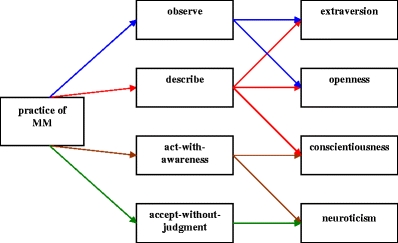
Mindfulness meditation (MM) has often been suggested to induce fundamental changes in the way events in life are experienced and dealt with, presumably leading to alterations in personality. However, the relationship between the practice of MM and personality has not been systematically studied. The aim of this study was to explore this relationship and to investigate the mediating role of mindfulness skills. Thirty-five experienced mindfulness meditators (age range, 31-75 years; meditation experience range, 0.25-35 years; mean, ∼13 years) and 35 age-, gender-, and ethnicity-matched controls (age range, 27-63 years) without any meditation experience completed a personality (NEO-FFI) and mindfulness (KIMS) questionnaire. The practice of MM was positively related to openness and extraversion and negatively related to neuroticism and conscientiousness. Thus, the results of the current study associate the practice of MM with higher levels of curiosity and receptivity to new experiences and experience of positive affect and with less proneness toward negative emotions and worrying and a reduced focus on achievements. Furthermore, the mediating role of specific mindfulness skills in the relationship between the practice of MM and personality traits was shown.
Overview
The claims and statistics of this paper haven’t been checked yet.
Run the check — free, no account needed. It reads the open-access text and checks the sources it cites.
Integrity signals
Registry
Cites
Statistics
Figures
Verification
Claims the paper makes
The claims and statistics of this paper haven’t been checked yet.
Run the check — free, no account needed. It reads the open-access text and checks the sources it cites.
Claims other papers make about this one
Each is checked against this paper’s own text: does it say what the citing paper says it does?
The cited source says what the claim attributes to it.
In the citing paper
“The latter possibility is more likely given that trait mindfulness has been shown to be associated with greater openness to experience (Baer et al., 2004, van den Hurk et al., 2011), and there is an association between schizotypy and openness to experience (DeYoung et al., 2011).”
From Schizotypy and mindfulness: Magical thinking without suspiciousness characterizes mindfulness meditators (2016) · cites this paper as van den Hurk et al., 2011
The cited source says what the claim attributes to it.
In the citing paper
“trait mindfulness has been shown to be associated with greater openness to experience (Baer et al., 2004, van den Hurk et al., 2011)”
From Schizotypy and mindfulness: Magical thinking without suspiciousness characterizes mindfulness meditators (2016) · cites this paper as van den Hurk et al., 2011
Self-check
Percentages, sums and reported differences re-computed from the paper’s own numbers.
The self-check needs the paper’s full text.
Citations
Cites
Preacher, K. J., & Hayes, A. F. (2008) · Behavior Research Methods · doi:10.3758/brm.40.3.879 · Cited by 34,117
The benefits of being present: Mindfulness and its role in psychological well-being
Brown, K. W., & Ryan, R. M. (2003) · Journal of Personality and Social Psychology · doi:10.1037/0022-3514.84.4.822 · Cited by 13,448
Using Self-Report Assessment Methods to Explore Facets of Mindfulness
Baer, R. A., Smith, G. T., Hopkins, J., Krietemeyer, J., & Toney, L. (2006) · Assessment · doi:10.1177/1073191105283504 · Cited by 7,511 · cited 2×
“…higher level of openness in the group of meditators and the positive relationship between the amount of MM practice and openness were in line with earlier research as several studies showed that openness was positively related to facets of mindfulness (Baer et al. 2004, 2006; Brown and Ryan 2003).”
ResultMindfulness: A proposed operational definition.
Bishop, S. R., Lau, M., Shapiro, S., Carlson, L., Anderson, N. D., Carmody, J., Segal, Z. V., Abbey, S., Speca, M., Velting, D., et al. (2004) · Clinical Psychology: Science and Practice · doi:10.1093/clipsy.bph077 · Cited by 7,234
(1993) · Cited by 7,136
Cognitive-Behavioral Treatment of Borderline Personality Disorder
Cary, G. L. (1994) · American Journal of Psychotherapy · doi:10.1176/appi.psychotherapy.1994.48.1.155 · Cited by 6,299
Kabat-Zinn, J. (1982) · General Hospital Psychiatry · doi:10.1016/0163-8343(82)90026-3 · Cited by 4,255
Shapiro, S. L., Carlson, L. E., Astin, J. A., & Freedman, B. (2006) · Journal of Clinical Psychology · doi:10.1002/jclp.20237 · Cited by 4,002
Mindfulness: Theoretical Foundations and Evidence for its Salutary Effects
Brown, K. W., Ryan, R. M., & Creswell, J. D. (2007) · Psychological Inquiry · doi:10.1080/10478400701598298 · Cited by 3,654
Baer, R. A., Smith, G. T., Lykins, E., Button, D., Krietemeyer, J., Sauer, S., Walsh, E., Duggan, D., & Williams, J. M. G. (2008) · Assessment · doi:10.1177/1073191107313003 · Cited by 2,930
Research works printed but not linked: 4
- Costa, P. T., Jr., & McCrae, R. R. (1992). Revised NEO Personality Inventory (NEO PI-R) and NEO Five-Factor Inventory (NEO-FFI): Professional manual. Odessa, FL: Psychological Assessment Resources.
- Hoekstra, H. A., Ormel, J., & de Fruyt, F. (1996). Handleiding NEO persoonlijkheidsvragenlijsten NEO-PI-R and NEO-FFI [Manual of the NEO personality inventories NEO-PI-R and NEO-FFI]. Lisse, the Netherlands: Swets Test Services.
- Kabat-Zinn, J. (1990). Full catastrophe living: The program of the Stress Reduction Clinic at the University of Massachusetts Medical Center. New York: Dell Publishing.
- Kabat-Zinn, J. (1996). Mindfulness meditation: What it is, what it isn’t, and its role in health care and medicine. In Y. Haruki, Y. Ishii, & M. Suzuki (Eds.), Comparative and psychological study on meditation. Delft: Eburon.
Cited by
Sorted by citations
Items 101–136 of 136
Lyon, A. (2023) · Oxford University Press eBooks · doi:10.1093/oso/9780198843757.003.0005 · Cited by 1
Day, B. (2015) · UA Campus Repository (The University of Arizona)
Larsen, T. (2019) · International Journal of Public and Private Perspectives on Healthcare Culture and the Environment · doi:10.4018/ijppphce.2020010102
Larsen, T. (2019) · International Journal of Patient-Centered Healthcare · doi:10.4018/ijpch.2019010101
Larsen, T. (2020) · Advances in human services and public health (AHSPH) book series · doi:10.4018/978-1-7998-3576-9.ch004
Neuroeconomic Perspectives for Economics
Larsen, T. (2020) · Advances in logistics, operations, and management science book series · doi:10.4018/978-1-7998-3473-1.ch012
Sanner, C. M., McGregor, H. A., Preston, A. E., & Neece, C. L. (2020) · International review of research in developmental disabilities · doi:10.1016/bs.irrdd.2020.09.004
Cechy osobowości jako predyktory uważności u Mistrzów Świata Sztuki Iluzji FISM
Napora, W., & Julia, G. (2021) · Przegląd Psychologiczny · doi:10.31648/pp.7352
Henderson, S. L., Sugumar, L., & Doshi, K. (2022) · Trends in Psychology · doi:10.1007/s43076-021-00135-6
(2021) · Advances in finance, accounting, and economics book series · doi:10.4018/978-1-7998-6424-0.ch006
Personality traits as determinants of mindfulness in FISM World Champions of Magic
Napora, W., & Julia, G. (2021) · Przegląd Psychologiczny · doi:10.31648/pp.7329
Lyon, A. (2023) · Oxford University Press eBooks · doi:10.1093/oso/9780198843757.003.0010
Lyon, A. (2023) · Oxford University Press eBooks · doi:10.1093/oso/9780198843757.003.0011
Lyon, A. (2023) · Oxford University Press eBooks · doi:10.1093/oso/9780198843757.003.0008
Lyon, A. (2023) · Oxford University Press eBooks · doi:10.1093/oso/9780198843757.003.0006
Lyon, A. (2023) · Oxford University Press eBooks · doi:10.1093/oso/9780198843757.003.0012
(2023) · Oxford University Press eBooks · doi:10.1093/oso/9780198843757.002.0006
Lyon, A. (2023) · Oxford University Press eBooks · doi:10.1093/oso/9780198843757.003.0007
(2023) · Oxford University Press eBooks · doi:10.1093/oso/9780198843757.002.0003
Lyon, A. (2023) · Oxford University Press eBooks · doi:10.1093/oso/9780198843757.003.0004
What Is Psychedelic Experience?
Lyon, A. (2023) · Oxford University Press eBooks · doi:10.1093/oso/9780198843757.003.0002
(2023) · Oxford University Press eBooks · doi:10.1093/oso/9780198843757.002.0005
Lyon, A. (2023) · Oxford University Press eBooks · doi:10.1093/oso/9780198843757.003.0003
Mindfulness, fantasia e depressão: um estudo de mediação
Tavares, J. J. C., de Meneses, D. A., & Lopez, L. C. S. (2023) · Revista Psicologia em Pesquisa · doi:10.34019/1982-1247.2023.v17.37115 · Cited by 1
Shi, K., Calia, C., & Takács, Z. K. (2026) · BMC Psychology · doi:10.1186/s40359-026-05331-6
Furnell, M., Gordon, W. V., & Elander, J. (2025) · Healthcare · doi:10.3390/healthcare13233044 · Cited by 1
High extraversion enhances attentional control through dynamic network reorganizationPreprint
Chen, J. C. C., Nandi, B., Campusano, R., Jiang, F., Ziegler, D. A., Gazzaley, A. H., & Zanto, T. P. (2025) · bioRxiv (Cold Spring Harbor Laboratory) · doi:10.1101/2025.11.20.689570
Holopainen, M., Hintsanen, M., Lahti, J. M. T., Vahlberg, T. J., & Volanen, S. (2026) · Mindfulness · doi:10.1007/s12671-025-02744-z
Mindfulness, disapproval, and morality
Mitchell, L. (2026) · Philosophical Psychology · doi:10.1080/09515089.2026.2654008
O.O., G. (2026) · Український медичний часопис · doi:10.32471/umj.1680-3051.276359
Hill, A. T., Chung, S. W., Emonson, M., Corcoran, A. W., Fitzgibbon, B. M., Fitzgerald, P. B., & Bailey, N. W. (2026) · Mindfulness · doi:10.1007/s12671-026-02921-8
McAlpine, R. G., Utanğaç, M., Kuc, J., Pankhurst, H., Sellers, A., Kraft, D., Litchy, A., Gupta, N. E., Timmermann, C., Kamboj, S. K., et al. (2026) · Mindfulness · doi:10.1007/s12671-026-02957-w · Cited by 5
Mesghina, A., & Richland, L. E. (2026) · Mindfulness · doi:10.1007/s12671-026-02995-4
Effects of Music and Mediation on Mood and Stress Across Personality Traits
Sterling, R. (2015) · Scholarship@Western (Western University)
(2013) · European Online Journal of Natural and Social Sciences · Cited by 15
Metadata
- Authors
- van den Hurk, P. A. M., Wingens, T., Giommi, F., Barendregt, H. P., Speckens, A. E. M., & van Schie, H. T.
- Affiliations
- Radboud University Nijmegen (NL)
- Venue
- Mindfulness
- Published
- 2011-06-18
- Volume
- 2
- Issue
- 3
- Pages
- 194-200
- ISSN
- 1868-8527 (ISSN-L)
- 1868-8535
- PMC
- PMC3146707
- OpenAlex
- W2158147424
- Cited by
- 135
- References
- 28
- Citations by year
- 2026: 7 · 2025: 7 · 2024: 4 · 2023: 23 · 2022: 10 · 2021: 10 · 2020: 15 · 2019: 8 · 2018: 12 · 2017: 7 · 2016: 6 · 2015: 13 · 2014: 7 · 2013: 4 · 2012: 2
- FWCI
- 4.49
- Type
- journal article
- Language
- en
- Open access
- hybrid
- doi.org
- Licence
- cc-by-nc
- Locations
- Mindfulness (publishedVersion, cc-by-nc)
- PubMed Central (publishedVersion, cc-by-nc)
- PubMed (publishedVersion)
- Radboud Repository (Radboud University) (submittedVersion, other-oa)
- Radboud Repository (Radboud University) (submittedVersion)
- Topics
- Social Sciences › Psychology › Clinical Psychology › Mindfulness and Compassion Interventions
- Social Sciences › Psychology › Social Psychology › Psychological Well-being and Life Satisfaction
- Social Sciences › Psychology › Clinical Psychology › Personality Traits and Psychology
- Keywords
- mindfulness meditation, personality traits, mindfulness skills, mediating role, Big Five personality traits, openness to experience, extraversion, neuroticism, conscientiousness, positive affect, negative affect, meditation experience
About these checks
Registry, retraction, Cites and statistics results are computed, not judged, with one exception: a printed reference that no index lists is read once by a model before it counts as a citation error. Claims are extracted by a model and kept only when their quote appears verbatim in the text; each cited source is then checked, with a model’s help, for whether it says what the claim relies on. Those verdicts can be wrong — read the claim’s quote and the cited source before relying on one.
Statistics and arithmetic are recomputed, not judged.
Confidence bands are shown only for fields calibrated on our annotated test set. None is calibrated yet, so no band is shown.
What counts as a claim ›How we measure confidence ›How we check this ›
Are you an author, or do you see a problem with this page? Request a review
