

Patient-facing genetic and genomic mobile apps in the UK: a systematic review of content, functionality, and quality
Open accessThe DOI matches its Crossref record; 40 of the 41 references it cites were found in a registry or an index.
Abstract
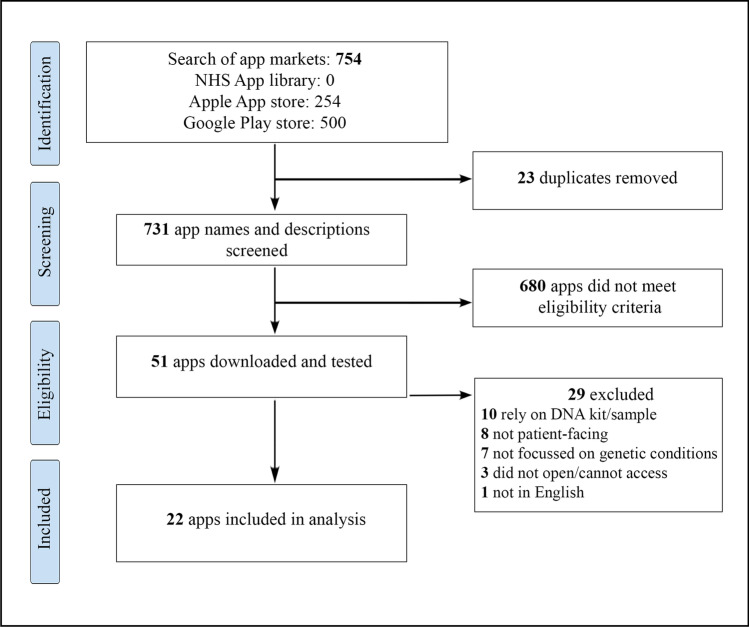
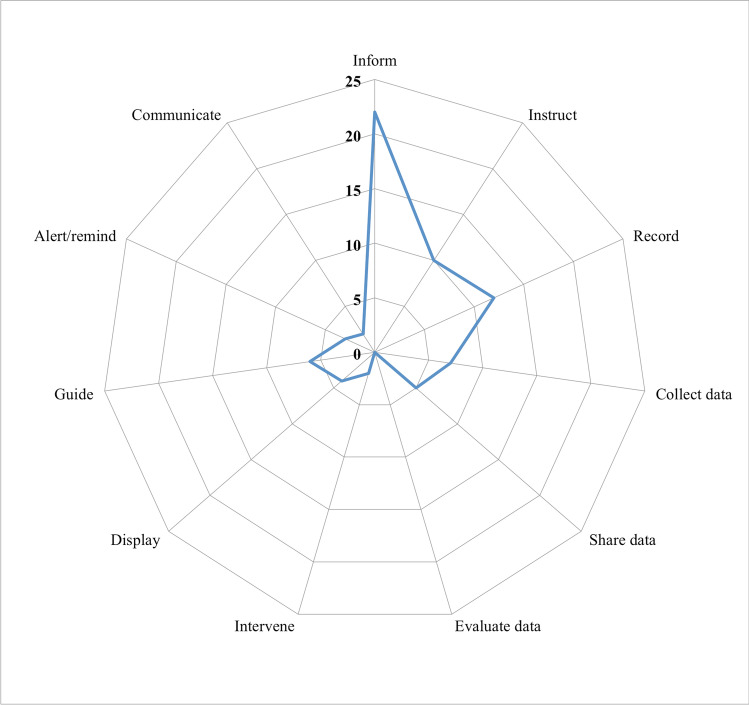
Close relative (consanguineous) marriage is widely practised globally, and it increases the risk of genetic disorders. Mobile apps may increase awareness and education regarding the associated risks in a sensitive, engaging, and accessible manner. This systematic review of patient-facing genetic/genomic mobile apps explores content, function, and quality. We searched the NHS Apps Library and the UK Google Play and Apple App stores for patient-facing genomic/genetic smartphone apps. Descriptive information and information on content was extracted and summarized. Readability was examined using the Flesch–Kincaid metrics. Two raters assessed each app, using the Mobile App Rating Scale (MARS) and the IMS Institute for Healthcare Informatics functionality score. A total of 754 apps were identified, of which 22 met the eligibility criteria. All apps intended to inform/educate users, while 32% analyzed genetic data, and 18% helped to diagnose genetic conditions. Most (68%) were clearly about genetics, but only 14% were affiliated with a medical/health body or charity, and only 36% had a privacy strategy. Mean reading scores were 35 (of 100), with the average reading age being equivalent to US grade 12 (UK year 13). On average, apps had 3.3 of the 11 IMS functionality criteria. The mean MARS quality score was 3.2 ± 0.7. Half met the minimum acceptability score (3 of 5). None had been formally evaluated. It was evident that there are few high-quality genomic/genetic patient-facing apps available in the UK. This demonstrates a need for an accessible, culturally sensitive, evidence-based app to improve genetic literacy within patient populations and specific communities.
Overview
The claims and statistics of this paper haven’t been checked yet.
Free: it reads the open-access text and checks the first 5 claims that cite a source we can check. Create a free account to check every claim.
Integrity signals
Registry
Cites
Statistics
Figures
Verification
Claims the paper makes
The claims and statistics of this paper haven’t been checked yet.
Free: it reads the open-access text and checks the first 5 claims that cite a source we can check. Create a free account to check every claim.
Self-check
Percentages, sums and reported differences re-computed from the paper’s own numbers.
The self-check needs the paper’s full text.
Citations
Cites
Preferred Reporting Items for Systematic Reviews and Meta-Analyses: the PRISMA statement
Moher, D., Liberati, A., Tetzlaff, J., Altman, D. G., & for the PRISMA Group (2009) · BMJ · doi:10.1136/bmj.b2535 · Cited by 83,823
Richards, S., Aziz, N., Bale, S., Bick, D., Das, S., Gastier-Foster, J., Grody, W. W., Hegde, M., Lyon, E., Spector, E., et al. (2015) · Genetics in Medicine · doi:10.1038/gim.2015.30 · Cited by 32,594 · cited 1×
“A genetic variant is defined as a heritable change to the DNA sequence, which can be benign or pathogenic and involves a single gene or multiple genes (Richards et al. 2015).”
BackgroundIntraclass correlations: Uses in assessing rater reliability.
Shrout, P. E., & Fleiss, J. L. (1979) · Psychological Bulletin · doi:10.1037/0033-2909.86.2.420 · Cited by 24,532 · cited 1×
“We calculated intra-class correlation coefficients (ICCs) on all MARS items using absolute agreement 2-way mixed-effects, average-measures models (Shrout and Fleiss 1979).”
MethodWang, G., Ma, R., Qiao, G., Wada, K., Aizawa, Y., & Satoh, T. (2015) · Integrative Medicine International · doi:10.1159/000368408 · Cited by 18,657
Kincaid, J. P., Fishburne, Jr., Robert P., R., Richard L., C., & Brad, S. (1975) · doi:10.21236/ada006655 · Cited by 3,497 · cited 6×
“We also determined the reading level for each app by copying the content into a Microsoft Word document and using two Flesch–Kincaid metrics (Flesch 1979; Kincaid et al. 1975).”
MethodInfluentialMobile app rating scale: a new tool for assessing the quality of health mobile apps
Stoyanov, S. R., Hides, L., Kavanagh, D. J., Zelenko, O., Tjondronegoro, D., & Mani, M. (2015) · JMIR mHealth and uHealth · doi:10.2196/mhealth.3422 · Cited by 2,233 · cited 2×
“Half ( n = 11) of the apps met the minimum acceptability score of 3 (Stoyanov et al. 2015).”
BackgroundMethodEstimating cumulative point prevalence of rare diseases: analysis of the Orphanet database
Nguengang Wakap, S., Lambert, D. M., Olry, A., Rodwell, C., Gueydan, C., Lanneau, V., Murphy, D., Le Cam, Y., & Rath, A. (2020) · European Journal of Human Genetics · doi:10.1038/s41431-019-0508-0 · Cited by 1,752 · cited 1×
“In 2020, analysis of the Orphanet rare disease registry found there to be 6172 unique rare diseases, and 71.9% of them were genetic; the global prevalence of rare disorders equates to between 263 and 446 million people affected at any one time (Nguengang Wakap et al. 2020).”
BackgroundInfluentialHealth App Use Among US Mobile Phone Owners: A National Survey
Krebs, P., & Duncan, D. T. (2015) · JMIR mHealth and uHealth · doi:10.2196/mhealth.4924 · Cited by 1,274 · cited 1×
“A cross-sectional survey of 1604 mobile phone users in the USA found that 58% of users had downloaded a health-related mobile app, but 45.7% of them failed to engage in continued use due to high data entry burden, loss of interest, and hidden costs (Krebs and Duncan 2015).”
BackgroundInfluentialUsing smartphones and health apps to change and manage health behaviors: a population-based survey
Ernsting, C., Dombrowski, S. U., Oedekoven, M., O´Sullivan, J. L., Kanzler, M., Kuhlmey, A., & Gellert, P. (2017) · Journal of Medical Internet Research · doi:10.2196/jmir.6838 · Cited by 400 · cited 1×
“…people who were aged 35 years or older found that 61% of participants used a smartphone, with users being younger, more likely to be educated to a university degree, more likely to work full-time, and be more engaged with health-related quality of life and health literacy (Ernsting et al. 2017).”
BackgroundBardus, M., van Beurden, S. B., Smith, J. R., & Abraham, C. (2016) · International Journal of Behavioral Nutrition and Physical Activity · doi:10.1186/s12966-016-0359-9 · Cited by 350 · cited 1×
“As in previous app reviews, the optional subscale for subjective quality was omitted to ensure that quality assessments were only objective (Ali et al. 2020; Bardus et al. 2016; Gasteiger et al. 2021; Kim et al. 2018).”
Genetic counselling and customary consanguineous marriage
Modell, B., & Darr, A. (2002) · Nature Reviews Genetics · doi:10.1038/nrg754 · Cited by 297 · cited 1×
“Roughly 20% of the world’s population (as of 2002) live in communities with a preference for consanguineous marriage (Modell and Darr 2002), with 10.7% (as of 2015) of the world’s population being consanguineous (Becker et al. 2015).”
BackgroundInfluentialDehling, T., Gao, F., Schneider, S., & Sunyaev, A. (2015) · JMIR mHealth and uHealth · doi:10.2196/mhealth.3672 · Cited by 243 · cited 1×
“Dehling et al. (2015) carried out an overview of mobile health apps and identified that out of 17,979 reviewed, 95.63% ( n = 17,193) posed potential information security and privacy infringement risks.”
BackgroundInfluential(1979) · Harper & Row eBooks · Cited by 224
Genetic Variation, Comparative Genomics, and the Diagnosis of Disease
Eichler, E. E. (2019) · New England Journal of Medicine · doi:10.1056/nejmra1809315 · Cited by 195 · cited 1×
“The impact of these genetic variants can vary from having a positive impact by keeping populations healthy, to no or minimal implications upon a person’s health or development, to significant morbidity and mortality (Eichler 2019).”
BackgroundMobile health and privacy: cross sectional study
Tangari, G., Ikram, M., Ijaz, K., Kaafar, M. A., & Berkovsky, S. (2021) · BMJ · doi:10.1136/bmj.n1248 · Cited by 158 · cited 2×
“%) apps reviewed (Tangari et al. 2021).”
BackgroundQuality of Publicly Available Physical Activity Apps: Review and Content Analysis
Bondaronek, P., Alkhaldi, G., Slee, A., Hamilton, F. L., & Murray, E. (2018) · JMIR mHealth and uHealth · doi:10.2196/mhealth.9069 · Cited by 156
Grainger, R., Townsley, H., White, B., Langlotz, T., & Taylor, W. J. (2017) · JMIR mHealth and uHealth · doi:10.2196/mhealth.6956 · Cited by 145 · cited 1×
“As in other systematic app reviews (Ali et al. 2020; Gasteiger et al. 2021; Grainger et al. 2017; Kim et al. 2018; Talwar et al. 2019), the Mobile App Rating Scale (Stoyanov et al. 2015) was used to determine the quality of each app.”
MethodKim, B. Y., Sharafoddini, A., Tran, N., Wen, E. Y., & Lee, J. (2018) · JMIR mhealth and uhealth · doi:10.2196/mhealth.8613 · Cited by 125 · cited 2×
“As in previous app reviews, the optional subscale for subjective quality was omitted to ensure that quality assessments were only objective (Ali et al. 2020; Bardus et al. 2016; Gasteiger et al. 2021; Kim et al. 2018).”
MethodSmartphone Medical Applications for Women’s Health: What Is the Evidence-Base and Feedback?
Derbyshire, E., & Dancey, D. (2013) · International Journal of Telemedicine and Applications · doi:10.1155/2013/782074 · Cited by 100 · cited 1×
“Involving patient groups and communities in the development and testing of mobile medical apps is also beneficial (Ceasar et al. 2019; Derbyshire and Dancey 2013).”
BackgroundGenetic discrimination: emerging ethical challenges in the context of advancing technology
Chapman, C. R., Mehta, K. S., Parent, B., & Caplan, A. L. (2019) · Journal of Law and the Biosciences · doi:10.1093/jlb/lsz016 · Cited by 91 · cited 1×
“As genetic testing is becoming more prevalent and accurate due to an ever-growing diagnostic capability, it is apparent that there are emerging ethical challenges associated with advancing technology (Chapman et al. 2020).”
BackgroundShaw, A., & Hurst, J. A. (2008) · Journal of Genetic Counseling · doi:10.1007/s10897-008-9156-1 · Cited by 79 · cited 1×
“Due to the rates of consanguineous marriage among the Pakistani community, the risks of recessive genetic disorders are higher than in non-consanguineous populations (Khan et al. 2010; Posch et al. 2012; Shaw and Hurst 2008).”
BackgroundAlkuraya, F. S. (2013) · Clinical Genetics · doi:10.1111/cge.12131 · Cited by 56 · cited 2×
“This could be important for helping overcome the previously reported religious and cultural barriers to clinical genetics (Alkuraya 2013).”
BackgroundDarr, A., Small, N., Ahmad, W. I. U., Atkin, K. M., Corry, P. C., & Modell, B. (2015) · Journal of Community Genetics · doi:10.1007/s12687-015-0252-2 · Cited by 56 · cited 1×
“It is apparent that, at times, there can be conflicting information regarding the risk of genetic disorders associated with consanguinity depending on the source, which can cause confusion amongst communities and a lack of trust in healthcare professionals (Darr et al. 2016).”
BackgroundWilliams, J. K., Erwin, C., Juhl, A. R., Mengeling, M., Bombard, Y., Hayden, M. R., Quaid, K., Shoulson, I., Taylor, S., Paulsen, J. S., et al. (2010) · American Journal of Medical Genetics Part B: Neuropsychiatric Genetics · doi:10.1002/ajmg.b.31080 · Cited by 54 · cited 2×
“This is because some cultural groups and patients may experience stigma or discrimination associated with genetic disorders (Williams et al. 2010).”
BackgroundBhopal, R. S., Petherick, E., Wright, J., & Small, N. (2013) · European Journal of Public Health · doi:10.1093/eurpub/ckt166 · Cited by 51 · cited 3×
“Consanguineous marriage is also common in the UK among the Pakistani community, which as of 2016 had numbers over 1.1 million (Bittles and Small 2016; Khan et al. 2016), with roughly 59.3% of women in the UK Pakistani community married to first or second cousins (Bhopal et al. 2014).”
BackgroundInfluentialCeasar, J. N., Claudel, S. E., Andrews, M. R., Tamura, K., Mitchell, V. M., Brooks, A. T., Dodge, T. L., El‐Toukhy, S., Farmer, N. M., Middleton, K. R., et al. (2019) · JMIR Formative Research · doi:10.2196/10944 · Cited by 48 · cited 1×
“Involving patient groups and communities in the development and testing of mobile medical apps is also beneficial (Ceasar et al. 2019; Derbyshire and Dancey 2013).”
BackgroundTeeuw, M. E., Loukili, G., Bartels, E. A. C., ten Kate, L. P., Cornel, M. C., & Henneman, L. (2013) · European Journal of Human Genetics · doi:10.1038/ejhg.2013.167 · Cited by 44 · cited 2×
“Consanguineous couples should receive appropriate information regarding their increased reproductive risk and possibilities for genetic counselling (Teeuw et al. 2014).”
BackgroundDigital manikins to self‐report pain on a smartphone: A systematic review of mobile apps
Ali, S. M., Lau, W. J., McBeth, J., Dixon, W. G., & van der Veer, S. N. (2020) · European Journal of Pain · doi:10.1002/ejp.1688 · Cited by 32 · cited 4×
“Informed by previous app reviews (Ali et al. 2020; Gasteiger et al. 2021), a coding sheet was created on Microsoft Excel, into which three raters (AV, NG and AD) extracted data from the apps (see Table 1).”
MethodInfluentialde Vries, J., Landouré, G., & Wonkam, A. (2020) · Social Science & Medicine · doi:10.1016/j.socscimed.2020.113091 · Cited by 31 · cited 1×
“Genomics can reveal sensitive information regarding group ancestry, which can create blame aimed towards individuals and within population groups (de Vries et al. 2020).”
BackgroundConsanguinity and pregnancy outcomes in a multi-ethnic, metropolitan European population
Becker, R., Keller, T., Wegner, R., Neitzel, H., Stümm, M., Knoll, U., Stärk, M., Fangerau, H., & Bittles, A. H. (2014) · Prenatal Diagnosis · doi:10.1002/pd.4487 · Cited by 30 · cited 2×
“Many West and South Asian countries have a very high prevalence of consanguineous marriage, especially close-cousin marriage (Becker et al. 2015; Hussain 2002).”
BackgroundInfluentialKhan, N., Benson, J. W., MacLeod, R., & Kingston, H. M. (2010) · Journal of Community Genetics · doi:10.1007/s12687-010-0012-2 · Cited by 28 · cited 1×
“Due to the rates of consanguineous marriage among the Pakistani community, the risks of recessive genetic disorders are higher than in non-consanguineous populations (Khan et al. 2010; Posch et al. 2012; Shaw and Hurst 2008).”
BackgroundSelf-citationSticky apps, not sticky hands: A systematic review and content synthesis of hand hygiene mobile apps
Gasteiger, N., Dowding, D., Ali, S. M., Scott, A. J. S., Wilson, P., & van der Veer, S. N. (2021) · Journal of the American Medical Informatics Association · doi:10.1093/jamia/ocab094 · Cited by 26 · cited 3×
“Informed by previous app reviews (Ali et al. 2020; Gasteiger et al. 2021), a coding sheet was created on Microsoft Excel, into which three raters (AV, NG and AD) extracted data from the apps (see Table 1).”
MethodSelf-citationSalway, S., Ali, P. A., Ratcliffe, G., Such, E., Khan, N., Kingston, H. M., & Quarrell, O. (2016) · Journal of Community Genetics · doi:10.1007/s12687-016-0269-1 · Cited by 25 · cited 4×
“An OECD survey in 2016 found that 9 million working adults in England have low literacy (or numeracy) skills, including those with university qualifications (Organisation for Economic Co-operation and Development 2016).”
BackgroundInfluentialSelf-citationCharacteristics and quality of genetics and genomics mobile apps: a systematic review
Talwar, D., Yeh, Y.-L., Chen, W., & Chen, L. (2019) · European Journal of Human Genetics · doi:10.1038/s41431-019-0360-2 · Cited by 24 · cited 4×
“A previously conducted systemic app review on 88 genetic apps available in the USA found that 55.7% ( n = 49) were created by commercial companies, and only 13.6% ( n = 12) were created by a reliable or credible agency (Talwar et al. 2019).”
BackgroundMethodResultInfluentialLay perceptions of genetic risks attributable to inbreeding in pakistan
Hussain, R. (2002) · American Journal of Human Biology · doi:10.1002/ajhb.10034 · Cited by 22 · cited 2×
“Many West and South Asian countries have a very high prevalence of consanguineous marriage, especially close-cousin marriage (Becker et al. 2015; Hussain 2002).”
BackgroundInfluentialDavies, A., Mueller, J., Hennings, J., Caress, A., & Jay, C. (2020) · JMIR Human Factors · doi:10.2196/16289 · Cited by 21 · cited 1×
“…Disease (COPD), researchers found that target users, researchers, and developers should be involved at every stage of app development, using an agile approach, including the building of a prototype app, which should then be tested in controlled settings as well as in the wild (Davies et al. 2020).”
BackgroundSelf-citationCONSANGUINITY, GENETICS AND DEFINITIONS OF KINSHIP IN THE UK PAKISTANI POPULATION
Bittles, A. H., & Small, N. (2015) · Journal of Biosocial Science · doi:10.1017/s0021932015000449 · Cited by 20 · cited 1×
“Consanguineous marriage is also common in the UK among the Pakistani community, which as of 2016 had numbers over 1.1 million (Bittles and Small 2016; Khan et al. 2016), with roughly 59.3% of women in the UK Pakistani community married to first or second cousins (Bhopal et al. 2014).”
BackgroundInfluentialPrenatal genetic counseling and consanguinity
Posch, A., Springer, S., Langer, M., Blaicher, W., Streubel, B., & Schmid, M. P. (2012) · Prenatal Diagnosis · doi:10.1002/pd.3971 · Cited by 15 · cited 1×
“Due to the rates of consanguineous marriage among the Pakistani community, the risks of recessive genetic disorders are higher than in non-consanguineous populations (Khan et al. 2010; Posch et al. 2012; Shaw and Hurst 2008).”
BackgroundKhan, N., Kerr, G., & Kingston, H. M. (2016) · Journal of Community Genetics · doi:10.1007/s12687-016-0278-0 · Cited by 12 · cited 1×
“Consanguineous marriage is also common in the UK among the Pakistani community, which as of 2016 had numbers over 1.1 million (Bittles and Small 2016; Khan et al. 2016), with roughly 59.3% of women in the UK Pakistani community married to first or second cousins (Bhopal et al. 2014).”
BackgroundInfluentialSelf-citation(2009) · Journal of Oncology Practice · doi:10.1200/jop.0912504 · Cited by 4
Untitled work
Moher (2009) · doi:10.1371/journal.pmed1000097
Research works printed but not linked: 1
- Harper, P. (2004). Practical genetic counselling (6 ed.). Arnold.
Cited by
Okuhara, T., Furukawa, E., Okada, H., Yokota, R., & Kiuchi, T. (2025) · Patient Education and Counseling · doi:10.1016/j.pec.2025.108656 · Cited by 99
Vercell, A., Gasteiger, N., Yorke, J., & Dowding, D. (2023) · International Journal of Medical Informatics · doi:10.1016/j.ijmedinf.2022.104931 · Cited by 36
Self-citationGasteiger, N., Dowding, D., Norman, G., McGarrigle, L., Eost‐Telling, C., Jones, D. J., Vercell, A., Ali, S. M., & O’Connor, S. (2023) · BMJ Open · doi:10.1136/bmjopen-2023-073283 · Cited by 44
“12 Gasteiger et al 2022 20 To identify patient-facing smartphone apps related to genetic or genomic conditions available in the UK and explore their purpose, functions and quality.”
BackgroundSelf-citationA systematic review of menopause apps with an emphasis on osteoporosis
Paripoorani, D., Gasteiger, N., Hawley-Hague, H., & Dowding, D. (2023) · BMC Women s Health · doi:10.1186/s12905-023-02612-9 · Cited by 23
Self-citationGasteiger, N., Vercell, A., Khan, N., Dowding, D., Davies, A. C., & Davies, A. (2023) · Journal of Community Genetics · doi:10.1007/s12687-023-00648-w · Cited by 14
“It was unsurprising that not many apps had been evaluated, given that our review of 22 patient-facing genetics apps available in the UK identified that none had been formally trialled or tested (Gasteiger et al. 2022).”
BackgroundInfluentialSelf-citation
Metadata
- Authors
- Gasteiger, N., Vercell, A., Davies, A., Dowding, D., Khan, N., & Davies, A.
- Affiliations
- University of Manchester (GB)
- Manchester Academic Health Science Centre (GB)
- Corresponding author
- Davies, Alan
- Davies, Angela
- Venue
- Journal of Community Genetics
- Published
- 2022-02-19
- Volume
- 13
- Issue
- 2
- Pages
- 171-182
- ISSN
- 1868-310X (ISSN-L)
- 1868-6001
- PMC
- PMC8941009
- OpenAlex
- W4212824807
- Cited by
- 16
- References
- 40
- Citations by year
- 2026: 2 · 2025: 4 · 2024: 3 · 2023: 6 · 2022: 1
- FWCI
- 0.68
- Type
- journal article
- Language
- en
- Open access
- hybrid
- doi.org
- Licence
- cc-by
- creativecommons.org/licenses/by/4.0 (tdm)
- creativecommons.org/licenses/by/4.0 (vor)
- Locations
- Journal of Community Genetics (publishedVersion, cc-by)
- PubMed Central (publishedVersion, cc-by)
- PubMed (publishedVersion)
- Research Explorer (The University of Manchester) (publishedVersion, other-oa)
- Funders
- National Institute for Health and Care Research (NIHR-INF-1567)
- Topics
- Health Sciences › Health Professions › General Health Professions › Mobile Health and mHealth Applications
- Health Sciences › Health Professions › Health Information Management › Health, Technology, Consumer Behavior
- Physical Sciences › Computer Science › Information Systems › Mobile Learning in Education
- Keywords
- mobile health apps, app quality, readability, genetic literacy, consanguineous marriage, genetic disorders, privacy, Mobile App Rating Scale
About these checks
Registry, retraction, Cites and statistics results are computed, not judged, with one exception: a printed reference that no index lists is read once by a model before it counts as a citation error. Claims are extracted by a model and kept only when their quote appears verbatim in the text; each cited source is then checked, with a model’s help, for whether it says what the claim relies on. Those verdicts can be wrong — read the claim’s quote and the cited source before relying on one.
Statistics and arithmetic are recomputed, not judged.
Confidence bands are shown only for fields calibrated on our annotated test set. None is calibrated yet, so no band is shown.
What counts as a claim ›How we measure confidence ›How we check this ›
Are you an author, or do you see a problem with this page? Request a review
Data sources
Bibliographic data: Semantic Scholar, OpenAlex, Crossref.
Contains information from the Semantic Scholar Academic Graph Datasets, made available under the ODC Attribution License (ODC-BY 1.0).
Semantic Scholar’s data is described in: Kinney, R., et al. (2023). The Semantic Scholar Open Data Platform. arXiv:2301.10140.
