

The DOI matches its Crossref record; 28 of the 28 references it cites were found in a registry or an index.
Adjunctive Use of Ketamine for Benzodiazepine-Resistant Severe Alcohol Withdrawal: a Retrospective Evaluation
Open accessAbstract
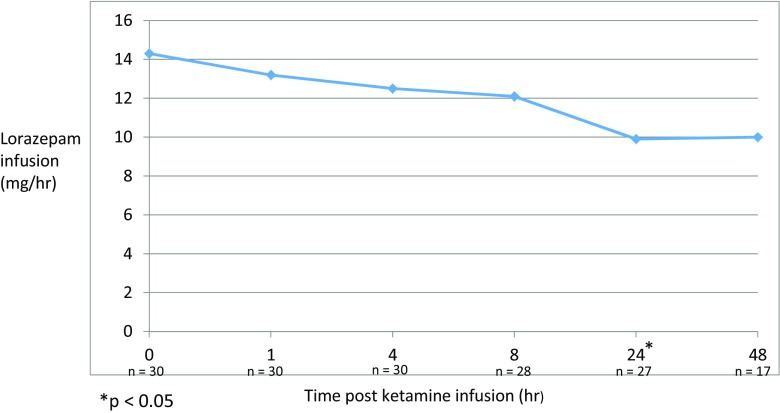
INTRODUCTION: Benzodiazepine (BZD)-resistant alcohol withdrawal remains a challenge for most institutions due to limited evidence with available agents. One published study currently exists utilizing the N-methyl-D-aspartate antagonist, ketamine, for alcohol withdrawal. OBJECTIVE: The purpose of our study was to evaluate the effect of adjunctive ketamine continuous infusion on symptom control and lorazepam infusion requirements for BZD-resistant alcohol withdrawal patients in the intensive care unit. METHODS: A retrospective review was conducted of patients receiving ketamine adjunctively with a lorazepam infusion for severe alcohol withdrawal between August 2012 and August 2014. Outcomes included time to symptom control, lorazepam infusion requirements, ketamine initial and maximum daily infusion rates, and adverse effects of ketamine. RESULTS: Thirty patients were included in the analysis. Mean time to initiation of ketamine after the initiation of a lorazepam infusion was 41.4 h. All patients achieved initial symptom control within 1 h of ketamine initiation. Median initial ketamine infusion rate was 0.75 mg/kg/h and the average maximum daily rate was 1.6 mg/kg/h. Significant decreases in lorazepam infusion rates from baseline were observed at 24 h (- 4 mg/h; p = 0.01) after ketamine initiation. No patients experienced documented CNS adverse effects. Two patients experienced hypertension and no patients experienced tachycardia related to ketamine. CONCLUSION: Adjunctive ketamine could provide symptom control for BZD-refractory patients and may potentially reduce lorazepam infusion requirements. Future studies to determine optimal dosing, timing of initiation, and place in therapy for BZD-resistant alcohol withdrawal are needed. The mechanism of action via the NMDA receptor with ketamine may provide benefit for BZD-resistant alcohol withdrawal.
Overview
The claims and statistics of this paper haven’t been checked yet.
Run the check — free, no account needed. It reads the open-access text and checks the sources it cites.
Integrity signals
Registry
Cites
Statistics
Figures
Verification
Claims the paper makes
The claims and statistics of this paper haven’t been checked yet.
Run the check — free, no account needed. It reads the open-access text and checks the sources it cites.
Claims other papers make about this one
Each is checked against this paper’s own text: does it say what the citing paper says it does?
The cited source says what the claim attributes to it.
In the citing paper
“In another retrospective study of 30 patients receiving ketamine adjunctively with a lorazepam infusion for severe alcohol withdrawal, significant decreases in lorazepam infusion rates were observed at 24 h after ketamine initiation.”
From A Narrative Review of Current and Emerging Trends in the Treatment of Alcohol Use Disorder (2024) · cites this paper as [25]
Self-check
Percentages, sums and reported differences re-computed from the paper’s own numbers.
The self-check needs the paper’s full text.
Citations
Cites
Barr, J., Fraser, G. L., Puntillo, K., Ely, E. W., Gélinas, C., Dasta, J. F., Davidson, J. E., Devlin, J. W., Kress, J. P., Joffe, A. M., et al. (2012) · Critical Care Medicine · doi:10.1097/ccm.0b013e3182783b72 · Cited by 3,896
Ketamine: Current applications in anesthesia, pain, and critical care
Kurdi, M., Theerth, K. A., & Deva, R. (2014) · Anesthesia Essays and Researches · doi:10.4103/0259-1162.143110 · Cited by 395
Alcohol withdrawal syndrome: mechanisms, manifestations, and management
Jesse, S., Bråthen, G., Ferrara, M., Keindl, M., Ben‐Menachem, E., Tănăsescu, R., Brodtkorb, E., Hillbom, M., Leone, M. A., & Ludolph, A. C. (2016) · Acta Neurologica Scandinavica · doi:10.1111/ane.12671 · Cited by 261
Bayard, M. M., McIntyre, J., Hill, K. R., & Woodside, J. R. (2000) · CRC Press eBooks · doi:10.1201/9781420036961-14 · Cited by 232
Gold, J. A., Rimal, B., Nolan, A., & Nelson, L. S. (2007) · Critical Care Medicine · doi:10.1097/01.ccm.0000256841.28351.80 · Cited by 183
Carlson, R. W., Kumar, N. N., Wong-Mckinstry, E., Ayyagari, S., Puri, N., Jackson, F. K., & Shashikumar, S. (2012) · Critical Care Clinics · doi:10.1016/j.ccc.2012.07.004 · Cited by 162
Şener, S., Eken, C., Schultz, C. H., et al. (2010) · Annals of Emergency Medicine · doi:10.1016/j.annemergmed.2010.09.010 · Cited by 160
Role of Glutamatergic and GABAergic Systems in Alcoholism
Davis, K. M., & Wu, J. ‐. (2001) · Journal of Biomedical Science · doi:10.1007/bf02255966 · Cited by 148
NMDA Receptor Antagonism and the Ethanol Intoxication Signal
Krystal, J. H., Petrakis, I. L., Krupitsky, E. M., Schütz, C., Trevisan, L. A., & D’Souza, D. C. (2003) · Annals of the New York Academy of Sciences · doi:10.1196/annals.1300.010 · Cited by 132
Alcohol withdrawal syndromes in the intensive care unit
Sarff, M., & Gold, J. A. (2010) · Critical Care Medicine · doi:10.1097/ccm.0b013e3181ec5412 · Cited by 129
Cited by
Sorted by citations
A Narrative Review of Current and Emerging Trends in the Treatment of Alcohol Use Disorder
Celik, M., Gold, M. S., & Fuehrlein, B. (2024) · Brain Sciences · doi:10.3390/brainsci14030294 · Cited by 25
Metadata
- Authors
- Shah, P., McDowell, M., Ebisu, R., Hanif, T., & Toerne, T.
- Affiliations
- Advocate Christ Medical Center (US)
- Minneapolis VA Health Care System (US)
- Corresponding author
- Shah, Poorvi
- Venue
- Journal of Medical Toxicology
- Published
- 2018-05-10
- Volume
- 14
- Issue
- 3
- Pages
- 229-236
- ISSN
- 1556-9039 (ISSN-L)
- 1937-6995
- PMC
- PMC6097970
- OpenAlex
- W2799971203
- Cited by
- 46
- References
- 28
- Citations by year
- 2026: 5 · 2025: 10 · 2024: 8 · 2023: 7 · 2022: 7 · 2021: 2 · 2020: 4 · 2019: 3
- FWCI
- 1.53
- Type
- journal article
- Language
- en
- Open access
- hybrid
- doi.org
- Licence
- Locations
- Journal of Medical Toxicology (publishedVersion, cc-by)
- Europe PMC (PubMed Central) (publishedVersion, other-oa)
- PubMed Central (publishedVersion, cc-by)
- PubMed (publishedVersion)
- Topics
- Health Sciences › Medicine › Clinical Neurology › Alcoholism and Thiamine Deficiency
- Health Sciences › Medicine › Anesthesiology and Pain Medicine › Anesthesia and Sedative Agents
- Health Sciences › Medicine › Epidemiology › Substance Abuse Treatment and Outcomes
- Keywords
- ketamine, alcohol withdrawal, benzodiazepine resistance, adjunctive therapy, continuous infusion, NMDA receptor antagonists, intensive care unit, ketamine side effects
- MeSH terms
- Blood Alcohol Content, Adult, Aged, Ethanol, Benzodiazepines, Central Nervous System Depressants, Critical Care, Drug Resistance, Female, Humans, Hypertension, Infusions, Intravenous, Ketamine, Lorazepam, Male, Middle Aged, Retrospective Studies, Substance Withdrawal Syndrome, Treatment Outcome, Excitatory Amino Acid Antagonists, Alcohol Withdrawal Seizures
About these checks
Registry, retraction, Cites and statistics results are computed, not judged, with one exception: a printed reference that no index lists is read once by a model before it counts as a citation error. Claims are extracted by a model and kept only when their quote appears verbatim in the text; each cited source is then checked, with a model’s help, for whether it says what the claim relies on. Those verdicts can be wrong — read the claim’s quote and the cited source before relying on one.
Statistics and arithmetic are recomputed, not judged.
Confidence bands are shown only for fields calibrated on our annotated test set. None is calibrated yet, so no band is shown.
What counts as a claim ›How we measure confidence ›How we check this ›
Are you an author, or do you see a problem with this page? Request a review
