

Towards future-oriented conservation: Managing protected areas in an era of climate change
Open accessThe DOI matches its Crossref record; 52 of the 54 references it cites were found in a registry or an index.
Abstract
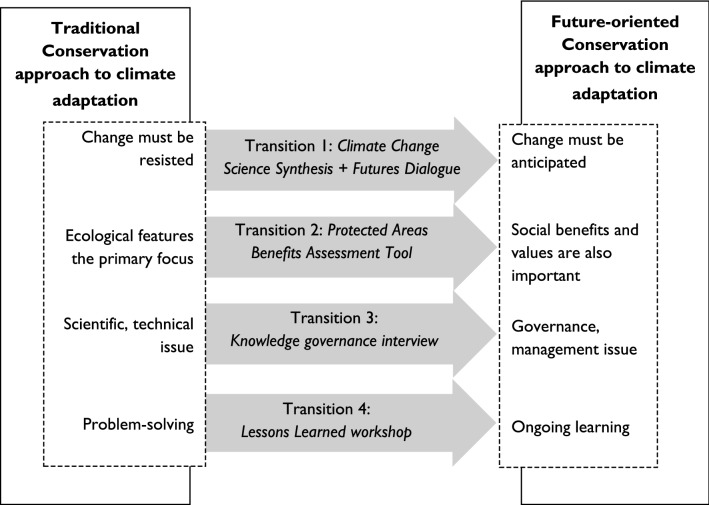
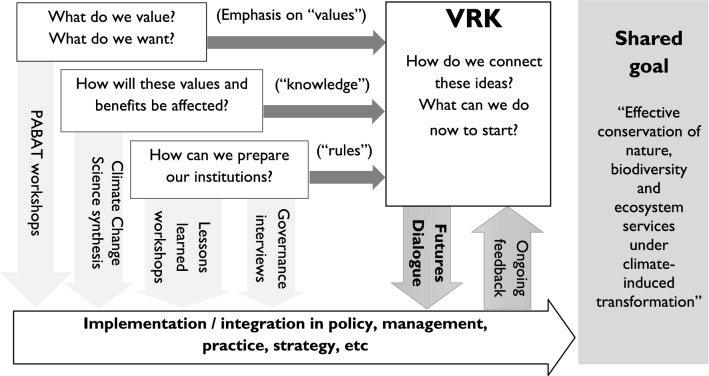
Management of protected areas must adapt to climate impacts, and prepare for ongoing ecological transformation. Future-Proofing Conservation is a dialogue-based, multi-stakeholder learning process that supports conservation managers to consider the implications of climate change for governance and management. It takes participants through a series of conceptual transitions to identify new management options that are robust to a range of possible biophysical futures, and steps that they can take now to prepare for ecological transformation. We outline the Future-Proofing Conservation process, and demonstrate its application in a pilot programme in Colombia. This process can be applied and adapted to a wide range of climate adaptation contexts, to support practitioners in developing positive ways forward for management and decision-making. By acknowledging scientific uncertainty, considering social values, and rethinking the rules that shape conservation governance, participants can identify new strategies towards "future-oriented conservation" over the long term.
Overview
The claims and statistics of this paper haven’t been checked yet.
Free: it reads the open-access text and checks the first 5 claims that cite a source we can check. Create a free account to check every claim.
Integrity signals
Registry
Cites
Statistics
Figures
Verification
Claims the paper makes
The claims and statistics of this paper haven’t been checked yet.
Free: it reads the open-access text and checks the first 5 claims that cite a source we can check. Create a free account to check every claim.
Claims other papers make about this one
Each is checked against this paper’s own text: does it say what the citing paper says it does?
The check wasn’t confident either way, so it gives no verdict — never disputed.
In the citing paper
“The park also encompasses the 36-hectare North Creek Wetland which was excavated by the hospital's patients during this period.188”
From Protecting and restoring habitats to benefit freshwater biodiversity (2024) · cites this paper as [188]
Experimental — accuracy not yet measured
Self-check
Percentages, sums and reported differences re-computed from the paper’s own numbers.
The self-check needs the paper’s full text.
Citations
Cites
(1994) · Journal of the American Dietetic Association · doi:10.1016/0002-8223(94)92216-0 · Cited by 45,910
Collaborative Governance in Theory and Practice
Ansell, C., & Gash, A. (2008) · Journal of Public Administration Research and Theory · doi:10.1093/jopart/mum032 · Cited by 8,256
Navigating Social-Ecological Systems: Building Resilience for Complexity and Change
Berkes, F., Colding, J., & Folke, C. (2008) · Cited by 2,793
Are there social limits to adaptation to climate change?
Adger, W. N., Dessai, S., Goulden, M., Hulme, M., Lorenzoni, I., Nelson, D. R., Naess, L. O., Wolf, J., & Wreford, A. (2009) · Climatic Change · doi:10.1007/s10584-008-9520-z · Cited by 2,501
Rowe, P. G. (1987) · Cited by 2,481
Adaptation to climate change : from resilience to transformation
Pelling, M. (2011) · Cited by 2,191
COPING WITH TRAGEDIES OF THE COMMONS
Ostrom, E. (1999) · Annual Review of Political Science · doi:10.1146/annurev.polisci.2.1.493 · Cited by 1,390 · cited 1×
“We considered both the formal institutional arrangements and the historically embedded informal expectations and norms that influence conservation actions (Ostrom 1999).”
BackgroundShooting the Rapids: Navigating Transitions to Adaptive Governance of Social-Ecological Systems
Olsson, P., Gunderson, L. H., Carpenter, S. R., Ryan, P., Lebel, L., Folke, C., & Holling, C. S. (2006) · Ecology and Society · doi:10.5751/es-01595-110118 · Cited by 1,324 · cited 1×
“Consistent with adaptive management approaches, interventions need to be informed by new knowledge from many sources, and adapt as biophysical conditions and societal values continue to change (Olsson et al. 2006; Berkes et al. 2008).”
BackgroundConservation Planning for Ecosystem Services
Chan, K. M. A., Shaw, M. R., Cameron, D. R., Underwood, E. C., & Daily, G. C. (2006) · PLoS Biology · doi:10.1371/journal.pbio.0040379 · Cited by 1,180 · cited 2×
“experienced by people may be different from maintaining the current state of the ecosystems themselves (Chan et al. 2006).”
BackgroundFoden, W. B., Butchart, S. H. M., Stuart, S. N., Vié, J.-C., Akçakaya, H. R., Angulo, A., DeVantier, L. M., Gutsche, A., Turak, E., Cao, L., et al. (2013) · PLoS ONE · doi:10.1371/journal.pone.0065427 · Cited by 988
Research works printed but not linked: 2
- Dudley N Stolton S The protected area benefits assessment tool 2009 Gland WWF International
- Figueroa C Behar K Análisis de los beneficios de la areas protegidas de la Cuenca Alta del Río Otún 2017 Bogota Luc Hoffmann Institute, WWF and Parques Nacionales Naturales de Colombia
Cited by
Principles for knowledge co-production in sustainability research
Norström, A. V., Cvitanovic, C., Löf, M. F., West, S., Wyborn, C., Balvanera, P., Bednarek, A. T., Bennett, E. M., Biggs, R., de Bremond, A., et al. (2020) · Nature Sustainability · doi:10.1038/s41893-019-0448-2 · Cited by 1,620
Self-citationArea-based conservation in the twenty-first century
Maxwell, S. L., Cazalis, V., Dudley, N., Hoffmann, M., Rodrigues, A. S. L., Stolton, S., Visconti, P., Woodley, S., Kingston, N., Lewis, E., et al. (2020) · Nature · doi:10.1038/s41586-020-2773-z · Cited by 998
Self-citationSix modes of co-production for sustainability
Chambers, J. M., Wyborn, C., Ryan, M. E., Reid, R. S., Riechers, M., Serban, A., Bennett, N. J., Cvitanovic, C., Fernández-Giménez, M. E., Galvin, K. A., et al. (2021) · Nature Sustainability · doi:10.1038/s41893-021-00755-x · Cited by 526
Self-citationCo-productive agility and four collaborative pathways to sustainability transformations
Chambers, J. M., Wyborn, C., Klenk, N. L., Ryan, M., Serban, A., Bennett, N. J., Brennan, R., Charli-Joseph, L., Fernández-Giménez, M. E., Galvin, K. A., et al. (2022) · Global Environmental Change · doi:10.1016/j.gloenvcha.2021.102422 · Cited by 292
Self-citationIntegrated ocean management for a sustainable ocean economy
Winther, J.-G., Dai, M., Rist, T., Hoel, A. H., Li, Y., Trice, A., Morrissey, K., Juinio-Meñez, M. A., Fernandes, L., Unger, S., et al. (2020) · Nature Ecology & Evolution · doi:10.1038/s41559-020-1259-6 · Cited by 245
Metadata
- Authors
- van Kerkhoff, L., Munera, C., Dudley, N., Guevara, O., Wyborn, C., Figueroa, C., Dunlop, M., Hoyos, M. A., Castiblanco, J., & Becerra, L.
- Affiliations
- Equilibrium Research (GB)
- WWF Colombia (CO)
- Luc Hoffmann Institute (CH)
- Commonwealth Scientific and Industrial Research Organisation (AU)
- Venue
- Ambio
- Published
- 2018-11-17
- Volume
- 48
- Issue
- 7
- Pages
- 699-713
- ISSN
- 0044-7447 (ISSN-L)
- 1654-7209
- PMC
- PMC6509096
- OpenAlex
- W2900655914
- Cited by
- 87
- References
- 54
- Citations by year
- 2026: 5 · 2025: 12 · 2024: 5 · 2023: 12 · 2022: 21 · 2021: 17 · 2020: 10 · 2019: 4
- FWCI
- 4.54
- Type
- journal article
- Language
- en
- Open access
- hybrid
- doi.org
- Licence
- cc-by
- creativecommons.org/licenses/by/4.0 (tdm)
- Locations
- AMBIO (publishedVersion, cc-by)
- Europe PMC (PubMed Central) (publishedVersion, cc-by)
- PubMed Central (publishedVersion, cc-by)
- PubMed (publishedVersion)
- ANU Open Research (Australian National University) (submittedVersion, cc-by)
- Funders
- Luc Hoffmann Institute (P10002150, PO#2174)
- Topics
- Physical Sciences › Environmental Science › Global and Planetary Change › Conservation, Biodiversity, and Resource Management
- Physical Sciences › Environmental Science › Global and Planetary Change › Sustainability and Climate Change Governance
- Life Sciences › Agricultural and Biological Sciences › Forestry › Forest Management and Policy
- Keywords
- protected area management, climate change adaptation, conservation governance, ecological transformation, dialogue process, scientific uncertainty, social values, conservation decision-making, Colombia
- MeSH terms
- Colombia, Conservation of Natural Resources, Decision Making, Ecology, Climate Change
About these checks
Registry, retraction, Cites and statistics results are computed, not judged, with one exception: a printed reference that no index lists is read once by a model before it counts as a citation error. Claims are extracted by a model and kept only when their quote appears verbatim in the text; each cited source is then checked, with a model’s help, for whether it says what the claim relies on. Those verdicts can be wrong — read the claim’s quote and the cited source before relying on one.
Statistics and arithmetic are recomputed, not judged.
Confidence bands are shown only for fields calibrated on our annotated test set. None is calibrated yet, so no band is shown.
What counts as a claim ›How we measure confidence ›How we check this ›
Are you an author, or do you see a problem with this page? Request a review
Data sources
Bibliographic data: Semantic Scholar, OpenAlex, Crossref.
Contains information from the Semantic Scholar Academic Graph Datasets, made available under the ODC Attribution License (ODC-BY 1.0).
Semantic Scholar’s data is described in: Kinney, R., et al. (2023). The Semantic Scholar Open Data Platform. arXiv:2301.10140.
