

Glucagon Administration by Nasal and Intramuscular Routes in Adults With Type 1 Diabetes During Insulin-Induced Hypoglycaemia: A Randomised, Open-Label, Crossover Study
Open accessThe DOI matches its Crossref record; 14 of the 14 references it cites were found in a registry or an index.
Abstract
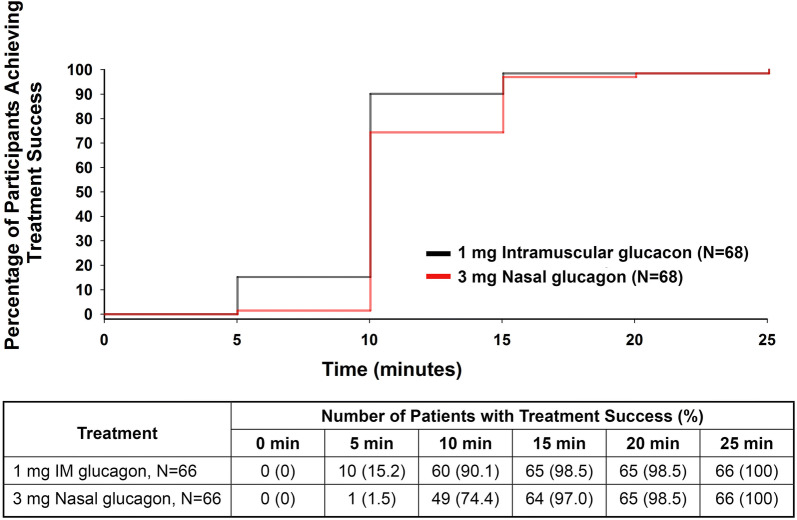
INTRODUCTION: Many commercially available glucagon products for treatment of severe hypoglycaemia require cumbersome reconstitution and potentially intimidating injection during an emergency. Nasal glucagon (NG) is a novel drug-device combination product consisting of a single-use dosing device that delivers glucagon dry powder through nasal administration. The present study assessed whether 3 mg NG was non-inferior to 1 mg intramuscular glucagon (IMG) in adults with type 1 diabetes. METHODS: This randomised, open-label, two-period, crossover trial was conducted at two clinical sites. Hypoglycaemia (plasma glucose [PG] target of < 3.3 mmol/l (60 mg/dl) was induced by an intravenous insulin infusion. Glucagon preparations were given by study staff. Treatment success was defined as an increase in PG to ≥ 3.9 mmol/l (70 mg/dl) or an increase of ≥ 1.1 mmol/l (20 mg/dl) from the PG nadir within 30 min of receiving glucagon. RESULTS: Of the 66 participants included in the primary efficacy analysis who received both NG and IMG, 100% achieved treatment success, thus demonstrating non-inferiority of NG to IMG. All participants achieved treatment success within 25 min with the mean time to treatment success of 11.4 min (NG) and 9.9 min (IMG). No serious adverse events occurred. Forty-eight treatment-emergent adverse events (TEAEs) occurred after NG and 51 after IMG. Most TEAEs were mild and transient. CONCLUSION: Nasal glucagon was as efficacious and well tolerated as IMG for the treatment of insulin-induced hypoglycaemia in adults and will be as useful as IMG as a rescue treatment for severe hypoglycaemia. TRIAL REGISTRATION: NCT03339453, ClinicalTrials.gov.
Overview
The claims and statistics of this paper haven’t been checked yet.
Free: it reads the open-access text and checks the first 5 claims that cite a source we can check. Create a free account to check every claim.
Integrity signals
Registry
Cites
Statistics
Figures
Verification
Claims the paper makes
The claims and statistics of this paper haven’t been checked yet.
Free: it reads the open-access text and checks the first 5 claims that cite a source we can check. Create a free account to check every claim.
Claims other papers make about this one
Each is checked against this paper’s own text: does it say what the citing paper says it does?
The source backs part of the claim, not all of it — or backs it for a different population, condition or comparison.
In the citing paper
“However, intranasal and ready-to-inject glucagon preparations are now widely available and are preferred due to their ease of administration resulting in more rapid correction of hypoglycemia (143-145).”
From 6. Glycemic Goals, Hypoglycemia, and Hyperglycemic Crises: Standards of Care in Diabetes-2026. (2026) · cites this paper as [144]
Experimental — accuracy not yet measured
Self-check
Percentages, sums and reported differences re-computed from the paper’s own numbers.
The self-check needs the paper’s full text.
Citations
Cites
International Hypoglycaemia Study Group (2017) · Diabetes Care · doi:10.2337/dc16-2215 · Cited by 608
Improved confidence intervals for the difference between binomial proportions based on paired data
Newcombe, R. G. (1998) · Statistics in Medicine · doi:10.1002/(sici)1097-0258(19981130)17:22<2635::aid-sim954>3.0.co;2-c · Cited by 416
The International Hypoglycaemia Study Group (2017) · Diabetologia · doi:10.1007/s00125-016-4146-6 · Cited by 360
Efficacy and safety of desloratadine in the treatment of perennial allergic rhinitis
Simons, F. E. R., Prenner, B. M., & Finn, A. F. (2003) · Journal of Allergy and Clinical Immunology · doi:10.1067/mai.2003.168 · Cited by 135 · cited 1×
“Safety assessments included spontaneously reported adverse events (AEs) and serious adverse events (SAEs), nasal and non-nasal symptoms solicited through the Nasal/Nonnasal Score Questionnaire [10] (Supplemental Table 1), and vital signs (supine systolic blood pressure, diastolic blood pressure, and heart rate).”
BackgroundTreatment of severe diabetic hypoglycemia with glucagon: an underutilized therapeutic approach
Kedia (2011) · Diabetes, Metabolic Syndrome and Obesity: Targets and Therapy · doi:10.2147/dmso.s20633 · Cited by 131
Rickels, M. R., Ruedy, K. J., Foster, N. C., Piché, C. A., Dulude, H., Sherr, J. L., Tamborlane, W. V., Bethin, K. E., DiMeglio, L. A., Wadwa, R. P., et al. (2016) · Diabetes Care · doi:10.2337/dc15-1498 · Cited by 128 · cited 2×
“conducted a study using the clinical trial NG drug product [8].”
BackgroundMethodSelf-citationYale, J.-F., Dulude, H., Egeth, M., Piché, C. A., Lafontaine, M., Carballo, D., Margolies, R., Dissinger, E., Shames, A. R., Kaplowitz, N., et al. (2017) · Diabetes Technology & Therapeutics · doi:10.1089/dia.2016.0460 · Cited by 88
Self-citationYanez, N. D., Kronmal, R. A., & Shemanski, L. R. (1998) · Statistics in Medicine · doi:10.1002/(sici)1097-0258(19981130)17:22<2597::aid-sim940>3.0.co;2-g · Cited by 77
Glucagon administration – underevaluated and undertaught
Harrism, G., Diment, A., Sulway, M., & Wilkinson, M. (2001) · Practical Diabetes International · doi:10.1002/pdi.138 · Cited by 71 · cited 3×
“Administration of injectable glucagon can be complicated by errors and failures to administer the drug by non-medical caregivers in a demanding situation [2, 3].”
BackgroundMethodInfluentialCeriello, A., Novials, A., Ortega, E., Pujadas, G., Sala, L. L., Testa, R., Bonfigli, A. R., & Genovese, S. (2013) · Nutrition Metabolism and Cardiovascular Diseases · doi:10.1016/j.numecd.2013.05.003 · Cited by 57 · cited 1×
“Evidence from a clinical study suggests potential harm through an increase in cardiovascular risk factors to type 1 diabetes patients that experience hyperglycaemia after recovery from hypoglycaemia [12].”
Background
Cited by
6. Glycemic Goals and Hypoglycemia: Standards of Care in Diabetes—2024
American Diabetes Association Professional Practice Committee, ElSayed, N. A., Aleppo, G., Bannuru, R. R., Bruemmer, D., Collins, B. S., Ekhlaspour, L., Hilliard, M. E., Johnson, E. L., Khunti, K., et al. (2024) · Diabetes Care · doi:10.2337/dc24-s006 · Cited by 486
6. Glycemic Goals and Hypoglycemia: Standards of Care in Diabetes—2025
American Diabetes Association Professional Practice Committee, ElSayed, N. A., McCoy, R. G., Aleppo, G., Balapattabi, K., Beverly, E. A., Briggs Early, K., Bruemmer, D., Echouffo-Tcheugui, J. B., Ekhlaspour, L., et al. (2025) · Diabetes Care · doi:10.2337/dc25-s006 · Cited by 440
Jeong, S.-H., Jang, J.-H., & Lee, Y.-B. (2023) · Journal of Pharmaceutical Investigation · doi:10.1007/s40005-022-00589-5 · Cited by 256
6. Glycemic Goals, Hypoglycemia, and Hyperglycemic Crises: Standards of Care in Diabetes-2026.
American Diabetes Association Professional Practice Committee for Diabetes*, Bajaj, M., McCoy, R. G., Balapattabi, K., Bannuru, R. R., Bellini, N. J., Bennett, A. K., Beverly, E. A., Briggs Early, K., ChallaSivaKanaka, S., et al. (2026) · Diabetes Care · doi:10.2337/dc26-s006 · Cited by 172
The past, present, and future physiology and pharmacology of glucagon
Capozzi, M. E., D’Alessio, D. A., & Campbell, J. E. (2022) · Cell Metabolism · doi:10.1016/j.cmet.2022.10.001 · Cited by 109
Roldan, V. D. T., Urtecho, M., Nayfeh, T., Firwana, M., Muthusamy, K., Hasan, B., Abd‐Rabu, R., Maraboto, A., Qoubaitary, A., Prokop, L. J., et al. (2022) · The Journal of Clinical Endocrinology & Metabolism · doi:10.1210/clinem/dgac601 · Cited by 49
Kang, S., Kang, S. M., Choi, J. H., Ko, S., Koo, B. K., Kwon, H.-S., Kim, M. K., Kim, S. Y., Kim, S., Kim, Y., et al. (2025) · Diabetes & Metabolism Journal · doi:10.4093/dmj.2025.0469 · Cited by 85
Fasiolo, L. T., Manniello, M. D., Banella, S., Napoli, L., Bortolotti, F., Quarta, E., Colombo, P., Balafas, E., Kostomitsopoulos, N. G., Rekkas, D. M., et al. (2021) · International Journal of Pharmaceutics · doi:10.1016/j.ijpharm.2021.120827 · Cited by 34
Vitore, J. G., Bharathi, K., Salave, S., Rana, D., Perla, A., Gupta, S., Shah, S., Pardhe, R., Chittemreddy, P., Kashid, S., et al. (2023) · Journal of Drug Delivery Science and Technology · doi:10.1016/j.jddst.2023.104421 · Cited by 24
Manta, K., Papakyriakopoulou, P., Nikolidaki, A., Balafas, E., Kostomitsopoulos, N. G., Banella, S., Colombo, G., & Valsami, G. N. (2023) · Pharmaceutics · doi:10.3390/pharmaceutics15082036 · Cited by 23
“FDA in 2019 for the delivery of an intranasal rescue treatment for severe hypoglycemia in individuals with diabetes [39,40].”
BackgroundExcipient Interactions in Glucagon Dry Powder Inhaler Formulation for Pulmonary Delivery
Rashid, M. A., El-Gied, A. A., Alhamhoom, Y., Chan, E., Rintoul, L., Allahham, A., & Islam, N. (2019) · Pharmaceutics · doi:10.3390/pharmaceutics11050207 · Cited by 21
Polysaccharides: New Frontiers for Nasal Administration of Medicines
Clementino, A., Climani, G., Bianchera, A., Buttini, F., & Sonvico, F. (2025) · Polysaccharides · doi:10.3390/polysaccharides6010006 · Cited by 21
“…clinical trial performed on the intranasal product (IN, 3 mg) by comparison with the intramuscular (IM, 1 mg), no significant differences were observed in terms of T max , but the C max increased by almost 60% (6130 pg/mL IN vs. 35,750 pg/mL IM), confirming the non-inferiority of the product [149].”
Porcellati, F., Mauro, S. D., Mazzieri, A., Scamporrino, A., Filippello, A., Fano, M. D., Fanelli, C. G., Purrello, F., Malaguarnera, R., & Piro, S. (2021) · Biomolecules · doi:10.3390/biom11091281 · Cited by 19
Giménez, M., Khunti, K., Matsuhisa, M., Chenji, S., Syring, K. E., & Yan, Y. (2023) · Diabetes Therapy · doi:10.1007/s13300-023-01466-6 · Cited by 11
Gupta, S., Perla, A., Roy, A., Vitore, J. G., Bharathi, K., Salave, S., Rana, D., Sharma, A. K., Rathod, R., Kumar, H., et al. (2023) · AAPS PharmSciTech · doi:10.1208/s12249-022-02496-2 · Cited by 8
“Recently, a powder-based glucagon formulation for the intranasal route has been introduced into the clinical practice wherein the pharmacokinetic parameters of this intranasal powder formulation are comparable to those of a reconstituted glucagon formulation administered intramuscularly [16, 17].”
Emergency Glucagon: a Focused Review of Psychosocial Experiences of Rescue Drugs for Type 1 Diabetes
CHAPMAN, K. S. M., Hughes, A. S., Bispham, J. A., Leon, C., Nguyen, H., & Wolf, W. A. (2022) · Current Diabetes Reports · doi:10.1007/s11892-021-01443-y · Cited by 8
Hypoglycemia in Type 1 Diabetes Mellitus
Şakar, K., & Çınar, N. (2024) · IntechOpen eBooks · doi:10.5772/intechopen.1004108 · Cited by 9
Uniform trehalose nanogels for glucagon stabilization
Puente, E. G., Sivasankaran, R. P., Vinciguerra, D., Yang, J., Lower, H.-A. C., Hevener, A. L., & Maynard, H. D. (2024) · RSC Applied Polymers · doi:10.1039/d3lp00226h · Cited by 7
Utility of a Novel Micro-Spraying Device for Intranasal Administration of Drug Solutions to Mice
Suzuki, N., Tanigawa, H., Nagatomo, T., Miyagishi, H., Kanazawa, T., Suzuki, T., & Kosuge, Y. (2023) · Pharmaceutics · doi:10.3390/pharmaceutics15112553 · Cited by 5
“These features enable the delivery of novel modalities, such as peptides and nucleic acid drugs, to the central nervous system [7,8] and suppress systemic side effects of drugs that occur when administered via conventional administration methods [6,9].”
BackgroundNot only for caregivers: intranasal glucagon for severe hypoglycaemia in a simulation study
Monzani, A., Savastio, S., Manzo, A., Scalogna, A., Pozzi, E., Sainaghi, P. P., Corte, F. D., & Rabbone, I. (2022) · Acta Diabetologica · doi:10.1007/s00592-022-01952-6 · Cited by 5
Mitchell, B. D., Rentz, A. M., Kummer, S., Yan, Y., Heidenreich, S., Krucien, N., Artime, E., Osumili, B., Rubio, M., & Gelhorn, H. L. (2022) · Journal of Diabetes Science and Technology · doi:10.1177/19322968221095882 · Cited by 3
“…for each of the clinical attributes were based on the results of two studies that compared nasal glucagon with conventional injectable glucagon, 10,19 as well as official prescribing information and instructions for use for the two products. b This attribute was omitted from the first direct…”
MethodRabbone, I., Missineo, A., Zanetta, S., Salzano, G., Schiaffini, R., Scaramuzza, A. E., & Lombardo, F. (2021) · Diabetes Obesity and Metabolism · doi:10.1111/dom.14398 · Cited by 3
Gogna, R., Jung, C., McLachlan, K., Krishnamurthy, B., Hong, A., Derbyshire, M. M., Kiburg, K., Zacharin, M., MacIsaac, R. J., Sachithanandan, N., et al. (2021) · Clinical Endocrinology · doi:10.1111/cen.14464 · Cited by 3
Zucchini, S., Ripoli, C., Cherubini, V., Coccioli, M. S., Delvecchio, M., Marco, R. D., Franceschi, R., Gallo, F., Graziani, V., Iafusco, D., et al. (2023) · Diabetes Obesity and Metabolism · doi:10.1111/dom.15330 · Cited by 2
Nasal versus sublingual routes for emergency drug administration
Debe, M. S., Khan, S. A., Ahmed, I. S., Hussain, Z., Uddin, M. N., & Rawas‐Qalaji, M. (2025) · Journal of Pharmaceutical Sciences · doi:10.1016/j.xphs.2025.103903 · Cited by 2
Current applications of biomolecules in biopharmaceuticals and drug discovery
Rastegari, A., Faghihi, H., & Mohammadi, Z. (2023) · Elsevier eBooks · doi:10.1016/b978-0-323-91684-4.00023-2 · Cited by 1
Stimson, R. H., Dover, A. R., Strachan, M. W. J., Wright, R. J., Lyall, M. J., Jeeyavudeen, M. S., Forbes, S., & Gibb, F. W. (2023) · Journal of Diabetes and its Complications · doi:10.1016/j.jdiacomp.2023.108561 · Cited by 1
Seaquist, E. R., Giménez, M., Yan, Y., Matsuhisa, M., Kao, C. Y., Wadwa, R. P., Nagai, Y., & Khunti, K. (2024) · Journal of the Endocrine Society · doi:10.1210/jendso/bvae034 · Cited by 1
“Patients from studies 1 [17] and 2 [18], which used the commercial-equivalent NG drug product, were included in the efficacy cohort.”
BackgroundMethodClinical Pharmacology of Glucagon
Kronfol, M. M., Chow, E. C. Y., Lau, S. W. J., Nounou, M. I., Vaidyanathan, J., & Seo, S. K. (2024) · Clinical Pharmacology & Therapeutics · doi:10.1002/cpt.3340 · Cited by 1
Nasu, R., James, D. E., Chigutsa, E., Garhyan, P., & Nagai, Y. (2023) · Pediatric Drugs · doi:10.1007/s40272-023-00565-y
Trevella, P., Caputo, C., Jung, C., Krishnamurthy, B., McLachlan, K., Sachithanandan, N., Derbyshire, M. M., MacIsaac, R. J., & Hong, A. (2025) · Clinical Endocrinology · doi:10.1111/cen.15292
Development of Polymeric Materials for the Stabilization and Delivery of Biological Therapeutics
Yang, J. (2023) · eScholarship (California Digital Library)
Lam, J. P. M., Justus-Heale, O., & Snead, E. C. R. (2026) · Journal of Feline Medicine and Surgery · doi:10.1177/1098612x261471152
Metadata
- Authors
- Suico, J. G., Hövelmann, U., Zhang, S., Shen, T., Bergman, B., Sherr, J., Zijlstra, E., Frier, B. M., & Plum-Mörschel, L.
- Affiliations
- Eli Lilly (United States) (US)
- Profil Institute for Metabolic Research (DE)
- Yale University (US)
- The Queen's Medical Research Institute (GB)
- Corresponding author
- Suico, Jeffrey G.
- ORCID
- Venue
- Diabetes Therapy
- Published
- 2020-06-08
- Volume
- 11
- Issue
- 7
- Pages
- 1591-1603
- ISSN
- 1869-6953 (ISSN-L)
- 1869-6961
- PMC
- PMC7324463
- OpenAlex
- W3033451567
- Semantic Scholar
- e87b010b1bdb96eb28eeb7d0d02ddf0cc63ebce0
- Cited by
- 32
- References
- 13
- Citations by year
- 2026: 1 · 2025: 5 · 2024: 5 · 2023: 10 · 2022: 6 · 2021: 4
- FWCI
- 3.77
- Type
- journal article
- Language
- en
- Open access
- gold
- doi.org
- Licence
- cc-by-nc
- creativecommons.org/licenses/by-nc/4.0 (tdm)
- creativecommons.org/licenses/by-nc/4.0 (vor)
- Locations
- Diabetes Therapy (publishedVersion, cc-by-nc)
- PubMed Central (publishedVersion, cc-by-nc)
- PubMed (publishedVersion)
- Funders
- Eli Lilly and Company
- Topics
- Health Sciences › Medicine › Endocrinology, Diabetes and Metabolism › Diabetes Management and Research
- Health Sciences › Medicine › Endocrinology, Diabetes and Metabolism › Diabetes Treatment and Management
- Health Sciences › Medicine › Public Health, Environmental and Occupational Health › Patient Safety and Medication Errors
- Keywords
- nasal glucagon, type 1 diabetes, severe hypoglycemia, insulin-induced hypoglycemia, drug-device combination products, non-inferiority, treatment success, adverse events
About these checks
Registry, retraction, Cites and statistics results are computed, not judged, with one exception: a printed reference that no index lists is read once by a model before it counts as a citation error. Claims are extracted by a model and kept only when their quote appears verbatim in the text; each cited source is then checked, with a model’s help, for whether it says what the claim relies on. Those verdicts can be wrong — read the claim’s quote and the cited source before relying on one.
Statistics and arithmetic are recomputed, not judged.
Confidence bands are shown only for fields calibrated on our annotated test set. None is calibrated yet, so no band is shown.
What counts as a claim ›How we measure confidence ›How we check this ›
Are you an author, or do you see a problem with this page? Request a review
Data sources
Bibliographic data: Semantic Scholar, OpenAlex, Crossref.
Contains information from the Semantic Scholar Academic Graph Datasets, made available under the ODC Attribution License (ODC-BY 1.0).
Semantic Scholar’s data is described in: Kinney, R., et al. (2023). The Semantic Scholar Open Data Platform. arXiv:2301.10140.
