

Insights from VERIFY: Early Combination Therapy Provides Better Glycaemic Durability Than a Stepwise Approach in Newly Diagnosed Type 2 Diabetes
Open accessThe DOI matches its Crossref record; 35 of the 35 references it cites were found in a registry or an index.
Abstract
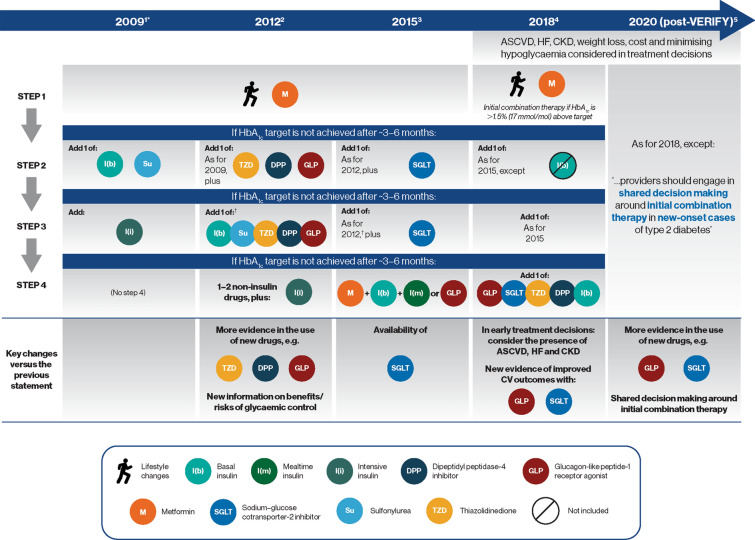
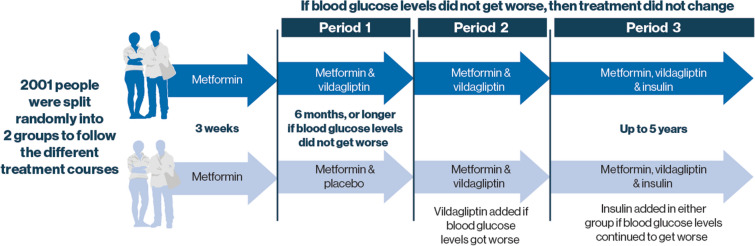
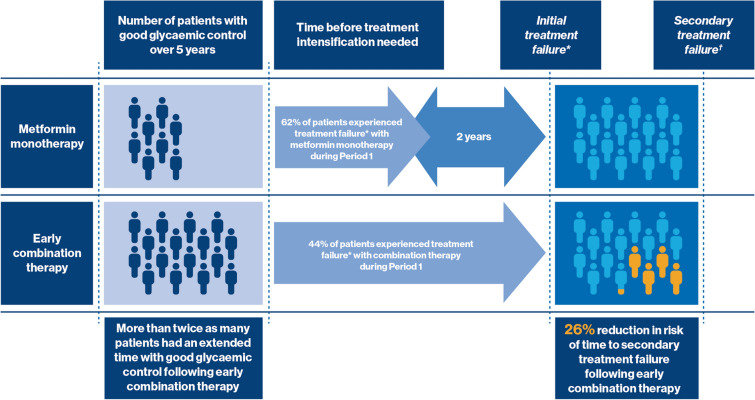
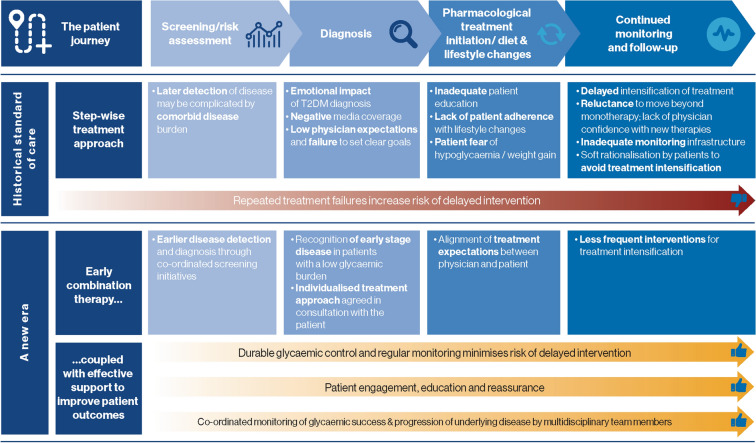
The treatment aims for type 2 diabetes are to prevent complications and premature mortality, and improve quality of life. Glycaemic control is central to these aims; clinical guidelines have sought to achieve this with a stepwise approach starting with lifestyle measures and metformin, adding further medications once glycated haemoglobin (HbA1c) levels rise above a predefined threshold. However, treatment intensification can be delayed when HbA1c levels increase, and HbA1c levels become inadequately controlled in many patients. Clinical inertia can result in sustained elevated levels of HbA1c; when combined with a late diagnosis, this negatively impacts patients’ prognosis. Early combination therapy using medications with complementary modes of action could achieve optimal glycaemic targets and alter the course of the disease more than metformin alone. The multinational VERIFY study (clinicaltrials.gov NCT01528254) provided evidence accrued over 5 years, demonstrating the potential of early combination therapy: time to loss of glycaemic control was nearly doubled, and more than twice the number of patients experienced extended glycaemic control, with a vildagliptin–metformin combination therapy versus metformin alone. The study also showed a delay in secondary treatment failure in patients receiving the combination. Early combination therapy therefore offers a different trajectory to the stepwise approach. Translating these findings into clinical practice will require early detection and diagnosis of type 2 diabetes plus a shift in disease management. Nonetheless, the potential benefits of sustained and continuous disease control that early combination therapy offers represent the start of a new era in early diagnosis and intensive management, to achieve the treatment aims of type 2 diabetes. Blood glucose progressively increases over time in type 2 diabetes and is currently treated in a stepwise fashion, with more medications added when a single treatment fails. The VERIFY trial studied people with newly or recently diagnosed type 2 diabetes. Treating people early with two glucose-lowering drugs given together could slow the worsening of blood glucose levels, compared with starting with metformin first and then adding a second treatment later. Taking the two treatments together was as well tolerated as taking the single treatment alone. Starting treatment with two glucose-lowering drugs given together lengthened the time before insulin was needed, compared with starting with metformin and then adding a second treatment later. This is important to people with diabetes, as early treatment is straightforward but becomes increasingly complicated in later stages. The long-term benefits of this early combination treatment are awaited. In the meantime, the VERIFY trial has shown that combination therapy given at the start of treatment with medication can improve blood glucose levels and delay the need for insulin.
Overview
The claims and statistics of this paper haven’t been checked yet.
Free: it reads the open-access text and checks the first 5 claims that cite a source we can check. Create a free account to check every claim.
Integrity signals
Registry
Cites
Statistics
Figures
Verification
Claims the paper makes
The claims and statistics of this paper haven’t been checked yet.
Free: it reads the open-access text and checks the first 5 claims that cite a source we can check. Create a free account to check every claim.
Claims other papers make about this one
Each is checked against this paper’s own text: does it say what the citing paper says it does?
The source backs part of the claim, not all of it — or backs it for a different population, condition or comparison.
In the citing paper
“Early combination therapy based on the perceived need for additional glycemic ef fi cacy or cardiorenal protection can be considered at treatment initiation to extend the time to treatment failure (176).”
From Management of Hyperglycemia in Type 2 Diabetes, 2022. A Consensus Report by the American Diabetes Association (ADA) and the European Association for the Study of Diabetes (EASD) (2022) · cites this paper as [176]
Experimental — accuracy not yet measured
Self-check
Percentages, sums and reported differences re-computed from the paper’s own numbers.
The self-check needs the paper’s full text.
Citations
Cites
10-year follow-up of intensive glucose control in type 2 diabetes
Holman, R. R., Paul, S. K., Bethel, M. A., Matthews, D. R., & Neil, H. A. W. (2008) · New England Journal of Medicine · doi:10.1056/nejmoa0806470 · Cited by 7,751
Self-citationGupta, A., & Uribarri, J. (2016) · Hormone Research in Paediatrics · doi:10.1159/000444053 · Cited by 4,006
Inzucchi, S. E., Bergenstal, R. M., Buse, J. B., Diamant, M., Ferrannini, E., Nauck, M., Peters, A. L., Tsapas, A., Wender, R., & Matthews, D. R. (2012) · Diabetologia · doi:10.1007/s00125-012-2534-0 · Cited by 3,919
Self-citationNathan, D. M., Buse, J. B., Davidson, M. B., Ferrannini, E., Holman, R. R., Sherwin, R., & Zinman, B. (2009) · Diabetes Care · doi:10.2337/dc08-9025 · Cited by 3,834
Davies, M. J., D’Alessio, D. A., Fradkin, J., Kernan, W. N., Mathieu, C., Mingrone, G., Rossing, P., Tsapas, A., Wexler, D. J., & Buse, J. B. (2018) · Diabetes Care · doi:10.2337/dci18-0033 · Cited by 3,518
Self-citationInzucchi, S. E., Bergenstal, R. M., Buse, J. B., Diamant, M., Ferrannini, E., Nauck, M., Peters, A. L., Tsapas, A., Wender, R., & Matthews, D. R. (2015) · Diabetes Care · doi:10.2337/dc14-2441 · Cited by 3,066
Self-citationDavies, M. J., D’Alessio, D. A., Fradkin, J., Kernan, W. N., Mathieu, C., Mingrone, G., Rossing, P., Tsapas, A., Wexler, D. J., & Buse, J. B. (2018) · Diabetologia · doi:10.1007/s00125-018-4729-5 · Cited by 1,455
Self-citation
Cited by
Davies, M. J., Aroda, V. R., Collins, B. S., Gabbay, R. A., Green, J., Maruthur, N. M., Rosas, S. E., Del Prato, S., Mathieu, C., Mingrone, G., et al. (2022) · Diabetes Care · doi:10.2337/dci22-0034 · Cited by 2,104
“Early combination therapy based on the perceived need for additional glycemic efficacy or cardiorenal protection can be considered at treatment initiation to extend the time to treatment failure (176).”
BackgroundSelf-citationDavies, M. J., Aroda, V. R., Collins, B. S., Gabbay, R. A., Green, J., Maruthur, N. M., Rosas, S. E., Del Prato, S., Mathieu, C., Mingrone, G., et al. (2022) · Diabetologia · doi:10.1007/s00125-022-05787-2 · Cited by 1,048
“on the perceived need for additional glycaemic efficacy or cardiorenal protection can be considered at treatment initiation to extend the time to treatment failure [176].”
Self-citationSeidu, S., Alabraba, V., Davies, S., Newland‐Jones, P., Fernando, K., Bain, S. C., Diggle, J., Evans, M., James, J., Kanumilli, N., et al. (2024) · Diabetes Therapy · doi:10.1007/s13300-024-01550-5 · Cited by 98
Aroda, V. R., & Eckel, R. H. (2022) · Diabetes Obesity and Metabolism · doi:10.1111/dom.14830 · Cited by 43
“treatment failure) and also reduced the risk of time to secondary treatment failure by 26%.(105,106) Although the trial was not powered to assess CV outcomes, early combination therapy was associated with a numerically longer time to first adjudicated macrovascular event than metformin monotherapy.”
BackgroundMohan, V., Zargar, A. H., Chawla, M. S., Joshi, A. S., Ayyagari, U., Sethi, B. K., Gaurav, K., Patted, U. R. H., Bhagat, S. V., & Mane, A. (2021) · Diabetes Metabolic Syndrome and Obesity · doi:10.2147/dmso.s315227 · Cited by 25
Self-citationChan, J. C. N., Chow, E., Kong, A. P. S., Cheung, E. Y. N., Tony, O., Lim, C. K. P., Fan, B., Tsoi, S. T. F., Fan, Y., Shi, M., et al. (2024) · Journal of Translational Genetics and Genomics · doi:10.20517/jtgg.2023.36 · Cited by 18
Self-citationNewsholme, P., Rowlands, J., Rose’Meyer, R. B., & Cruzat, V. F. (2022) · Antioxidants · doi:10.3390/antiox11010108 · Cited by 17
Patient Adherence for Oral Combination Therapies in Diabetes Management: A Scoping Review
Zarrinkamar, M., Geran, M., & Geran, M. (2025) · Health Science Reports · doi:10.1002/hsr2.70780 · Cited by 11
Treatment adherence and the contemporary approach to treating type 2 diabetes mellitus
Kolarš, B., Minaković, I., Grabovac, B., Živanović, D., & Mijatović, V. (2024) · Biomedical Papers · doi:10.5507/bp.2024.009 · Cited by 14
Koufakis, T., Zografou, I., Doumas, M. N., & Kotsa, K. (2023) · American Journal of Cardiovascular Drugs · doi:10.1007/s40256-023-00610-8 · Cited by 10
Almahmeed, W. A., Al-Abadla, Z., Alawadi, F., Alrohmaihi, D., Alshamiri, M. Q., Elbadawi, H., El‐Tamimi, H., Elzouki, A.-N. Y., Farghaly, M., Hafidh, K., et al. (2025) · Advances in Therapy · doi:10.1007/s12325-024-03103-5 · Cited by 10
Striving for early effective glycaemic and weight management in type 2 diabetes: A narrative review
CHENG, A. Y. Y., Heine, R. J., Prato, S. D., Green, J. B., Thieu, V. T., & Zeytinoglu, M. (2025) · Diabetes Obesity and Metabolism · doi:10.1111/dom.16206 · Cited by 7
“40,41 In this study, 2001 participants recently diagnosed with T2D received metformin plus vildagliptin (combination) or metformin plus placebo (monotherapy) over 5 years.”
InfluentialLarsen, A. T., Melander, S. A., Mohamed, K. E., Petersen, E. A., Benmarce, M., Karsdal, M. A., & Henriksen, K. (2025) · Biomedicine & Pharmacotherapy · doi:10.1016/j.biopha.2025.118388 · Cited by 3
Chawla, M. S., CHAWLA, P. M., Jethwani, P., Shah, K., & Reddy, S. (2023) · Clinics and Practice · doi:10.3390/clinpract13020045 · Cited by 3
Early Combination Therapies for the Preservation of Pancreatic β Cells in Type 2 Diabetes Mellitus
Rachdaoui, N. (2023) · Endocrinology · doi:10.1210/endocr/bqad134 · Cited by 3
Albajy, M. A., & Mihailescu, D. F. (2024) · Health Problems of Civilization · doi:10.5114/hpc.2024.136467 · Cited by 2
Kwiendacz, H., Nabrdalik, K., Czupryniak, L., Klupa, T., Malecki, M. T., Myśliwiec, M., Strojek, K., & Gumprecht, J. (2023) · Advances in Therapy · doi:10.1007/s12325-023-02567-1 · Cited by 2
Shaikh, S. S., Vaidya, V., Gupta, A. K., Kulkarni, R., Joshi, A., Kulkarni, M., Sharma, V., & Revankar, S. Y. (2024) · Cureus · doi:10.7759/cureus.59850 · Cited by 3
“%) on monotherapy has been declining every year [34], with failure rates of up to 45% [35,36].”
BackgroundPatient-Driven Solutions: Integrating Vildagliptin and Dapagliflozin in Diabetes Management
Maladkar, M. N., Yadav, A., & Anchan, N. (2024) · International Journal of Diabetes and Endocrinology · doi:10.11648/j.ijde.20240902.12 · Cited by 2
Ghosh, S., Mukhopadhyay, M., Agrawal, M. B., Shahid, M., Lamba, M., Jain, S., Prasad, A., Gupta, A., Kesarkar, R. N., Warrier, S. B., et al. (2024) · International Journal of Diabetes and Technology · doi:10.4103/ijdt.ijdt_24_24 · Cited by 2
Ruyatkina, L. A., Ruyatkin, D. S., & Iskhakova, I. S. (2021) · Meditsinskiy sovet = Medical Council · doi:10.21518/2079-701x-2021-7-33-44 · Cited by 3
Erande, S. G., Mukhopadhyay, J., Dange, A., Deogaonkar, A., Birla, A., Doshi, C., Revankar, S. Y., Sridhar, S. B., Kumar, N., & Kadam, P. (2023) · Cureus · doi:10.7759/cureus.44548 · Cited by 2
“Early combination therapy using agents with complementary modes of action holds the promise of altering the course of the disease, thereby providing extended periods of stable HbA1c levels, delaying the need for therapy intensification, and reducing the risk of chronic complications [4].”
Sarda, A., Sosale, B., Mohan, B. J., Tanna, S., Gupta, V., Gupta, S., Langade, D., Kotwal, R., Kolapkar, V., & Patel, K. (2025) · Cureus · doi:10.7759/cureus.82549 · Cited by 2
“Implementing early combination therapy can also modify the disease's progression, offering more durable glycemic control and potentially altering the clinical course of T2DM [17].”
Butranova, O. I., Zyryanov, S. K., Melnikova, A. R., & Matsepuro, A. E. (2025) · Terapevticheskii arkhiv · doi:10.26442/00403660.2025.08.203345 · Cited by 2
CHENG, A. Y. Y., Mottl, A. K., & MAGWIRE, M. L. (2025) · Diabetes Therapy · doi:10.1007/s13300-025-01796-7 · Cited by 5
Moreira, R. O., Nicodemus, N. A., Çömlekçi, A., Yu, M., & Almalki, M. (2025) · Advances in Therapy · doi:10.1007/s12325-025-03394-2 · Cited by 1
Manjula, S. N., & Krishna Kumar, M. (2024) · South Asian Research Journal of Medical Sciences · doi:10.36346/sarjms.2024.v06i01.003 · Cited by 1
“The multinational VERIFY trial has shown that combination of two glucose lowering drugs at the start of treatment can improve blood glucose levels and delay the need for insulin [7].”
BackgroundAmin, H. H., & Chaudhary, H. R. (2024) · International Journal of Pharmaceutical Sciences and Drug Research · doi:10.25004/ijpsdr.2024.160317
Ayyar, V. S., Ommen, T., Shukla, R. P., Ahmed, A., Fulara, S. N., Mahule, A., Prasad, A., & Pednekar, A. (2025) · International Journal of Basic & Clinical Pharmacology · doi:10.18203/2319-2003.ijbcp20250018 · Cited by 2
Васильевна, Ц. О., Тимощенко, О. В., & Latyntseva, L. D. (2022) · Ateroscleroz · doi:10.52727/2078-256x-2021-17-4-66-73
Study of physicians' preferences for optimizing the pharmacy assortment of glocose-lowering drugs
Власенко, І. О. (2023) · Farmatsevtychnyi zhurnal · doi:10.32352/0367-3057.3.23.02
Lei, Y., Yi, Q., Ji, S., Lu, J., & Yang, Z. (2026) · Clinical Pharmacology in Drug Development · doi:10.1002/cpdd.70029
Mahapatra, H., Gupta, P. K., Paul, A., Nampalliwar, A., Bansal, M., Das, B., & Namboothiri, K. P. (2026) · Cureus · doi:10.7759/cureus.104344 · Cited by 1
“Combination therapy targets complementary mechanisms simultaneously, providing a mechanistic rationale for improved and more sustained glycemic control [25,26].”
Sambhav, K., Batham, A. K., Nimavat, A. S., Singh, R., Lodha, N., Jha, H., & Patel, A. (2026) · Cureus · doi:10.7759/cureus.108406
“Simultaneous targeting of complementary mechanisms, such as insulin resistance, impaired insulin secretion, and increased renal glucose reabsorption, has been shown to enhance therapeutic effectiveness compared with single-agent approaches [21,28].”
John, M., Panikar, V., Seshadri, K. G., Bhartia, M., Joshi, A., PADHYE, D. A., Kapoor, N., Ayyagari, U., Periyandavar, I., Vijayakumar, G., et al. (2026) · Journal of Diabetology · doi:10.4103/jod.jod_71_26
Metadata
- Authors
- Matthews, D., Del Prato, S., Mohan, V., Mathieu, C., Vencio, S., Chan, J. C. N., Stumvoll, M., & Paldánius, P. M.
- Affiliations
- University of Oxford (GB)
- Madras Diabetes Research Foundation (IN)
- Universitair Ziekenhuis Leuven (BE)
- Chinese University of Hong Kong (HK)
- Novartis (Switzerland) (CH)
- Corresponding author
- Matthews, David
- Venue
- Diabetes Therapy
- Published
- 2020-09-25
- Volume
- 11
- Issue
- 11
- Pages
- 2465-2476
- ISSN
- 1869-6953 (ISSN-L)
- 1869-6961
- PMC
- PMC7547931
- OpenAlex
- W3089094100
- Cited by
- 35
- References
- 35
- Citations by year
- 2026: 4 · 2025: 9 · 2024: 9 · 2023: 6 · 2022: 5 · 2021: 2
- FWCI
- 2.45
- Type
- journal article
- Language
- en
- Open access
- gold
- doi.org
- Licence
- cc-by-nc
- creativecommons.org/licenses/by-nc/4.0 (tdm)
- creativecommons.org/licenses/by-nc/4.0 (vor)
- Locations
- Diabetes Therapy (publishedVersion, cc-by-nc)
- PubMed Central (publishedVersion, cc-by-nc)
- PubMed (publishedVersion)
- Lirias (submittedVersion, cc-by-nc)
- Työväentutkimus Vuosikirja (submittedVersion)
- PuSH - Publication Server of Helmholtz Zentrum München (submittedVersion)
- Funders
- Novartis, Basel, Switzerland
- Topics
- Health Sciences › Medicine › Endocrinology, Diabetes and Metabolism › Diabetes Treatment and Management
- Health Sciences › Medicine › Endocrinology, Diabetes and Metabolism › Diabetes Management and Research
- Health Sciences › Medicine › Endocrinology, Diabetes and Metabolism › Diabetes, Cardiovascular Risks, and Lipoproteins
- Keywords
- type 2 diabetes, early combination therapy, vildagliptin, metformin, glycemic control, HbA1c, clinical inertia, newly diagnosed diabetes, insulin requirement, antidiabetic drugs, treatment failure, disease management, early detection of diabetes, tolerability, cost-effectiveness, quality of life
About these checks
Registry, retraction, Cites and statistics results are computed, not judged, with one exception: a printed reference that no index lists is read once by a model before it counts as a citation error. Claims are extracted by a model and kept only when their quote appears verbatim in the text; each cited source is then checked, with a model’s help, for whether it says what the claim relies on. Those verdicts can be wrong — read the claim’s quote and the cited source before relying on one.
Statistics and arithmetic are recomputed, not judged.
Confidence bands are shown only for fields calibrated on our annotated test set. None is calibrated yet, so no band is shown.
What counts as a claim ›How we measure confidence ›How we check this ›
Are you an author, or do you see a problem with this page? Request a review
Data sources
Bibliographic data: Semantic Scholar, OpenAlex, Crossref.
Contains information from the Semantic Scholar Academic Graph Datasets, made available under the ODC Attribution License (ODC-BY 1.0).
Semantic Scholar’s data is described in: Kinney, R., et al. (2023). The Semantic Scholar Open Data Platform. arXiv:2301.10140.
