

Cost-Effectiveness of FreeStyle Libre for Glucose Self-Management Among People with Diabetes Mellitus: A Canadian Private Payer Perspective
Open accessThe DOI matches its Crossref record; 67 of the 67 references it cites were found in a registry or an index.
Abstract
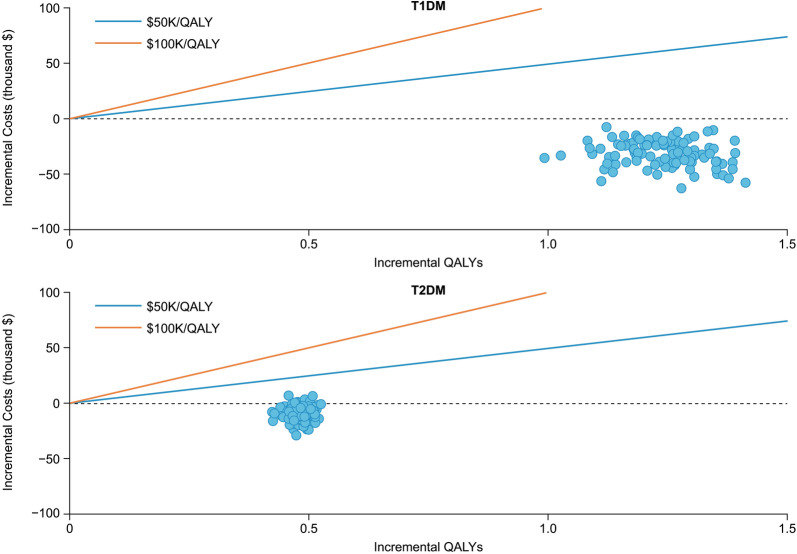
For people living with diabetes, effective glucose monitoring is a key component in diabetes care, helping to reduce disease burden, complications, and healthcare utilization. Sensor-based glucose monitoring systems, which can provide more comprehensive information about glucose levels than capillary-based self-monitoring of blood glucose (SMBG), are becoming established among people living with diabetes. The objective of this study was to assess the cost-effectiveness of glucose monitoring with FreeStyle Libre systems, compared with SMBG, from the perspective of a Canadian private payer. The analysis used the validated, person-level microsimulation model DEDUCE (Determination of Diabetes Utilities, Costs, and Effects). Analyses were conducted separately for populations of people with type 1 and type 2 diabetes mellitus (T1DM; T2DM), with time horizons of 40 and 25 years, respectively. T2DM treatment was assumed to be 84% non-insulin, 10% basal insulin, and 6% multiple daily injections of insulin. The effect of FreeStyle Libre was modeled as reductions versus SMBG in glycated hemoglobin level (T1DM, − 0.42%; insulin-treated T2DM, − 0.59%; non-insulin-treated T2DM, − 0.3%) and in acute diabetic events (hypoglycemia and diabetic ketoacidosis). Costs (in 2023 Canadian dollars (Can$)) and utilities were discounted at 1.5%. Outcomes were assessed as costs and quality-adjusted life years (QALYs). In both populations, FreeStyle Libre was dominant to SMBG, providing more QALYs at a lower cost (T1DM: + 1.25 QALYs, − Can$32,287 costs; T2DM: + 0.48 QALYs, − Can$8091 costs). Reductions were seen in the cumulative incidence of all complications (except blindness in the T1DM analysis). FreeStyle Libre was dominant to SMBG in all scenarios tested. Probabilistic sensitivity analysis showed that FreeStyle Libre had a 100% probability of being dominant to SMBG for T1DM and a 91% probability of being dominant for T2DM. This economic analysis shows that, from a Canadian private payer perspective, FreeStyle Libre is cost-effective compared with SMBG for all people living with diabetes. Glucose monitoring is important for people living with diabetes. Effective glucose monitoring can reduce the risk of hypoglycemia (low blood sugar), diabetic ketoacidosis (a potentially life-threatening complication which occurs when the body has low insulin and high blood sugar levels), and long-term complications. This can be done using finger sticks and test strips or sensor-based devices such as the FreeStyle Libre systems. In this study, we modeled the effect of FreeStyle Libre use in persons living with type 1 or type 2 diabetes mellitus in Canada using the DEDUCE economic model. In both analyses, FreeStyle Libre use was predicted to lead to better outcomes (measured as quality-adjusted life years—a measure of health which combines life expectancy with quality of life) for people living with diabetes while reducing costs.
Overview
The claims and statistics of this paper haven’t been checked yet.
Free: it reads the open-access text and checks the first 5 claims that cite a source we can check. Create a free account to check every claim.
Integrity signals
Registry
Cites
Statistics
Figures
Verification
Claims the paper makes
The claims and statistics of this paper haven’t been checked yet.
Free: it reads the open-access text and checks the first 5 claims that cite a source we can check. Create a free account to check every claim.
Claims other papers make about this one
Each is checked against this paper’s own text: does it say what the citing paper says it does?
The cited source says what the claim attributes to it.
In the citing paper
“A recent Canadian economic analysis using a person‐level microsimulation model showed that isCGM is more cost‐effective than BGM. 60”
Self-check
Percentages, sums and reported differences re-computed from the paper’s own numbers.
The self-check needs the paper’s full text.
Citations
Cites
Canadian Institute for Health Information.
Lalonde, A. (1994) · PubMed · Cited by 4,739
Bolinder, J., Antuna, R., Geelhoed-Duijvestijn, P., Kröger, J., & Weitgasser, R. (2016) · The Lancet · doi:10.1016/s0140-6736(16)31535-5 · Cited by 893
Continuous Glucose Monitoring: A Review of Successes, Challenges, and Opportunities
Rodbard, D. (2016) · Diabetes Technology & Therapeutics · doi:10.1089/dia.2015.0417 · Cited by 737 · cited 2×
“As a result, the use of sensor-based glucose monitoring systems, which can provide more comprehensive information about glucose levels than SMBG while reducing the need for fingersticks, is becoming established among people living with diabetes [5].”
Haak, T., Hanaire, H., Ajjan, R., Hermanns, N., Riveline, J.-P., & Rayman, G. (2017) · Diabetes Therapy · doi:10.1007/s13300-016-0223-6 · Cited by 623
The Wisconsin Epidemiologic Study of Diabetic Retinopathy XXII
Klein, R., Knudtson, M. D., Lee, K. E., Gangnon, R., & Klein, B. E. K. (2008) · Ophthalmology · doi:10.1016/j.ophtha.2008.08.023 · Cited by 584 · cited 1×
“…T1DM, complications are modeled using the Sheffield Type 1 Diabetes Model equations, which were primarily derived from the Diabetes Control and Complications Trial/Epidemiology of Diabetes Interventions and Complications Study and the Wisconsin Epidemiological Study of Diabetic Retinopathy [19–21].”
Estimating Utility Values for Health States of Type 2 Diabetic Patients Using the EQ-5D (UKPDS 62)
Clarke, P., Gray, A., & Holman, R. (2002) · Medical Decision Making · doi:10.1177/027298902400448902 · Cited by 515 · cited 1×
“In the absence of Canada-specific data, baseline health utility values (0.839 for T1DM and 0.785 for T2DM) were taken from two UK prospective studies (Supplementary Material, Table S1) [25, 35, 56–64].”
InfluentialMultivariate models of health-related utility and the fear of hypoglycaemia in people with diabetes
Currie, C. J., Morgan, C. L., Poole, C. D., Sharplin, P., Lammert, M., & McEwan, P. (2006) · Current Medical Research and Opinion · doi:10.1185/030079906x115757 · Cited by 279 · cited 1×
“For people living with T1DM, a further disutility of 0.025 was applied to those using SMBG, based on the fear of hypo-glycemia reported in a UK survey [63].”
InfluentialEdridge, C. L., Dunkley, A. J., Bodicoat, D. H., Rose, T. C., Gray, L. J., Davies, M. J., & Khunti, K. (2015) · PLOS ONE · doi:10.1371/journal.pone.0126427 · Cited by 225 · cited 2×
“The rate of NSHE was based on published studies [14, 31, 35] and was conservatively assumed not to be reduced with FreeStyle Libre among persons living with T2DM who were not using insulin.”
Basu, S., Sussman, J. B., Berkowitz, S. A., Hayward, R. A., & Yudkin, J. S. (2017) · The Lancet Diabetes & Endocrinology · doi:10.1016/s2213-8587(17)30221-8 · Cited by 206 · cited 4×
“The modeled population characteristics are shown in Table 1 [11, 25] and Table 2 [7, 22, 26, 27].”
Influential
Cited by
Aronson, R., Abitbol, A., Bajaj, H. S., Cheng, A. Y. Y., Christopoulos, S., Harris, S. B., Jain, A. B., & Goldenberg, R. M. (2025) · Diabetes, Obesity and Metabolism · doi:10.1111/dom.70008 · Cited by 33
“A recent Canadian economic analysis using a person-level microsimulation model showed that isCGM is more cost-effective than BGM. 60 A similar analysis, modelled on the patient characteristics reported by Aronson and colleagues 49 also demonstrated greater cost-effectiveness of rtCGM over BGM for Canadian public payor…”
InfluentialSelf-citationUsing digital tools to improve diabetes care in India with continuous glucose monitoring
Kesavadev, J., Saboo, B., Chawla, M. S., Unnikrishnan, A., Dunn, T. C., & TIWASKAR, M. H. (2025) · Therapeutic Advances in Endocrinology and Metabolism · doi:10.1177/20420188251372290 · Cited by 8
“70, 71 Further local research is necessary to evaluate the cost-effectiveness and practical implementation of CGM technologies in the diverse Indian healthcare context.”
Bruttomesso, D., Petrie, J., Evans, M. L., Fleming, G. A., Hanaire, H. P., Holl, R. W., Sherr, J. L., Bergenstal, R. M., Heinemann, L., & Peters, A. L. (2026) · Diabetes Care · doi:10.2337/dci26-0018 · Cited by 8
Robles-Plaza, M., Peralta, F. G., Bellido, V., Ampudia‐Blasco, F. J., Carretero‐Gómez, J., Cuenca, A. M. C., de la Cuadra-Grande, A., & Mezquita‐Raya, P. (2025) · Diabetes Therapy · doi:10.1007/s13300-025-01816-6 · Cited by 6
Clinical Impact of Continuous Glucose Monitoring in Noninsulin Treated Type 2 Diabetes: A Review
Aleppo, G., Carlson, A. L., McGill, J. B., Alshannaq, H. A., Galindo, R. J., Kruger, D. F., Levy, C. J., Matuoka, J. Y., Ilham, S., Umpierrez, G. E., et al. (2026) · Diabetes Technology & Therapeutics · doi:10.1177/15209156251414980 · Cited by 6
Bruttomesso, D., Petrie, J. R., Evans, M. L., Fleming, G. A., Hanaire, H. P., Holl, R. W., Sherr, J. L., Bergenstal, R. M., Heinemann, L., & Peters, A. L. (2026) · Diabetologia · doi:10.1007/s00125-025-06651-9 · Cited by 3
van Dijk, P. R., Chesters, C., Timmons, J., Szafranski, K., Bakker, J., & Levrat‐Guillen, F. (2025) · Diabetes Therapy · doi:10.1007/s13300-025-01821-9 · Cited by 2
“Similarly, a Canadian study that included costs due to work absenteeism found that from a private payer perspective FSL was dominant to SMBG for people with T2DM on intensive insulin, basal insulin, or non‑insulin therapies [41].”
Self-citationSelf-Management Sebagai Komponen Esensial dalam Pencegahan dan Pengelolaan Ulkus Kaki Diabetes
Iriantono, G., Armiyati, Y., & Soesanto, E. (2025) · Jurnal Penelitian Kesehatan "SUARA FORIKES" (Journal of Health Research "Forikes Voice") · doi:10.33846/sf16343 · Cited by 1
WRIGHT, E. E., Gavin, J. R., ROWES, J. R., Lee, A., & Poon, Y. (2026) · Diabetes Technology and Obesity Medicine · doi:10.1177/29986702261438674 · Cited by 1
Self-citationMedical Devices in the VUCA World
Krämer, A., & Franco, C. (2025) · Springer eBooks · doi:10.1007/978-3-032-03577-6_1
de Pouvourville, G., Timmons, J., Levrat‐Guillen, F., Zara, A. T., & Poon, Y. (2025) · Cost Effectiveness and Resource Allocation · doi:10.1186/s12962-025-00673-1
“Similarly, FSL has been found to be dominant to SMBG for T1DM from a Canadian private payer perspective [58].”
InfluentialSelf-citationShepherd, M. E., Harris-Shapiro, J., Hines, D. W., Steele‐Adjognon, M., Lee, A., & Poon, Y. (2026) · Journal of Diabetes Science and Technology · doi:10.1177/19322968261428484
Self-citationGilbert, J., Reichert, S. M., Cadieux, T., & Senior, P. A. (2026) · Canadian Journal of Diabetes · doi:10.1016/j.jcjd.2026.04.007
Ryu, O., & Lee, Y. M. (2026) · Health Insurance Review & Assessment Service Research · doi:10.52937/hira.26.6.1.e6
Munshi, M. N., Lee, A., Kerr, K. W., & Poon, Y. (2026) · Diabetes Technology and Obesity Medicine · doi:10.1177/29986702261489433
Self-citationCalderón, B., López, T., Soto, M., Cepeda, J., Polanco, K., & Yudkin, J. S. (2026) · Diabetes Technology and Obesity Medicine · doi:10.1177/29986702261488797
Martens, T. W., Herman, A., Elkind-Hirsch, K. E., Di, J., Johnson, M. L., Xu, Y., Yang, L., Sampat, K., Reddan, M., Crawford, M. A., et al. (2026) · Diabetes Research and Clinical Practice · doi:10.1016/j.diabres.2026.113659
Metadata
- Authors
- Harris, S., Cimino, S., Nguyen, Y., Szafranski, K., & Poon, Y.
- Affiliations
- Western University (CA)
- EVERSANA (Canada) (CA)
- Abbott (Canada) (CA)
- Corresponding author
- Poon, Yeesha
- Venue
- Diabetes Therapy
- Published
- 2024-12-17
- Volume
- 16
- Issue
- 2
- Pages
- 169-186
- ISSN
- 1869-6953 (ISSN-L)
- 1869-6961
- PMC
- PMC11794756
- OpenAlex
- W4405458940
- Cited by
- 12
- References
- 67
- Citations by year
- 2026: 7 · 2025: 5
- FWCI
- 3.95
- Type
- journal article
- Language
- en
- Open access
- gold
- doi.org
- Licence
- cc-by-nc
- creativecommons.org/licenses/by-nc/4.0 (tdm)
- creativecommons.org/licenses/by-nc/4.0 (vor)
- Locations
- Diabetes Therapy (publishedVersion, cc-by-nc)
- PubMed Central (publishedVersion, cc-by-nc)
- PubMed (publishedVersion)
- Funders
- Abbott Diabetes Care
- Topics
- Health Sciences › Medicine › Endocrinology, Diabetes and Metabolism › Diabetes Management and Research
- Social Sciences › Economics, Econometrics and Finance › Economics and Econometrics › Health Systems, Economic Evaluations, Quality of Life
- Health Sciences › Medicine › Endocrinology, Diabetes and Metabolism › Diabetes Treatment and Management
- Keywords
- FreeStyle Libre, continuous glucose monitoring, diabetes self-management, type 1 diabetes, type 2 diabetes, self-monitoring of blood glucose, cost-effectiveness, HbA1c, hypoglycemia, diabetic ketoacidosis, quality-adjusted life years, Canadian healthcare costs, diabetes complications, insulin
About these checks
Registry, retraction, Cites and statistics results are computed, not judged, with one exception: a printed reference that no index lists is read once by a model before it counts as a citation error. Claims are extracted by a model and kept only when their quote appears verbatim in the text; each cited source is then checked, with a model’s help, for whether it says what the claim relies on. Those verdicts can be wrong — read the claim’s quote and the cited source before relying on one.
Statistics and arithmetic are recomputed, not judged.
Confidence bands are shown only for fields calibrated on our annotated test set. None is calibrated yet, so no band is shown.
What counts as a claim ›How we measure confidence ›How we check this ›
Are you an author, or do you see a problem with this page? Request a review
Data sources
Bibliographic data: Semantic Scholar, OpenAlex, Crossref.
Contains information from the Semantic Scholar Academic Graph Datasets, made available under the ODC Attribution License (ODC-BY 1.0).
Semantic Scholar’s data is described in: Kinney, R., et al. (2023). The Semantic Scholar Open Data Platform. arXiv:2301.10140.
