

Practical Approaches to Continuous Glucose Monitoring in Primary Care: A UK-Based Consensus Opinion
Open accessThe DOI matches its Crossref record; 72 of the 72 references it cites were found in a registry or an index.
Abstract
INTRODUCTION: Type 2 diabetes (T2D) imposes significant personal challenges and societal costs. Continuous glucose monitoring (CGM) is recognised as a state-of-the-art tool, but remains underutilised. Adoption of CGM in primary care should be informed by a broader understanding of the technology's capabilities and limitations. METHODS: An expert panel was convened to review current literature and clinical experience to provide practical approaches to CGM for primary care practitioners and discuss the technology's value in the routine management of T2D. The goals were to review and reach consensus on the current state of CGM in non-specialist practice settings and on strategies for successfully initiating and maintaining people on CGM. RESULTS: Initiation and maintenance of CGM therapy can be successfully conducted in primary care settings. CGM therapy should include proper patient selection, proper setting of expectations, and evidence-based adjustments to therapy. Most patients are likely to see quick, meaningful, and lasting improvements in their diabetes, along with a better understanding of their condition and greater motivation for successful management. Retrospective report interpretation is feasible and intuitive. Barriers to adoption and sustained use include cost, technological limitations, behavioural or psychological factors, and therapeutic inertia. Addressing these barriers is critical to enable better access to CGM. Continuous glucose monitoring can be leveraged by primary care teams to inform treatment decisions and also by patients to inform diabetes self-management. CONCLUSION: CGM should be considered for all people with T2D. The recommendations provided here should simplify adoption and maintenance use of CGM in primary care and maximise the glycaemic and psychosocial benefits of the technology.
Overview
The claims and statistics of this paper haven’t been checked yet.
Free: it reads the open-access text and checks the first 5 claims that cite a source we can check. Create a free account to check every claim.
Integrity signals
Registry
Cites
Statistics
Figures
Verification
Claims the paper makes
The claims and statistics of this paper haven’t been checked yet.
Free: it reads the open-access text and checks the first 5 claims that cite a source we can check. Create a free account to check every claim.
Claims other papers make about this one
Each is checked against this paper’s own text: does it say what the citing paper says it does?
The cited source says what the claim attributes to it.
In the citing paper
“Ajjan et al. 54 and Fernando et al. 55 provide strong support for expanding CGM use in noninsulin‐treated adults living with T2DM, including a proposed framework for the use of CGM throughout the natural history of T2D.”
Self-check
Percentages, sums and reported differences re-computed from the paper’s own numbers.
The self-check needs the paper’s full text.
Citations
Cites
Battelino, T., Danne, T., Bergenstal, R. M., Amiel, S. A., Beck, R., Biester, T., Bosi, E., Buckingham, B. A., Cefalu, W. T., Close, K. L., et al. (2019) · Diabetes Care · doi:10.2337/dci19-0028 · Cited by 4,237 · cited 2×
“An international consensus publication [23] provides population-specific goals for these proportions—for example, most people with T2D are advised to adopt > 70% time in the 3.9–10.0 mmol/l range (TIR) as a goal.”
InfluentialDeFronzo, R. A. (2009) · Diabetes · doi:10.2337/db09-9028 · Cited by 3,016
Davies, M. J., Aroda, V. R., Collins, B. S., Gabbay, R. A., Green, J., Maruthur, N. M., Rosas, S. E., Del Prato, S., Mathieu, C., Mingrone, G., et al. (2022) · Diabetologia · doi:10.1007/s00125-022-05787-2 · Cited by 1,048
Insulin Action, Diabetogenes, and the Cause of Type II Diabetes
Kahn, C. R. (1994) · Diabetes · doi:10.2337/diab.43.8.1066 · Cited by 916
Glucose management indicator (GMI): a new term for estimating A1C from continuous glucose monitoring
Bergenstal, R. M., Beck, R. W., Close, K. L., Grunberger, G., Sacks, D. B., Kowalski, A., Brown, A. S., Heinemann, L., Aleppo, G., Ryan, D. B., et al. (2018) · Diabetes Care · doi:10.2337/dc18-1581 · Cited by 684 · cited 1×
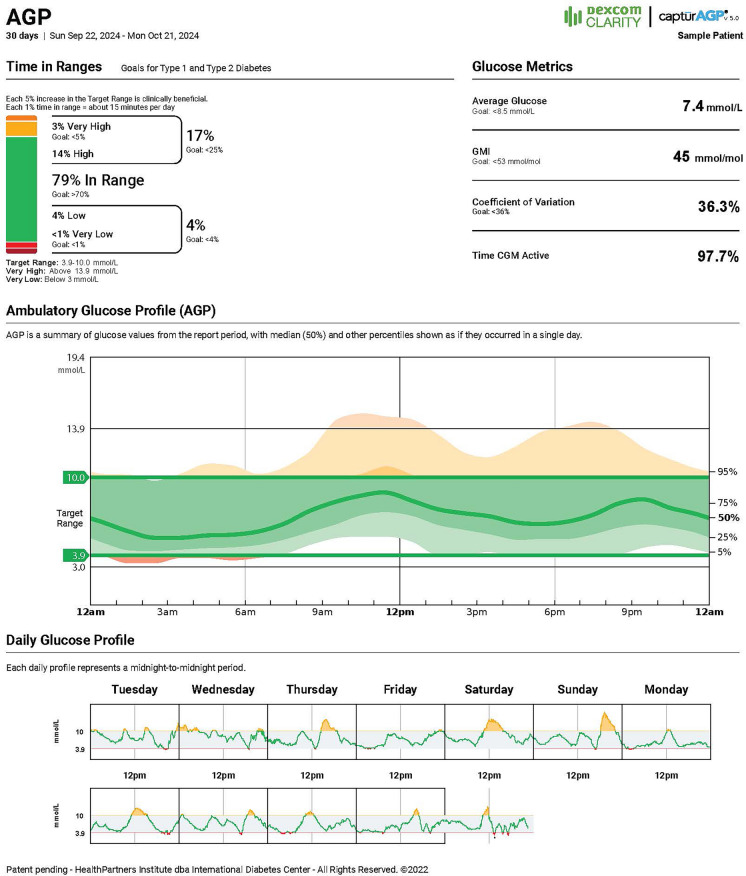
“The AGP provides summary statistics for user-specified date ranges including the average glucose value, its coefficient of variation, and the Glucose Management Indicator (GMI), which is derived from the average glucose and intended to align closely with patients’ HbA1c values [22].”
6. Glycemic Goals and Hypoglycemia: Standards of Care in Diabetes—2024
American Diabetes Association Professional Practice Committee, ElSayed, N. A., Aleppo, G., Bannuru, R. R., Bruemmer, D., Collins, B. S., Ekhlaspour, L., Hilliard, M. E., Johnson, E. L., Khunti, K., et al. (2024) · Diabetes Care · doi:10.2337/dc24-s006 · Cited by 486
The fallacy of average: how using HbA1c alone to assess glycemic control can be misleading
Beck, R. W., Connor, C. G., Mullen, D. M., Wesley, D. M., & Bergenstal, R. M. (2017) · Diabetes Care · doi:10.2337/dc17-0636 · Cited by 477 · cited 1×
“Because isolated HbA1c levels may be misleading [27], specialist consultation may be appropriate for patients with large or unexpected discrepancies between GMI and HbA1c values including pregnant women, those with haemoglobinopa-thies, habitual blood donors, and patients with high glycaemic…”
Glucotypes reveal new patterns of glucose dysregulation
Hall, H., Perelman, D., Breschi, A., Limcaoco, P., Kellogg, R., McLaughlin, T., & Snyder, M. (2018) · PLOS Biology · doi:10.1371/journal.pbio.2005143 · Cited by 326
Bergenstal, R. M., Ahmann, A. J., Bailey, T., Beck, R. W., Bissen, J., Buckingham, B., Deeb, L., Dolin, R. H., Garg, S. K., Goland, R., et al. (2013) · Diabetes Technology & Therapeutics · doi:10.1089/dia.2013.0051 · Cited by 307 · cited 1×
“The ambulatory glucose profile (AGP) was introduced in 2013 as a standardised way to present CGM data [20, 21], and most CGM manufacturers license it for use with their systems’ data.”
Racial Differences in the Relationship of Glucose Concentrations and Hemoglobin A1c Levels
Bergenstal, R. M., Gal, R. L., Connor, C. G., Gubitosi-Klug, R., Kruger, D., Olson, B. A., Willi, S. M., Aleppo, G., Weinstock, R. S., Wood, J., et al. (2017) · Annals of Internal Medicine · doi:10.7326/m16-2596 · Cited by 306 · cited 1×
“The GMI-HbA1c relationship shows considerable variability between individuals and may also be influenced by race-related factors [30].”
Vigersky, R. A., Fonda, S. J., Chellappa, M., Walker, M. S., & Ehrhardt, N. M. (2012) · Diabetes Care · doi:10.2337/dc11-1438 · Cited by 301
Yapanis, M., James, S., Craig, M. E., O’Neal, D., & Ekinci, E. I. (2022) · The Journal of Clinical Endocrinology & Metabolism · doi:10.1210/clinem/dgac034 · Cited by 291
Lu, J., Wang, C., Shen, Y., Chen, L., Zhang, L., Cai, J., Lu, W., Zhu, W., Hu, G., Xia, T., et al. (2021) · Diabetes Care · doi:10.2337/dc20-1862 · Cited by 282
Yoo, H. J., An, H. G., Park, S. Y., Ryu, O. H., Kim, H. Y., Seo, J. A., Hong, E. G., Shin, D. H., Kim, Y. H., Kim, S. G., et al. (2008) · Diabetes Research and Clinical Practice · doi:10.1016/j.diabres.2008.06.015 · Cited by 244
Khunti, K., Ceriello, A., Cos, X., & De Block, C. (2018) · Diabetes Research and Clinical Practice · doi:10.1016/j.diabres.2017.12.004 · Cited by 200
Strain, W. D., Down, S., Brown, P., Puttanna, A., & Sinclair, A. (2021) · Diabetes Therapy · doi:10.1007/s13300-021-01035-9 · Cited by 194
Self-citationKarter, A. J., Parker, M. M., Moffet, H. H., Gilliam, L. K., & Dlott, R. (2021) · JAMA · doi:10.1001/jama.2021.6530 · Cited by 191
Bergenstal, R. M., Layne, J. E., Zisser, H., Gabbay, R. A., Barleen, N. A., Lee, A. A., Majithia, A. R., Parkin, C. G., & Dixon, R. F. (2021) · Diabetes Technology & Therapeutics · doi:10.1089/dia.2020.0396 · Cited by 110
Ehrhardt, N., & Al Zaghal, E. (2019) · Journal of Diabetes Science and Technology · doi:10.1177/1932296818790994 · Cited by 105
Johnson, M. L., Martens, T. W., Criego, A. B., Carlson, A. L., Simonson, G. D., & Bergenstal, R. M. (2019) · Diabetes Technology & Therapeutics · doi:10.1089/dia.2019.0034 · Cited by 104
Ida, S., Kaneko, R., & Murata, K. (2019) · Journal of Diabetes Research · doi:10.1155/2019/4684815 · Cited by 86
Mayberry, L. S., Guy, C., Hendrickson, C. D., McCoy, A. B., & Elasy, T. (2023) · Journal of General Internal Medicine · doi:10.1007/s11606-023-08222-3 · Cited by 77
Continuous Glucose Monitoring and Physical Activity
Schubert-Olesen, O., Kröger, J., Siegmund, T., Thurm, U., & Halle, M. (2022) · International Journal of Environmental Research and Public Health · doi:10.3390/ijerph191912296 · Cited by 72
Oser, T. K., Hall, T. L., Dickinson, L. M., Callen, E., Carroll, J. K., Nease, D. E., Michaels, L., & Oser, S. M. (2022) · The Annals of Family Medicine · doi:10.1370/afm.2876 · Cited by 72
Moon, S. J., Kim, K., Lee, W. J., Lee, M. Y., Vigersky, R., & Park, C. (2023) · Diabetes, Obesity and Metabolism · doi:10.1111/dom.14852 · Cited by 69 · cited 1×
“Evidence in support of intermittent short-term use of CGM exists from randomised trials of noninsulin-treated patients using oral glucose-lowering medications [59] and patients not on prandial insulin [60].”
Interferences with CGM systems: practical relevance?
Heinemann, L. (2022) · Journal of Diabetes Science and Technology · doi:10.1177/19322968211065065 · Cited by 65
Scherrenberg, M., Falter, M., Kaihara, T., Xu, L., van Leunen, M., Kemps, H., Kindermans, H. P. J., & Dendale, P. (2023) · Journal of Medical Internet Research · doi:10.2196/41615 · Cited by 56
Mattishent, K., Lane, K., Salter, C., Dhatariya, K., May, H. M., Neupane, S., & Loke, Y. K. (2019) · BMJ Open · doi:10.1136/bmjopen-2019-032037 · Cited by 54
Oser, T. K., Litchman, M. L., Allen, N. A., Kwan, B. M., Fisher, L., Jortberg, B. T., Polonsky, W. H., & Oser, S. M. (2021) · Current Diabetes Reports · doi:10.1007/s11892-021-01408-1 · Cited by 43
Isitt, J. J., Roze, S., Sharland, H., Cogswell, G., Alshannaq, H. A., Norman, G. J., & Lynch, P. M. (2022) · Diabetes Therapy · doi:10.1007/s13300-022-01324-x · Cited by 43
Garg, S. K., Hirsch, I. B., Repetto, E., Snell‐Bergeon, J. K., Ulmer, B. J., Perkins, C., & Bergenstal, R. M. (2024) · Diabetes Obesity and Metabolism · doi:10.1111/dom.15866 · Cited by 43
Ulriksdotter, J., Svedman, C., Bruze, M., Glimsjö, J., Källberg, K. D., Sukakul, T., & Mowitz, M. (2020) · Contact Dermatitis · doi:10.1111/cod.13649 · Cited by 41
Clark, T. L., Polonsky, W. H., & Soriano, E. C. (2024) · Diabetes Technology & Therapeutics · doi:10.1089/dia.2023.0612 · Cited by 40
Tao, R., Yu, X., Lu, J., Shen, Y., Lu, W., Zhu, W., Bao, Y., Li, H., & Zhou, J. (2021) · BMJ Open Diabetes Research & Care · doi:10.1136/bmjdrc-2020-001869 · Cited by 39
Identifying the deficiencies of currently available CGM to improve uptake and benefit
Barnard‐Kelly, K. D., Martínez‐Brocca, M. A., Glatzer, T., & Oliver, N. (2024) · Diabetic Medicine · doi:10.1111/dme.15338 · Cited by 37 · cited 2×
“Discussion and adjustment of alert settings will help find the right balance between helpful and nuisance alerts [19].”
Layne, J. E., Jepson, L. H., Carite, A. M., Parkin, C. G., & Bergenstal, R. M. (2024) · Diabetes Technology & Therapeutics · doi:10.1089/dia.2024.0197 · Cited by 37 · cited 2×
“A recent real-world study of 3840 suboptimally managed people with T2D who were not treated with insulin [43] showed that CGM initiation with either the Dexcom G6 or G7 system was associated with significant improvement in all CGM-based metrics, including a 17 percentage point improvement in TIR,…”
Munshi, M. N., Slyne, C., Adam, A., CONERY, C. D., Oladunjoye, A. O., Neuwahl, S. J., Wypij, D., & Toschi, E. (2024) · Diabetes Care · doi:10.2337/dc24-1069 · Cited by 32
Oganesova, Z., Pembérton, J. H., & Brown, A. C. (2024) · Diabetic Medicine · doi:10.1111/dme.15369 · Cited by 31
Carlson, A. L., Martens, T. W., Johnson, L., & Criego, A. B. (2021) · Diabetes Technology & Therapeutics · doi:10.1089/dia.2021.0241 · Cited by 29
Development and Preliminary Validation of a Screener for Digital Health Readiness
Rising, K. L., Guth, A., Gentsch, A. T., González, K. M., Hass, R. W., Shughart, L., Gelfer, S., McVane, M., Worster, B. K., & Leader, A. E. (2024) · JAMA Network Open · doi:10.1001/jamanetworkopen.2024.32718 · Cited by 26
The Arduous Path Toward Equitable Access to Endocrinology Care
Romeo, G. R., Caputo, T., Stanescu, I. W., & Alkhaddo, J. B. (2024) · Journal of the Endocrine Society · doi:10.1210/jendso/bvae134 · Cited by 25
Interferent effect of hydroxyurea on continuous glucose monitoring
Szmuilowicz, E. D., & Aleppo, G. (2021) · Diabetes Care · doi:10.2337/dc20-3114 · Cited by 23 · cited 1×
“Renal impairment may adversely affect the accuracy of some CGM systems, as can drugs such as high-dose acetaminophen and ascorbic acid [25] or uncommon drugs such as hydroxyurea [26].”
Aktürk, H. K., Snell‐Bergeon, J. K., & Shah, V. N. (2020) · Diabetes Technology & Therapeutics · doi:10.1089/dia.2020.0320 · Cited by 23
Hannah, K. L., Nemlekar, P. M., Green, C. R., & Norman, G. J. (2024) · Advances in Therapy · doi:10.1007/s12325-024-02851-8 · Cited by 22
Reed, J., Dong, T., Eaton, E., Friswold, J., Porges, J., Al‐Kindi, S. G., Rajagopalan, S., & Neeland, I. J. (2024) · Diabetes, Obesity and Metabolism · doi:10.1111/dom.15608 · Cited by 22 · cited 1×
“For example, a study of people living with obesity and suboptimally managed T2D who were not using insulin [44] found associations between CGM use and significant improvements in BMI, triglycerides, blood pressure, total cholesterol, diabetes distress, and an increase in prescriptions for other…”
Alshannaq, H. A., Isitt, J. J., Pollock, R. F., Norman, G. J., Cogswell, G., Lynch, P. M., & Roze, S. (2023) · Journal of Comparative Effectiveness Research · doi:10.57264/cer-2023-0075 · Cited by 21
Oppel, E. M., Högg, C., Oschmann, A., Summer, B., & Kamann, S. (2022) · Contact Dermatitis · doi:10.1111/cod.14141 · Cited by 21
Miller, E. M., & Miller, K. (2024) · Clinical Diabetes · doi:10.2337/cd23-0077 · Cited by 20
Prato, S. D., Giorgino, F., Szafranski, K., & Poon, Y. (2024) · Diabetes Obesity and Metabolism · doi:10.1111/dom.15703 · Cited by 19
How use of continuous glucose monitoring can address therapeutic inertia in primary care
Martens, T. W., & Parkin, C. G. (2022) · Postgraduate Medicine · doi:10.1080/00325481.2022.2080419 · Cited by 16
Start-ups Tout Continuous Glucose Monitoring for People Without Diabetes
Jaklevic, M. C. (2021) · JAMA · doi:10.1001/jama.2021.3789 · Cited by 16
Farhan, H., Bukhari, K., Grewal, N., Devarasetty, S., & Munir, K. M. (2022) · BMJ Case Reports · doi:10.1136/bcr-2021-248579 · Cited by 15
Raghinaru, D., Calhoun, P., Bergenstal, R. M., & Beck, R. W. (2022) · Diabetes Technology & Therapeutics · doi:10.1089/dia.2022.0274 · Cited by 15
Alshannaq, H. A., Pollock, R. F., Joubert, M., Ahmed, W., Norman, G. J., Lynch, P. M., & Roze, S. (2024) · Journal of Comparative Effectiveness Research · doi:10.57264/cer-2023-0174 · Cited by 15
Karter, A. J., Parker, M. M., Moffet, H. H., Gilliam, L. K., & Dlott, R. S. (2022) · Diabetes Technology & Therapeutics · doi:10.1089/dia.2021.0450 · Cited by 15
Psavko, S., Katz, N., Mirchi, T., & Green, C. R. (2022) · JMIR Human Factors · doi:10.2196/42057 · Cited by 15
Randazzese, S. F., Bombaci, B., Costantino, S., Giorgianni, Y., Lombardo, F., & Salzano, G. (2024) · Children · doi:10.3390/children11020210 · Cited by 12
Kim, J. Y., Ilham, S., Alshannaq, H. A., Pollock, R. F., Ahmed, W., Norman, G. J., Jin, S., & Kim, J. H. (2024) · Journal of Medical Economics · doi:10.1080/13696998.2024.2405293 · Cited by 12
Nakajima, R., Idesawa, H., Daisuke, S. A. T. O., Ito, J., Ito, K., Fujii, M., Suzuki, T., Furuta, T., Kawai, H., Takayashiki, N., et al. (2023) · Endocrinology Diabetes and Metabolism Case Reports · doi:10.1530/edm-23-0056 · Cited by 11
Practical Application of Continuous Glucose Monitoring in Clinical Practice: Case Studies
Unger, J., & Franco, D. R. (2023) · Diabetes Technology & Therapeutics · doi:10.1089/dia.2023.0080 · Cited by 7
Intermittent Use of Continuous Glucose Monitoring: A New Paradigm in Treatment of Type 2 Diabetes.
Saboo, B., Unnikrishnan, R., Kesavadev, J., TIWASKAR, M. H., Czupryniak, L., Chawla, M. S., Choudhary, P., Battelino, T., Agarwal, S., Danne, T., et al. (2023) · PubMed · doi:10.5005/japi-11001-0274 · Cited by 7
Alsaif, M., Farhat, A. A. K., Blumer, Z., & Barham, L. (2024) · Health Economics Review · doi:10.1186/s13561-024-00505-7 · Cited by 7
Grace, T., Edgington, A., Reinhart, L., Burkart, T., Dyer, E., Halsey, J., Baroudi, K., Hicks, C., Layne, J. E., & Walker, T. C. (2024) · Clinical Diabetes · doi:10.2337/cd24-0030 · Cited by 7
A Hemoglobinopathy That Produces an Array of Different Hemoglobin A1c Values
Marin, M. J., Osa-Andrews, B., Maher, P. A., Wasserfall, C. H., Winter, W. E., Muzwagi, A. B., & Harris, N. (2024) · Journal of Hematology · doi:10.14740/jh1268 · Cited by 6
How the Diabetes Research Hub Will Modernize and Enhance Diabetes Data Utilization
Ayers, A. T., Ho, C., Friedman, E., Espinoza, J., Shah, S. N., & Klonoff, D. C. (2024) · Journal of Diabetes Science and Technology · doi:10.1177/19322968241306129 · Cited by 5
The Benefits of Using Continuous Glucose Monitoring to Diagnose Type 1 Diabetes
Ayers, A. T., Ho, C., Wong, J. C., Kerr, D. E., Mader, J. K., & Klonoff, D. C. (2024) · Journal of Diabetes Science and Technology · doi:10.1177/19322968241288923 · Cited by 4
Bonnet, J., Fasolo, M., Marty, L., Galibert, L., Richard, C. D., Sultan, A., Attalin, V., & Avignon, A. (2024) · Clinical Nutrition ESPEN · doi:10.1016/j.clnesp.2024.11.010 · Cited by 4
CRAWFORD, M. A., HICKS, C., & Singh, H. (2024) · Diabetes · doi:10.2337/db24-1852-lb · Cited by 3
Manov, A., Haddadin, R. W., Chauhan, S., & Benge, E. (2024) · Cureus · doi:10.7759/cureus.64594 · Cited by 3
Manov, A. E., Dhillon, G. S., Chauhan, S., Asllanaj, B., & Uy, E. S. (2023) · Cureus · doi:10.7759/cureus.36970 · Cited by 2
Hannah, K. L., Nemlekar, P. M., Bushman, J. S., & Norman, G. J. (2024) · Diabetes Obesity and Metabolism · doi:10.1111/dom.15982 · Cited by 2
Nontraditional Uses of Continuous Glucose Monitoring
Kapsar, P., Chao, C., & Walker, T. C. (2022) · The Journal for Nurse Practitioners · doi:10.1016/j.nurpra.2022.06.013 · Cited by 1
Research works printed but not linked: 2
- Millson V, Hammond P. How to analyse CGM data: a structured and practical approach. J Diabetes Nursing. 2020;24:JDN135.
- Crawford MA, Hicks C, Gopisetty N, et al. Improved health behaviors and psychosocial status in prediabetes using continuous glucose monitors. Obesity. 2024;32(S1):147.
Cited by
Aronson, R., Abitbol, A., Bajaj, H. S., Cheng, A. Y. Y., Christopoulos, S., Harris, S. B., Jain, A. B., & Goldenberg, R. M. (2025) · Diabetes, Obesity and Metabolism · doi:10.1111/dom.70008 · Cited by 33
“4,5 Ajjan et al. 54 and Fernando et al. 55 provide strong support for expanding CGM use in noninsulin-treated adults living with T2DM, including a proposed framework for the use of CGM throughout the natural history of T2D.”
Upadhaya, A., Pegu, J., Singh, Y. D., & Ngomle, S. (2025) · Biosensors and Bioelectronics X · doi:10.1016/j.biosx.2025.100675 · Cited by 16
Cuenca, A. M. C., de la Cuadra-Grande, A., Martínez, E. A., Cabello, M. I. E., Cruz, N. M., Cuatrecasas, G., Hermida, Á. B. Á., Navarro, J., Oyagüez, I., & de la Puente, J. B. (2026) · Primary care diabetes · doi:10.1016/j.pcd.2026.07.007 · Cited by 2
Susanti, S., Sukartini, T., Bistara, D. N., & Mustamu, A. C. (2025) · Rwanda medical journal · doi:10.4314/rmj.v82i2.2 · Cited by 1
Sihota, A., Jain, A., CHIN, A., Chow, W., Jin, S., Molberg, T., PATIL, S., Siemens, R. L., Sivapalan, S., Smith, T., et al. (2026) · Canadian Journal of Diabetes · doi:10.1016/j.jcjd.2026.01.005
Metadata
- Authors
- Fernando, K., Alabraba, V., Welsh, J. B., Seidu, S., Strain, W. D., Bell, H. E., Davies, S., & Evans, M.
- Affiliations
- University Hospitals of Leicester NHS Trust (GB)
- Dexcom (United States) (US)
- University of Leicester (GB)
- Royal Devon and Exeter Hospital (GB)
- University Hospital Llandough (GB)
- Corresponding author
- Welsh, John B.
- Venue
- Diabetes Therapy
- Published
- 2025-02-28
- Volume
- 16
- Issue
- 4
- Pages
- 749-762
- ISSN
- 1869-6953 (ISSN-L)
- 1869-6961
- PMC
- PMC11925819
- OpenAlex
- W4408009668
- Cited by
- 7
- References
- 72
- Citations by year
- 2026: 5 · 2025: 2
- FWCI
- 4.77
- Type
- journal article
- Language
- en
- Open access
- gold
- doi.org
- Licence
- cc-by-nc
- creativecommons.org/licenses/by-nc/4.0 (tdm)
- creativecommons.org/licenses/by-nc/4.0 (vor)
- Locations
- Diabetes Therapy (publishedVersion, cc-by-nc)
- PubMed Central (publishedVersion, cc-by-nc)
- PubMed (publishedVersion)
- Royal Devon and Exeter Research Repository (Royal Devon and Exeter) (submittedVersion)
- Topics
- Health Sciences › Medicine › Endocrinology, Diabetes and Metabolism › Diabetes Management and Research
- Health Sciences › Medicine › Endocrinology, Diabetes and Metabolism › Diabetes Treatment and Management
- Health Sciences › Medicine › Endocrinology, Diabetes and Metabolism › Diabetes Management and Education
- Keywords
- continuous glucose monitoring, type 2 diabetes, primary care, patient selection, barriers to adoption, diabetes self-management, glycemic control, therapeutic inertia, cost barriers, psychosocial benefits
About these checks
Registry, retraction, Cites and statistics results are computed, not judged, with one exception: a printed reference that no index lists is read once by a model before it counts as a citation error. Claims are extracted by a model and kept only when their quote appears verbatim in the text; each cited source is then checked, with a model’s help, for whether it says what the claim relies on. Those verdicts can be wrong — read the claim’s quote and the cited source before relying on one.
Statistics and arithmetic are recomputed, not judged.
Confidence bands are shown only for fields calibrated on our annotated test set. None is calibrated yet, so no band is shown.
What counts as a claim ›How we measure confidence ›How we check this ›
Are you an author, or do you see a problem with this page? Request a review
Data sources
Bibliographic data: Semantic Scholar, OpenAlex, Crossref.
Contains information from the Semantic Scholar Academic Graph Datasets, made available under the ODC Attribution License (ODC-BY 1.0).
Semantic Scholar’s data is described in: Kinney, R., et al. (2023). The Semantic Scholar Open Data Platform. arXiv:2301.10140.
