

The influence of habitat structure on genetic differentiation in red fox populations in north-eastern Poland
Open accessThe DOI matches its Crossref record; 79 of the 79 references it cites were found in a registry or an index.
Abstract
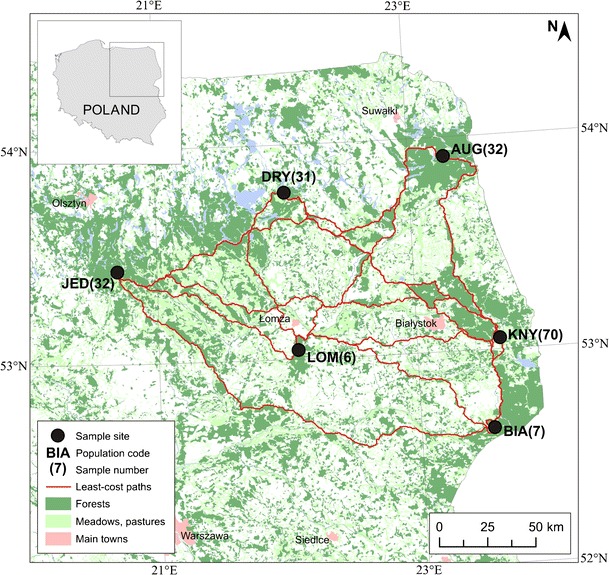
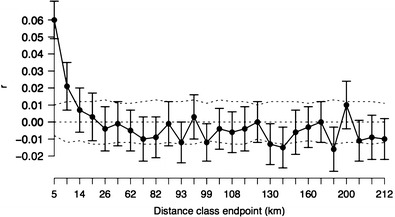
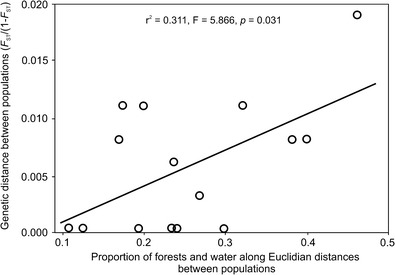
) has the widest global distribution among terrestrial carnivore species, occupying most of the Northern Hemisphere in its native range. Because it carries diseases that can be transmitted to humans and domestic animals, it is important to gather information about their movements and dispersal in their natural habitat but it is difficult to do so at a broad scale with trapping and telemetry. In this study, we have described the genetic diversity and structure of red fox populations in six areas of north-eastern Poland, based on samples collected from 2002-2003. We tested 22 microsatellite loci isolated from the dog and the red fox genome to select a panel of nine polymorphic loci suitable for this study. Genetic differentiation between the six studied populations was low to moderate and analysis in Structure revealed a panmictic population in the region. Spatial autocorrelation among all individuals showed a pattern of decreasing relatedness with increasing distance and this was not significantly negative until 93 km, indicating a pattern of isolation-by-distance over a large area. However, there was no correlation between genetic distance and either Euclidean distance or least-cost path distance at the population level. There was a significant relationship between genetic distance and the proportion of large forests and water along the Euclidean distances. These types of habitats may influence dispersal paths taken by red foxes, which is useful information in terms of wildlife disease management.
Overview
The claims and statistics of this paper haven’t been checked yet.
Free: it reads the open-access text and checks the first 5 claims that cite a source we can check. Create a free account to check every claim.
Integrity signals
Registry
Cites
Statistics
Figures
Verification
Claims the paper makes
The claims and statistics of this paper haven’t been checked yet.
Free: it reads the open-access text and checks the first 5 claims that cite a source we can check. Create a free account to check every claim.
Claims other papers make about this one
Each is checked against this paper’s own text: does it say what the citing paper says it does?
The source backs part of the claim, not all of it — or backs it for a different population, condition or comparison.
In the citing paper
“Of note, limited levels of population differentiation were found when population genetics were studied at a national scale, such as in Switzerland [36], Poland [37], Croatia [38] and Portugal [72].”
From Genetic and spatial characterization of the red fox (Vulpes vulpes) population in the area stretching between the Eastern and Dinaric Alps and its relationship with rabies and canine distemper dynamics (2019) · cites this paper as [37]
Experimental — accuracy not yet measured
Self-check
Percentages, sums and reported differences re-computed from the paper’s own numbers.
The self-check needs the paper’s full text.
Citations
Cites
Inference of Population Structure Using Multilocus Genotype Data
Pritchard, J. K., Stephens, M., & Donnelly, P. (2000) · Genetics · doi:10.1093/genetics/155.2.945 · Cited by 33,908
A note on two problems in connexion with graphs
Dijkstra, E. W. (1959) · Numerische Mathematik · doi:10.1007/bf01386390 · Cited by 29,065
ESTIMATING F -STATISTICS FOR THE ANALYSIS OF POPULATION STRUCTURE
Weir, B. S., & Cockerham, C. C. (1984) · Evolution · doi:10.1111/j.1558-5646.1984.tb05657.x · Cited by 19,066
genalex 6: genetic analysis in Excel. Population genetic software for teaching and research
PEAKALL, R., & SMOUSE, P. E. (2006) · Molecular Ecology Notes · doi:10.1111/j.1471-8286.2005.01155.x · Cited by 16,589
EXCOFFIER, L., & LISCHER, H. E. L. (2010) · Molecular Ecology Resources · doi:10.1111/j.1755-0998.2010.02847.x · Cited by 16,326
Analyzing Tables of Statistical Tests
Rice, W. R. (1989) · Evolution · doi:10.2307/2409177 · Cited by 14,571
ANALYZING TABLES OF STATISTICAL TESTS
Rice, W. R. (1989) · Evolution · doi:10.1111/j.1558-5646.1989.tb04220.x · Cited by 14,547
Peakall, R., & Smouse, P. E. (2012) · Bioinformatics · doi:10.1093/bioinformatics/bts460 · Cited by 13,131
IUCN Red List of Threatened Species
(2012) · Choice Reviews Online · doi:10.5860/choice.49-6872 · Cited by 12,728
Earl, D. A., & vonHoldt, B. M. (2012) · Conservation Genetics Resources · doi:10.1007/s12686-011-9548-7 · Cited by 12,340
Cited by
Pisano, S. R. R., Zimmermann, F., Rossi, L., Capt, S., Akdesir, E., Bürki, R., Kunz, F., Origgi, F. C., & Ryser-Degiorgis, M.-P. (2019) · Parasites & Vectors · doi:10.1186/s13071-019-3762-7 · Cited by 36
Ashrafzadeh, M. R., Khosravi, R., Ahmadi, M., & Kaboli, M. (2018) · Mammalian Biology · doi:10.1016/j.mambio.2018.08.007 · Cited by 37
Garrido-Garduño, T., Téllez‐Valdés, O., Manel, S., & Vázquez‐Domínguez, E. (2015) · Journal of Zoology · doi:10.1111/jzo.12307 · Cited by 40
Khosravi, R., Hemami, M., Malekian, M., Silva, T. L., Rezaei, H. R., & Brito, J. C. (2017) · Conservation Genetics · doi:10.1007/s10592-017-1002-2 · Cited by 29
“IBR models have been successfully used to evaluate effects of landscape features on the genetic structure of multiple vertebrates (e.g. Coulon et al. 2006; Klug et al. 2011; Geiser et al. 2013; Mullins et al. 2014).”
MethodBasto, M. P., Santos-Reis, M., Simões, L., Grilo, C., Cardoso, L., Cortes, H., Bruford, M. W., & Fernandes, C. (2016) · PLOS ONE · doi:10.1371/journal.pone.0145165 · Cited by 28
“This might be expected given the high ecological plasticity of the red fox, and the adaptability and dispersal ability of the species have been invoked to explain the weak genetic structuring found in other studies [14,49].”
BackgroundResultPopulation genetic structure of the red fox (Vulpes vulpes) in the UK
Atterby, H., Allnutt, T. R., MacNicoll, A. D., Jones, E. P., & Smith, G. C. (2015) · Mammal Research · doi:10.1007/s13364-014-0209-6 · Cited by 27
“These findings were in contrast to the fox microsatellite study in North East Poland (Mullins et al. 2014), which found no population substructuring, but similar to those in Israel (Magory Cohen et al. 2013), which also identified four genetic subpopulations.”
BackgroundResultInfluentialRobertson, L. J., Troell, K., Woolsey, I. D., & Kapel, C. M. O. (2016) · Parasitology Research · doi:10.1007/s00436-016-5015-4 · Cited by 29
“…in Poland, with the density varying with season, but probably ranging from around 1 per km2 to around 0.4 per km2 depending on the time of year (lowest at end of winter, highest after birth of kits), and has increased somewhat in recent years (Goszczyński, 1989; Jamrozy, 2008; Mullins et al, 2014).”
BackgroundInfluentialStojak, J., Wójcik, J. M., Ruczyńska, I., Searle, J. B., & McDevitt, A. D. (2016) · Mammal Research · doi:10.1007/s13364-015-0260-y · Cited by 23
“Rivers have been identified as significant barriers to gene flow in many terrestrial mammals (e.g. Gerlach and Musolf 2000; Mullins et al. 2014).”
BackgroundSelf-citationKołodziej‐Sobocińska, M., Stojak, J., Kondzior, E., Ruczyńska, I., & Wójcik, J. M. (2019) · Journal of Zoological Systematics & Evolutionary Research · doi:10.1111/jzs.12319 · Cited by 24
Self-citationZecchin, B., De Nardi, M., Nouvellet, P., Vernesi, C., Babbucci, M., Crestanello, B., Bagó, Z., Bedeković, T., Hostnik, P., Milani, A., et al. (2019) · PLOS ONE · doi:10.1371/journal.pone.0213515 · Cited by 20
Hong, Y., Kim, K. S., Kimura, J., Kauhala, K., Voloshina, I., Goncharuk, M. S., Yu, L., Zhang, Y., Sashika, M., Lee, H., et al. (2018) · ZOOLOGICAL SCIENCE · doi:10.2108/zs170140 · Cited by 19
Statham, M. J., Edwards, C. J., Norén, K., Soulsbury, C. D., & Sacks, B. N. (2018) · Quaternary Science Reviews · doi:10.1016/j.quascirev.2018.08.019 · Cited by 20
Ashrafzadeh, M. R., Khosravi, R., Fernandes, C., Aguayo, C., Bagi, Z., Lavadinović, V. M., Szendrei, L., Beuković, D., Mihalik, B., & Kusza, S. (2021) · Scientific Reports · doi:10.1038/s41598-021-00567-1 · Cited by 19
Moving far, staying close: red fox dispersal patterns revealed by SNP genotyping
Walton, Z., Hagenlund, M., Østbye, K., Samelius, G., Odden, M., Norman, A. J., Willebrand, T., & Spong, G. (2021) · Conservation Genetics · doi:10.1007/s10592-021-01332-7 · Cited by 20
Cranial and body size variation in the Iberian red fox (Vulpes vulpes silacea)
Gomes, A. C., & Valente, A. (2016) · Mammalian Biology · doi:10.1016/j.mambio.2016.08.005 · Cited by 8
Kondzior, E., Kowalczyk, R., Tokarska, M., Borowik, T., Zalewski, A., & Kołodziej‐Sobocińska, M. (2020) · Parasites & Vectors · doi:10.1186/s13071-020-04431-5 · Cited by 10
Self-citationDonaldson, M. E., Rico, Y., Hueffer, K., Rando, H. M., Kukekova, A. V., & Kyle, C. J. (2017) · Ecology and Evolution · doi:10.1002/ece3.3583 · Cited by 10
“Our observed heterozygosity is also high compared to reported estimates of expected heterozygosity in Polish red fox (72%, Mullins et al., 2014) and that of other carnivores, including the American badger (81%; Rico et al., 2016) and Canadian black bear (55%–81%; Pelletier et al., 2017).”
ResultGeography vs. past climate: the drivers of population genetic structure of the Himalayan langur
Arekar, K., Tiwari, N., Sathyakumar, S., Khaleel, M., & Karanth, K. P. (2022) · BMC Ecology and Evolution · doi:10.1186/s12862-022-02054-1 · Cited by 10
Talbot, B., Alanazi, T. J., Albert, V., Bordeleau, É., Bouchard, É., Leighton, P. A., Marshall, H. D., Rondeau-Geoffrion, D., Simon, A., & Massé, A. (2023) · PLoS ONE · doi:10.1371/journal.pone.0286784 · Cited by 7
“Several landscape components, including tundra versus boreal landscape boundaries [25], prey community structure [26] and forest and water patch distributions [27] have been identified as potentially responsible for the cryptic levels of genetic structure observed in both species.”
BackgroundZatoń‐Dobrowolska, M., Moska, M., Mucha, A., Wierzbicki, H., & Dobrowolski, M. (2017) · Canadian Journal of Animal Science · doi:10.1139/cjas-2017-0015 · Cited by 11
Mullins, J., Ascensão, F., Simões, L. G., Andrade, L., Santos‐Reis, M., & Fernandes, C. (2014) · Landscape Ecology · doi:10.1007/s10980-014-0130-z · Cited by 6
“The IBD model does not account for the relative influence of the matrix habitat, which can improve models of landscape connectivity (Mullins et al. 2014), while prominent landscape features such as roads may not completely hinder wildlife movements (Cushman et al.”
BackgroundSelf-citationHagenlund, M., Linløkken, A., Østbye, K., Walton, Z., Odden, M., Samelius, G., Willebrand, T., & Wilson, R. (2019) · Applied Sciences · doi:10.3390/app9245289 · Cited by 7
Aghbolaghi, M. A., Keyghobadi, N., Azarakhsh, Z., Dadizadeh, M., Aghbolaghi, S. A., & Zamani, N. (2023) · Ecology and Evolution · doi:10.1002/ece3.10225 · Cited by 6
Basto, M. P. (2015) · Portuguese National Funding Agency for Science, Research and Technology (RCAAP Project by FCT) · Cited by 3
Horecka, B., Jakubczak, A., Ślaska, B., & Jeżewska-Witkowska, G. (2022) · The European Zoological Journal · doi:10.1080/24750263.2022.2070289 · Cited by 4
“Tracking the dispersal and movement of individuals might also be helpful in understanding the epidemiology of zoonotic diseases and pathogen transmission (Cohen et al. 2013; Mullins et al. 2014).”
BackgroundGładysz, P., Świątalska, A., Samorek-Pieróg, M., Karamon, J., & Lass, A. (2025) · One Health · doi:10.1016/j.onehlt.2025.101151 · Cited by 2
“These land cover categories, however, may have been too broad and did not account for red fox habitat selectivity [45].”
Devedžić, A., Urzi, F., Pokorny, B., Vengušt, G., Vengušt, D. Ž., Janžekovič, F., Velić, L., Eterović, T., Stroil, B. K., & Bužan, E. (2024) · Vavilov Journal of Genetics and Breeding · doi:10.18699/vjgb-24-83 · Cited by 1
Kondzior, E., Kowalczyk, R., Tokarska, M., Borowik, T., Zalewski, A., & Kołodziej‐Sobocińska, M. (2020) · Figshare · doi:10.6084/m9.figshare.13212472
Self-citationKondzior, E., Kowalczyk, R., Tokarska, M., Borowik, T., Zalewski, A., & Kołodziej‐Sobocińska, M. (2020) · Figshare · doi:10.6084/m9.figshare.13212469
Self-citationArekar, K., Tiwari, N., Sathyakumar, S., Khaleel, M., & Karanth, P. (2022) · Figshare · doi:10.6084/m9.figshare.20495820
Arekar, K., Tiwari, N., Sathyakumar, S., Khaleel, M., & Karanth, P. (2022) · Figshare · doi:10.6084/m9.figshare.20495823
Kondzior, E., Kowalczyk, R., Tokarska, M., Borowik, T., Zalewski, A., & Kołodziej‐Sobocińska, M. (2020) · Figshare · doi:10.6084/m9.figshare.13212466
Self-citationArekar, K., Tiwari, N., Sathyakumar, S., Khaleel, M., & Karanth, P. (2022) · Figshare · doi:10.6084/m9.figshare.20495829
Scholz, L. G., Oehler, F., Kunz, F., Hagen, R., Balkenhol, N., Ebert, C., Alef, T., Bhardwaj, M., Arnold, J., Kopp, G. H., et al. (2026) · Wildlife Biology · doi:10.1002/wlb3.01596
Metadata
- Authors
- Mullins, J., McDevitt, A. D., Kowalczyk, R., Ruczyńska, I., Górny, M., & Wójcik, J. M.
- Affiliations
- Mammal Research Institute (PL)
- University College Dublin (IE)
- Corresponding author
- Wójcik, Jan M.
- Venue
- Acta Theriologica
- Published
- 2014-03-22
- Volume
- 59
- Issue
- 3
- Pages
- 367-376
- ISSN
- 0001-7051 (ISSN-L)
- 2190-3743
- PMC
- PMC4058057
- OpenAlex
- W2103533878
- Cited by
- 34
- References
- 78
- Citations by year
- 2026: 1 · 2025: 1 · 2024: 1 · 2023: 2 · 2022: 5 · 2021: 2 · 2020: 4 · 2019: 4 · 2018: 3 · 2017: 3 · 2016: 4 · 2015: 2 · 2014: 2
- FWCI
- 2.41
- Type
- journal article
- Language
- en
- Open access
- hybrid
- doi.org
- Locations
- ACTA THERIOLOGICA (publishedVersion, cc-by)
- PubMed Central (publishedVersion, cc-by)
- PubMed (publishedVersion)
- Lirias (KU Leuven) (submittedVersion, other-oa)
- University of Salford Institutional Repository (University of Salford) (submittedVersion, cc-by)
- Topics
- Life Sciences › Biochemistry, Genetics and Molecular Biology › Genetics › Genetic diversity and population structure
- Physical Sciences › Environmental Science › Ecology › Wildlife Ecology and Conservation
- Life Sciences › Biochemistry, Genetics and Molecular Biology › Genetics › Forensic and Genetic Research
- Keywords
- red fox, Vulpia vulpes, habitat structure, genetic differentiation, population structure, microsatellite markers, isolation by distance, dispersal, panmixia, spatial autocorrelation, forest cover, water bodies, wildlife disease control, north-eastern Poland
About these checks
Registry, retraction, Cites and statistics results are computed, not judged, with one exception: a printed reference that no index lists is read once by a model before it counts as a citation error. Claims are extracted by a model and kept only when their quote appears verbatim in the text; each cited source is then checked, with a model’s help, for whether it says what the claim relies on. Those verdicts can be wrong — read the claim’s quote and the cited source before relying on one.
Statistics and arithmetic are recomputed, not judged.
Confidence bands are shown only for fields calibrated on our annotated test set. None is calibrated yet, so no band is shown.
What counts as a claim ›How we measure confidence ›How we check this ›
Are you an author, or do you see a problem with this page? Request a review
Data sources
Bibliographic data: Semantic Scholar, OpenAlex, Crossref.
Contains information from the Semantic Scholar Academic Graph Datasets, made available under the ODC Attribution License (ODC-BY 1.0).
Semantic Scholar’s data is described in: Kinney, R., et al. (2023). The Semantic Scholar Open Data Platform. arXiv:2301.10140.
