

Comparison of the red fox gut microbiota among different habitat types in southern Anatolia
Open accessPublished version of a preprint
The DOI matches its Crossref record; 70 of the 71 references it cites were found in a registry or an index, and 1 are not checked yet; 2 of the 27 sources its claims cite were checked for support.
Abstract
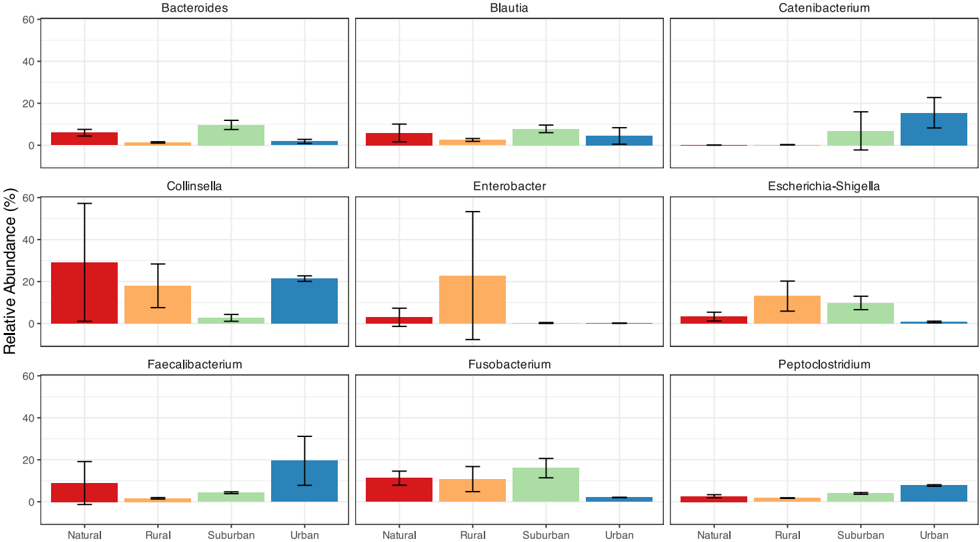
Environmental conditions, especially diet, affect the diversity of gut microbiota (GM). This diversity within and between populations may influence the host’s health and fitness and, therefore, play an important role in adaptation. Regarding this, we collected fecal samples from natural, rural, suburban, and urban habitats to reveal the interaction between diet and compositional diversity of GM of a generalist carnivore, the red fox. The prokaryotic diversity of fecal microbiota was investigated by sequencing the 16S rRNA gene V3-V4 regions. A total of 46 archaeal and bacterial phyla were identified, with Bacillota being the most common phylum in most samples. The dominant genera in the GM of the red fox were Collinsella , Fusobacterium , Faecalibacterium , Escherichia-Shigella , and Blautia . Fusobacterium showed higher relative abundance in suburban (16.0%), natural (11.0%), and rural habitats (10.8%) compared to urban habitats (2.0%), indicating dietary differences of the red foxes that feed close to human settlements. Despite the observed differences in specific taxa, the overall microbial diversity remained relatively stable across the habitats. Our study determined the compositional changes of the GM of a wild animal for the first time in the Anatolian peninsula and revealed the effects of dietary changes, especially urbanization, on the diversity of GM of red foxes.
Verified 2026-11-22 · 1 reference not checked yet
Overview
CoChat Summary
TL;DR
This study used 16S rRNA sequencing of red fox fecal samples from natural, rural, suburban, and urban habitats in Adana, Türkiye, to test whether habitat-associated dietary differences alter gut microbiota composition. It found habitat-related shifts in specific taxa but no statistically significant differences in overall alpha diversity, with the paper stating that community composition remained relatively stable across habitats.
Key findings
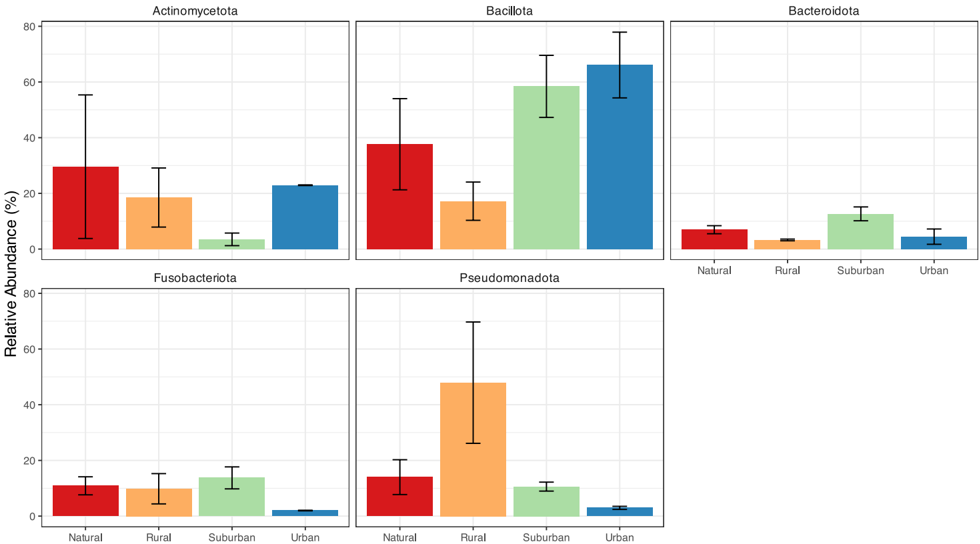
- A total of 46 archaeal and bacterial phyla were identified, with Bacillota most common in most samples (13/24); Bacillota relative abundance was 37.6% in natural, 17.2% in rural, 58.4% in suburban, and 66.1% in urban samples. The dominant genera were *Collinsella*, *Fusobacterium*, *Faecalibacterium*, *Escherichia-Shigella*, and *Blautia*.
- *Fusobacterium* was higher in suburban (16.0%), natural (11.0%), and rural (10.8%) habitats than in urban habitats (2.0%). *Faecalibacterium* was higher in urban samples (19.5%) than in suburban (4.3%), rural (1.6%), or natural (8.9%) samples; *Catenibacterium* and *Peptoclostridium* were more abundant in suburban and urban samples.
- DESeq2 identified 23 genera significantly different between urban and natural samples (adj. P < 0.01). Alpha diversity (Observed, Shannon, Simpson) showed no statistically significant differences across habitats (Wilcoxon test, P.adj > 0.05), and the paper reports that fecal communities did not cluster separately by habitat in PCoA (PERMANOVA R² = 0.186, F = 1.52, P = 0.026 as reported).
Methods
- Cross-sectional fecal sampling across four habitat types in Adana province, southern Anatolia, Türkiye (natural, rural, suburban, urban) between June and September 2021. A total of 64 samples were collected (22 natural, 22 rural, 13 suburban, 7 urban); 41 amplified successfully, and 24 were randomly selected for sequencing (7 natural, 7 rural, 6 suburban, 4 urban).
- DNA was extracted, and the 16S rRNA gene V3–V4 region was amplified with 314F/806R primers and sequenced on an Illumina NovaSeq 6000 system (2 × 250 read length, minimum 100,000 reads per sample). Bioinformatics used cutadapt, DADA2, and the SILVA v138.1 reference database; analyses were performed in R with vegan, phyloseq, DESeq2, and ggplot2.
- Alpha diversity (Observed, Shannon, Simpson) was tested with Wilcoxon tests and FDR < 0.05; beta diversity used Bray-Curtis PCoA and PERMANOVA (1000 permutations); differential abundance used DESeq2 after excluding ASVs seen in fewer than 20% of samples (440 ASVs retained), with an FDR cutoff of 0.01.
Limitations
- Stated: The study did not directly measure diet; dietary differences were inferred from the habitat types where fecal samples were collected.
- Stated: The authors report no statistically significant differences in alpha diversity or overall community structure, despite observable differences in specific taxa.
- Evident from the text: the sequenced sample is small (24 total; urban n = 4), limiting statistical power and generalizability; the design is cross-sectional and relies on fecal samples assumed to belong to red foxes, with no longitudinal or direct dietary data.
Model-written summary. Check it against the paper before relying on it.
Integrity signals
Registry
Cites
Statistics
Figures
Verification
Claims the paper makes
2 Valid · 1 Not valid · 14 Not checked · 24 Own results and interpretations
The cited sources support only part of this claim — read each source’s verdict below.
In the paper
“Available food sources can turn their protein-based diets, mainly consisting of rodents, birds, lizards, and invertebrates in natural areas, into carbohydrate and fat-based diets, including garbage in urban areas (Castañeda et al. 2022).”
What the sources say
- Partly supportedcites Castañeda et al. 2022 matched to “Variation in red fox Vulpes vulpes diet in five continents” (2022) sourceExperimental — accuracy not yet measured
The source supports the shift-with-availability part: the Anthropogenic impacts section reports 'large mammal FO in fox diet decreased with increasing HFI, while bird and fruit FO increased', attributing the fruit rise to horticultural/ornamental plants around cities, and Conclusions point 3 notes foxes' 'ability to exploit novel anthropogenic food resources'; the Global and continental fox diet section confirms small mammals (FO 45%) and invertebrates (41%) dominate globally. However, our copy never characterises fox diet in macronutrient terms — there is no 'protein-based' versus 'carbohydrate- and fat-based' framing anywhere — and reptiles/lizards are reported only as a low-occurrence category that is relatively higher in Australia, not as a staple of natural-area diets. The garbage element is also weaker than attributed: garbage appears only as a food category with continental means (higher in Europe 18% and North America 8%), and no relationship between garbage occurrence and HFI/urbanization is reported, so 'garbage in urban areas' as the anthropogenic shift is not what this paper found. (LLM, conf=0.75)
plainstates a cause- Asserted: passes — The authors put it forward as true.
- Checkable: passes — It can be checked against evidence.
- Load-bearing: passes — The paper’s conclusions depend on it.
- Based: passes — The paper gives a reason why it holds.
- Partly supported
The sources with a verdict support this claim; the rest weren’t checked yet, have no full text we could read, or their verdicts aren’t rated yet.
In the paper
“Previous studies have indicated that red foxes living in different environments have different dietary habits (Handler et al. 2020; Scholz et al. 2020; Castañeda et al. 2022)”
What the sources say
- Not checked yetcites Handler et al. 2020 matched to “Evidence for red fox (Vulpes vulpes) exploitation of anthropogenic food sources along an urbanization gradient using stable isotope analysis” (2020) source
Checked before — its earlier verdict is held back until a new check runs.
- Not checked yetcites Scholz et al. 2020 matched to “Individual dietary specialization in a generalist predator: A stable isotope analysis of urban and rural red foxes” (2020) source
Checked before — its earlier verdict is held back until a new check runs.
- Supportedcites Castañeda et al. 2022 matched to “Variation in red fox Vulpes vulpes diet in five continents” (2022) source
The Abstract (p. 1, points 2-5) states that diet composition varied across 276 locations in five continents according to geographic location, climate and anthropogenic impact, and that 'the diet of foxes showed substantial variation throughout the species' range'. The Discussion opens by confirming 'fox diet composition varied among continents and that geographic, climatic, and anthropogenic variables influenced fox diet richness', and the Conclusions attribute this to spatially adaptive feeding behaviour in response to prey/food availability. This directly supports the paraphrased claim that foxes in different environments have different dietary habits. (LLM, conf=0.92)
hedgedstates an association- Asserted: passes — The authors put it forward as true.
- Checkable: passes — It can be checked against evidence.
- Load-bearing: passes — The paper’s conclusions depend on it.
- Based: passes — The paper gives a reason why it holds.
- Not checked yet
A result the paper reports from its own data — it cites no other source for it, so there is none to check. The quote shows it is in the paper.
In the paper
“While Bacillota was the most common phylum in most samples (13 out of 24), its proportion was different between the samples that were collected from different habitats (37.6% in natural, 17.2% in rural, 58.4% in suburban, and 66.1% in urban).”
plainstates an association- Asserted: passes — The authors put it forward as true.
- Checkable: passes — It can be checked against evidence.
- Load-bearing: passes — The paper’s conclusions depend on it.
- Based: passes — The paper gives a reason why it holds.
A result the paper reports from its own data — it cites no other source for it, so there is none to check. The quote shows it is in the paper.
In the paper
“the dominant genera in the GM of the red fox were Collinsella , Fusobacterium , Faecalibacterium , Escherichia-Shigella , and Blautia”
- Also stated in: § Results · p. 4 · plain
“Collinsella , Fusobacterium , Faecaelibacterium , Escherichia-Shigella , and Blautia were the most common genera in all samples”
plain- Asserted: passes — The authors put it forward as true.
- Checkable: passes — It can be checked against evidence.
- Load-bearing: unclear — It is unclear whether the paper’s conclusions depend on it.
- Based: passes — The paper gives a reason why it holds.
- Also stated in: § Results · p. 4 · plain
A result the paper reports from its own data — it cites no other source for it, so there is none to check. The quote shows it is in the paper.
In the paper
“Faecalibacterium showed higher relative abundance in urban samples (19.5%) than in other samples (4.3% in suburban, 1.6% in rural, and 8.9% in natural)”
plainstates an association- Asserted: passes — The authors put it forward as true.
- Checkable: passes — It can be checked against evidence.
- Load-bearing: unclear — It is unclear whether the paper’s conclusions depend on it.
- Based: passes — The paper gives a reason why it holds.
17 more claims
Create a free account to see all 41 claims and to verify the 24 references still open.
- The quote only partly states this claim. 3
- It may state two separate claims as one. 13
- Probably not a substantial claim. 6
Self-check
Percentages, sums and reported differences re-computed from the paper’s own numbers.
Each contradiction between two passages listed here was confirmed by an independent check.
Rated major: it would touch a result — a value a result rests on, reported and recomputed p-values on opposite sides of the significance level, two passages that conflict with no sign which is right, or a cited work retracted before this paper was published.
In the paper
§ Results · p. 4
“PERMANOVA test, R 2 = 0.186, F = 1.52, P = 0.026”
§ Discussion · p. 6
“we could not find statistically significant differences in alpha diversity (observed species richness, Shannon index, and Simpson evenness) or in the overall community structure (beta diversity) of the prokaryotic communities”
Citations
Cites
R: A Language and Environment for Statistical Computing
R Core Team (2025) · doi:10.32614/r.manuals · Cited by 352,181
Moderated estimation of fold change and dispersion for RNA-seq data with DESeq2
Love, M. I., Huber, W., & Anders, S. (2014) · Genome Biology · doi:10.1186/s13059-014-0550-8 · Cited by 95,106
DADA2: High–resolution sample inference from Illumina amplicon data
Callahan, B. J., McMurdie, P. J., Rosen, M. J., Han, A. W., Johnson, A. J. A., & Holmes, S. P. (2016) · Nature Methods · doi:10.1038/nmeth.3869 · Cited by 35,698
Cutadapt removes adapter sequences from high-throughput sequencing reads
Martin, M. (2011) · EMBnet.journal · doi:10.14806/ej.17.1.200 · Cited by 33,889 · cited 1×
“6 (Martin 2011).”
Wickham, H. (2016) · Use R! · doi:10.1007/978-3-319-24277-4 · Cited by 33,115
The SILVA ribosomal RNA gene database project: improved data processing and web-based tools
Quast, C., Pruesse, E., Yilmaz, P., Gerken, J., Schweer, T., Yarza, P., Peplies, J., & Glöckner, F. O. (2012) · Nucleic Acids Research · doi:10.1093/nar/gks1219 · Cited by 33,055
phyloseq: An R Package for Reproducible Interactive Analysis and Graphics of Microbiome Census Data
McMurdie, P. J., & Holmes, S. (2013) · PLoS ONE · doi:10.1371/journal.pone.0061217 · Cited by 21,322
An obesity-associated gut microbiome with increased capacity for energy harvest
Turnbaugh, P. J., Ley, R. E., Mahowald, M. A., Magrini, V., Mardis, E. R., & Gordon, J. I. (2006) · Nature · doi:10.1038/nature05414 · Cited by 12,444 · cited 1×
“GM plays a key role in host health, aiding in digestion, metabolism, and immune function (Turnbaugh et al. 2006; Ganal et al. 2012; Greenblum et al. 2012; Markle et al. 2013).”
Predictive functional profiling of microbial communities using 16S rRNA marker gene sequences
Langille, M. G. I., Zaneveld, J., Caporaso, J. G., McDonald, D., Knights, D., Reyes, J. A., Clemente, J. C., Burkepile, D. E., Vega Thurber, R. L., Knight, R., et al. (2013) · Nature Biotechnology · doi:10.1038/nbt.2676 · Cited by 9,116
Klindworth, A., Pruesse, E., Schweer, T., Peplies, J., Quast, C., Horn, M., & Glöckner, F. O. (2013) · Nucleic Acids Research · doi:10.1093/nar/gks808 · Cited by 8,850 · cited 2×
“Since the sample quality and the amount of bacterial DNA of environmental samples might be very different from one another, a test PCR was performed for all 64 samples by using 314F (CCT AYG GGRBGCASCAG) and 806R (GGA CTA CNNGGG TAT CTAAT) primers (Klindworth et al. 2013).”
Evolution of mammals and their gut microbes
Ley, R. E., Hamady, M., Lozupone, C., Turnbaugh, P. J., Ramey, R. R., Bircher, J. S., Schlegel, M. L., Tucker, T. A., Schrenzel, M. D., Knight, R., et al. (2008) · Science · doi:10.1126/science.1155725 · Cited by 3,747 · cited 1×
“GM plays a key role in host health, aiding in digestion, metabolism, and immune function (Turnbaugh et al. 2006; Ganal et al. 2012; Greenblum et al. 2012; Markle et al. 2013).”
Decoupling function and taxonomy in the global ocean microbiome
Louca, S., Parfrey, L. W., & Doebeli, M. (2016) · Science · doi:10.1126/science.aaf4507 · Cited by 3,510
Rinninella, E., Raoul, P., Cintoni, M., Franceschi, F., Miggiano, G. A. D., Gasbarrini, A., & Mele, M. C. (2019) · Microorganisms · doi:10.3390/microorganisms7010014 · Cited by 3,462 · cited 3×
“Urbanization, in particular, introduces new food sources, such as human waste and agricultural byproducts, that may significantly alter GM (Dil-lard et al. 2022).”
Sex differences in the gut microbiome drive hormone-dependent regulation of autoimmunity
Markle, J. G. M., Frank, D. N., Mortin-Toth, S., Robertson, C. E., Feazel, L. M., Rolle-Kampczyk, U., von Bergen, M., McCoy, K. D., Macpherson, A. J., & Danska, J. S. (2013) · Science · doi:10.1126/science.1233521 · Cited by 2,025 · cited 1×
“GM plays a key role in host health, aiding in digestion, metabolism, and immune function (Turnbaugh et al. 2006; Ganal et al. 2012; Greenblum et al. 2012; Markle et al. 2013).”
Diet Drives Convergence in Gut Microbiome Functions Across Mammalian Phylogeny and Within Humans
Muegge, B. D., Kuczynski, J., Knights, D., Clemente, J. C., González, A., Fontana, L., Henrissat, B., Knight, R., & Gordon, J. I. (2011) · Science · doi:10.1126/science.1198719 · Cited by 1,988 · cited 1×
“In wild animals, changes in diet due to habitat differences can lead to significant shifts in GM composition, which may affect the animal’s overall fitness and adaptability (Bradley and Altizer 2007; Muegge et al. 2011; Amato et al. 2013).”
Moderated estimation of fold change and dispersion for RNA-seq data with DESeq2Preprint
Love, M. I., Huber, W. K., & Anders, S. (2014) · bioRxiv (Cold Spring Harbor Laboratory) · doi:10.1101/002832 · Cited by 1,849
Habitat degradation impacts black howler monkey ( Alouatta pigra ) gastrointestinal microbiomes
Amato, K. R., Yeoman, C. J., Kent, A., Righini, N., Carbonero, F., Estrada, A., Rex Gaskins, H., Stumpf, R. M., Yildirim, S., Torralba, M., et al. (2013) · The ISME Journal · doi:10.1038/ismej.2013.16 · Cited by 1,238
Bioconductor workflow for microbiome data analysis: from raw reads to community analyses
Callahan, B. J., Sankaran, K., Fukuyama, J. A., McMurdie, P. J., & Holmes, S. P. (2016) · F1000Research · doi:10.12688/f1000research.8986.1 · Cited by 1,129
Prugh, L. R., Stoner, C. J., Epps, C. W., Bean, W. T., Ripple, W. J., Laliberte, A. S., & Brashares, J. S. (2009) · BioScience · doi:10.1525/bio.2009.59.9.9 · Cited by 977
Urbanization and the ecology of wildlife diseases
Bradley, C. A., & Altizer, S. (2007) · Trends in Ecology & Evolution · doi:10.1016/j.tree.2006.11.001 · Cited by 881
Big City Life: Carnivores in Urban Environments
Bateman, P. W., & Fleming, P. A. (2012) · Journal of Zoology · doi:10.1111/j.1469-7998.2011.00887.x · Cited by 832 · cited 1×
“Red foxes have an opportunistic feeding behavior that allows them to survive in various environments, including highly modified urban areas, where they consume anthropogenic foods (Bateman and Fleming 2012).”
Greenblum, S., Turnbaugh, P. J., & Borenstein, E. (2012) · Proceedings of the National Academy of Sciences · doi:10.1073/pnas.1116053109 · Cited by 821
Louis, P., Young, P., Holtrop, G., & Flint, H. J. (2010) · Environmental Microbiology · doi:10.1111/j.1462-2920.2009.02066.x · Cited by 774
Youngblut, N. D., Reischer, G. H., Walters, W., Schuster, N., Walzer, C., Stalder, G., Ley, R. E., & Farnleitner, A. H. (2019) · Nature Communications · doi:10.1038/s41467-019-10191-3 · Cited by 589
Molecular Interactions between Bacterial Symbionts and Their Hosts
Dale, C., & Moran, N. A. (2006) · Cell · doi:10.1016/j.cell.2006.07.014 · Cited by 546
Ganal, S. C., Sanos, S. L., Kallfass, C., Oberle, K., Johner, C., Kirschning, C., Lienenklaus, S., Weiss, S., Staeheli, P., Aichele, P., et al. (2012) · Immunity · doi:10.1016/j.immuni.2012.05.020 · Cited by 484 · cited 1×
“GM plays a key role in host health, aiding in digestion, metabolism, and immune function (Turnbaugh et al. 2006; Ganal et al. 2012; Greenblum et al. 2012; Markle et al. 2013).”
The Ecological Role of the Mammalian Mesocarnivore
Roemer, G. W., Gompper, M. E., & Van Valkenburgh, B. (2009) · BioScience · doi:10.1525/bio.2009.59.2.9 · Cited by 476
The Role of the Canine Gut Microbiome and Metabolome in Health and Gastrointestinal Disease
Pilla, R., & Suchodolski, J. S. (2020) · Frontiers in Veterinary Science · doi:10.3389/fvets.2019.00498 · Cited by 463
ggpicrust2: an R package for PICRUSt2 predicted functional profile analysis and visualization
Yang, C., Mai, J., Cao, X., Burberry, A., Cominelli, F., & Zhang, L. (2023) · Bioinformatics · doi:10.1093/bioinformatics/btad470 · Cited by 284
Dog and human inflammatory bowel disease rely on overlapping yet distinct dysbiosis networks
Vázquez-Baeza, Y., Hyde, E. R., Suchodolski, J. S., & Knight, R. (2016) · Nature Microbiology · doi:10.1038/nmicrobiol.2016.177 · Cited by 261
Bermingham, E. N., Maclean, P., Thomas, D. G., Cave, N. J., & Young, W. (2017) · PeerJ · doi:10.7717/peerj.3019 · Cited by 222
Lariviere, S., & Pasitschniak-Arts, M. (1996) · Mammalian Species · doi:10.2307/3504236 · Cited by 186
The Gut Microbiome of 54 Mammalian Species
de Jonge, N., Carlsen, B., Christensen, M. H., Pertoldi, C., & Nielsen, J. L. (2022) · Frontiers in Microbiology · doi:10.3389/fmicb.2022.886252 · Cited by 119
Vital, M., Gao, J., Rizzo, M., Harrison, T., & Tiedje, J. M. (2015) · The ISME Journal · doi:10.1038/ismej.2014.179 · Cited by 116
O’ Donnell, M. M., Harris, H. M. B., Ross, R. P., & O'Toole, P. W. (2017) · MicrobiologyOpen · doi:10.1002/mbo3.509 · Cited by 115
Urbanization, climate and species traits shape mammal communities from local to continental scales
Haight, J. D., Hall, S. J., Fidino, M., Adalsteinsson, S. A., Ahlers, A. A., Angstmann, J. L., Anthonysamy, W. J. B., Biro, E. G., Collins, M. K., Dugelby, B. L., et al. (2023) · Nature Ecology & Evolution · doi:10.1038/s41559-023-02166-x · Cited by 84
Host and microbiome jointly contribute to environmental adaptation
Petersen, C., Hamerich, I. K., Adair, K. L., Griem-Krey, H., Torres Oliva, M., Hoeppner, M. P., Bohannan, B. J. M., & Schulenburg, H. (2023) · The ISME Journal · doi:10.1038/s41396-023-01507-9 · Cited by 78
Wu, X., Zhang, H., Chen, J., Shang, S., Yan, J., Chen, Y., Tang, X., & Zhang, H. (2017) · Scientific Reports · doi:10.1038/s41598-017-11770-4 · Cited by 76
Adaptations of the red fox (Vulpes vulpes) to urban environments in Sydney, Australia
Gil‐Fernández, M., Harcourt, R. G., Newsome, T. M., Towerton, A. L., & Carthey, A. J. R. (2020) · Journal of Urban Ecology · doi:10.1093/jue/juaa009 · Cited by 74
Scholz, C., Firozpoor, J., Kramer‐Schadt, S., Gras, P., Schulze, C., Kimmig, S. E., Voigt, C. C., & Ortmann, S. (2020) · Ecology and Evolution · doi:10.1002/ece3.6584 · Cited by 66
TreeSummarizedExperiment: a S4 class for data with hierarchical structure
Huang, R., Soneson, C., Ernst, F. G. M., Rue-Albrecht, K., Yu, G., Hicks, S. C., & Robinson, M. D. (2020) · F1000Research · doi:10.12688/f1000research.26669.1 · Cited by 64
Lyu, T., Liu, G., Zhang, H., Wang, L., Zhou, S., Dou, H., Pang, B., Sha, W., & Zhang, H. (2018) · AMB Express · doi:10.1186/s13568-018-0652-x · Cited by 63
Habitat Requirements of the Red Fox
Lloyd, H. G. (1980) · The Red Fox · doi:10.1007/978-94-017-5592-4_2 · Cited by 60
Variation in red fox Vulpes vulpes diet in five continents
Castañeda, I., Doherty, T. S., Fleming, P. A., Stobo‐Wilson, A. M., Woinarski, J. C. Z., & Newsome, T. M. (2022) · Mammal Review · doi:10.1111/mam.12292 · Cited by 59 · cited 2×
“…studies have indicated that red foxes living in different environments have different dietary habits (Han-dler et al. 2020; Scholz et al. 2020; Castañeda et al. 2022), and we expect similar patterns in this study and hypothesize that the gut microbiota reflects the dietary variation…”
Humanization of wildlife gut microbiota in urban environments
Dillard, B. A., Chung, A. K., Gunderson, A. R., Campbell-Staton, S. C., & Moeller, A. H. (2022) · eLife · doi:10.7554/elife.76381 · Cited by 55
Lanszki, J., Heltai, M., Kövér, G., & Zalewski, A. (2019) · Basic and Applied Ecology · doi:10.1016/j.baae.2019.06.004 · Cited by 51
Acta agriculturæ Scandinavica. Section A, Animal science
lantbruksakademien, K. S. O. (1992) · Munksgaard eBooks · Cited by 48
The Utilisation of Prebiotics and Synbiotics in Dogs
Pinna, C., & Biagi, G. (2014) · Italian Journal of Animal Science · doi:10.4081/ijas.2014.3107 · Cited by 48
Zhang, H., & Chen, L. (2010) · Molecular Biology Reports · doi:10.1007/s11033-010-0060-z · Cited by 42
Generalist carnivores can be effective biodiversity samplers of terrestrial vertebrates
Shao, X., Lu, Q., Liu, M., Xiong, M., Bu, H., Wang, D., Liu, S., Zhao, J., Li, S., & Yao, M. (2021) · Frontiers in Ecology and the Environment · doi:10.1002/fee.2407 · Cited by 41
Wang, X., Shang, Y., Wei, Q., Wu, X., Dou, H., Zhang, H., Zhou, S., Sha, W., Sun, G., Ma, S., et al. (2022) · Microbial Ecology · doi:10.1007/s00248-021-01806-8 · Cited by 36 · cited 3×
“Many studies have tested the relationship between GM composition and environmental conditions across species of Canidae that have adapted to different ecological niches and habitats (Peng et al. 2018; DeCandia et al. 2021; Wang et al. 2022; Nardi et al. 2022).”
The Fecal Microbiota of Dogs Switching to a Raw Diet Only Partially Converges to That of Wolves
Xu, J., Becker, A. A. M. J., Luo, Y. H., Zhang, W., Ge, B., Leng, C., Wang, G., Ding, L., Wang, J., Fu, X., et al. (2021) · Frontiers in Microbiology · doi:10.3389/fmicb.2021.701439 · Cited by 32
Acta Agriculturae Scandinavica Section A, Animal Science
Skarp, S.-U., & Rendel, J. (1991) · Acta Agriculturae Scandinavica · doi:10.1080/00015129109439902 · Cited by 32
Comparison of fecal microbiota of three captive carnivore species inhabiting Korea
An, C., OKAMOTO, Y., Xu, S., Eo, K.-Y., Kimura, J., & Yamamoto, N. (2016) · Journal of Veterinary Medical Science · doi:10.1292/jvms.16-0472 · Cited by 31
Handler, A. M., Lonsdorf, E. V., & Ardia, D. R. (2020) · Canadian Journal of Zoology · doi:10.1139/cjz-2019-0004 · Cited by 29
DeCandia, A. L., Cassidy, K. A., Stahler, D. R., Stahler, E. E., & vonHoldt, B. M. (2021) · Ecology and Evolution · doi:10.1002/ece3.7767 · Cited by 26
Sugden, S., Clair, C. C. S., & Stein, L. Y. (2020) · Microbial Ecology · doi:10.1007/s00248-020-01547-0 · Cited by 25
Vulpes vulpes: Hoffmann, M. & Sillero-Zubiri, C.
IUCN (2016) · IUCN Red List of Threatened Species · doi:10.2305/iucn.uk.2021-1.rlts.t23062a193903628.en · Cited by 23
Anders, J. L., Mychajliw, A. M., Moustafa, M. A. M., Mohamed, W. M. A., Hayakawa, T., Nakao, R., & Koizumi, I. (2022) · Ecology and Evolution · doi:10.1002/ece3.9216 · Cited by 22
The diet of coyotes and red foxes in Southern New York
Peterson, M., Baglieri, M., Mahon, K., Sarno, R. J., Ries, L., Burman, P., & Grigione, M. M. (2021) · Urban Ecosystems · doi:10.1007/s11252-020-01010-5 · Cited by 21
Fecal microbiota of the synanthropic golden jackal (Canis aureus)
Lapid, R., Motro, Y., Craddock, H. A., Khalfin, B., King, R., Bar‐Gal, G. K., & Moran‐Gilad, J. (2023) · Animal Microbiome · doi:10.1186/s42523-023-00259-3 · Cited by 14
Phungviwatnikul, T., Alexander, C., Do, S., He, F., Suchodolski, J. S., de Godoy, M. R. C., & Swanson, K. S. (2021) · Journal of Animal Science · doi:10.1093/jas/skab225 · Cited by 13
Nguyen, H. K., Jones, P. J., Kendal, D., Powell, S. M., & Flies, E. J. (2024) · Microbiota and Host · doi:10.1530/mah-24-0003 · Cited by 13
Composition and diversity of Canidae fecal flora
Zhang, H., Cao, X., & Chen, L. (2012) · Acta Ecologica Sinica · doi:10.1016/j.chnaes.2012.07.008 · Cited by 7
Analysis of Scat for Gut Microbiome Identification in Wolves from a Mediterranean and an Alpine Area
Nardi, F., Lazzeri, L., Iannotti, N., Donini, V., Cucini, C., Belardi, I., Frati, F., Carapelli, A., & Ferretti, F. (2022) · Diversity · doi:10.3390/d15010037 · Cited by 3
Peng, Y., Zhang, Z., Li, H., Li, S., Shi, Q., & Zhang, J. (2018) · Acta Agriculturae Scandinavica, Section A — Animal Science · doi:10.1080/09064702.2019.1637451 · Cited by 1
DADA2: High resolution sample inference from amplicon data
Callahan, B. J., McMurdie, P. J., Rosen, M. J., et al. (2015) · doi:10.1101/024034
Anders, J., Mychajliw, A., Moustafa, M., Mohamed, W., Hayakawa, T., Nakao, R., & Koizumi, I. (2021) · doi:10.22541/au.162751253.38863425/v1
Humanization of wildlife gut microbiota in urban environments
Dillard, B. A., Chung, A. K., Gunderson, A. R., Campbell-Staton, S. C., & Moeller, A. H. (2022) · doi:10.1101/2022.01.05.475040
Haight, J. D., Hall, S. J., Fidino, M., Adalsteinsson, S. A., Ahlers, A. A., Angstmann, J., Anthonysamy, W. J. B., Biro, E., Collins, M. K., Dugelby, B., et al. (2024) · Nature Ecology & Evolution · doi:10.1038/s41559-024-02429-1
Youngblut, N. D., Reischer, G. H., Walters, W., Schuster, N., Walzer, C., Stalder, G., Ley, R. E., & Farnleitner, A. H. (2018) · doi:10.1101/484006
Research works printed but not linked: 1
- Lloyd HG (1980) The Red Fox. Batsford Ltd., London, England
Cited by
Berezina, Y. A., Bespyatykh, O. Y., Domsky, I., Syutkina, A. S., & Strelyaniy, S. F. (2025) · Agricultural science Euro-North-East · doi:10.30766/2072-9081.2025.26.3.671-679
Domínguez-Sánchez, C., Friesen, O. C., Breiter, C.-J. C., Florko, K. R. N., Gamblin, H. E. L., Nace, A., Petersen, S. D., Pisani-Konert, M., Shuert, C. R., Yurkowski, D. J., et al. (2026) · Royal Society Open Science · doi:10.1098/rsos.251653 · Cited by 1
Metadata
- Authors
- Akbaba, B., Kucukyildirim, S., & Ünal, H.
- Affiliations
- Hacettepe University (TR)
- Corresponding author
- Akbaba, Burak
- Venue
- Mammal Research
- Published
- 2025-02-07
- Volume
- 70
- Issue
- 2
- Pages
- 175-182
- ISSN
- 2199-241X (ISSN-L)
- 2199-2401
- OpenAlex
- W4407241066
- Semantic Scholar
- 90926edfecbeb56347c73ac8d797f7e19d56e4f7
- Cited by
- 2
- References
- 63
- Citations by year
- 2026: 1 · 2025: 1
- FWCI
- 0.44
- Type
- journal article
- Language
- en
- Open access
- hybrid
- doi.org
- Licence
- cc-by
- creativecommons.org/licenses/by/4.0 (tdm)
- creativecommons.org/licenses/by/4.0 (vor)
- Locations
- Mammal Research (publishedVersion, cc-by)
- Research Square (submittedVersion, cc-by)
- Funders
- Hacettepe University
- Topics
- Life Sciences › Biochemistry, Genetics and Molecular Biology › Molecular Biology › Gut microbiota and health
- Physical Sciences › Environmental Science › Ecology › Microbial Community Ecology and Physiology
- Life Sciences › Agricultural and Biological Sciences › Animal Science and Zoology › Animal Nutrition and Physiology
- Keywords
- red fox, gut microbiota, habitat type, urbanization, diet, microbial diversity, Fusobacterium, 16S rRNA gene, wild carnivores, southern Anatolia, human-wildlife interactions
About these checks
Registry, retraction, Cites and statistics results are computed, not judged, with one exception: a printed reference that no index lists is read once by a model before it counts as a citation error. Claims are extracted by a model and kept only when their quote appears verbatim in the text; each cited source is then checked, with a model’s help, for whether it says what the claim relies on. Those verdicts can be wrong — read the claim’s quote and the cited source before relying on one.
The claim verdicts this report counts are experimental: their accuracy is not yet measured.
A language model drew the claims from the paper on 2026-11-14, under version 3 of the claim definition (model deepseek-v4.1-flash, prompt extract-v3).
A second model labelled each claim on 2026-11-14 (model jev-1.13-20260917, definition revision gold-guideline-v0.2).
Cited sources are checked with a language model’s help (qwen3.8-omni-flash).
Statistics and arithmetic are recomputed, not judged.
Confidence bands are shown only for fields calibrated on our annotated test set. None is calibrated yet, so no band is shown.
What counts as a claim ›How we measure confidence ›How we check this ›
Are you an author, or do you see a problem with this page? Request a review
Data sources
Bibliographic data: Semantic Scholar, OpenAlex, Crossref.
Contains information from the Semantic Scholar Academic Graph Datasets, made available under the ODC Attribution License (ODC-BY 1.0).
Semantic Scholar’s data is described in: Kinney, R., et al. (2023). The Semantic Scholar Open Data Platform. arXiv:2301.10140.
