

Decreasing antibiotic resistance trends nationally in gram-negative bacteria across United States Veterans Affairs medical centers, 2011-2020.
Open accessThe DOI matches its Crossref record; 28 of the 28 references it cites were found in a registry or an index.
Abstract
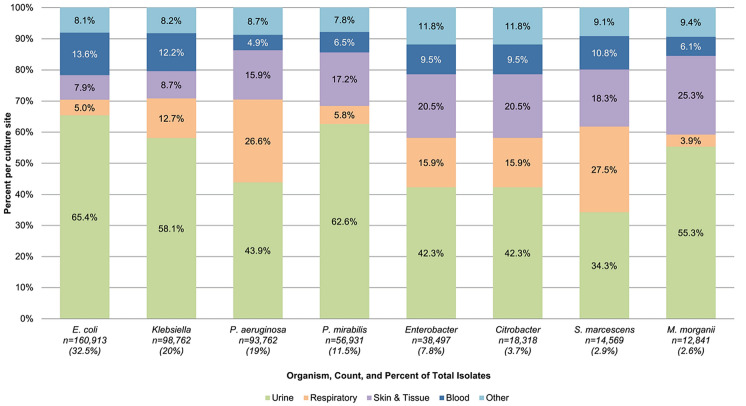
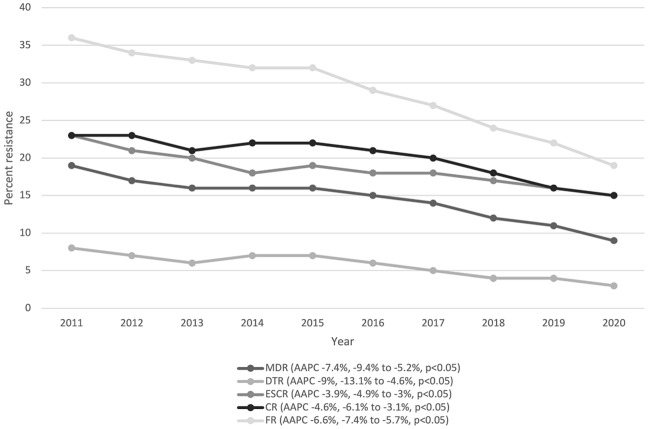
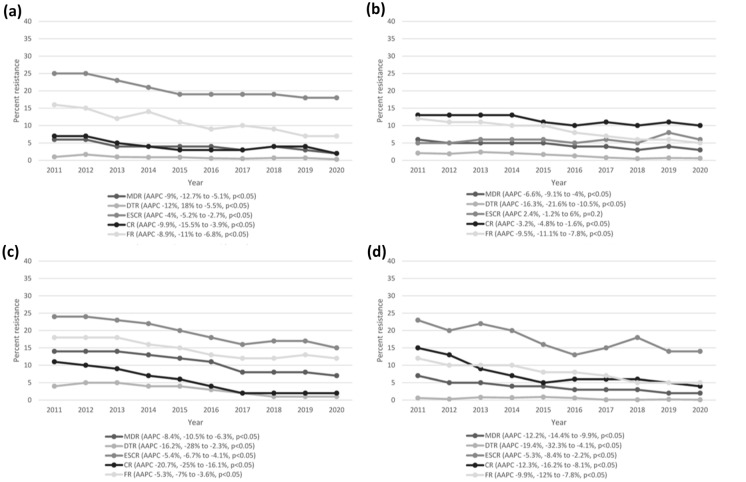
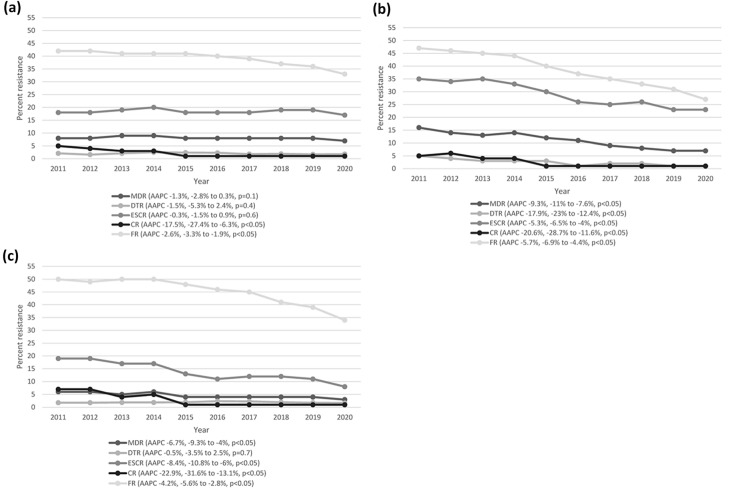
INTRODUCTION: Gram-negative resistance is a well-acknowledged public health threat. Surveillance data can be used to monitor resistance trends and identify strategies to mitigate their threat. The objective of this study was to assess antibiotic resistance trends in Gram-negative bacteria. METHODS: The first cultures of Pseudomonas aeruginosa, Citrobacter, Escherichia coli, Enterobacter, Klebsiella, Morganella morganii, Proteus mirabilis, and Serratia marcescens per hospitalized patient per month collected from 125 Veterans Affairs Medical Centers (VAMCs) between 2011 to 2020 were included. Time trends of resistance phenotypes (carbapenem, fluoroquinolone, extended-spectrum cephalosporin, multi-drug, and difficult-to-treat) were analyzed with Joinpoint regression to estimate average annual percent changes (AAPC) with 95% confidence intervals and p values. A 2020 antibiogram of reported antibiotic percent susceptibilities was also created to evaluate resistance rates at the beginning of the COVID-19 pandemic. RESULTS: Among 40 antimicrobial resistance phenotype trends assessed in 494,593 Gram-negative isolates, there were no noted increases; significant decreases were observed in 87.5% (n = 35), including in all P. aeruginosa, Citrobacter, Klebsiella, M. morganii, and S. marcescens phenotypes (p < 0.05). The largest decreases were seen in carbapenem-resistant phenotypes of P. mirabilis, Klebsiella, and M. morganii (AAPCs: - 22.9%, - 20.7%, and - 20.6%, respectively). In 2020, percent susceptibility was over 80% for all organisms tested against aminoglycosides, cefepime, ertapenem, meropenem, ceftazidime-avibactam, ceftolozane-tazobactam, and meropenem-vaborbactam. CONCLUSION: We observed significant decreases in antibiotic resistance for P. aeruginosa and Enterobacterales over the past decade. According to the 2020 antibiogram, in vitro antimicrobial activity was observed for most treatment options. These results may be related to the robust infection control and antimicrobial stewardship programs instituted nationally among VAMCs.
Overview
The claims and statistics of this paper haven’t been checked yet.
Free: it reads the open-access text and checks the first 5 claims that cite a source we can check. Create a free account to check every claim.
Integrity signals
Registry
Cites
Statistics
Figures
Verification
Claims the paper makes
The claims and statistics of this paper haven’t been checked yet.
Free: it reads the open-access text and checks the first 5 claims that cite a source we can check. Create a free account to check every claim.
Claims other papers make about this one
Each is checked against this paper’s own text: does it say what the citing paper says it does?
The source backs part of the claim, not all of it — or backs it for a different population, condition or comparison.
In the citing paper
“other studies have reported recent declines in community-onset MRSA, Pseudomonas, and Acinetobacter infections.”
From Trends in empiric broad-Spectrum antibiotic use for suspected community-onset Sepsis in US hospitals (2024) · cites this paper as [37]
Experimental — accuracy not yet measured
Self-check
Percentages, sums and reported differences re-computed from the paper’s own numbers.
The self-check needs the paper’s full text.
Citations
Cites
Magiorakos, A.-P., Srinivasan, A., Carey, R. B., Carmeli, Y., Falagas, M. E., Giske, C. G., Harbarth, S., Hindler, J. F., Kahlmeter, G., Olsson-Liljequist, B., et al. (2012) · Clinical Microbiology and Infection · doi:10.1111/j.1469-0691.2011.03570.x · Cited by 14,449 · cited 1×
“Gram-negative bacilli, including Enterobacterales and Pseudomonas aeruginosa, can demonstrate resistance to all available antibiotics through various resistance mechanisms [2].”
BackgroundAntibiotic resistance threats in the United States, 2019
(U.S.), C. F. D. C. A. P. (2019) · doi:10.15620/cdc:82532 · Cited by 5,782
Mechanisms of Resistance to Quinolones
Jacoby, G. A. (2005) · Clinical Infectious Diseases · doi:10.1086/428052 · Cited by 924 · cited 1×
“Also, considering the boxed warnings regarding their safety profile and Gram-negative bacteria’s ability to acquire multiple resistance mechanisms that may be precipitated by prior fluoroquinolone exposure, continuing to avoid fluoroquinolone use is a prudent treatment approach if other empiric options are available […”
BackgroundTamma, P. D., Aitken, S. L., Bonomo, R. A., Mathers, A. J., van Duin, D., & Clancy, C. J. (2023) · Clinical Infectious Diseases · doi:10.1093/cid/ciad428 · Cited by 740
Kadri, S. S., Adjemian, J., Lai, Y. L., Spaulding, A. B., Ricotta, E., Prevots, D. R., Palmore, T. N., Rhee, C., Klompas, M., Dekker, J. P., et al. (2018) · Clinical Infectious Diseases · doi:10.1093/cid/ciy378 · Cited by 605 · cited 1×
“Difficult-to-treat resistance [6] Non-susceptible to all reported agents in the following categories: Extended-spectrum cephalosporins (cefepime, ceftriaxone, ceftazidime, cefotaxime) Beta-lactams (piperacillin/tazobactam, aztreonam) Fluoroquinolones (ciprofloxacin, levofloxacin) Carbapenems (imipenem, meropenem, dori…”
BackgroundMultidrug-resistant bacterial infections in U.S. hospitalized patients, 2012-2017.
Jernigan, J. A., Hatfield, K. M., Wolford, H., Nelson, R. E., Olubajo, B., Reddy, S. C., McCarthy, N., Paul, P., McDonald, L. C., Kallen, A., et al. (2020) · New England Journal of Medicine · doi:10.1056/nejmoa1914433 · Cited by 577 · cited 1×
“Data on overall US resistance trends are largely derived from CDC modeling estimates, with smaller surveillance studies at times reporting differing trends [1, 14].”
Tamma, P. D., Aitken, S. L., Bonomo, R. A., Mathers, A. J., van Duin, D., & Clancy, C. J. (2021) · Clinical Infectious Diseases · doi:10.1093/cid/ciab295 · Cited by 390
Epidemiology and Mechanisms of Resistance of Extensively Drug Resistant Gram-Negative Bacteria
Eichenberger, E. M., & Thaden, J. T. (2019) · Antibiotics · doi:10.3390/antibiotics8020037 · Cited by 237 · cited 1×
“Further, they can cause nosocomial outbreaks, which has led to the global emergence and dissemination of Gram-negative bacterial strains that harbor high-level resistance due to extended-spectrum beta-lactamases such as carbapenemases [3].”
BackgroundUnderstanding and Addressing CLSI Breakpoint Revisions: a Primer for Clinical Laboratories
Humphries, R. M., Abbott, A. N., & Hindler, J. A. (2019) · Journal of Clinical Microbiology · doi:10.1128/jcm.00203-19 · Cited by 193 · cited 1×
“Since testing methods are not standardized across VHA laboratories, only half of included culture results contain MICs, and facility-level testing methods were not available in the data source, the variation in MIC interpretations could be due to differiences in methods utilized across laboratories or delays in updati…”
MethodSurveillance of antibiotic resistance
Johnson, A. P. (2015) · Philosophical Transactions of the Royal Society B: Biological Sciences · doi:10.1098/rstb.2014.0080 · Cited by 148 · cited 1×
“To support these efforts, surveillance systems for monitoring AR have been developed, including facility-level reporting with the CDC’s National Healthcare Safety Network (NHSN) and country-level reporting through WHO’s Global Antimicrobial Resistance Surveillance System [1, 8, 12, 13].”
MethodKelly, A. A., Jones, M., Echevarria, K. L., Kralovic, S. M., Samore, M. H., Goetz, M. B., Madaras‐Kelly, K., Simbartl, L. A., Morreale, A. P., Neuhauser, M. M., et al. (2017) · Infection Control and Hospital Epidemiology · doi:10.1017/ice.2016.328 · Cited by 96 · cited 2×
“The implementation of the VHA Antimicrobial Stewardship Taskforce in January 2014 mandated all VAMCs to develop ASPs and report to the NHSN Antibiotic Use module [10, 33].”
MethodResultWilson, B. M., Chakhtoura, N. G. E., Patel, S. R., Saade, E., Donskey, C. J., Bonomo, R. A., & Pérez, F. (2017) · Emerging infectious diseases · doi:10.3201/eid2305.162034 · Cited by 73
Gupta, V., Ye, G., Olesky, M., Lawrence, K. R., Murray, J., & Yu, K. C. (2019) · BMC Infectious Diseases · doi:10.1186/s12879-019-4387-3 · Cited by 70 · cited 1×
“, Enterobacter aerogenes changing to Klebsiella aerogenes) [17, 18, 29].”
BackgroundDunne, M. W., Aronin, S. I., Yu, K. C., Watts, J. A., & Gupta, V. (2022) · BMC Infectious Diseases · doi:10.1186/s12879-022-07167-y · Cited by 52 · cited 1×
“, Enterobacter aerogenes changing to Klebsiella aerogenes) [17, 18, 29].”
BackgroundMorrill, H. J., Morton, J. B., Caffrey, A. R., Jiang, L., Dosa, D. M., Mermel, L. A., & LaPlante, K. L. (2017) · Antimicrobial Agents and Chemotherapy · doi:10.1128/aac.02236-16 · Cited by 50
Self-citationGoto, M., O'Shea, A. M. J., Livorsi, D. J., McDanel, J. S., Jones, M. M., Richardson, K. K., Beck, B. F., Alexander, B., Evans, M. E., Roselle, G. A., et al. (2016) · Clinical Infectious Diseases · doi:10.1093/cid/ciw423 · Cited by 43
Mammina, C., Palma, D. M., Bonura, C., Plano, M. R. A., Monastero, R., Sodano, C., Calà, C., & Tetamo, R. (2010) · Journal of Clinical Microbiology · doi:10.1128/jcm.00315-10 · Cited by 41
Dieringer, T. D., Furukawa, D., Graber, C. J., Stevens, V. W., Jones, M., Rubin, M. A., & Goetz, M. B. (2020) · Infection Control and Hospital Epidemiology · doi:10.1017/ice.2020.1277 · Cited by 39 · cited 2×
“The aforementioned VA study noting decreases in inpatient antibiotic DOT from 2015 to 2019 found increasing DOT in 2020, with a corresponding trend for decreasing narrow-spectrum DOT from 2015 to 2019 that reversed in 2020; these effects persisted when facilities heavily impacted by COVID-19 were excluded [35].”
BackgroundResultEvans, M. E., Simbartl, L. A., Kralovic, S. M., Clifton, M., DeRoos, K., McCauley, B. P., Gauldin, N., Flarida, L., Gamage, S. D., Jones, M., et al. (2022) · Infection Control and Hospital Epidemiology · doi:10.1017/ice.2022.93 · Cited by 29
Aronin, S. I., Gupta, V., Dunne, M. W., Watts, J. A., & Yu, K. C. (2022) · International Journal of Infectious Diseases · doi:10.1016/j.ijid.2022.03.052 · Cited by 20 · cited 1×
“Further, as previous work has demonstrated geographical variation in Gramnegative AR, the use of local AR rates to inform IC/ASP interventions is preferred [34, 39].”
BackgroundHughes, M. A., Dosa, D. M., Caffrey, A. R., Appaneal, H. J., Jump, R., Lopes, V., & LaPlante, K. L. (2019) · Journal of the American Medical Directors Association · doi:10.1016/j.jamda.2019.07.016 · Cited by 18 · cited 13×
“Ciprofloxacin retained PS80 for Citrobacter, Enterobacter, Klebsiella, S. marcescens, and P. aeruginosa.”
BackgroundInfluentialSelf-citationWalters, M. S., Witwer, M. L., Lee, Y.-K., Albrecht, V. S., Lonsway, D. R., Rasheed, J. K., Anacker, M. L., Snippes-Vagnone, P., Lynfield, R., & Kallen, A. J. (2018) · MMWR Morbidity and Mortality Weekly Report · doi:10.15585/mmwr.mm6723a4 · Cited by 17
Appaneal, H. J., Caffrey, A. R., Jiang, L., Dosa, D. M., Mermel, L. A., & LaPlante, K. L. (2017) · Diagnostic Microbiology and Infectious Disease · doi:10.1016/j.diagmicrobio.2017.11.022 · Cited by 15
Self-citationNational trends in hospital, long-term care and outpatient Acinetobacter baumannii resistance rates
Appaneal, H. J., O’Neill, E., Lopes, V., LaPlante, K. L., & Caffrey, A. R. (2021) · Journal of Medical Microbiology · doi:10.1099/jmm.0.001473 · Cited by 14 · cited 1×
“pneumoniae were observed from 2006 to 2015 [15, 36, 37].”
BackgroundSelf-citationNelson, R. E., Goto, M., Samore, M. H., Jones, M., Stevens, V. W., Evans, M. E., Schweizer, M. L., Perencevich, E. N., & Rubin, M. A. (2020) · Clinical Infectious Diseases · doi:10.1093/cid/ciaa1591 · Cited by 13
Shortridge, D., Carvalhaes, C. G., Streit, J. M., & Flamm, R. K. (2020) · Diagnostic Microbiology and Infectious Disease · doi:10.1016/j.diagmicrobio.2020.115302 · Cited by 11
Gentry, C. A., & Williams, R. J. (2015) · Microbial Drug Resistance · doi:10.1089/mdr.2014.0287 · Cited by 6
1254. DoD Adherence to CDC Core Elements of Hospital Antibiotic Stewardship Programs
Lynch, L. C., Tribble, D. R., Tribble, D. R., & Mende, K. (2023) · Open Forum Infectious Diseases · doi:10.1093/ofid/ofad500.1094 · Cited by 3
Research works printed but not linked: 5
- WHO Global priority list of antibiotic-resistant bacteria to guide research, discovery, and development of new antibiotics 2017 Geneva World Health Organization
- WHO WHO policy guidance on integrated antimicrobial stewardship activities 2021 Geneva World Health Organization
- CLSI Performance standards for antimicrobial susceptibility testing: twentieth informational supplement M100–S20 2020 Wayne Clinical and Laboratory Standards Institute
- FDA. Drug safety communication: FDA advises restricting fluoroquinolone antibiotic use for certain uncomplicated infections; warns about disabling side effects that can occur together. Press release. Silver Spring: US Food and Drug Administration; 2016.
- CDC 2022 special report: COVID-19 US impact on antimicrobial resistance 2022 Atlanta US Centers for Disease Control and Prevention
Cited by
Trends in empiric broad-Spectrum antibiotic use for suspected community-onset Sepsis in US hospitals
Rhee, C., Chen, T., Kadri, S. S., Lawandi, A., Yek, C., Walker, M., Warner, S., Fram, D., Chen, H.-C., Shappell, C. N., et al. (2024) · JAMA Network Open · doi:10.1001/jamanetworkopen.2024.18923 · Cited by 58
Trends in Incidence of Carbapenem-Resistant Enterobacterales in 7 US Sites, 2016─2020
Duffy, N., Li, R., Czaja, C. A., Johnston, H. L., Janelle, S. J., Jacob, J. T., Smith, G., Wilson, L. E., Vaeth, E., Lynfield, R., et al. (2023) · Open Forum Infectious Diseases · doi:10.1093/ofid/ofad609 · Cited by 27
Sumana, M. N., Maheshwarappa, Y. D., Kalyani, G., Mahale, R. P., Shivappa, S. G., Rao, M. R., Gowda, R. S., Chitaragi, V. B., Deepashree, R., Sujatha, S. R., et al. (2025) · Frontiers in Microbiology · doi:10.3389/fmicb.2025.1553943 · Cited by 13
Mauritz, M. D., Claus, B., Förster, J., Petzold, M., Schneitler, S., Halfmann, A., Hauswaldt, S., Nurjadi, D., & Toepfner, N. (2024) · Journal of Hospital Infection · doi:10.1016/j.jhin.2024.03.010 · Cited by 12
Khan, S., Madhi, S. A., & Olwagen, C. P. (2023) · Scientific Reports · doi:10.1038/s41598-023-48696-z · Cited by 11
“Furthermore, MDR A. baumannii is often associated with inappropriate empiric therapies which contribute to high case fatality rates 6 .”
Background
Metadata
- Authors
- Liao, J. X., Appaneal, H. J., Menon, A., Lopes, V., LaPlante, K. L., & Caffrey, A. R.
- Affiliations
- University of Rhode Island (US)
- Brown University (US)
- Providence VA Medical Center (US)
- Corresponding author
- LaPlante, Kerry L.
- Caffrey, Aisling R.
- Venue
- Infectious Diseases and Therapy
- Published
- 2023-06-16
- Volume
- 12
- Issue
- 7
- Pages
- 1835-1848
- ISSN
- 2193-6382 (ISSN-L)
- 2193-8229
- PMC
- PMC10390413
- OpenAlex
- W4380872152
- Cited by
- 16
- References
- 28
- Citations by year
- 2026: 1 · 2025: 6 · 2024: 6 · 2023: 3
- FWCI
- 1.37
- Type
- journal article
- Language
- en
- Open access
- gold
- doi.org
- Licence
- cc-by-nc
- creativecommons.org/licenses/by-nc/4.0 (tdm)
- creativecommons.org/licenses/by-nc/4.0 (vor)
- Locations
- Infectious Diseases and Therapy (publishedVersion, cc-by-nc)
- PubMed Central (publishedVersion, cc-by-nc)
- PubMed (publishedVersion)
- DOAJ (DOAJ: Directory of Open Access Journals) (submittedVersion, cc-by-sa)
- Funders
- U.S. Department of Veterans Affairs
- Topics
- Health Sciences › Medicine › Microbiology (medical) › Antibiotic Resistance in Bacteria
- Health Sciences › Medicine › Infectious Diseases › Antibiotic Use and Resistance
- Health Sciences › Medicine › Urology › Urinary Tract Infections Management
- Keywords
- antibiotic resistance trends, Gram-negative bacteria, veterans, Pseudomonas aeruginosa, Enterobacterales, carbapenem resistance, fluoroquinolone resistance, extended-spectrum cephalosporins, multidrug resistance, Klebsiella, Morganella morganii, Proteus mirabilis, Serratia marcescens, Citrobacter, Escherichia coli, antimicrobial susceptibility, infection control, COVID-19 pandemic, antimicrobial stewardship
About these checks
Registry, retraction, Cites and statistics results are computed, not judged, with one exception: a printed reference that no index lists is read once by a model before it counts as a citation error. Claims are extracted by a model and kept only when their quote appears verbatim in the text; each cited source is then checked, with a model’s help, for whether it says what the claim relies on. Those verdicts can be wrong — read the claim’s quote and the cited source before relying on one.
Statistics and arithmetic are recomputed, not judged.
Confidence bands are shown only for fields calibrated on our annotated test set. None is calibrated yet, so no band is shown.
What counts as a claim ›How we measure confidence ›How we check this ›
Are you an author, or do you see a problem with this page? Request a review
Data sources
Bibliographic data: Semantic Scholar, OpenAlex, Crossref.
Contains information from the Semantic Scholar Academic Graph Datasets, made available under the ODC Attribution License (ODC-BY 1.0).
Semantic Scholar’s data is described in: Kinney, R., et al. (2023). The Semantic Scholar Open Data Platform. arXiv:2301.10140.
