

The DOI matches its Crossref record; 62 of the 63 references it cites were found in a registry or an index.
Concurrent Use of Prescription Drugs and Herbal Medicinal Products in Older Adults: A Systematic Review
Open accessAbstract
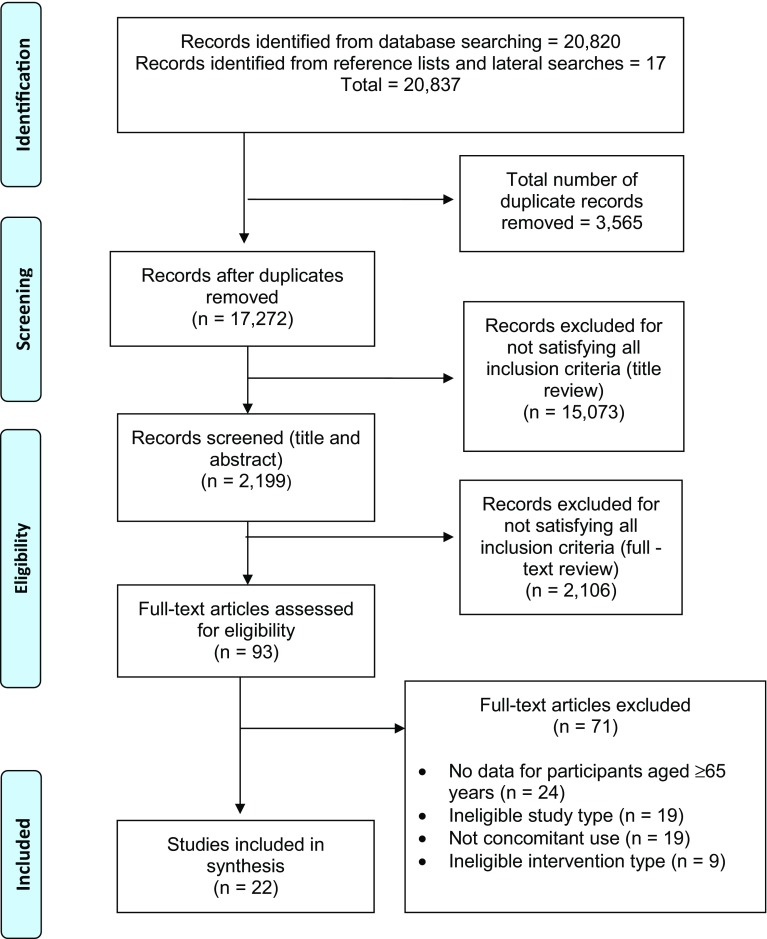
BACKGROUND: The use of herbal medicinal products (HMPs) is common among older adults; however, little is known about concurrent use with prescription drugs, as well as potential interactions associated with such combinations. OBJECTIVE: The aim of this systematic review was to identify and evaluate the literature on concurrent prescription and HMP use among older adults to assess prevalence, patterns, potential interactions and factors associated with this use. METHODS: Systematic searches were conducted in the MEDLINE, PsycINFO, EMBASE, CINAHL, AMED, Web of Science and Cochrane databases from inception to May 2017 for studies reporting concurrent use of prescription medicines with HMPs in adults ≥ 65 years of age. Quality was assessed using the Joanna Briggs Institute checklists. And the Evidence for Policy and Practice Information and Co-ordinating Centre (EPPI-Centre) three-stage approach to mixed method research was used to synthesise data. RESULTS: Twenty-two studies were included. A definition of HMPs or what was considered an HMP was frequently missing. Prevalence of concurrent use by older adults varied widely between 5.3 and 88.3%. Prescription medicines most combined with HMPs were antihypertensive drugs, β-blockers, diuretics, antihyperlipidemic agents, anticoagulants, analgesics, antihistamines, antidiabetics, antidepressants and statins. The HMPs most frequently used were Ginkgo biloba, garlic, ginseng, St John's wort, Echinacea, saw palmetto, evening primrose oil and ginger. Potential risks of bleeding due to the use of Ginkgo biloba, garlic or ginseng with aspirin or warfarin was the most reported herb-drug interaction. Some data suggest being female, and having a lower household income and less than a high-school education were associated with concurrent use. CONCLUSION: The prevalence of concurrent prescription drugs and HMP use among older adults is substantial and potential interactions have been reported. Knowledge of the extent and manner in which older adults combine prescription drugs will aid healthcare professionals in appropriately identifying and managing patients at risk. Systematic Review Registration Number: PROSPERO 2014:CRD42014009091.
Overview
The claims and statistics of this paper haven’t been checked yet.
Run the check — free, no account needed. It reads the open-access text and checks the sources it cites.
Integrity signals
Registry
Cites
Statistics
Figures
Verification
Claims the paper makes
The claims and statistics of this paper haven’t been checked yet.
Run the check — free, no account needed. It reads the open-access text and checks the sources it cites.
Claims other papers make about this one
Each is checked against this paper’s own text: does it say what the citing paper says it does?
The source backs part of the claim, not all of it — or backs it for a different population, condition or comparison.
In the citing paper
“Concurrent, often undisclosed use with prescription drugs is common in older adults, yet berberine is far from inert.”
From Berberine-Drug Interactions: Mechanisms, Clinical Relevance and Risk Stratification-A Narrative Review (2026) · cites this paper as [5]
Experimental — accuracy not yet measuredThe cited source says what the claim attributes to it.
In the citing paper
“Population studies report that between 5% and over 80% of older adults combine supplements with prescription drugs, and a substantial proportion carry at least one potential interaction [3,4,5,6,7].”
From Berberine-Drug Interactions: Mechanisms, Clinical Relevance and Risk Stratification-A Narrative Review (2026) · cites this paper as [5]
Self-check
Percentages, sums and reported differences re-computed from the paper’s own numbers.
The self-check needs the paper’s full text.
Citations
Cites
Shamseer, L., Moher, D., Clarke, M., Ghersi, D., Liberati, A., Petticrew, M., Shekelle, P., Stewart, L. A., & the PRISMA-P Group (2015) · BMJ · doi:10.1136/bmj.g7647 · Cited by 13,120
Munn, Z., Moola, S., Lisy, K., Riitano, D., & Tufanaru, C. (2015) · International Journal of Evidence-Based Healthcare · doi:10.1097/xeb.0000000000000054 · Cited by 3,131
Mangoni, A. A., & Jackson, S. H. (2003) · British Journal of Clinical Pharmacology · doi:10.1046/j.1365-2125.2003.02007.x · Cited by 1,887
Kaufman, D. W., Kelly, J. P., Rosenberg, L., Anderson, T. E., & Mitchell, A. A. (2002) · JAMA · doi:10.1001/jama.287.3.337 · Cited by 1,845
Fugh‐Berman, A. (2000) · The Lancet · doi:10.1016/s0140-6736(99)06457-0 · Cited by 1,194
Tsang, A., Von Korff, M., Lee, S., Alonso, J., Karam, E., Angermeyer, M. C., Borges, G. L. G., Bromet, E. J., de Girolamo, G., de Graaf, R., et al. (2008) · The Journal of Pain · doi:10.1016/j.jpain.2008.05.005 · Cited by 1,157
Synergy and other interactions in phytomedicines
WILLIAMSON, E. (2001) · Phytomedicine · doi:10.1078/0944-7113-00060 · Cited by 1,027
(2006) · CRC Press eBooks · doi:10.1201/9781420006452.ch4 · Cited by 909
Levine, M. E. (2012) · The Journals of Gerontology Series A · doi:10.1093/gerona/gls233 · Cited by 897
Research works printed but not linked: 3
- MHRA, Ipsos MORI. Public perception of herbal medicines. London: MHRA; 2009.
- Commission of the European Communities. Amended proposal for a Directive of the European Parliament and of the Council amending the directive 2001/83/EC as regards traditional herbal medicinal products. Brussels: European Commission; 2003. p. 67.
- The Joanna Briggs Institute. Joanna Briggs Institute reviewers’ manual. 2016th ed. Adelaide: The Joanna Briggs Institute; 2016.
Cited by
Sorted by citations
Interventions to improve the appropriate use of polypharmacy for older people
Rankin, A., Cadogan, C. A., Patterson, S. M., Kerse, N. M., Cardwell, C. R., Bradley, M. C., Ryan, C. A., & Hughes, C. M. (2018) · Cochrane Database of Systematic Reviews · doi:10.1002/14651858.cd008165.pub4 · Cited by 525
Trends in use, pharmacology, and clinical applications of emerging herbal nutraceuticals
Williamson, E. M., Liu, X., & Izzo, A. A. (2019) · British Journal of Pharmacology · doi:10.1111/bph.14943 · Cited by 323
Bailey, R. L. (2018) · Critical Reviews in Food Science and Nutrition · doi:10.1080/10408398.2018.1524364 · Cited by 174
Interventions to improve the appropriate use of polypharmacy for older people
Cole, J. A., Gonçalves, D. C., Alqahtani, M., Barry, H. E., Cadogan, C. A., Rankin, A., Patterson, S. M., Kerse, N. M., Cardwell, C. R., Ryan, C. A., et al. (2023) · Cochrane Database of Systematic Reviews · doi:10.1002/14651858.cd008165.pub5 · Cited by 168
Prevalence of drug-herb and drug-supplement interactions in older adults: A cross-sectional survey
Agbabiaka, T. B., Spencer, N. H., Khanom, S., & Goodman, C. (2018) · British Journal of General Practice · doi:10.3399/bjgp18x699101 · Cited by 115
Self-citation
Metadata
- Authors
- Agbabiaka, T. B., Wider, B., Watson, L. K., & Goodman, C.
- Affiliations
- University of Hertfordshire (GB)
- University of Exeter (GB)
- Corresponding author
- Agbabiaka, Taofikat B.
- Venue
- Drugs & Aging
- Published
- 2017-12
- Volume
- 34
- Issue
- 12
- Pages
- 891-905
- ISSN
- 1170-229X (ISSN-L)
- 1179-1969
- PMC
- PMC5730633
- OpenAlex
- W2773883339
- Cited by
- 141
- References
- 63
- Citations by year
- 2026: 20 · 2025: 18 · 2024: 8 · 2023: 19 · 2022: 16 · 2021: 22 · 2020: 10 · 2019: 17 · 2018: 9 · 2017: 2
- FWCI
- 2.22
- Type
- journal article
- Language
- en
- Open access
- hybrid
- doi.org
- Licence
- Locations
- Drugs & Aging (publishedVersion, cc-by-nc)
- PubMed Central (publishedVersion, cc-by-nc)
- PubMed (publishedVersion)
- University of Hertfordshire Research Archive (University of Hertfordshire) (submittedVersion)
- Figshare (submittedVersion)
- Open Research Exeter (University of Exeter) (submittedVersion, cc-by-nc)
- University of Hertfordshire Research Archive (University of Hertfordshire) (submittedVersion, cc-by-nc)
- Funders
- National Institute for Health and Care Research (NF-SI-0515-10103)
- Topics
- Health Sciences › Medicine › Complementary and alternative medicine › Complementary and Alternative Medicine Studies
- Health Sciences › Medicine › Geriatrics and Gerontology › Pharmaceutical Practices and Patient Outcomes
- Life Sciences › Agricultural and Biological Sciences › Plant Science › Phytochemistry Medicinal Plant Applications
- Keywords
- herbal medicinal products, prescription drugs, polypharmacy, older adults, herb-drug interactions, anticoagulants, Ginkgo biloba, garlic, ginseng, Hypericum perforatum, saw palmetto, bleeding risk, warfarin, aspirin, socioeconomic factors
- MeSH terms
- Age Factors, Aged, Aged, 80 and over, Female, Humans, Male, Phytotherapy, Plant Preparations, Herb-Drug Interactions, Prescription Drugs
About these checks
Registry, retraction, Cites and statistics results are computed, not judged, with one exception: a printed reference that no index lists is read once by a model before it counts as a citation error. Claims are extracted by a model and kept only when their quote appears verbatim in the text; each cited source is then checked, with a model’s help, for whether it says what the claim relies on. Those verdicts can be wrong — read the claim’s quote and the cited source before relying on one.
Statistics and arithmetic are recomputed, not judged.
Confidence bands are shown only for fields calibrated on our annotated test set. None is calibrated yet, so no band is shown.
What counts as a claim ›How we measure confidence ›How we check this ›
Are you an author, or do you see a problem with this page? Request a review
