

Intervention Strategies Used in Sport Injury Prevention Studies: A Systematic Review Identifying Studies Applying the Haddon Matrix
Open accessThe DOI matches its Crossref record; 205 of the 206 references it cites were found in a registry or an index.
Abstract
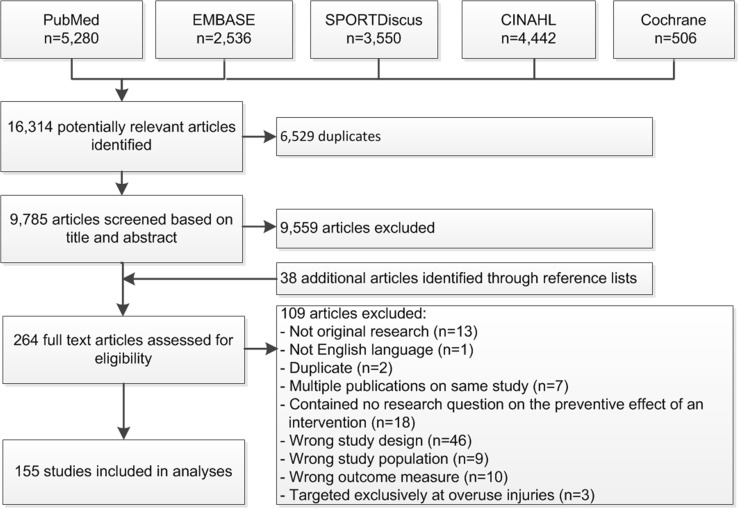
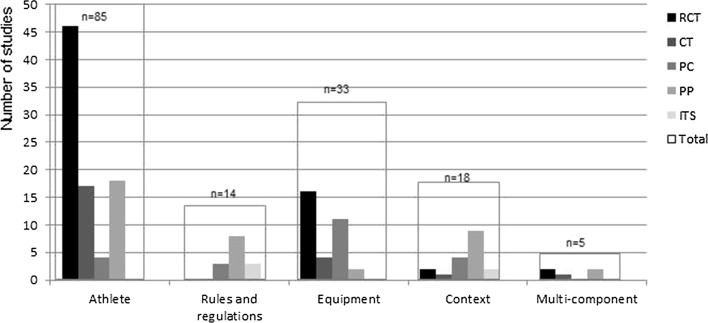
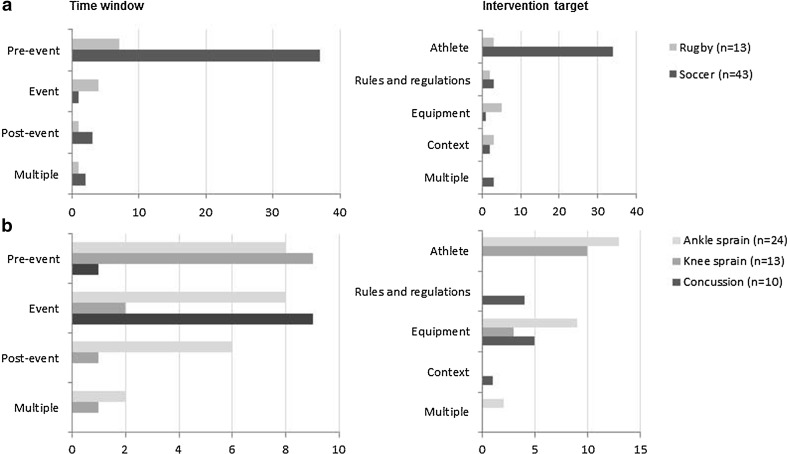
BACKGROUND: Prevention of sport injuries is crucial to maximise the health and societal benefits of a physically active lifestyle. To strengthen the translation and implementation of the available evidence base on effective preventive measures, a range of potentially relevant strategies should be considered. OBJECTIVE: Our aim was to identify and categorise intervention strategies for the prevention of acute sport injuries evaluated in the scientific literature, applying the Haddon matrix, and identify potential knowledge gaps. METHODS: Five electronic databases were searched (PubMed, EMBASE, SPORTDiscus, CINAHL, Cochrane) for studies that evaluated the effect of interventions on the occurrence of acute sport injuries. Studies were required to include a control group/condition, prospective data collection, and a quantitative injury outcome measure. RESULTS: A total of 155 studies were included, mostly randomised controlled trials (43%). The majority of studies (55%) focussed on strategies requiring a behavioural change on the part of athletes. Studies predominantly evaluated the preventive effect of various training programmes targeted at the 'pre-event' phase (n = 73) and the use of equipment to avoid injury in the 'event phase' (n = 29). A limited number of studies evaluated the preventive effect of strategies geared at rules and regulations (n = 14), and contextual modifications (n = 18). Studies specifically aimed at preventing re-injuries were a minority (n = 8), and were mostly related to ankle sprains (n = 5). CONCLUSIONS: Valuable insight into the extent of the evidence base of sport injury prevention studies was obtained for 20 potential intervention strategies. This approach can be used to monitor potential gaps in the knowledge base on sport injury prevention.
Overview
The claims and statistics of this paper haven’t been checked yet.
Free: it reads the open-access text and checks the first 5 claims that cite a source we can check. Create a free account to check every claim.
Integrity signals
Registry
Cites
Statistics
Figures
Verification
Claims the paper makes
The claims and statistics of this paper haven’t been checked yet.
Free: it reads the open-access text and checks the first 5 claims that cite a source we can check. Create a free account to check every claim.
Self-check
Percentages, sums and reported differences re-computed from the paper’s own numbers.
The self-check needs the paper’s full text.
Citations
Cites
Items 201–205 of 205
Research designs for evaluation studies
Emery, C. A. (2009) · Oxford University Press eBooks · doi:10.1093/acprof:oso/9780199561629.003.013 · Cited by 6 · cited 4×
“study designs have also been used in sport injury prevention studies [11], as RCTs are not always feasible in a realworld sport setting due to ethical or practical reasons [14, 15].”
BackgroundMethodInfluentialPhysical Activity, Clinical Medicine, and Public Health
Blair, S. N. (2007) · Current Sports Medicine Reports · doi:10.1007/bf02941144 · Cited by 5
The quality of officiating as an injury prevention factor in intramural touch football
KRAUS, J. F., Anderson, B. D., & Mueller, C. (1971) · Medicine & Science in Sports & Exercise · doi:10.1249/00005768-197100330-00009 · Cited by 2
Do Sleep Disorders Have an Impact on Blood Pressure?
Lenfant, C. J. M. (2008) · American Journal of Therapeutics · doi:10.1097/mjt.0b013e31815fd0fe · Cited by 2
Verhagen, E. A. L. M. (2013) · Acta Médica Portuguesa · doi:10.20344/amp.546 · Cited by 2 · cited 1×
“Similarly, differences between strategies used to prevent ankle and knee sprains, as opposed to concussions, can be related to the aetiology and mechanisms of these injuries [10, 192, 193].”
BackgroundSelf-citation
Research works printed but not linked: 4
- Carey T, Sanders GD, Viswanathan M, et al. Appendix A, Taxonomy for study designs. Framework for considering study designs for future research needs (Methods Future Research Needs Reports, No 8). Rockville: Agency for Healthcare Research and Quality (US); 2012. 22624168
- Sebelien C Stiller C Maher S Effects of implementing Nordic hamstring exercises for semi-professional soccer players in Akershus, Norway Orthop Pract 2014 26 2 90 97
- Elena-Doina M Mogaseanu M Dunarintu S Prevention of musculo-skeletal traumas in competitive sportsmen: (aspects regarding trauma incidence in volleyball and basketball teams) Ovidius Univ Ann Ser Phys Educ Sport/Sci Mov Health 2011 10 1 80 84
- Carey T, Sanders GD, Viswanathan M, et al. Appendix A, taxonomy for study designs. Framework for considering study designs for future research needs (methods future research needs reports, No 8). 2012. http://www.ncbi.nlm.nih.gov/books/NBK95280/. Accessed 25 March 2016.
Cited by
Anterior cruciate ligament injury: towards a gendered environmental approach
Parsons, J. L., Coen, S. E., & Bekker, S. (2021) · British Journal of Sports Medicine · doi:10.1136/bjsports-2020-103173 · Cited by 300
“51 In a recent scoping review of primarily ACL injury studies, Truong et al reported a dearth of studies that considered social and contextual factors at time of injury and in recovery.”
BackgroundContext matters: revisiting the first step of the 'Sequence of Prevention' of sports injuries
Bolling, C., van Mechelen, W., Pasman, H. R., & Verhagen, E. (2018) · Sports Medicine · doi:10.1007/s40279-018-0953-x · Cited by 262
“[21] reviewed intervention strategies for sports injury prevention and concluded that most of Fig.”
BackgroundSelf-citationMeta‐analysis of meta‐analyses of anterior cruciate ligament injury reduction training programs
Webster, K. E., & Hewett, T. E. (2018) · Journal of Orthopaedic Research · doi:10.1002/jor.24043 · Cited by 253
Chia, L., De Oliveira Silva, D., Whalan, M., McKay, M. J., Sullivan, J., Fuller, C. W., & Pappas, E. (2022) · Sports Medicine · doi:10.1007/s40279-022-01697-w · Cited by 196
“Exercise-based injury risk reduction programs (IRRPs) are a prominent feature in ACL injury risk-reduction efforts [6] and these programs seem to have a stronger effect on reducing the risk of non-contact ACL injuries (odds ratio (OR) 0.”
The Star Excursion Balance Test: An Update Review and Practical Guidelines
Picot, B., Terrier, R., Forestier, N., Fourchet, F., & McKeon, P. O. (2021) · International Journal of Athletic Therapy & Training · doi:10.1123/ijatt.2020-0106 · Cited by 146
Metadata
- Authors
- Vriend, I., Gouttebarge, V., Finch, C. F., van Mechelen, W., & Verhagen, E. A. L. M.
- Affiliations
- Amsterdam Public Health (NL)
- University of Cape Town (ZA)
- Federation University (AU)
- Corresponding author
- Verhagen, Evert A. L. M.
- Venue
- Sports Medicine
- Published
- 2017-03-16
- Volume
- 47
- Issue
- 10
- Pages
- 2027-2043
- ISSN
- 0112-1642 (ISSN-L)
- 1179-2035
- PMC
- PMC5603636
- OpenAlex
- W2595765925
- Semantic Scholar
- df2f55ccefea723c413541b5a83ebd3fbff97719
- Cited by
- 108
- References
- 206
- Citations by year
- 2026: 10 · 2025: 8 · 2024: 14 · 2023: 13 · 2022: 11 · 2021: 18 · 2020: 16 · 2019: 6 · 2018: 11 · 2017: 1
- FWCI
- 1.69
- Type
- journal article
- Language
- en
- Open access
- hybrid
- doi.org
- Locations
- Sports Medicine (publishedVersion, cc-by)
- Europe PMC (PubMed Central) (publishedVersion, cc-by)
- PubMed Central (publishedVersion, cc-by)
- PubMed (publishedVersion)
- Pure Amsterdam UMC (publishedVersion, cc-by)
- Amsterdam UMC (VU Amsterdam) - Institutional Repository (publishedVersion, other-oa)
- Minerva Access (University of Melbourne) (submittedVersion, cc-by)
- FedUni ResearchOnline (Federation University Australia) (submittedVersion, cc-by)
- Data Archiving and Networked Services (DANS) (submittedVersion)
- Data Archiving and Networked Services (DANS) (submittedVersion, other-oa)
- Funders
- National Health and Medical Research Council Principal Research Fellowship (1058737)
- Topics
- Health Sciences › Medicine › Orthopedics and Sports Medicine › Sports injuries and prevention
- Health Sciences › Medicine › Public Health, Environmental and Occupational Health › Injury Epidemiology and Prevention
- Health Sciences › Medicine › Public Health, Environmental and Occupational Health › Physical Activity and Health
- Keywords
- sports injury prevention, Haddon matrix, intervention strategies, personal protective equipment, rules and regulations, reinjury prevention, ankle sprain, training program
- MeSH terms
- Adult, Aged, Athletic Injuries, Child, Female, Humans, Male, Research, Sports, Exercise, Ankle Injuries
About these checks
Registry, retraction, Cites and statistics results are computed, not judged, with one exception: a printed reference that no index lists is read once by a model before it counts as a citation error. Claims are extracted by a model and kept only when their quote appears verbatim in the text; each cited source is then checked, with a model’s help, for whether it says what the claim relies on. Those verdicts can be wrong — read the claim’s quote and the cited source before relying on one.
Statistics and arithmetic are recomputed, not judged.
Confidence bands are shown only for fields calibrated on our annotated test set. None is calibrated yet, so no band is shown.
What counts as a claim ›How we measure confidence ›How we check this ›
Are you an author, or do you see a problem with this page? Request a review
Data sources
Bibliographic data: Semantic Scholar, OpenAlex, Crossref.
Contains information from the Semantic Scholar Academic Graph Datasets, made available under the ODC Attribution License (ODC-BY 1.0).
Semantic Scholar’s data is described in: Kinney, R., et al. (2023). The Semantic Scholar Open Data Platform. arXiv:2301.10140.
