

Resistance exercise minimal dose strategies for increasing muscle strength in the general population: an overview.
Open accessThe DOI matches its Crossref record; 208 of the 208 references it cites were found in a registry or an index.
Abstract
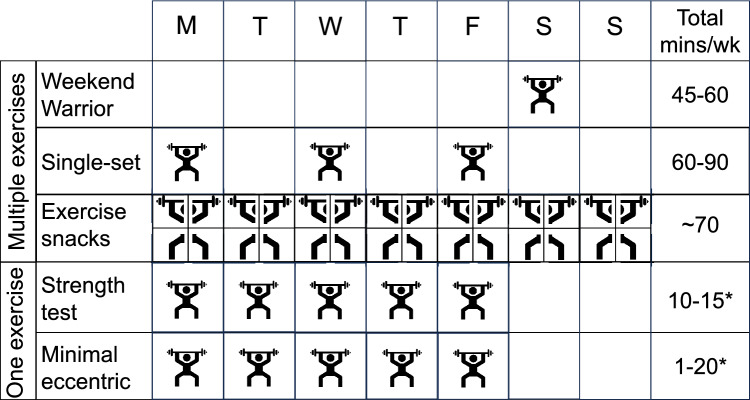
Many individuals do not participate in resistance exercise, with perceived lack of time being a key barrier. Minimal dose strategies, which generally reduce weekly exercise volumes to less than recommended guidelines, might improve muscle strength with minimal time investment. However, minimal dose strategies and their effects on muscle strength are still unclear. Here our aims are to define and characterize minimal dose resistance exercise strategies and summarize their effects on muscle strength in individuals who are not currently engaged in resistance exercise. The minimal dose strategies overviewed were: "Weekend Warrior," single-set resistance exercise, resistance exercise "snacking," practicing the strength test, and eccentric minimal doses. "Weekend Warrior," which minimizes training frequency, is resistance exercise performed in one weekly session. Single-set resistance exercise, which minimizes set number and session duration, is one set of multiple exercises performed multiple times per week. "Snacks," which minimize exercise number and session duration, are brief bouts (few minutes) of resistance exercise performed once or more daily. Practicing the strength test, which minimizes repetition number and session duration, is one maximal repetition performed in one or more sets, multiple days per week. Eccentric minimal doses, which eliminate or minimize concentric phase muscle actions, are low weekly volumes of submaximal or maximal eccentric-only repetitions. All approaches increase muscle strength, and some approaches improve other outcomes of health and fitness. "Weekend Warrior" and single-set resistance exercise are the approaches most strongly supported by current research, while snacking and eccentric minimal doses are emerging concepts with promising results. Public health programs can promote small volumes of resistance exercise as being better for muscle strength than no resistance exercise at all.
Overview
The claims and statistics of this paper haven’t been checked yet.
Free: it reads the open-access text and checks the first 5 claims that cite a source we can check. Create a free account to check every claim.
Integrity signals
Registry
Cites
Statistics
Figures
Verification
Claims the paper makes
The claims and statistics of this paper haven’t been checked yet.
Free: it reads the open-access text and checks the first 5 claims that cite a source we can check. Create a free account to check every claim.
Self-check
Percentages, sums and reported differences re-computed from the paper’s own numbers.
The self-check needs the paper’s full text.
Citations
Cites
A typology of reviews: an analysis of 14 review types and associated methodologies
Grant, M. J., & Booth, A. (2009) · Health Information & Libraries Journal · doi:10.1111/j.1471-1842.2009.00848.x · Cited by 10,817 · cited 1×
“Due to the varying literature on minimal dose exercise, and because some study interventions might not have been conceived of or labeled as minimal dose at the time of publication, we chose an overview method rather than a systematic review method to best summarize the relevant literature [49, 50].”
MethodThe Physical Activity Guidelines for Americans
Piercy, K. L., Troiano, R. P., Ballard, R. M., Carlson, S. A., Fulton, J. E., Galuska, D. A., George, S. M., & Olson, R. D. (2018) · JAMA · doi:10.1001/jama.2018.14854 · Cited by 9,755
Garber, C. E., Blissmer, B., Deschenes, M. R., Franklin, B. A., Lamonte, M. J., Lee, I.-M., Nieman, D. C., & Swain, D. P. (2011) · Medicine & Science in Sports & Exercise · doi:10.1249/mss.0b013e318213fefb · Cited by 9,319
Physical Activity and Health: A Report of the Surgeon General: (525162010-001)
(1995) · PsycEXTRA Dataset · doi:10.1037/e525162010-001 · Cited by 5,479
Exercise and Physical Activity for Older Adults
Chodzko-Zajko, W. J., Proctor, D. N., Fiatarone Singh, M. A., Minson, C. T., Nigg, C. R., Salem, G. J., & Skinner, J. S. (2009) · Medicine & Science in Sports & Exercise · doi:10.1249/mss.0b013e3181a0c95c · Cited by 5,153
American College of Sports Medicine position stand
Otis, C. L. (1997) · Medical Entomology and Zoology · Cited by 4,407
Progression Models in Resistance Training for Healthy Adults
(2009) · Medicine & Science in Sports & Exercise · doi:10.1249/mss.0b013e3181915670 · Cited by 4,332
CAMPBELL, K. L., WINTERS-STONE, K. M., WISKEMANN, J., MAY, A. M., SCHWARTZ, A. L., COURNEYA, K. S., ZUCKER, D. S., MATTHEWS, C. E., LIGIBEL, J. A., GERBER, L. H., et al. (2019) · Medicine & Science in Sports & Exercise · doi:10.1249/mss.0000000000002116 · Cited by 2,988
Leong, D. P., Teo, K. K., Rangarajan, S., Lopez-Jaramillo, P., Avezum, A., Orlandini, A., Seron, P., Ahmed, S. H., Rosengren, A., Kelishadi, R., et al. (2015) · The Lancet · doi:10.1016/s0140-6736(14)62000-6 · Cited by 1,876
Midlife Hand Grip Strength as a Predictor of Old Age Disability
Rantanen, T. (1999) · JAMA · doi:10.1001/jama.281.6.558 · Cited by 1,476
Research works printed but not linked: 7
- Moore BY The attitude of college women toward physical activity as a means of recreation Res Q 1941 12 4 720 725
- Watson JC Ayers SF Zizzi S Naoi A Student recreation centers: a comparison of users and non-users on psychosocial variables Recr Sports J 2006 30 9 19
- Scholes S, Mindell J. Health Survey England 2012, Chapter 2: physical activity in adults. 2012.
- Firebaugh G Gender differences in exercise and sports Soc Soc Res 1989 73 2 59 66
- Lee J Yoo K-H Once-weekly online video bodyweight resistance training during COVID-19: dose it affect body fat mass, muscle strength and quality of life in middle-aged men? J Mens Health 2022 18 12 68 76
- Capen EK Study of four programs of heavy resistance exercises for development of muscular strength Res Q 1956 27 2 132 142
- Mathews DK Kruse R Effects of isometric and isotonic exercises on elbow flexor muscle groups Res Q 1957 28 1 26 37
Cited by
CURRIER, B. S., D’SOUZA, A. C., SINGH, M. A. F., LOWISZ, C. V., RAWSON, E. S., SCHOENFELD, B. J., SMITH-RYAN, A. E., STEEN, J. P., THOMAS, G. A., TRIPLETT, N. T., et al. (2026) · Medicine & Science in Sports & Exercise · doi:10.1249/mss.0000000000003897 · Cited by 105
“There was insufficient evidence to form recommendations on emerging RTx strategies; for example, various minimal-dose RT programs warrant further investigation and consideration when individualizing RT programs (195).”
Yin, M., Li, Y., Aziz, A. R., Buffey, A., Bishop, D. J., Bao, D., Nassis, G. P., Islam, H., Wang, H., Fyfe, J. J., et al. (2026) · Journal of Sport and Health Science · doi:10.1016/j.jshs.2025.101088 · Cited by 35
Physical exercise for brain plasticity promotion an overview of the underlying oscillatory mechanism
Li, X., Qu, X., Shi, K., Yang, Y., & Sun, J. (2024) · Frontiers in Neuroscience · doi:10.3389/fnins.2024.1440975 · Cited by 50
Mexican Clinical Practice Guidelines for Adult Overweight and Obesity Management
Chávez‐Manzanera, E., Vera-Zertuche, J. M., Kaufer‐Horwitz, M., Vázquez‐Velázquez, V., Flores-Lázaro, J. R., Mireles-Zavala, L., Calzada‐León, R., Garnica-Cuéllar, J. C., Sánchez-Muñoz, V., Ramírez-Butanda, E., et al. (2024) · Current Obesity Reports · doi:10.1007/s13679-024-00585-w · Cited by 43
“…frequency of three or more episodes during the day improves various aspects of health: cardiorespiratory capacity [86, 87], muscle strength [84, 88–91], and cardiometabolic health [82, 92–94] This guideline includes evidence-based recommendations (Table 5) and consensus-based good practice…”
BackgroundKirk, B. J. C., Mavropalias, G., Blazevich, A. J., Wilkie, J. C., Molan, A., & Nosaka, K. (2025) · European Journal of Applied Physiology · doi:10.1007/s00421-025-05757-7 · Cited by 20
“…longer durations, resistance exercises, including min-imal-dose strategies such as single-set resistance exercise or eccentric exercise approaches, can provide significant health benefits with shorter time commitments (Sato et al. 2022; Yoshida et al. 2022; Katsura et al. 2019; Nuzzo et al. 2024).”
Self-citationHernández-Martínez, J., Cid-Calfucura, I., Valdés-Badilla, P. A., Franchini, É., García‐García, J. M., & Herrera-Valenzuela, T. (2024) · Applied Sciences · doi:10.3390/app14219706 · Cited by 18
Kim, Y. S., Shin, Y.-H., Oh, M., Jeon, J. Y., & Lee, D. H. (2025) · Public Health · doi:10.1016/j.puhe.2025.105977 · Cited by 16
Baxter, B. A., Baross, A., Ryan, D. J., Tkadlec, S., & Kay, A. D. (2024) · Scientific Reports · doi:10.1038/s41598-024-59788-9 · Cited by 19
Li, Z., Qi, Y., Chen, X., Li, J., Zhang, J., Li, P., & Zhou, Z. (2024) · Scandinavian Journal of Medicine and Science in Sports · doi:10.1111/sms.14764 · Cited by 14
“For instance, an escalation in training frequency and per-session duration might precipitate overtraining syndrome, thereby impeding muscular adaptation and the accrual of strength [81].”
Randomized controlled trial of resistance exercise and brain aging clocks
González-Gómez, R., Demnitz, N., Coronel, C., Gates, A. T., Kjær, M., Siebner, H. R., Boraxbekk, C., & Ibáñez, A. M. (2026) · GeroScience · doi:10.1007/s11357-026-02141-x · Cited by 11
Franke, R. D. A., Rodrigues, R., López, P., Nakamura, F. Y., & Baroni, B. M. (2025) · The Journal of Strength and Conditioning Research · doi:10.1519/jsc.0000000000005184 · Cited by 8
Sarcopenia in Aging: Pathogenesis, Diagnosis, and Emerging Therapeutic Frontiers
Jeyaraman, M., Jeyaraman, N., Nallakumarasamy, A., Ramasubramanian, S., Muthu, S., Murugan, S., Rajendran, S. N. S., Rajendran, R. L., Ahn, B., & Gangadaran, P. (2025) · Molecular Imaging and Biology · doi:10.1007/s11307-025-02071-8 · Cited by 10
What is resistance exercise? A review of current uses and potential ways forward
Lohmann, L. H., Afonso, J. R., Behm, D. G., Siegel, S., Keiner, M., WIRTH, K. J., Blazevich, A. J., Helms, E. R., Spence, A., & Warneke, K. (2026) · European Journal of Applied Physiology · doi:10.1007/s00421-026-06148-2 · Cited by 9
“…that some RE reviews list plyometrics or calisthenics as inclusion (e.g., Steele et al. 2012; Lloyd et al. 2014; Pavlova et al. 2023; Mcleod et al. 2024; Nuzzo et al. 2024; Paluch et al. 2024) and others as exclusion criteria (e.g., Dankel et al. 2019; Wewege et al. 2022 ; Serafim et al. 2023 ).”
Jochum, D., Siegel, S. D., Plöschberger, G., Fenske, L., & Warneke, K. (2026) · GeroScience · doi:10.1007/s11357-026-02156-4 · Cited by 6
Chandrasekaran, B., Bairapareddy, K. C., & Rao, C. R. (2025) · Journal of Occupational Rehabilitation · doi:10.1007/s10926-025-10273-8 · Cited by 6
“To our knowledge there is only one recent narrative review has provided recommendations for RT (weekend warrior, exercise snacks, single set) and benefits in general population [57].”
Wang, L., Liu, Y., Zhang, W., Wang, Y., Zhai, Z., Cheng, H. W., & Yao, N. (2025) · Supportive Care in Cancer · doi:10.1007/s00520-025-09448-z · Cited by 8
Huang, Y., Wang, Q., Dong, Y., Wang, T., & Lu, Z. (2025) · Preventive Medicine Reports · doi:10.1016/j.pmedr.2025.103118 · Cited by 6
Hu, Z., Li, S., Shi, X., Huang, K., Huang, H., & Yuan, X. (2026) · Frontiers in Medicine · doi:10.3389/fmed.2026.1755508 · Cited by 5
“Physiologically, it demonstrates that the cumulative metabolic stress induced by the “exercise snacking” regimen was sufficient to elicit adaptive responses in skeletal muscle (43).”
Kabul, E. G., Çalık, B. B., Kuru, S., & Yiğit, M. (2025) · Journal of Bodywork and Movement Therapies · doi:10.1016/j.jbmt.2025.05.039 · Cited by 4
Mang, Z. A., Beam, J. R., & Kravitz, L. R. (2025) · The Journal of Strength and Conditioning Research · doi:10.1519/jsc.0000000000005246 · Cited by 4
Zhang, S., Wang, M., Lin, R., Shuai, Z., Lv, Z., Wang, C., Zhang, R., Yang, T., Wang, Y., & Zhang, X. (2026) · Frontiers in Physiology · doi:10.3389/fphys.2026.1709619 · Cited by 4
“…sufficient physical activity (i.e., do not meet the WHO recommendation of at least 150 min/week of moderate-intensity physical activity) due to barriers such as lack of time, low self-efficacy, and limited access to recreational facilities (Mal et al., 2025; Zhou et al., 2024; Nuzzo et al., 2024).”
InfluentialMatsumoto, T., Takamaru, Y., Nakayama, C., Sawada, S., & Machida, S. (2025) · Journal of Functional Morphology and Kinesiology · doi:10.3390/jfmk10030355 · Cited by 3
“According to a meta-analysis by Nuzzo et al. (2024), women tend to have a higher proportion of type I fibers and smaller cross-sectional areas of type II fibers than men [32].”
Škorik, M., Kalina, T., Pupiš, M., & Hrubý, M. (2026) · BMC Sports Science Medicine and Rehabilitation · doi:10.1186/s13102-026-01556-5 · Cited by 5
“When combining microdosing with plyometric training, it is essential to consider the minimum effective dose (MED), which helps determine optimal training volume and identify the lowest training stimulus that still elicits the desired adaptations [36, 37].”
Kercher, V. M. M., Goss, J. M., Watkins, J. M., Phillips, L. A., Roy, B. A., Dow, J. F., Golzarri‐Arroyo, L., & Kercher, K. A. (2025) · Sports · doi:10.3390/sports13030088 · Cited by 3
“Resistance training (RT) is associated with a decrease in mortality and improvement in physical function [1,2].”
Lopes, M., Marques, M. C., Fonseca, N., Marques, D. L., Nunes, C., Marinho, D. A., Neiva, H. P., Izquierdo, M., Esteves, D., & Fonseca, C. P. (2025) · Applied Sciences · doi:10.3390/app15137091 · Cited by 2
Kirk, B. J. C., Mavropalias, G., Blazevich, A. J., Wilkie, J. C., Molan, A., & Nosaka, K. (2025) · European Journal of Applied Physiology · doi:10.1007/s00421-025-05989-7 · Cited by 2
“Emerging research has shown that minimal-dose exercise programs can lead to meaningful improvements in physical fitness, body composition, and mental well-being (Yoshida et al. 2024; Katsura et al. 2019; Morgan et al. 2013; Nuzzo et al. 2024).”
Self-citationFeasibility, Physiological Rationale, and Practical Application of Resistance-based Exercise Snacks
Lee, K., & Jo, J. (2026) · The Korean Journal of Sports Medicine · doi:10.5763/kjsm.2026.44.1.4 · Cited by 2
Lawford, B. J., Bennell, K. L., Spiers, L., Kimp, A. J., Dell’Isola, A., Harmer, A. R., van der Esch, M., Hall, M., & Hinman, R. S. (2024) · Arthritis Care & Research · doi:10.1002/acr.25476 · Cited by 2
Hui, S. S., Chin, E. C., Jacky Ka-Wai, C. H. A. N., Chan, P. S., James Ho-pong, W. A. N., & Wong, S. W. S. (2025) · BMC Public Health · doi:10.1186/s12889-025-24711-y · Cited by 2
“A recent review revealed that even one weekly session of resistance exercise can increase muscle size and strength [35].”
Dergaa, I., Saad, H. B., Dhahbi, W., Żmijewski, P., & Chamari, K. (2026) · British Journal of Sports Medicine · doi:10.1136/bjsports-2026-111849 · Cited by 2
Pinto, M. D., Ughini, C. C., Nunes, J. P., Cadore, E. L., & Pinto, R. S. (2025) · The Journal of Strength and Conditioning Research · doi:10.1519/jsc.0000000000005045 · Cited by 1
“…one single-joint exercise, the pec deck, and therefore, our volume counting was 1:1 ratio (39), so we specifically examined the effect of 1S vs. 3S (2S vs. 6S per week), which falls within the “ minimal dose ” concept (20,29) and the lowest volume recommended by professional organizations (17,37).”
InfluentialSelf-citationTime-Efficient Resistance Training: Bridging Science and Practical Implementation
Gonzalez, A. M., Harhash, T. S., Krawczyk, M. P., & Wang, D. (2025) · Journal of Fitness Wellness and Human Performance · doi:10.70834/jfwhp-25-0002 · Cited by 1
Montemurro, A., Ruiz-Cárdenas, J. D., Gruet, M., & Souron, R. (2025) · European Journal of Applied Physiology · doi:10.1007/s00421-025-06010-x · Cited by 1
Bruno, J. M. S. (2026) · International Journal of Sports Science & Coaching · doi:10.1177/17479541261426460 · Cited by 2
Fan, W., Zhang, Q., & Lu, Q. (2026) · Journal of Medical Internet Research · doi:10.2196/79563 · Cited by 1
“This result may also be related to the dose-response relationship of rehabilitation [77,78].”
de Oliveira, G. M., Paulo, L. R., Lourenço, B. M., Magalhães, F. D. C., & Oliveira, V. C. (2026) · European Spine Journal · doi:10.1007/s00586-026-09901-5 · Cited by 1
Brummer, J., Herbolsheimer, F., Fyfe, J. J., & Steindorf, K. (2026) · Frontiers in Public Health · doi:10.3389/fpubh.2026.1872337 · Cited by 1
“• Low-volume RT programs can induce favorable muscular adaptations – even very minimalistic single-set RT programs (47).”
Exercise Prescription for Power in Older Adults: A Case Study Approach
Mang, Z. A., & Fragala, M. S. (2025) · ACSMʼs Health & Fitness Journal · doi:10.1249/fit.0000000000001091 · Cited by 1
(2025) · Frontiers research topics · doi:10.3389/978-2-8325-5916-1
Ayubi, N., Wibawa, J. C., Swasono, B. A., & Aljunaid, M. (2025) · doi:10.56984/8zg00e1q5wv
Sato, S., Yoshida, R., Murakami, Y., Kasahara, K., Nosaka, K., & Nakamura, M. (2025) · European Journal of Applied Physiology · doi:10.1007/s00421-025-06023-6
Self-citationMetcalfe, R. S. (2026) · Cronfa (Swansea University)
Minimum-Effective Resistance Training Doses
Mang, Z. (2025) · ACSMʼs Health & Fitness Journal · doi:10.1249/fit.0000000000001117
Muszkiet, Z., Truchel, D., Bluszcz, M., Rysak, A., Janota, A., Bar, M., Poszwa, D., Dynowska, Z., & Roczniak, P. (2026) · International Journal of Innovative Technologies in Social Science · doi:10.31435/ijitss.1(49).2026.4752
Sato, S., Maroto‐Izquierdo, S., Nunes, J. P., & Nakamura, M. (2026) · European Journal of Applied Physiology · doi:10.1007/s00421-026-06169-x · Cited by 1
“Nuzzo et al. ( 2024 ) reviewed minimal-intensity protocols and found that eccentric training can effectively increase muscle strength with lower training volumes.”
InfluentialMansoor, M. A. M., Alam, M. T., Lijeron-Herrera, F., & Masternak, M. M. (2026) · Advances in Translational Research · doi:10.1556/1661.2026.00109
Maroto‐Izquierdo, S., Gómez, M., López‐Ortiz, S., Martin-Rivera, F., Nakamura, M., & Gonzalo‐Skok, Ó. (2026) · International Journal of Sports Physiology and Performance · doi:10.1123/ijspp.2025-0582
Haber, T. S. W., Bennell, K. L., Metcalf, B., McManus, F. J., Lawford, B. J., Lamb, K. E., Button, P., & Hinman, R. S. (2026) · Osteoarthritis and Cartilage Open · doi:10.1016/j.ocarto.2026.100816
“Numerous studies have shown that strength training once a week, comprised of four exercises or more, can increase muscle strength and functional performance in generally healthy individuals [24 – 27].”
Kirk, B. J. C., Mavropalias, G., Blazevich, A. J., Wilkie, J. C., Molan, A., & Nosaka, K. (2026) · Journal of Occupational Health · doi:10.1093/joccuh/uiag026
“101 This makes eccentric exercise particularly attractive in operational settings where space, exertion tolerance, and recover y resources are limited.”
Self-citationSevero-Silveira, L., Garcia, E., Viana-Dias, J. D., Roberti, L. D. S., Serrão, F. V., & Baroni, B. M. (2026) · Brazilian Journal of Physical Therapy · doi:10.1016/j.bjpt.2026.101599 · Cited by 1
“27 This approach involves a lower exercise volume compared to those from guidelines but is still able to produce positive effects on target outcomes.”
Rodríguez-Barrantes, M. J., Morales-Scholz, M. G., & Gómez-Granados, A. (2026) · Dialnet (Universidad de la Rioja) · doi:10.15517/3atk6790
Eidiyan-Kakhki, M. M., Rajabi, H., Amani-Shalamzari, S., & Motamedi, P. (2026) · European Geriatric Medicine · doi:10.1007/s41999-026-01529-4
Khachfe, H. H., Diab, A., Sater, B. H. A., & Sater, A. H. A. (2026) · Sports Health A Multidisciplinary Approach · doi:10.1177/19417381261460192
“16 The synthesis of the VBP framework across the 9 included studies reveals a consistent trend toward higher efficiency in minimal-dose protocols (Figure 2).”
Rachma, N., Zulizar, A. A., & Rohmani, A. (2026) · JIKES Jurnal Ilmu Kesehatan · doi:10.71456/jik.v5i1.2402
Zhou, W., Li, P.-T., Li, H.-Y., & Li, W. (2026) · European Journal of Pharmacology · doi:10.1016/j.ejphar.2026.179200
Effects of a minimal dose of plyometric training on the FITescola®
Costa, A. D., Baptista, R. R., Printes, C. B., Sousa, P. M., Pinheiro, V., & Montoro-Bombú, R. (2026) · Human Movement · doi:10.5114/hm/222354
“The concept of minimal-dose training has already been explored in other domains, especially in resistance training [4, 6, 7].”
Methods and Systems of Resistance Training: A Narrative Review Based on Contemporary Recommendations
Rios, M. J., Ferreira, F. A., Chapman, D. W., Fernandes, R. J., & Reis, V. M. (2026) · Sports · doi:10.3390/sports14080348
“Recent reviews suggest that eccentric training may produce slightly greater strength gains than traditional training, whereas hypertrophy outcomes are generally similar when the overall training dose is comparable [22].”
Wang, Y., Lin, R., Wang, M., Zhang, X., Zhang, S., Zhou, K., & Shuai, Z. (2026) · Complementary Therapies in Medicine · doi:10.1016/j.ctim.2026.103423
McPhail, J., Cross, M. R., Linnamo, V., & Spörri, J. (2026) · International Journal of Sports Science & Coaching · doi:10.1177/17479541261479190
Dutton, G. R., Kinsey, A. W., Tanner, R. M., Krantz, O., Dobelstein, A., Dong, C., Baidwan, N. K., Mehta, T. S., Butryn, M. L., Raynor, H. A., et al. (2026) · Contemporary Clinical Trials · doi:10.1016/j.cct.2026.108448
Fonseca, N., Esteves, D., Marques, D. L., Fonseca, C. P., Costa, J., Sousa, T., de Sousa, A. C., Neiva, H. P., Izquierdo, M., & Marques, M. C. (2026) · The Journals of Gerontology Series A · doi:10.1093/gerona/glag216
Yang, Y.-J., Goh, C.-M., Lin, C.-Y., Chen, C., Pan, C.-H., & Cheng, C.-F. (2026) · Journal of Exercise Science & Fitness · doi:10.1016/j.jesf.2026.200525
“14,15 The 7-min workout (7 MW)-based HICT program requiring minimal equipment, has been proposed as a time-efficient alternative.”
Hubungan Aktivitas Fisik dan IMT dengan Massa Otot pada Lansia Diabetes Melitus di Puskesmas Pamotan
Rachma, N., Zulizar, A. A., & Afiana, A. (2026) · JUKEJ Jurnal Kesehatan Jompa · doi:10.57218/jkj.vol5.iss3.2604
Zhang, C., Wang, Y., & Huang, W. (2026) · Frontiers in Nutrition · doi:10.3389/fnut.2026.1946052
“Resistance training (RT) has been established as an effective intervention to mitigate this decline by stimulating muscle protein synthesis and enhancing neuromuscular adaptation (5–7).”
Zhou, X.-J., Liu, Q.-Y., Yang, Y.-S., Wang, W.-Z., & Tan, X. (2026) · Cardiology in Review · doi:10.1097/crd.0000000000001519
Sánchez‐Sánchez, J. L., Valenzuela, P. L., Izquierdo, M., Liu-Ambrose, T. Y. L., Vellas, B. J., Rolland, Y., & Barreto, P. D. S. (2026) · The Lancet Healthy Longevity · doi:10.1016/j.lanhl.2026.100914 · Cited by 1
Metadata
- Authors
- Nuzzo, J. L., Pinto, M. D., Kirk, B. J. C., & Nosaka, K.
- Affiliations
- Edith Cowan University (AU)
- Corresponding author
- Nuzzo, James L.
- Venue
- Sports Medicine
- Published
- 2024-03-20
- Volume
- 54
- Issue
- 5
- Pages
- 1139-1162
- ISSN
- 0112-1642 (ISSN-L)
- 1179-2035
- PMC
- PMC11127831
- OpenAlex
- W4392979840
- Cited by
- 56
- References
- 204
- Citations by year
- 2026: 28 · 2025: 22 · 2024: 6
- FWCI
- 5.97
- Type
- journal article
- Language
- en
- Open access
- hybrid
- doi.org
- Licence
- cc-by
- creativecommons.org/licenses/by/4.0 (tdm)
- creativecommons.org/licenses/by/4.0 (vor)
- Locations
- Sports Medicine (publishedVersion, cc-by)
- PubMed Central (publishedVersion, cc-by)
- PubMed (publishedVersion)
- Australasian Journal of Paramedicine (submittedVersion, cc-by)
- Funders
- Edith Cowan University
- Topics
- Health Sciences › Medicine › Orthopedics and Sports Medicine › Sports Performance and Training
- Health Sciences › Medicine › Public Health, Environmental and Occupational Health › Physical Activity and Health
- Health Sciences › Medicine › Physiology (medical) › Cardiovascular and exercise physiology
- Keywords
- resistance training, muscle strength, weekend warriors, eccentric training, training volume, time constraints, sedentary populations, public health promotion
- MeSH terms
- Humans, Muscle, Skeletal, Muscle Strength, Resistance Training
About these checks
Registry, retraction, Cites and statistics results are computed, not judged, with one exception: a printed reference that no index lists is read once by a model before it counts as a citation error. Claims are extracted by a model and kept only when their quote appears verbatim in the text; each cited source is then checked, with a model’s help, for whether it says what the claim relies on. Those verdicts can be wrong — read the claim’s quote and the cited source before relying on one.
Statistics and arithmetic are recomputed, not judged.
Confidence bands are shown only for fields calibrated on our annotated test set. None is calibrated yet, so no band is shown.
What counts as a claim ›How we measure confidence ›How we check this ›
Are you an author, or do you see a problem with this page? Request a review
Data sources
Bibliographic data: Semantic Scholar, OpenAlex, Crossref.
Contains information from the Semantic Scholar Academic Graph Datasets, made available under the ODC Attribution License (ODC-BY 1.0).
Semantic Scholar’s data is described in: Kinney, R., et al. (2023). The Semantic Scholar Open Data Platform. arXiv:2301.10140.
