

Urinary incontinence and quality of life: a systematic review and meta-analysis
Open accessThe DOI matches its Crossref record; 61 of the 61 references it cites were found in a registry or an index.
Abstract
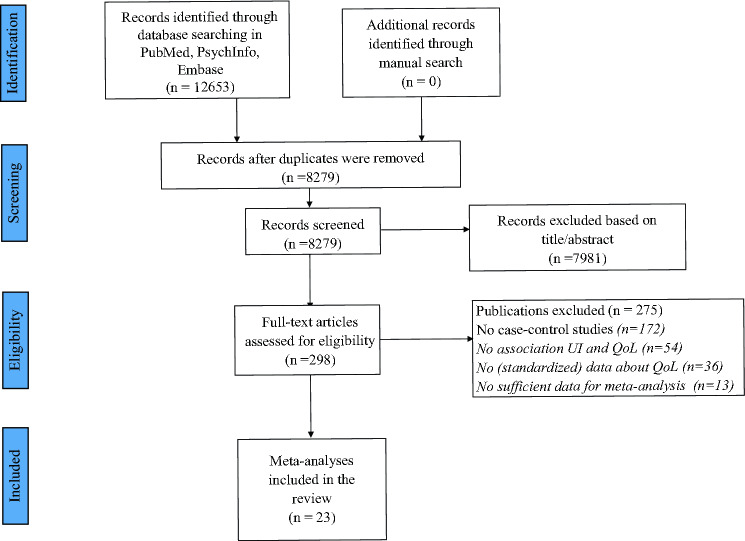
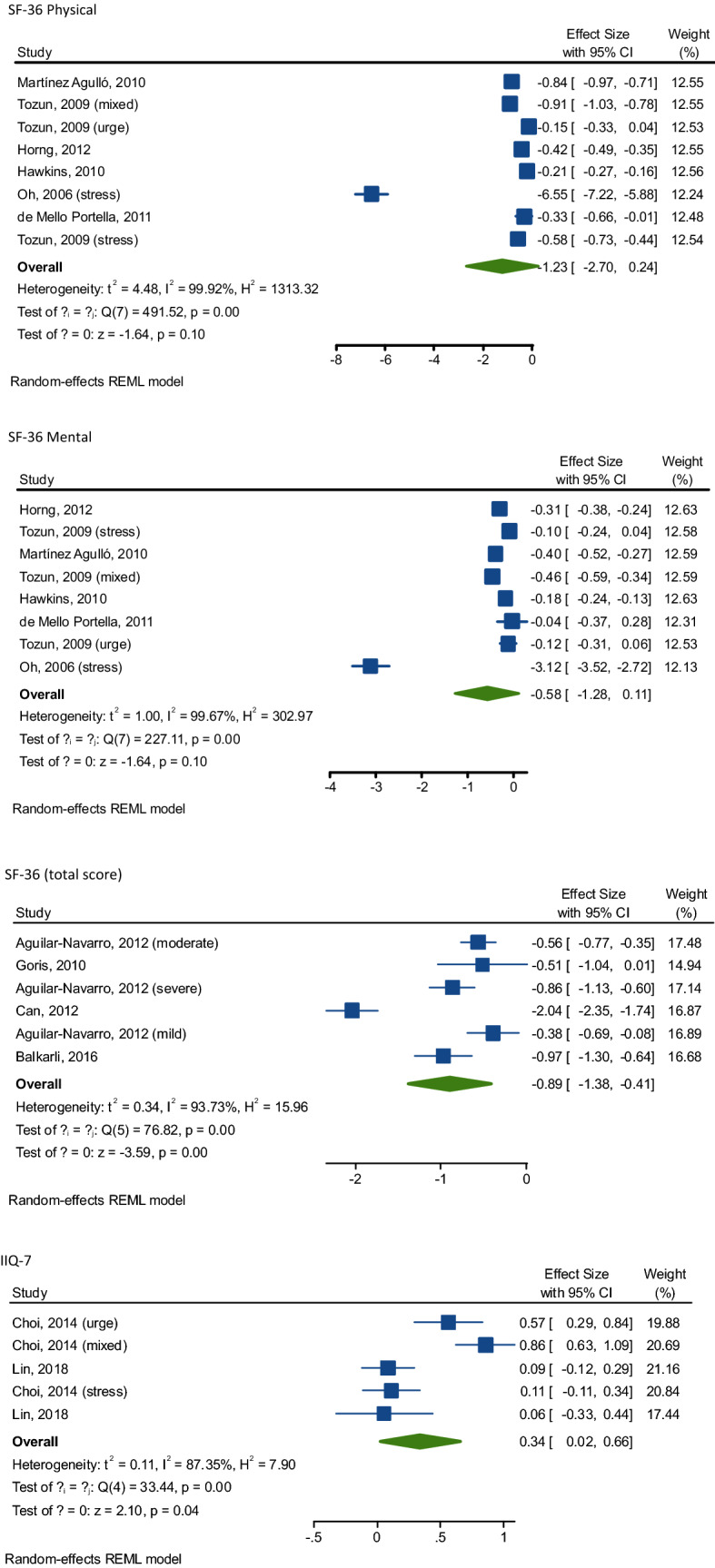
Background: Urinary incontinence (UI) and low quality of life (QoL) are two common conditions. Some recent literature proposed that these two entities can be associated. However, no attempt was made to collate this literature. Therefore, the aim of this study was to conduct a systematic review and meta-analysis of existing data to estimate the strength of the association between UI and QoL. Methods: An electronic search of major databases up to 18th April 2020 was carried out. Meta-analysis of cross-sectional and case–control studies comparing mean values in QoL between patients with UI and controls was performed, reporting random-effects standardized mean differences (SMDs) ± 95% confidence intervals (CIs) as the effect size. Heterogeneity was assessed with the I 2 . Results: Out of 8279 articles initially screened, 23 were finally included for a total of 24,983 participants, mainly women. The mean age was ≥ 50 years in 12/23 studies. UI was significantly associated with poor QoL as assessed by the short-form 36 (SF-36) total score ( n = 6 studies; UI: 473 vs. 2971 controls; SMD = − 0.89; 95% CI − 1.3 to − 0.42; I 2 = 93.5) and by the sub-scales of SF-36 and 5/8 of the domains included in the SF-36. Similar results were found using other QoL tools. The risk of bias of the studies included was generally high. Conclusions: UI is associated with a poor QoL, with a strong level of certainty. This work, however, mainly based on cross-sectional and case–control studies, highlights the necessity of future longitudinal studies for better understanding the importance of UI on QoL.
Overview
The claims and statistics of this paper haven’t been checked yet.
Free: it reads the open-access text and checks the first 5 claims that cite a source we can check. Create a free account to check every claim.
Integrity signals
Registry
Cites
Statistics
Figures
Verification
Claims the paper makes
The claims and statistics of this paper haven’t been checked yet.
Free: it reads the open-access text and checks the first 5 claims that cite a source we can check. Create a free account to check every claim.
Claims other papers make about this one
Each is checked against this paper’s own text: does it say what the citing paper says it does?
The source backs part of the claim, not all of it — or backs it for a different population, condition or comparison.
In the citing paper
“Likewise, urinary incontinence and other related geriatric syndromes received minimal attention in the identified literature, despite their potential effects on quality of life [128,129].”
From Toward Holistic Aging in Lebanon: A Mapping of Gerontology and Geriatrics Research Trends, Gaps, and Future Directions (2026) · cites this paper as [128]
Experimental — accuracy not yet measured
Self-check
Percentages, sums and reported differences re-computed from the paper’s own numbers.
The self-check needs the paper’s full text.
Citations
Cites
Bias in meta-analysis detected by a simple, graphical test
Egger, M., Smith, G. D., Schneider, M., & Minder, C. (1997) · BMJ · doi:10.1136/bmj.315.7109.629 · Cited by 56,722
The Cochrane Collaboration's tool for assessing risk of bias in randomised trials
Higgins, J. P. T., Altman, D. G., Gotzsche, P. C., Juni, P., Moher, D., Oxman, A. D., Savovic, J., Schulz, K. F., Weeks, L., Sterne, J. A. C., et al. (2011) · BMJ · doi:10.1136/bmj.d5928 · Cited by 33,817
Liberati, A., Altman, D. G., Tetzlaff, J., Mulrow, C., Gøtzsche, P. C., Ioannidis, J. P. A., Clarke, M., Devereaux, P. J., Kleijnen, J., & Moher, D. (2009) · PLoS Medicine · doi:10.1371/journal.pmed.1000100 · Cited by 28,164
Cochrane Handbook for Systematic Reviews of Interventions: Cochrane Book Series
(2008) · doi:10.1002/9780470712184 · Cited by 25,048
Dermyshi, E., Wang, Y., Yan, C., Hong, W., Qiu, G., Gong, X., & Zhang, T. (2017) · Neonatology · doi:10.1159/000454668 · Cited by 24,451
Meta-analysis of Observational Studies in Epidemiology<SUBTITLE>A Proposal for Reporting</SUBTITLE>
Stroup, D. F. (2000) · JAMA · doi:10.1001/jama.283.15.2008 · Cited by 20,623
Abrams, P., Cardozo, L., Fall, M., Griffiths, D., Rosier, P., Ulmsten, U., van Kerrebroeck, P., Victor, A., & Wein, A. (2002) · Neurourology and Urodynamics · doi:10.1002/nau.10052 · Cited by 8,296
Cochrane Handbook for Systematic Reviews of Interventions Version 5.0.1. The Cochrane Collaboration
Higgins, J. P. T., Green, S. R., & Higgins, J. P. T. (2008) · Cited by 7,261
Cohen, J. (1992) · Current Directions in Psychological Science · doi:10.1111/1467-8721.ep10768783 · Cited by 5,870
Progress in Development of the Index of ADL
Katz, S., Downs, T. D., Cash, H. R., & Grotz, R. C. (1970) · The Gerontologist · doi:10.1093/geront/10.1_part_1.20 · Cited by 4,118
Measuring Health-Related Quality of Life
Guyatt, G. H., Feeny, D. H., & Patrick, D. L. (1993) · Annals of Internal Medicine · doi:10.7326/0003-4819-118-8-199304150-00009 · Cited by 3,958
A Nonparametric “Trim and Fill” Method of Accounting for Publication Bias in Meta-Analysis
Duval, S., & Tweedie, R. (2000) · Journal of the American Statistical Association · doi:10.1080/01621459.2000.10473905 · Cited by 2,955 · cited 1×
“In case of publication bias, when ≥ 3 studies were available, we used the Duval and Tweedie non-parametric trim-and-fill method to account for potential publication bias [21].”
MethodShort form 36 (SF36) health survey questionnaire: normative data for adults of working age.
Jenkinson, C., Coulter, A., & Wright, L. (1993) · BMJ · doi:10.1136/bmj.306.6890.1437 · Cited by 1,718
Abrams, P., Cardozo, L., Fall, M., Griffiths, D., Rosier, P., Ulmsten, U., van Kerrebroeck, P., Victor, A., & Wein, A. (2002) · American Journal of Obstetrics and Gynecology · doi:10.1067/mob.2002.125704 · Cited by 1,043
Luchini, C., Stubbs, B., Solmi, M., & Veronese, N. (2017) · World Journal of Meta-Analysis · doi:10.13105/wjma.v5.i4.80 · Cited by 977 · cited 1×
“As per the NOS grading in past reviews, we graded studies as having a high (< 5 stars), moderate (5–7 stars) or low risk of bias (≥ 8 stars) [16].”
MethodSelf-citationCoyne, K. S., Sexton, C. C., Irwin, D. E., Kopp, Z. S., Kelleher, C. J., & Milsom, I. (2008) · BJU International · doi:10.1111/j.1464-410x.2008.07601.x · Cited by 837
Norton, P., & Brubaker, L. (2006) · The Lancet · doi:10.1016/s0140-6736(06)67925-7 · Cited by 579
Sandvik, H., Hunskaar, S., Seim, A., Hermstad, R., Vanvik, A., & Bratt, H. (1993) · Journal of Epidemiology and Community Health · doi:10.1136/jech.47.6.497 · Cited by 517
Shamliyan, T. A., Kane, R. L., Wyman, J., & Wilt, T. J. (2008) · Annals of Internal Medicine · doi:10.7326/0003-4819-148-6-200803180-00211 · Cited by 281
Bartoli, S., Aguzzi, G., & Tarricone, R. (2010) · Urology · doi:10.1016/j.urology.2009.07.1325 · Cited by 267
Offermans, M. P. W., Du Moulin, M. F. M. T., Hamers, J. P. H., Dassen, T., & Halfens, R. J. G. (2009) · Neurourology and Urodynamics · doi:10.1002/nau.20668 · Cited by 230
Lin, Y.-H., Chang, S., Hsieh, W., Chang, Y., Chueh, H.-Y., Chao, A., & Liang, C.-C. (2018) · Taiwanese Journal of Obstetrics and Gynecology · doi:10.1016/j.tjog.2018.04.003 · Cited by 229
Urinary Incontinence Prevalence: Results From the National Health and Nutrition Examination Survey
Dooley, Y., Kenton, K., Cao, G., Luke, A., Durazo-Arvizu, R., Kramer, H., & Brubaker, L. (2008) · Journal of Urology · doi:10.1016/j.juro.2007.09.081 · Cited by 193
Nygaard, I., DeLancey, J., Arnsdorf, L., & Murphy, E. (1990) · International Journal of Gynecology & Obstetrics · doi:10.1016/0020-7292(90)90554-x · Cited by 172
Psychosocial and societal burden of incontinence in the aged population: a review
Farage, M. A., Miller, K. W., Berardesca, E., & Maïbach, H. I. (2007) · Archives of Gynecology and Obstetrics · doi:10.1007/s00404-007-0505-3 · Cited by 169
Ebbesen, M. H., Hunskaar, S., Rortveit, G., & Hannestad, Y. S. (2013) · BMC Urology · doi:10.1186/1471-2490-13-27 · Cited by 165
Markland, A. D., Goode, P. S., Redden, D. T., Borrud, L. G., & Burgio, K. L. (2010) · The Journal of Urology · doi:10.1016/j.juro.2010.05.025 · Cited by 139
Quality of Life of Women with Urinary Incontinence: A Systematic Literature Review
Kwon, B. E., Kim, G. Y., Son, Y. J., Roh, Y. S., & You, M. A. (2010) · International Neurourology Journal · doi:10.5213/inj.2010.14.3.133 · Cited by 136
Beele, H., Smet, S., Damme, N. V., & Beeckman, D. (2017) · Drugs & Aging · doi:10.1007/s40266-017-0507-1 · Cited by 136
Tang, D. H., Colayco, D. C., Khalaf, K. M., Piercy, J., Patel, V. D., GLOBE, D. R., & Ginsberg, D. A. (2014) · British Journal of Urology · doi:10.1111/bju.12505 · Cited by 116
Aguilar-Navarro, S. G., Navarrete‐Reyes, A. P., Grados-Chavarría, B. H., García-Lara, J. M. A., Amieva, H., & Ávila‐Funes, J. A. (2012) · The Journals of Gerontology Series A · doi:10.1093/gerona/gls152 · Cited by 108
The greatest taboo: urinary incontinence as a source of shame and embarrassment
Elenskaia, K., Haidvogel, K., Heidinger, C., Dörfler, D., Umek, W. H., & Hanzal, E. (2011) · Wiener klinische Wochenschrift · doi:10.1007/s00508-011-0013-0 · Cited by 102
Office Management of Geriatric Urinary Incontinence
Gibbs, C. F., Johnson, T. M., & Ouslander, J. G. (2007) · The American Journal of Medicine · doi:10.1016/j.amjmed.2006.03.044 · Cited by 92
OLIVEIRA, C. D. F., Seleme, M., Cansi, P. F., Consentino, R. F. D. C., Kumakura, F. Y., Moreira, G. A., & Berghmans, B. C. M. (2013) · Revista da Associação Médica Brasileira · doi:10.1016/j.ramb.2013.08.002 · Cited by 92
Lim, R., Liong, M. L., Leong, W. S., Khan, N. A. K., & Yuen, K. H. (2016) · The Journal of Urology · doi:10.1016/j.juro.2016.01.090 · Cited by 86
Xiao, J., Caan, B. J., Weltzien, E., Cespedes Feliciano, E. M., Kroenke, C. H., Meyerhardt, J. A., Baracos, V. E., Kwan, M. L., Castillo, A. L., & Prado, C. M. (2018) · Journal of Cachexia, Sarcopenia and Muscle · doi:10.1002/jcsm.12301 · Cited by 84
Incontinence-associated dermatitis: moving prevention forward
Beeckman, D., Campbell, J., Campbell, K., Chimentao, D., Domansky, R. D. C., GRAY, M. L., Hevia, H., Junkin, J., Karada, A., Kottner, J., et al. (2015) · ePrints Soton (University of Southampton) · Cited by 76
Borello‐France, D., Zyczynski, H. M., Downey, P. A., Rause, C. R., & Wister, J. (2006) · Physical Therapy · doi:10.1093/ptj/86.7.974 · Cited by 70
Association between urinary incontinence and frailty: a systematic review and meta-analysis
The Special Interest Group on Urinary Incontinence, Veronese, N., The Special Interest Group of Systematic Reviews and Meta-Analysis for Healthy Aging, E. G. M. S. (., Soysal, P., Stubbs, B., Marengoni, A., Demurtas, J., Maggi, S., Petrović, M., & Verdejo-Bravo, C. (2018) · European Geriatric Medicine · doi:10.1007/s41999-018-0102-y · Cited by 64
Self-citationSchimpf, M. O., Patel, M. S., O’Sullivan, D. M., & Tulikangas, P. K. (2009) · International Urogynecology Journal · doi:10.1007/s00192-009-0855-4 · Cited by 62
Tözün, M., Ayrancı, Ü., & Ünsal, A. (2009) · Gynecologic and Obstetric Investigation · doi:10.1159/000209310 · Cited by 51
Steiblienė, V., Aniulienė, R., Aniulis, P., Raškauskienė, N., & Adomaitienė, V. (2020) · Neuropsychiatric Disease and Treatment · doi:10.2147/ndt.s236234 · Cited by 51
Testing of the Incontinence Impact Questionnaire (IIQ-7) With Men After Radical Prostatectomy
Moore, K. N., & Jensen, L. (2000) · Journal of Wound Ostomy and Continence Nursing · doi:10.1067/mjw.2000.110623 · Cited by 48
Hawkins, K., Pernarelli, J. M., Ozminkowski, R. J., Bai, M., Gaston, S. J., Hommer, C. E., Migliori, R. J., & Yeh, C. S. (2010) · Quality of Life Research · doi:10.1007/s11136-010-9808-0 · Cited by 48
Anxiety Disorders and Disability Secondary to Urinary Incontinence among Adults over Age 50
Bogner, H. R., Gallo, J. J., Swartz, K., & Ford, D. E. (2002) · The International Journal of Psychiatry in Medicine · doi:10.2190/y0l8-k2uv-bg4n-vw2j · Cited by 47
Effect of Urinary Incontinence on Quality of Life among Iranian Women.
Mallah, F., Montazeri, A., Ghanbari, Z., Tavoli, A., Haghollahi, F., & Aziminekoo, E. (2014) · Europe PMC (PubMed Central) · Cited by 38
Horng, S.-S., Huang, N., Wu, S., Fang, Y., Chou, Y., & Chou, P. (2012) · Neurourology and Urodynamics · doi:10.1002/nau.22302 · Cited by 38
Choi, E. P. H., Lam, C. L. K., & Chin, W. (2014) · Quality of Life Research · doi:10.1007/s11136-014-0725-5 · Cited by 35
Impact of duloxetine on quality of life for women with symptoms of urinary incontinence
Kinchen, K., Obenchain, R. L., & Swindle, R. W. (2005) · International Urogynecology Journal · doi:10.1007/s00192-004-1270-5 · Cited by 32
Urinary Incontinence Incidence: Quantitative Meta-Analysis of Factors that Explain Variation
Stewart, W. F., Hirsch, A. G., Kirchner, H. L., Clarke, D. N., Lichtenfeld, M. J., & Minassian, V. A. (2013) · The Journal of Urology · doi:10.1016/j.juro.2013.10.050 · Cited by 31
Portella, P. D. M., Feldner, P. C., da Conceição, J. C., Castro, R. A., Sartori, M. G. F., & Girão, M. J. B. C. (2012) · European Journal of Obstetrics & Gynecology and Reproductive Biology · doi:10.1016/j.ejogrb.2011.11.009 · Cited by 26
Consensus document on the management of urinary incontinence in older people
Aharony, L., Cock, J. D., Nuotio, M. S., Pedone, C., Rifel, J., Walle, N. V., Velghe, A., Vella, A., & Bravo, C. V. (2017) · European Geriatric Medicine · doi:10.1016/j.eurger.2017.04.002 · Cited by 25
Oh, S., & Ku, J. H. (2006) · International Urogynecology Journal · doi:10.1007/s00192-006-0112-z · Cited by 21
Gascón, M. R. P., Mellão, M. D. A., de Mello, S. H. D. S., Negrão, R. M., Casseb, J., & de Oliveira, A. C. P. (2018) · The Brazilian Journal of Infectious Diseases · doi:10.1016/j.bjid.2018.07.003 · Cited by 21
Agulló, E. M., Cerdá, J. L. R., Gómez-Pérez, L., Rebollo, P., Pérez, M., & de Chaves, J. R. G. (2010) · Actas Urológicas Españolas · doi:10.1016/j.acuro.2009.09.001 · Cited by 18
Nunzio, C. D., Pastore, A. L., Lombardo, R., Cancrini, F., Carbone, A., Fuschi, A., Dutto, L., Tubaro, A., & Witt, J. H. (2019) · Urologic Oncology Seminars and Original Investigations · doi:10.1016/j.urolonc.2019.06.024 · Cited by 17
Urodynamic diagnoses and quality of life in women presenting for evaluation of urinary incontinence
Duggan, P. (2011) · Australian and New Zealand Journal of Obstetrics and Gynaecology · doi:10.1111/j.1479-828x.2011.01344.x · Cited by 14
Agulló, E. M., Cerdá, J. L. R., Gómez-Pérez, L., Rebollo, P., Pérez, M., & de Chaves, J. R. G. (2010) · Actas Urológicas Españolas (English Edition) · doi:10.1016/s2173-5786(10)70056-1 · Cited by 14
Ferrans and Powers’ Quality of life index applied in urinary incontinence research – a pilot study
Rannestad, T., & Skjeldestad, F. E. (2010) · Scandinavian Journal of Caring Sciences · doi:10.1111/j.1471-6712.2010.00852.x · Cited by 11
Göriş, S., Sungur, G., Taşçı, S., Mirza, M., Ceyhan, Ö., & Kartin, P. T. (2010) · Cited by 7
Balkarlı, A., Semiz, M., Uslu, A. U., Yalçınkaya, S., Can, B., Şahin, M., Küçük, A., Solak, Y., & Tunç, R. (2016) · Cited by 3
Cited by
Elite female athletes’ experiences of symptoms of pelvic floor dysfunction: A systematic review
Culleton-Quinn, E., Bø, K., Fleming, N., Mockler, D., Cusack, C., & Daly, D. (2022) · International Urogynecology Journal · doi:10.1007/s00192-022-05302-6 · Cited by 103
Curillo-Aguirre, C. A., & Gea–Izquierdo, E. (2023) · Medicina · doi:10.3390/medicina59061004 · Cited by 86
Comparisons of approaches to pelvic floor muscle training for urinary incontinence in women
Hay‐Smith, J., Starzec‐Proserpio, M., Moller, B., Aldabe, D., Cacciari, L., Pitangui, A. C. R., Vesentini, G., Woodley, S. J., Dumoulin, C. L., Frawley, H., et al. (2024) · Cochrane Database of Systematic Reviews · doi:10.1002/14651858.cd009508.pub2 · Cited by 79
Alquaiz, A. M., Kazi, A., Alyousefi, N. A., Alwatban, L., AlHabib, Y., & Turkistani, I. (2023) · Healthcare · doi:10.3390/healthcare11121772 · Cited by 77
A review of quality-of-life in elderly osteoarthritis
Atukorala, I. G., & Hunter, D. J. (2023) · Expert Review of Pharmacoeconomics & Outcomes Research · doi:10.1080/14737167.2023.2181791 · Cited by 69
Metadata
- Authors
- Pizzol, D., Demurtas, J., Celotto, S., Maggi, S., Smith, L., Angiolelli, G., Trott, M., Yang, L., & Veronese, N.
- Affiliations
- Agenzia Italiana per la Cooperazione allo Sviluppo (IT)
- University of Modena and Reggio Emilia (IT)
- Azienda sanitaria universitaria Friuli Centrale (IT)
- National Research Council (IT)
- Universidad de Murcia (ES)
- Alberta Health Services (CA)
- University of Palermo (IT)
- Corresponding author
- Veronese, Nicola
- ORCID
- Venue
- Aging Clinical and Experimental Research
- Published
- 2020-09-22
- Volume
- 33
- Issue
- 1
- Pages
- 25-35
- ISSN
- 1594-0667 (ISSN-L)
- 1720-8319
- PMC
- PMC7897623
- OpenAlex
- W3087843062
- Cited by
- 310
- References
- 61
- Citations by year
- 2026: 63 · 2025: 62 · 2024: 70 · 2023: 58 · 2022: 43 · 2021: 14
- FWCI
- 4.45
- Type
- journal article
- Language
- en
- Open access
- hybrid
- doi.org
- Licence
- cc-by
- creativecommons.org/licenses/by/4.0 (tdm)
- creativecommons.org/licenses/by/4.0 (vor)
- Locations
- Aging Clinical and Experimental Research (publishedVersion, cc-by)
- PubMed Central (publishedVersion, cc-by)
- PubMed (publishedVersion)
- Anglia Ruskin Research Online (Anglia Ruskin University) (submittedVersion)
- Figshare (submittedVersion, cc-by-nc-nd)
- Nova Science Publishers (Nova Science Publishers, Inc.) (submittedVersion, other-oa)
- Padua Research Archive (University of Padova) (submittedVersion, cc-by)
- Funders
- Santex SPA
- Topics
- Health Sciences › Medicine › Urology › Pelvic floor disorders treatments
- Health Sciences › Medicine › Urology › Urinary Bladder and Prostate Research
- Health Sciences › Medicine › Urology › Urinary Tract Infections Management
- Keywords
- urinary incontinence, quality of life, SF-36, health-related quality of life, women, older adults, risk of bias
- MeSH terms
- Cross-Sectional Studies, Female, Humans, Quality of Life, Urinary Incontinence, Case-Control Studies
About these checks
Registry, retraction, Cites and statistics results are computed, not judged, with one exception: a printed reference that no index lists is read once by a model before it counts as a citation error. Claims are extracted by a model and kept only when their quote appears verbatim in the text; each cited source is then checked, with a model’s help, for whether it says what the claim relies on. Those verdicts can be wrong — read the claim’s quote and the cited source before relying on one.
Statistics and arithmetic are recomputed, not judged.
Confidence bands are shown only for fields calibrated on our annotated test set. None is calibrated yet, so no band is shown.
What counts as a claim ›How we measure confidence ›How we check this ›
Are you an author, or do you see a problem with this page? Request a review
Data sources
Bibliographic data: Semantic Scholar, OpenAlex, Crossref.
Contains information from the Semantic Scholar Academic Graph Datasets, made available under the ODC Attribution License (ODC-BY 1.0).
Semantic Scholar’s data is described in: Kinney, R., et al. (2023). The Semantic Scholar Open Data Platform. arXiv:2301.10140.
