

An Educational System for Learning Search Algorithms and Automatically Assessing Student Performance
Open accessThe DOI matches its Crossref record; 82 of the 86 references it cites were found in a registry or an index.
Abstract
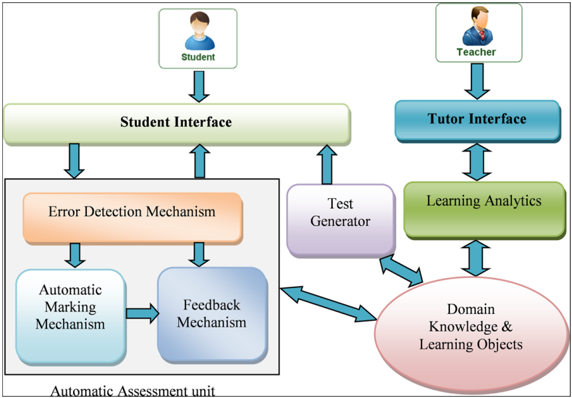
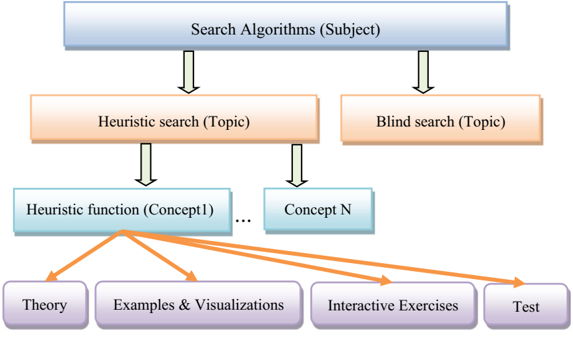
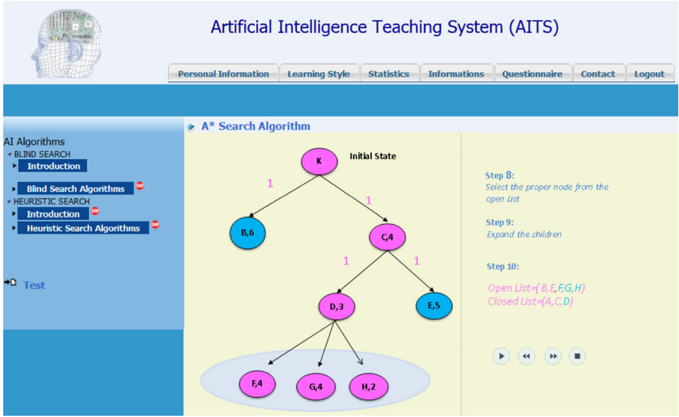
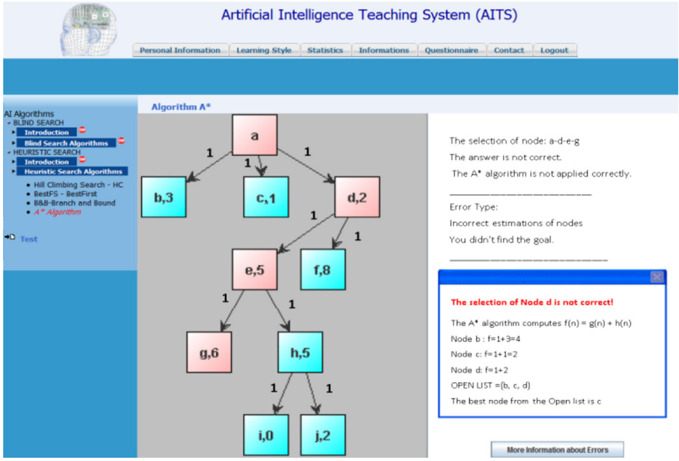
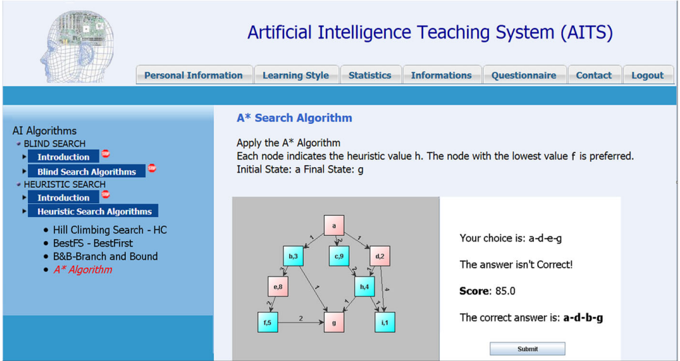
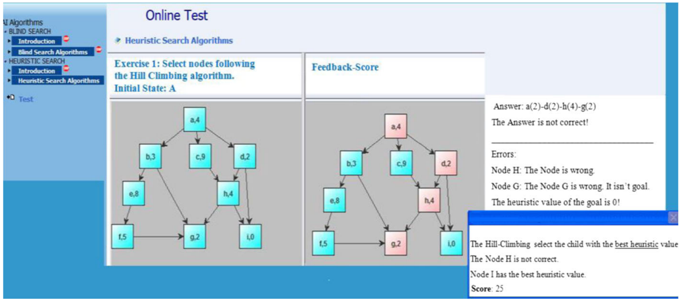
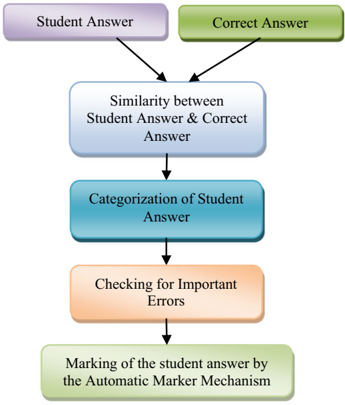
In this paper, first we present an educational system that assists students in learning and tutors in teaching search algorithms, an artificial intelligence topic. Learning is achieved through a wide range of learning activities. Algorithm visualizations demonstrate the operational functionality of algorithms according to the principles of active learning. So, a visualization process can stop and request from a student to specify the next step or explain the way that a decision was made by the algorithm. Similarly, interactive exercises assist students in learning to apply algorithms in a step-by-step interactive way. Students can apply an algorithm to an example case, specifying the algorithm’s steps interactively, with the system’s guidance and help, when necessary. Next, we present assessment approaches integrated in the system that aim to assist tutors in assessing the performance of students, reduce their marking task workload and provide immediate and meaningful feedback to students. Automatic assessment is achieved in four stages, which constitute a general assessment framework. First, the system calculates the similarity between the student’s and the correct answer using the edit distance metric. In the next stage, it identifies the type of the answer, based on an introduced answer categorization scheme related to completeness and accuracy of an answer, taking into account student carelessness too. Afterwards, the types of errors are identified, based on an introduced error categorization scheme. Finally, answer is automatically marked via an automated marker, based on its type, the edit distance and the type of errors made. To assess the learning effectiveness of the system an extended evaluation study was conducted in real class conditions. The experiment showed very encouraging results. Furthermore, to evaluate the performance of the assessment system, we compared the assessment mechanism against expert (human) tutors. A total of 400 students’ answers were assessed by three tutors and the results showed a very good agreement between the automatic assessment system and the tutors.
Overview
The claims and statistics of this paper haven’t been checked yet.
Free: it reads the open-access text and checks the first 5 claims that cite a source we can check. Create a free account to check every claim.
Integrity signals
Registry
Cites
Statistics
Figures

Verification
Claims the paper makes
The claims and statistics of this paper haven’t been checked yet.
Free: it reads the open-access text and checks the first 5 claims that cite a source we can check. Create a free account to check every claim.
Claims other papers make about this one
Each is checked against this paper’s own text: does it say what the citing paper says it does?
The source backs part of the claim, not all of it — or backs it for a different population, condition or comparison.
In the citing paper
“Grivokostopoulou et al. [42] use AI to evaluate students' performance in programing and automatically give them a grade on the task performed.”
From Artificial Intelligence for Student Assessment: A Systematic Review (2021) · cites this paper as [42]
Experimental — accuracy not yet measuredThe source backs part of the claim, not all of it — or backs it for a different population, condition or comparison.
In the citing paper
“When analyzing the result in relation to four levels related to student grades-very low, low, medium, good, and excellent-it was observed that the results were quite similar, only finding higher results as excellent by the teacher than by the AI.”
From Artificial Intelligence for Student Assessment: A Systematic Review (2021) · cites this paper as [42]
Experimental — accuracy not yet measuredThe cited source says what the claim attributes to it.
In the citing paper
“three of them determine the need to give early feedback as an essential aspect in the educational process [22,37,42]”
From Artificial Intelligence for Student Assessment: A Systematic Review (2021) · cites this paper as [42]
The cited source says what the claim attributes to it.
In the citing paper
“In the same way, Grivokostopoulou et al. [42] show how their AI system is suitable for student evaluation and grading, as it is similar to teacher evaluation.”
From Artificial Intelligence for Student Assessment: A Systematic Review (2021) · cites this paper as [42]
The cited source says what the claim attributes to it.
In the citing paper
“In general, the results were very similar and correlated with each other.”
From Artificial Intelligence for Student Assessment: A Systematic Review (2021) · cites this paper as [42]
1 more claim about this paper
Create a free account to see every claim other papers make about this one.
Self-check
Percentages, sums and reported differences re-computed from the paper’s own numbers.
The self-check needs the paper’s full text.
Citations
Cites
Coefficient Alpha and the Internal Structure of Tests
Cronbach, L. J. (1951) · Psychometrika · doi:10.1007/bf02310555 · Cited by 43,931 · cited 1×
“After analyzing the students’ responses to the questionnaires, the reliability of the questionnaire was checked using the Cronbach’s alpha (Cronbach 1951).”
MethodA Coefficient of Agreement for Nominal Scales
Cohen, J. (1960) · Educational and Psychological Measurement · doi:10.1177/001316446002000104 · Cited by 42,398
Binary Codes capable of currecting deletions, insertions, and reversals
Levenshtein, V. I. (1965) · Soviet physics. Doklady · Cited by 15,165
Hattie, J., & Timperley, H. (2007) · Review of Educational Research · doi:10.3102/003465430298487 · Cited by 12,905
(2005) · PubMed · Cited by 7,011
Nicol, D. J., & Macfarlane‐Dick, D. (2006) · Studies in Higher Education · doi:10.1080/03075070600572090 · Cited by 5,846
Spillane, J. P. (2004) · Educational Evaluation and Policy Analysis · doi:10.3102/01623737026002169 · Cited by 2,536
VanLEHN, K. (2011) · Educational Psychologist · doi:10.1080/00461520.2011.611369 · Cited by 2,323
Metacognition in Educational Theory and Practice
(1998) · Routledge eBooks · doi:10.4324/9781410602350 · Cited by 2,119
Self‐Explanations: How Students Study and Use Examples in Learning to Solve Problems
Chi, M. T. H., Bassok, M., Lewis, M. W., Reimann, P., & Glaser, R. (1989) · Cognitive Science · doi:10.1207/s15516709cog1302_1 · Cited by 1,714 · cited 2×
“…cognitive and educational psychology indicate correlations between self-assessment and learning outcomes, pointing out that students, who are aware of their own learning more accurately and timely, tend to have better learning outcomes (Chi et al. 1989; Long and Aleven 2013; Winne and Hadwin 1998).”
Background
Research works printed but not linked: 2
- 47. Jenkins, T. (2002). On the difficulty of learning to program. In Proceedings of the 3rd Annual Conference of the LTSN Centre for Information and Computer Sciences (Vol. 4, pp. 53-58).
- 74. Shute, V. J., & Zapata-Rivera, D. (2010). Educational measurement and intelligent systems. of the International Encyclopedia of Education. Oxford: Elsevier Publishers.
Cited by
Mousavinasab, E., Zarifsanaiey, N., R. Niakan Kalhori, S., Rakhshan, M., Keikha, L., & Ghazi Saeedi, M. (2021) · Interactive Learning Environments · doi:10.1080/10494820.2018.1558257 · Cited by 605
Artificial Intelligence for Student Assessment: A Systematic Review
González-Calatayud, V., Prendes-Espinosa, P., & Roig-Vila, R. (2021) · Applied Sciences · doi:10.3390/app11125467 · Cited by 503
Power to the Teachers: An Exploratory Review on Artificial Intelligence in Education
Lameras, P., & Arnab, S. (2021) · Information · doi:10.3390/info13010014 · Cited by 291
“An adaptive feedback system or a computerised adaptive test system (e.g., Grivokostopoulou et al. [92]; Barker [93]) may offer improved functionality to ascertain a student’s level of knowledge, thereby adjusting assessment and feedback to delineate controllable levels of complexity.”
BackgroundHu, B., Gaurav, A., Choi, C., & Almomani, A. (2022) · International Journal on Semantic Web and Information Systems · doi:10.4018/ijswis.302895 · Cited by 89
What Do Turkish Pre-Service Teachers Think About Artificial Intelligence?
Haseski, H. I. (2019) · International Journal of Computer Science Education in Schools · doi:10.21585/ijcses.v3i2.55 · Cited by 78
Kooli, C., & Yusuf, N. (2024) · International Journal of Human–Computer Interaction · doi:10.1080/10447318.2024.2338330 · Cited by 63
“Nevertheless, only research by Grivokostopoulou et al. (2017) supported the immediate adoption of AI in grading exams by showcasing an educational system’s capability to automate grading and provide immediate feedback.”
Daradoumis, T., Marquès Puig, J. M., Arguedas, M., & Calvet Liñan, L. (2019) · Computers & Education · doi:10.1016/j.compedu.2018.09.021 · Cited by 57
Adaptive learning in computer science education: A scoping review
Barbosa, P. L. S., do Carmo, R. A. F., Gomes, J. P. P., & Viana, W. (2023) · Education and Information Technologies · doi:10.1007/s10639-023-12066-z · Cited by 78
Sembey, R., Hoda, R., & Grundy, J. (2024) · Journal of Systems and Software · doi:10.1016/j.jss.2024.111988 · Cited by 49
Learning recommendation with formal concept analysis for intelligent tutoring system
Muangprathub, J., Boonjing, V., & Chamnongthai, K. (2020) · Heliyon · doi:10.1016/j.heliyon.2020.e05227 · Cited by 51
Process mining based approach to performance evaluation in computer‐aided examinations
Baykasoğlu, A., Özbel, B. K., Dudaklı, N., Subulan, K., & Şenol, M. E. (2018) · Computer Applications in Engineering Education · doi:10.1002/cae.21971 · Cited by 34
Nilashi, M., Abumalloh, R. A., Zibarzani, M., Samad, S., Zogaan, W. A., Ismail, M. Y., Mohd, S. B., & Akib, N. A. M. (2022) · Education and Information Technologies · doi:10.1007/s10639-022-10997-7 · Cited by 39
Towfek, S. K., Khodadadi, N., Abualigah, L., & Rizk, F. H. (2024) · Journal of Artificial Intelligence in Engineering Practice. · doi:10.21608/jaiep.2024.354003 · Cited by 51
Empowering Private Tutoring by Chaining Large Language Models
Chen, Y., Ding, N., Zheng, H.-T., Liu, Z., Sun, M., & Zhou, B. (2024) · ACM International Conference on Information and Knowledge Management (CIKM) · doi:10.1145/3627673.3679665 · Cited by 78
Code-quality evaluation scheme for assessment of student contributions to programming projects
Chen, H., Nguyen, B.-A., & Dow, C. (2022) · Journal of Systems and Software · doi:10.1016/j.jss.2022.111273 · Cited by 28
A Vision of Teaching and Learning with AI
Lameras, P. (2022) · IEEE Global Engineering Education Conference (EDUCON) · doi:10.1109/educon52537.2022.9766718 · Cited by 24
The Potential of Augmented Reality for Computer Science Education
Resnyansky, D., İbili, E., & Billinghurst, M. (2018) · IEEE International Conference on Teaching, Assessment, and Learning for Engineering · doi:10.1109/tale.2018.8615331 · Cited by 27
An Ontology-based Approach for User Modelling and Personalization in E-Learning Systems
Grivokostopoulou, F., Perikos, I., Paraskevas, M., & Hatzilygeroudis, I. (2019) · IEEE/ACIS International Conference on Computer and Information Science (ICIS) · doi:10.1109/icis46139.2019.8940269 · Cited by 23
Self-citationCurrent Trends in AI-Based Educational Processes—An Overview
Ivanović, M. D., Klašnja‐Milićević, A., Paprzycki, M., Ganzha, M., Bădică, C., Bădică, A., & Jain, L. C. (2022) · Learning and analytics in intelligent systems · doi:10.1007/978-3-031-04662-9_1 · Cited by 23
Trikoili, A., Georgiou, D., Pappa, C. I., & Pittich, D. (2025) · International Journal of Human-Computer Interaction · doi:10.1080/10447318.2025.2499164 · Cited by 40
Daradoumis, Τ., Puig, J. M. M., Arguedas, M., & Calvet, L. (2021) · Educational Technology Research and Development · doi:10.1007/s11423-021-09975-6 · Cited by 15
A Parallel Education Based Intelligent Tutoring Systems Framework
Jing, S., Tang, Y. G., Liu, X., Gong, X., Cui, W., & Liang, J. (2020) · IEEE International Conference on Networking, Sensing and Control (ICNSC) · doi:10.1109/icnsc48988.2020.9238052 · Cited by 15
Redefining Mathematics Education in the Age of Artificial Intelligence: Challenges and Opportunities
Zreık, M. (2024) · Advances in educational technologies and instructional design book series · doi:10.4018/979-8-3693-2873-6.ch002 · Cited by 18
Bashraheel, M., & Ghinea, G. (2026) · Computer Science Review · doi:10.1016/j.cosrev.2026.100929 · Cited by 18
Mangera, E., Supratno, H., & Suyatno (2023) · Pegem Journal of Education and Instruction · doi:10.47750/pegegog.13.02.05 · Cited by 18
AI ‐Assisted Assessment of Inquiry Skills in Socioscientific Issue Contexts
Zhang, W.-X., Lin, J. J. H., & Hsu, Y. (2024) · Journal of Computer Assisted Learning · doi:10.1111/jcal.13102 · Cited by 10
Wang, Z., Zhang, Y., Min, W., Guan, Q., & Yu, W. (2025) · Journal of Geography in Higher Education · doi:10.1080/03098265.2025.2549784 · Cited by 10
Grivokostopoulou, F., Perikos, I., & Hatzilygeroudis, I. (2017) · Lecture notes in computer science · doi:10.1007/978-3-319-67615-9_15 · Cited by 7
Self-citationGalindo‐Domínguez, H., Delgado, N., de la Maza, M. S., & Expósito, E. (2024) · Edutec Revista Electrónica de Tecnología Educativa · doi:10.21556/edutec.2024.89.3509 · Cited by 20
AI-assisted evaluation of problem-solving performance using eye movement and handwriting
Lin, J. J. H. (2024) · Journal of Research on Technology in Education · doi:10.1080/15391523.2024.2339474 · Cited by 10
Grivokostopoulou, F., Perikos, I., & Hatzilygeroudis, I. (2016) · Intelligent systems reference library · doi:10.1007/978-3-319-46200-4_4 · Cited by 6
Self-citationPuig, J. M. M., Daradoumis, Τ., Arguedas, M., & Calvet, L. (2021) · Journal of Computer Assisted Learning · doi:10.1111/jcal.12605 · Cited by 13
Regression verification for automated evaluation of students programs
Janičić, M. V., & Marić, F. (2019) · Computer Science and Information Systems · doi:10.2298/csis181220019v · Cited by 7
The Diagnosing Behaviour of Intelligent Tutoring Systems
van der Bent, R., Jeuring, J. T., & Heeren, B. J. (2019) · Lecture notes in computer science · doi:10.1007/978-3-030-29736-7_9 · Cited by 4
Artificial Intelligence in Neuroeducation: The Influence of Emotions in the Learning Science
Jiménez-Gaona, Y., Vivanco-Galván, O., Castillo, D., Torres-Carrión, P., & Jiménez, M. A. (2020) · Advances in intelligent systems and computing · doi:10.1007/978-3-030-60467-7_6 · Cited by 11
Bayesian Knowledge Tracing for Navigation through Marzano’s Taxonomy.
Cervantes-Pérez, F., Perales, J. N., Velázquez, A. L. F., & de‐la‐Fuente‐Valentín, L. (2021) · International Journal of Interactive Multimedia and Artificial Intelligence · doi:10.9781/ijimai.2021.05.006 · Cited by 6
Puig, J. M. M., Daradoumis, Τ., Calvet, L., & Arguedas, M. (2019) · British Journal of Educational Technology · doi:10.1111/bjet.12756 · Cited by 4
Rybina, G. V., Rybin, V. M., Blokhin, Y. M., & Sergienko, E. S. (2017) · Advances in intelligent systems and computing · doi:10.1007/978-3-319-68324-9_2 · Cited by 4
AI-teacher agreement in evaluating learning diaries
Reinhold, L., Händel, M., & Naujoks-Schober, N. (2025) · Frontiers in Education · doi:10.3389/feduc.2025.1601789 · Cited by 4
Predicting the Future of Education in the Light of Artificial Intelligence
Majeed, M. (2023) · BENTHAM SCIENCE PUBLISHERS eBooks · doi:10.2174/9789815124750123010014 · Cited by 5
Le, T. T., Luu, S. T., Nguyen, H. D., & Do, N. V. (2019) · Asia-Pacific Conference on Communications (APCC) · doi:10.1109/apcc47188.2019.9026411 · Cited by 3
Using ontological approach in tutoring integrated expert systems
Rybina, G. V., Rybin, V. M., Blokhin, Y. M., & Sergienko, E. S. (2017) · Russian-Pacific Conference on Computer Technology and Applications (RPC) · doi:10.1109/rpc.2017.8168087 · Cited by 2
Yamasari, Y., Rusimamto, P. W., Rochmawati, N., Suyatno, D. F., Wibawa, S. C., Nugroho, S. M. S., & Purnomo, M. H. (2018) · MATEC Web of Conferences · doi:10.1051/matecconf/201819703006 · Cited by 2
AN INTELLIGENT TUTORING SYSTEM TO MAINTAIN THE STUDENTS’ MOTIVATION
Ramaha, N. T. A., Abdellatef, H., & Karaş, İ. R. (2022) · The international archives of the photogrammetry, remote sensing and spatial information sciences/International archives of the photogrammetry, remote sensing and spatial information sciences · doi:10.5194/isprs-archives-xlviii-4-w3-2022-143-2022 · Cited by 2
Design of intelligent agent on Moodle to automate the learning assessment process
Ouassam, E., Hmina, N., & Bouikhalene, B. (2023) · Indonesian Journal of Electrical Engineering and Computer Science · doi:10.11591/ijeecs.v31.i3.pp1665-1672 · Cited by 3
MultiGen: Child-Friendly Multilingual Speech Generator with LLMs
Gao, X., Zhang, H., & Chen, N. F. (2025) · Companion Publication of the International Conference on Multimodal Interaction (ICMI Companion) · doi:10.1145/3747327.3764897 · Cited by 4
DaST: An Online Platform for Automated Exercise Generation and Solving in the Data Science Domain
Kotsiopoulos, C., Doudoumis, I., Raftopoulou, P., & Tryfonopoulos, C. (2019) · Computer Science Education Research Conference · doi:10.1145/3375258.3375271 · Cited by 2
Yamasari, Y., Garry, M. H., Nugroho, S. M. S., & Purnomo, M. H. (2019) · IEEE International Conference on Teaching, Assessment, and Learning for Engineering · doi:10.1109/tale48000.2019.9225922 · Cited by 2
Personalized E-learning System Using Linear Regression for Intelligent Tutoring Systems
Vijaykumar, A., & Malagi, V. P. (2023) · Advances in intelligent systems and computing · doi:10.1007/978-981-99-1588-0_9 · Cited by 2
Enhanced Agile Methodology for Ontology Development in E-Learning Environments
Taye, M. M. (2024) · International Journal of Interactive Mobile Technologies (iJIM) · doi:10.3991/ijim.v18i16.49225 · Cited by 1
Divayani, M. P., Agustika, G. N. S., & Chindytia (2024) · Thinking Skills and Creativity Journal · doi:10.23887/tscj.v7i2.92196 · Cited by 2
Sultana, H., & Gemayel, J. E. (2026) · Conference on Human Centred Artificial Intelligence - Education and Practice (HCAIep) · doi:10.1145/3777490.3777505 · Cited by 2
الشمری, ع. ز. (2023) · التربية (الأزهر) مجلة علمية محکمة للبحوث التربوية والنفسية والاجتماعية) · doi:10.21608/jsrep.2023.284406 · Cited by 3
A Design Method for an Intelligent Tutoring System with Algorithms Visualization
Nguyen, H. D., Hoang, H. T., Triet, N. T., Truong, K., Huynh, A. T., Le, T. T., & Vu, S. (2023) · Lecture notes in computer science · doi:10.1007/978-3-031-36819-6_19 · Cited by 1
Jin, S., Funabiki, N., Fang, T.-L., Hsieh, P.-C., Fan, Y., Kao, W.-C., & Lee, Y. (2025) · International Conference on Information and Education Technology (ICIET) · doi:10.1109/iciet66371.2025.11046218 · Cited by 1
Olivos, F., Kamelski, T., & Gac, S. A. (2025) · Teaching Sociology · doi:10.1177/0092055x251397371 · Cited by 4
Balancing Innovation with Ethics
Luise, R. S. A.-D., Arnau‐González, P., Serrano-Mamolar, A., Solera-Monforte, S., & Wu, Y. (2024) · Wiley eBooks · doi:10.1002/9781394257744.ch11 · Cited by 1
Chachoua, S. (2019) · theses.fr (ABES) · doi:10.70675/4787fd00zc89bz4965za129z9b71ae83f225 · Cited by 1
ReAQ: An Intelligent Tutoring System with Augmented Reality Technology Focused on Chemistry
Uriarte-Portillo, A., Cabada, R. Z., Estrada, M. L. B., & Ibáñez, M. B. (2020) · Research in Computing Science
Algorithm of Assessment System in MOOCs Learning: Literature Review
Sumarsono, S., Sutrisno, & Fatwanto, A. (2021) · Advances in engineering research/Advances in Engineering Research · doi:10.2991/aer.k.211222.019
Nguyen, B.-A., Nguyen, N.-L., & Chen, H. (2023) · Advances in educational technologies and instructional design book series · doi:10.4018/978-1-6684-9527-8.ch017 · Cited by 1
Puger, I. G. N. (2023) · Thinking Skills and Creativity Journal · doi:10.23887/tscj.v6i2.73054 · Cited by 1
Kutelia, L., Zivzivadze, L., & Margishvili, L. (2026) · Research Square · doi:10.21203/rs.3.rs-9136139/v1 · Cited by 1
Yetişensoy, O. (2026) · Interactive Learning Environments · doi:10.1080/10494820.2026.2637614
Intelligent Tutoring Systems for Psychomotor Development in Open Environments
Neagu, L.-M. (2022) · theses.fr (ABES) · doi:10.70675/7921214az93cez43c9za21az86cf2e046f09 · Cited by 1
Kailas, M., Bhatt, V., & Sharma, A. (2026) · Discover Education · doi:10.1007/s44217-026-01760-y
Dang, N. Y. (2026) · International Conference on Information and Education Technology (ICIET) · doi:10.1109/iciet69664.2026.11561598
An Instrument for Human-Based Evaluation of GenAI Educational Alignment
Ahmed, H., López‐Pernas, S., Vogelsmeier, L. V. D. E., Tukiainen, M., & Saqr, M. (2026) · Technology Knowledge and Learning · doi:10.1007/s10758-026-10005-8
Li, Y., & Sun, D. (2026) · International Conference on Computer Science and Technologies in Education (CSTE) · doi:10.1109/cste69562.2026.11649763
Balasingham, D., Wijayaraja, J. L., Kahandawaarachchi, C., & Kodagoda, N. (2026) · IEEE Access · doi:10.1109/access.2026.3731386
Aydın, F., & Yurdugül, H. (2026) · Technology Knowledge and Learning · doi:10.1007/s10758-026-10039-y
Metadata
- Authors
- Grivokostopoulou, F., Perikos, I., & Hatzilygeroudis, I.
- Affiliations
- University of Patras (GR)
- Corresponding author
- Hatzilygeroudis, Ioannis
- Venue
- International Journal of Artificial Intelligence in Education
- Publisher
- Elsevier BV
- Published
- 2017-03
- Volume
- 27
- Issue
- 1
- Pages
- 207-240
- ISSN
- 1560-4292 (ISSN-L)
- OpenAlex
- W2461804984
- Cited by
- 71
- References
- 86
- Citations by year
- 2026: 10 · 2025: 6 · 2024: 11 · 2023: 9 · 2022: 7 · 2021: 6 · 2020: 4 · 2019: 9 · 2018: 5 · 2017: 3
- FWCI
- 4.94
- Type
- journal article
- Language
- en
- Open access
- hybrid
- doi.org
- Licence
- cc-by-nc-nd
- www.elsevier.com/tdm/userlicense/1.0/ (tdm)
- www.elsevier.com/legal/tdmrep-license (tdm)
- creativecommons.org/licenses/by-nc-nd/4.0/ (vor, 3345 d)
- Locations
- International Journal of Artificial Intelligence in Education (publishedVersion, cc-by-nc-nd)
- Topics
- Physical Sciences › Computer Science › Artificial Intelligence › Intelligent Tutoring Systems and Adaptive Learning
- Physical Sciences › Computer Science › Information Systems › Educational Technology and Assessment
- Physical Sciences › Computer Science › Computer Science Applications › Teaching and Learning Programming
- Keywords
- search algorithms, algorithm visualization, interactive exercises, automated assessment, automated marking, edit distance, error classification, student feedback, artificial intelligence in education, active learning
About these checks
Registry, retraction, Cites and statistics results are computed, not judged, with one exception: a printed reference that no index lists is read once by a model before it counts as a citation error. Claims are extracted by a model and kept only when their quote appears verbatim in the text; each cited source is then checked, with a model’s help, for whether it says what the claim relies on. Those verdicts can be wrong — read the claim’s quote and the cited source before relying on one.
Statistics and arithmetic are recomputed, not judged.
Confidence bands are shown only for fields calibrated on our annotated test set. None is calibrated yet, so no band is shown.
What counts as a claim ›How we measure confidence ›How we check this ›
Are you an author, or do you see a problem with this page? Request a review
Data sources
Bibliographic data: Semantic Scholar, OpenAlex, Crossref.
Contains information from the Semantic Scholar Academic Graph Datasets, made available under the ODC Attribution License (ODC-BY 1.0).
Semantic Scholar’s data is described in: Kinney, R., et al. (2023). The Semantic Scholar Open Data Platform. arXiv:2301.10140.
