

The DOI matches its Crossref record; 64 of the 64 references it cites were found in a registry or an index.
Changes in College Students Mental Health and Lifestyle During the COVID-19 Pandemic: A Systematic Review of Longitudinal Studies
Open accessAbstract
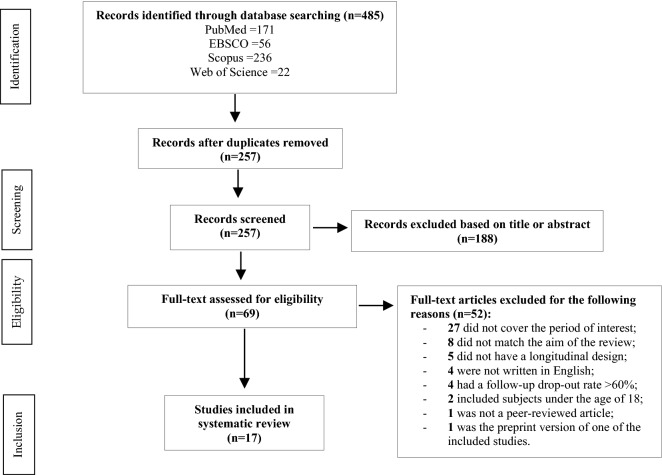
College students have poorer mental health than their peers. Their poorer health conditions seem to be caused by the greater number of stressors to which they are exposed, which can increase the risk of the onset of mental disorders. The pandemic has been an additional stressor that may have further compromised the mental health of college students and changed their lifestyles with important consequences for their well-being. Although research has recognized the impact of COVID-19 on college students, only longitudinal studies can improve knowledge on this topic. This review summarizes the data from 17 longitudinal studies examining changes in mental health and lifestyle among college students during the COVID-19 pandemic, in order to improve understanding of the effects of the outbreak on this population. Following PRISMA statements, the following databases were searched PubMed, EBSCO, SCOPUS and Web of Science. The overall sample included 20,108 students. The results show an increase in anxiety, mood disorders, alcohol use, sedentary behavior, and Internet use and a decrease in physical activity. Female students and sexual and gender minority youth reported poorer mental health conditions. Further research is needed to clarify the impact of the COVID-19 pandemic on vulnerable subgroups of college students. Supplementary Information: The online version contains supplementary material available at 10.1007/s40894-022-00192-7.
Overview
The claims and statistics of this paper haven’t been checked yet.
Run the check — free, no account needed. It reads the open-access text and checks the sources it cites.
Integrity signals
Registry
Cites
Statistics
Figures
Verification
Claims the paper makes
The claims and statistics of this paper haven’t been checked yet.
Run the check — free, no account needed. It reads the open-access text and checks the sources it cites.
Claims other papers make about this one
Each is checked against this paper’s own text: does it say what the citing paper says it does?
The cited source says what the claim attributes to it.
In the citing paper
“Recent systematic reviews and metanalyses (Buizza et al., 2022; Carvalho et al., 2022; Elharake et al., 2023; Luo et al., 2021) point out that college students experienced particular challenges in terms of disruption to their social and academic lives, with negative consequences for their mental health”
From Social connections combat loneliness and promote wellbeing among college students coming out of the COVID-19 pandemic (2025) · cites this paper as Buizza et al., 2022
Self-check
Percentages, sums and reported differences re-computed from the paper’s own numbers.
The self-check needs the paper’s full text.
Citations
Cites
(2007) · PubMed Central · Cited by 2,521
Sex Differences in Coping Behavior: A Meta-Analytic Review and an Examination of Relative Coping
Tamres, L. K., Janicki, D., & Helgeson, V. S. (2002) · Personality and Social Psychology Review · doi:10.1207/s15327957pspr0601_1 · Cited by 2,044 · cited 1×
“A possible explanation for this result is that women appear to rely on social support more than men (Tamres et al., 2002), while SGMs rely on their communities of equals and allies to cope with the difficulties of discrimination and prejudice (de Lira & de Morais, 2018).”
BackgroundElmer, T., Mepham, K., & Stadtfeld, C. (2020) · PLOS ONE · doi:10.1371/journal.pone.0236337 · Cited by 1,658
Exercise and Pharmacotherapy in the Treatment of Major Depressive Disorder
Blumenthal, J. A., Babyak, M. A., Doraiswamy, P. M., Watkins, L., Hoffman, B. M., Barbour, K. A., Herman, S., Craighead, W. E., Brosse, A. L., Waugh, R., et al. (2007) · Psychosomatic Medicine · doi:10.1097/psy.0b013e318148c19a · Cited by 1,019
Hao, F., Tan, W., Jiang, L., Zhang, L., Zhao, X., Zou, Y., Hu, Y., Luo, X., Jiang, X., McIntyre, R. S., et al. (2020) · Brain, Behavior, and Immunity · doi:10.1016/j.bbi.2020.04.069 · Cited by 968
Huckins, J. F., daSilva, A. W., Wang, W., Hedlund, E., Rogers, C., Nepal, S. K., Wu, J., Obuchi, M., Murphy, E. I., Meyer, M. L., et al. (2020) · Journal of Medical Internet Research · doi:10.2196/20185 · Cited by 759
Stress, Sex Differences, and Coping Strategies Among College Students
Brougham, R. R., Zail, C. M., Mendoza, C. M., & Miller, J. R. (2009) · Current Psychology · doi:10.1007/s12144-009-9047-0 · Cited by 669
Impact of COVID-19 pandemic on college student mental health and wellness.
Copeland, W. E., McGinnis, E., Bai, Y., Adams, Z., Nardone, H., Devadanam, V., Rettew, J., & Hudziak, J. J. (2021) · Journal of the American Academy of Child & Adolescent Psychiatry · doi:10.1016/j.jaac.2020.08.466 · Cited by 668
Saraswathi, I., Saikarthik, J., Senthil Kumar, K., Madhan Srinivasan, K., Ardhanaari, M., & Gunapriya, R. (2020) · PeerJ · doi:10.7717/peerj.10164 · Cited by 608
Kirkbride, J. B., Errázuriz, A., Croudace, T. J., Morgan, C., Jackson, D., Boydell, J. E., Murray, R. M., & Jones, P. B. (2012) · PLoS ONE · doi:10.1371/journal.pone.0031660 · Cited by 588
Research works printed but not linked: 1
- Moher, D., Liberati, A., Tetzlaff, J., & Altman, D. G. (2015). Linee guida per il reporting di revisioni sistematiche e meta-analisi: Il PRISMA Statement. Evidence, 7(6), 1–8.
Cited by
Sorted by citations
Cai, Z., Mao, P., Wang, Z., Wang, D., He, J., & Fan, X. (2023) · Adolescent Research Review · doi:10.1007/s40894-022-00201-9 · Cited by 192
Pagano, M., Bacaro, V., & Crocetti, E. (2023) · Computers in Human Behavior · doi:10.1016/j.chb.2023.107813 · Cited by 74
Fazia, T., Bubbico, F., Nova, A., Buizza, C., Cela, H., Iozzi, D., Calgan, B., Maggi, F., Floris, V., Sutti, I., et al. (2023) · Scientific Reports · doi:10.1038/s41598-023-35483-z · Cited by 88
Self-citationLife's Essential 8 and Depression: A National Cross-Sectional Analysis in US Emerging Adults
You, Y., Zheng, K., Ablitip, A., Wang, D., Chen, C., Liu, Y., Chen, Y., & Ma, X. (2025) · Journal of Adolescent Health · doi:10.1016/j.jadohealth.2025.03.023 · Cited by 60
Attending lectures in person, hybrid or online—how do students choose, and what about the outcome?
Kortemeyer, G., Dittmann-Domenichini, N., Schlienger, C., Spilling, E., Yaroshchuk, A., & Dissertori, G. (2023) · International Journal of Educational Technology in Higher Education · doi:10.1186/s41239-023-00387-5 · Cited by 49
Metadata
- Authors
- Buizza, C., Bazzoli, L., & Ghilardi, A.
- Affiliations
- University of Brescia (IT)
- Corresponding author
- Buizza, Chiara
- Venue
- Adolescent Research Review
- Published
- 2022-08-03
- Volume
- 7
- Issue
- 4
- Pages
- 537-550
- ISSN
- 2363-8346 (ISSN-L)
- 2363-8354
- PMC
- PMC9362152
- OpenAlex
- W4289550243
- Cited by
- 149
- References
- 64
- Citations by year
- 2026: 20 · 2025: 33 · 2024: 53 · 2023: 40 · 2022: 2
- FWCI
- 5.32
- Type
- journal article
- Language
- en
- Open access
- hybrid
- doi.org
- Locations
- Adolescent Research Review (publishedVersion, cc-by)
- PubMed Central (publishedVersion, cc-by)
- PubMed (publishedVersion)
- Institutional Research Information System (Università degli Studi di Brescia) (submittedVersion, other-oa)
- Funders
- Università degli Studi di Brescia
- Topics
- Social Sciences › Psychology › Clinical Psychology › COVID-19 and Mental Health
- Social Sciences › Psychology › Developmental and Educational Psychology › Student Stress and Coping
- Health Sciences › Medicine › Public Health, Environmental and Occupational Health › Health and Lifestyle Studies
- Keywords
- university students, mental health, COVID-19 pandemic, lifestyle modification, anxiety, mood disorders, alcohol consumption, sedentary behavior, physical activity, internet use, sexual and gender minority students, female students, student well-being
About these checks
Registry, retraction, Cites and statistics results are computed, not judged, with one exception: a printed reference that no index lists is read once by a model before it counts as a citation error. Claims are extracted by a model and kept only when their quote appears verbatim in the text; each cited source is then checked, with a model’s help, for whether it says what the claim relies on. Those verdicts can be wrong — read the claim’s quote and the cited source before relying on one.
Statistics and arithmetic are recomputed, not judged.
Confidence bands are shown only for fields calibrated on our annotated test set. None is calibrated yet, so no band is shown.
What counts as a claim ›How we measure confidence ›How we check this ›
Are you an author, or do you see a problem with this page? Request a review
