

A randomized, double-blind, placebo-controlled, cross-over pilot study to investigate the efficacy of Rest-ZZZ formula in healthy participants with occasional sleeplessness
Open accessThe DOI matches its Crossref record; 29 of the 29 references it cites were found in a registry or an index.
Abstract
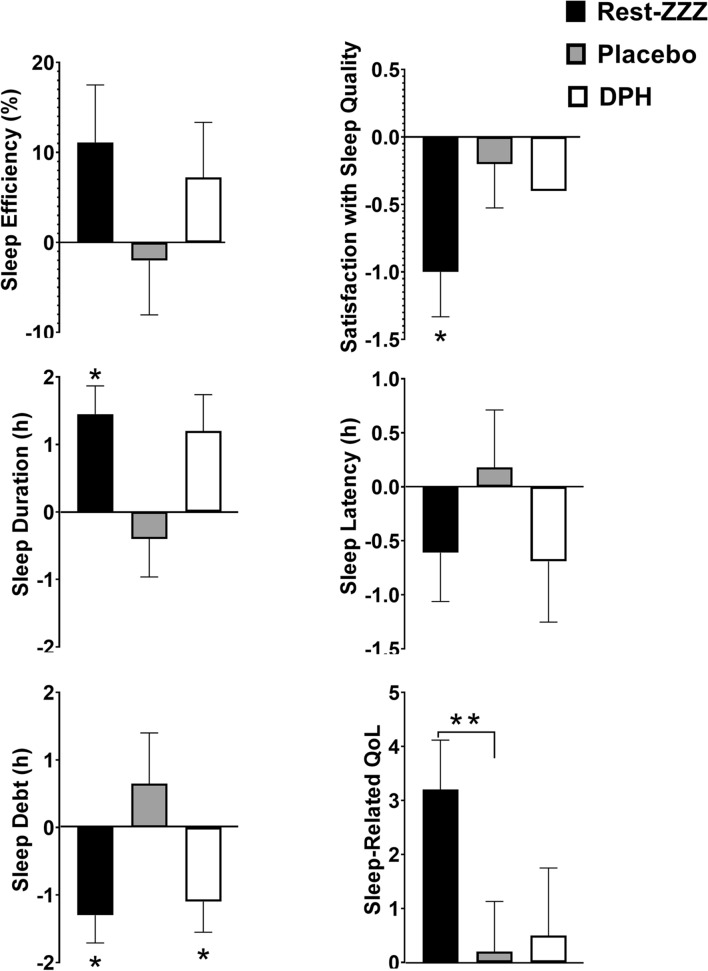
The purpose of this study was to investigate the safety and efficacy of Rest-ZZZ, a natural sleep supplement, in healthy adults without a diagnosed sleep disorder. This randomized, double-blind, placebo-controlled, cross-over study consisted of three 7-day supplementation periods with either Rest-ZZZ, Diphenhydramine (DPH), or Placebo, with a 7-day washout. Twenty-seven participants were randomized to one of three intervention sequences and the Healthy People Sleep Quality Index (HPSQI), Quality of Life (QoL), and Profile of Mood States (POMS) questionnaires were assessed at the beginning and end of each supplementation period. Rest-ZZZ and Placebo showed improvements in sleep-related QoL (p ≤ 0.044) and total mood disturbance (TMD) (p = ≤ 0.028). Fatigue–Inertia was reduced by all study products (p ≤ 0.031). DPH did not result in any significant improvements on sleep quality parameters. A subgroup analysis of participants ≤ 45 years found enhanced efficacy of Rest-ZZZ and improvement in sleep-related QoL vs. Placebo (p = 0.007), as well as improvements in sleep duration (p = 0.007), sleep debt (p = 0.011), and sleep-related QoL (p = 0.033). DPH supplementation resulted in significant improvement in only sleep debt (p = 0.038). Rest-ZZZ had a safe hematology and chemistry profile. Rest-ZZZ resulted in restful sleep that generated corresponding improvements in sleep-related QoL and overall mood. Rest-ZZZ is an efficacious sleep supplement with a favorable safety profile, particularly in those aged 25–45 years.
Overview
The claims and statistics of this paper haven’t been checked yet.
Free: it reads the open-access text and checks the first 5 claims that cite a source we can check. Create a free account to check every claim.
Integrity signals
Registry
Cites
Statistics
Figures



Verification
Claims the paper makes
The claims and statistics of this paper haven’t been checked yet.
Free: it reads the open-access text and checks the first 5 claims that cite a source we can check. Create a free account to check every claim.
Claims other papers make about this one
Each is checked against this paper’s own text: does it say what the citing paper says it does?
The cited source says what the claim attributes to it.
In the citing paper
“The HPSQI provides subjective measures of sleep quality [19].”
Self-check
Percentages, sums and reported differences re-computed from the paper’s own numbers.
The self-check needs the paper’s full text.
Citations
Cites
R: A Language and Environment for Statistical Computing
R Core Team (2025) · doi:10.32614/r.manuals · Cited by 352,181
The Pittsburgh Sleep Quality Index: a new instrument for psychiatric practice and research
Buysse, D. J., Reynolds, C. F., Monk, T. H., Berman, S. R., & Kupfer, D. J. (1989) · Psychiatry Research · doi:10.1016/0165-1781(89)90047-4 · Cited by 35,234 · cited 13×
“Future investigations should consider assessing SQ by pairing the HPSQI with objective measures, such as actigraphy or polysomnography, to provide a comprehensive measure of SQ that includes objective outcomes such as sleep efficiency, 1 3 Fig.”
BackgroundInfluentialSample size of 12 per group rule of thumb for a pilot study
Julious, S. A. (2005) · Pharmaceutical Statistics · doi:10.1002/pst.185 · Cited by 3,068 · cited 1×
“Twenty-seven participants were enrolled in this study and accounted for 20% attrition rate and aligned with guidelines for pilot studies [22].”
MethodSleep and Sleep Disorders in Older Adults
Crowley, K. (2011) · Neuropsychology Review · doi:10.1007/s11065-010-9154-6 · Cited by 617 · cited 1×
“This may be explained by the fact that sleep changes as humans age, with older adults experiencing greater sleep difficulties compared to the younger population [32].”
BackgroundMeasuring Subjective Sleep Quality: A Review
Fabbri, M., Beracci, A., Martoni, M., Meneo, D., Tonetti, L., & Natale, V. (2021) · International Journal of Environmental Research and Public Health · doi:10.3390/ijerph18031082 · Cited by 599 · cited 1×
“Previous research has questioned the validity of the PSQI daytime dysfunction subscale and noted that it did not provide a clear distinction between sleep problems and daytime functioning [19, 20].”
MethodHoevenaar-Blom, M. P., Spijkerman, A. M. W., Kromhout, D., van den Berg, J. F., & Verschuren, W. M. M. (2011) · Sleep · doi:10.5665/sleep.1382 · Cited by 558
Relaxation and immunity enhancement effects of γ‐Aminobutyric acid (GABA) administration in humans
Abdou, A. M., Higashiguchi, S., Horie, K., Kim, M., Hatta, H., & Yokogoshi, H. (2006) · BioFactors · doi:10.1002/biof.5520260305 · Cited by 407
Insomnia and daytime functioning
Riedel, B. W., & Lichstein, K. L. (2000) · Sleep Medicine Reviews · doi:10.1053/smrv.1999.0074 · Cited by 309 · cited 1×
“The gap between expectation and need has been documented as sleep need misperception, as individuals may expect more or less sleep than is actually needed, with excessive daytime sleepiness or impaired performance reported in both cases [34].”
BackgroundDisturbed Sleep and Its Relationship to Alcohol Use
Stein, M. D., & Friedmann, P. D. (2006) · Substance Abuse · doi:10.1300/j465v26n01_01 · Cited by 288 · cited 1×
“Researchers should also consider restricting the alcohol intake of participants as previous literature has demonstrated an association between alcohol use and poor sleep [29], particularly among women [30].”
ResultChronic Insomnia and the Stress System
Basta, M., Chrousos, G. P., Vela-Bueno, A., & Vgontzas, A. N. (2007) · Sleep Medicine Clinics · doi:10.1016/j.jsmc.2007.04.002 · Cited by 286
Aqueous extract of valerian root (Valeriana officinalis L.) improves sleep quality in man
Leathwood, P. D., Chauffard, F., Heck, E., & Munoz-Box, R. (1982) · Pharmacology Biochemistry and Behavior · doi:10.1016/0091-3057(82)90264-7 · Cited by 229
Tolerance to Daytime Sedative Effects of H1 Antihistamines
Richardson, G. S., Roehrs, T. A., Rosenthal, L., Koshorek, G., & Roth, T. (2002) · Journal of Clinical Psychopharmacology · doi:10.1097/00004714-200210000-00012 · Cited by 218 · cited 1×
“Only short-term use of DPH is recommended when used for sleep as tolerance to its hypnotic effects have been reported after only 4 days of administration [7].”
BackgroundDifferential Function of Melatonin MT1 and MT2 Receptors in REM and NREM Sleep
Gobbi, G., & Comai, S. (2019) · Frontiers in Endocrinology · doi:10.3389/fendo.2019.00087 · Cited by 178 · cited 2×
“Making up the largest quantity of active ingredients in Rest-ZZZ, melatonin promotes sleep as a result of the activation of high-affinity, G protein coupled receptors, MT1 and MT2 [15].”
BackgroundA survey on sleep questionnaires and diaries
Ibáñez, V., Silva, J., & Cauli, O. (2018) · Sleep Medicine · doi:10.1016/j.sleep.2017.08.026 · Cited by 168 · cited 1×
“1 3 such as the Pittsburgh Sleep Quality Index (PSQI), are often used as the first diagnostic test in determining sleep-related pathologies [17, 18].”
MethodWang, L., Wu, Y., Lin, Y., Wang, L., Zeng, Z., Xie, X.-L., Chen, Q.-Y., & Wei, S. (2021) · Journal of Clinical Sleep Medicine · doi:10.5664/jcsm.9658 · Cited by 111 · cited 1×
“Previous research has questioned the validity of the PSQI daytime dysfunction subscale and noted that it did not provide a clear distinction between sleep problems and daytime functioning [19, 20].”
MethodPharmacological Treatment of Insomnia.
(2015) · PubMed Central · Cited by 109
Herbal Remedies and Their Possible Effect on the GABAergic System and Sleep
Bruni, O., Ferini-Strambi, L., Giacomoni, E., & Pellegrino, P. (2021) · Nutrients · doi:10.3390/nu13020530 · Cited by 108 · cited 1×
“1 3 gamma-aminobutyric acid (GABA) receptor system [16], and other natural sleep ingredients has yet to be explored.”
BackgroundLow dose melatonin improves sleep in healthy middle-aged subjects
Attenburrow, M. E. J., Cowen, P. J., & Sharpley, A. L. (1996) · Psychopharmacology · doi:10.1007/bf02246354 · Cited by 97
Effect of Placebo Conditions on Polysomnographic Parameters in Primary Insomnia: A Meta-Analysis
Winkler, A., & Rief, W. (2015) · SLEEP · doi:10.5665/sleep.4742 · Cited by 80 · cited 1×
“Consistent with literature demonstrating a large placebo effect (39–100%) in pharmacological sleep studies [26], a 77.”
BackgroundCerny, A., & Schmid, K. (1999) · Fitoterapia · doi:10.1016/s0367-326x(99)00018-0 · Cited by 72
Sleep quality in healthy and mood-disordered persons predicts daily life emotional reactivity
O'Leary, K., Small, B. J., Panaite, V., Bylsma, L. M., & Rottenberg, J. (2017) · Cognition and Emotion · doi:10.1080/02699931.2015.1126554 · Cited by 65 · cited 2×
“Research has shown that dysfunctional sleep has been linked to impaired emotional functioning and dulled responses to every day events in healthy individuals [33].”
BackgroundTakeuchi, H., Taki, Y., Nouchi, R., Yokoyama, R., Kotozaki, Y., Nakagawa, S., Sekiguchi, A., Iizuka, K., Yamamoto, Y., Hanawa, S., et al. (2018) · Scientific Reports · doi:10.1038/s41598-018-24226-0 · Cited by 57 · cited 1×
“Previous sleep research has demonstrated that shorter sleep duration with better SQ is more beneficial for brain and heart health [27, 28], suggesting that the more restful sleep provided by RestZZZ may be associated with better health outcomes.”
BackgroundPrescription and Nonprescription Sleep Product Use Among Older Adults in the United States
Maust, D. T., Solway, E. S., Clark, S. J., Kirch, M., Singer, D., & Malani, P. (2018) · American Journal of Geriatric Psychiatry · doi:10.1016/j.jagp.2018.09.004 · Cited by 54 · cited 1×
“Over 21% of older adults in the US reported using over-the-counter (OTC) sleep aids [5], such as Diphenhydramine (DPH), a common ingredient in night-time cold medications that induces a sedative effect by competitively blocking histamine binding [6].”
BackgroundSleep and Alcohol Use in Women
Inkelis, S. M., Hasler, B. P., & Baker, F. C. (2020) · Alcohol research · doi:10.35946/arcr.v40.2.13 · Cited by 52 · cited 1×
“Researchers should also consider restricting the alcohol intake of participants as previous literature has demonstrated an association between alcohol use and poor sleep [29], particularly among women [30].”
ResultUpdates on Nutraceutical Sleep Therapeutics and Investigational Research
Yurcheshen, M. E., Seehuus, M., & Pigeon, W. R. (2015) · Evidence-based Complementary and Alternative Medicine · doi:10.1155/2015/105256 · Cited by 47
Sleep and pain: summary of the 2015 Sleep in America Poll
Knutson, K. L. (2015) · Sleep Health · doi:10.1016/j.sleh.2015.03.006 · Cited by 28
Assessment methodologies in sleep medicine clinical trials
Wood, E. A., & McCall, W. V. (2013) · Clinical Investigation · doi:10.4155/cli.13.57 · Cited by 7 · cited 1×
“1 3 such as the Pittsburgh Sleep Quality Index (PSQI), are often used as the first diagnostic test in determining sleep-related pathologies [17, 18].”
MethodMatricaria chamomilla (German chamomile). Monograph.
(2008) · PubMed · Cited by 3
2018 Sleep in America® Poll – Sleep Prioritization and Personal Effectiveness
(2018) · Sleep Health · doi:10.1016/j.sleh.2018.02.007 · Cited by 2
Research works printed but not linked: 5
- Randall S, Roehrs TA, Roth T. Over-the-counter sleep aid medications and insomnia. Primary Psychiatry J. 2008;15(5):52–8.
- O’Connolly M, Bernhoft G, Bartch G. Handling of older, multi-morbidity patients with stenocardio with those symptoms. Therapie Woche. 1987;37:587–600.
- McNair D, Lorr M, Droppleman L. Manual for the profile of mood states (POMS). San Diego: Educational and Industrial Testing Service; 1971.
- RStudio. Integrated development environment for R. Boston: RStudio, Inc.; 2015.
- Leathwood PD, Chauffard F, Heck E, Munoz-Box R. Aqueous extract of valerian root (Valeriana officinalis L.) improves sleep quality in man. Pharmacol Biochem Behav. 1982;17(1):65–71. · DOI · Paper page
Cited by
Moulin, M., Crowley, D. C., Xiong, L., Guthrie, N., & Lewis, E. D. (2024) · Neurology and Therapy · doi:10.1007/s40120-024-00624-7 · Cited by 14
“Healthy Person Sleep Quality Index The HPSQI provides subjective measures of sleep quality [19].”
Self-citationKhedr, E. M., Ahmed, G. K., Korayem, M. A., Elamary, S. A. S. H., Elkholy, M. M., & Haridy, N. A. (2024) · Brain Sciences · doi:10.3390/brainsci14060556 · Cited by 16
“1 software based on previous study [26] with an alpha level of 0.05, a power of 0.80, and an allocation ratio (N2/N1) of 1.”
MethodInfluentialAriza-Salamanca, D. F., Venegas, M., Parejo, K., Galeano, S. A., Echeverry, J., & Calderón‐Ospina, C. (2025) · Journal of Clinical Medicine · doi:10.3390/jcm14103297 · Cited by 6
“Similar findings have been reported in healthy individuals [29,30].”
Ma, D., Yang, H., Zhao, M., Luo, Z., Teng, R., Huang, X., Liu, T., Lv, S., & Wang, M. (2026) · Frontiers in Pharmacology · doi:10.3389/fphar.2026.1681709 · Cited by 4
Moulin, M., Lewis, E. D., Crowley, D. C., May, C. E., & Evans, M. (2024) · Current Urology · doi:10.1097/cu9.0000000000000248 · Cited by 2
Self-citation
Metadata
- Authors
- Moulin, M., Lewis, E. D., Crowley, D. C., Langston, J., & Evans, M.
- Corresponding author
- Evans, Malkanthi
- Venue
- Sleep and Biological Rhythms
- Published
- 2022-08-22
- Volume
- 21
- Issue
- 1
- Pages
- 59-68
- ISSN
- 1446-9235 (ISSN-L)
- 1479-8425
- PMC
- PMC10900002
- OpenAlex
- W4292560463
- Cited by
- 6
- References
- 29
- Citations by year
- 2026: 2 · 2025: 1 · 2024: 3
- FWCI
- 0.92
- Type
- journal article
- Language
- en
- Open access
- hybrid
- doi.org
- Licence
- cc-by
- creativecommons.org/licenses/by/4.0 (tdm)
- creativecommons.org/licenses/by/4.0 (vor)
- Locations
- Sleep and Biological Rhythms (publishedVersion, cc-by)
- PubMed Central (publishedVersion, cc-by)
- PubMed (publishedVersion)
- Funders
- LifeSeasons, Inc.
- Topics
- Social Sciences › Psychology › Experimental and Cognitive Psychology › Sleep and related disorders
- Health Sciences › Medicine › Complementary and alternative medicine › Medicinal Plant Extracts Effects
- Social Sciences › Psychology › Experimental and Cognitive Psychology › Sleep and Work-Related Fatigue
- Keywords
- diphenhydramine, sleep quality, quality of life, mood disturbance, sleep debt, sleep duration, supplement safety, healthy adults
About these checks
Registry, retraction, Cites and statistics results are computed, not judged, with one exception: a printed reference that no index lists is read once by a model before it counts as a citation error. Claims are extracted by a model and kept only when their quote appears verbatim in the text; each cited source is then checked, with a model’s help, for whether it says what the claim relies on. Those verdicts can be wrong — read the claim’s quote and the cited source before relying on one.
Statistics and arithmetic are recomputed, not judged.
Confidence bands are shown only for fields calibrated on our annotated test set. None is calibrated yet, so no band is shown.
What counts as a claim ›How we measure confidence ›How we check this ›
Are you an author, or do you see a problem with this page? Request a review
Data sources
Bibliographic data: Semantic Scholar, OpenAlex, Crossref.
Contains information from the Semantic Scholar Academic Graph Datasets, made available under the ODC Attribution License (ODC-BY 1.0).
Semantic Scholar’s data is described in: Kinney, R., et al. (2023). The Semantic Scholar Open Data Platform. arXiv:2301.10140.
