

The DOI matches its Crossref record; 48 of the 49 references it cites were found in a registry or an index.
Problematic Mobile Phone Use and Addiction Across Generations: the Roles of Psychopathological Symptoms and Smartphone Use
Open accessAbstract
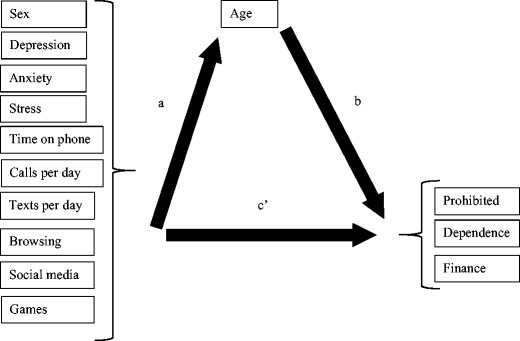
Contemporary technological advances have led to a significant increase in using mobile technologies. Recent research has pointed to potential problems as a consequence of mobile overuse, including addiction, financial problems, dangerous use (i.e. whilst driving) and prohibited use (i.e. use in forbidden areas). The aim of this study is to extend previous findings regarding the predictive power of psychopathological symptoms (depression, anxiety and stress), mobile phone use (i.e. calls, SMS, time spent on the phone, as well as the engagement in specific smartphone activities) across Generations X and Y on problematic mobile phone use in a sample of 273 adults. Findings revealed prohibited use and dependence were predicted by calls/day, time on the phone and using social media. Only for dependent mobile phone use (rather than prohibited), stress appeared as significant. Using social media and anxiety significantly predicted belonging to Generation Y, with calls per day predicted belonging to Generation X. This finding suggests Generation Y are more likely to use asynchronous social media-based communication, whereas Generation X engage more in synchronous communication. The findings have implications for prevention and awareness-raising efforts of possibly problematic mobile phone use for educators, parents and individuals, particularly including dependence and prohibited use.
Overview
The claims and statistics of this paper haven’t been checked yet.
Run the check — free, no account needed. It reads the open-access text and checks the sources it cites.
Integrity signals
Registry
Cites
Statistics
Figures
Verification
Claims the paper makes
The claims and statistics of this paper haven’t been checked yet.
Run the check — free, no account needed. It reads the open-access text and checks the sources it cites.
Claims other papers make about this one
Each is checked against this paper’s own text: does it say what the citing paper says it does?
The source backs part of the claim, not all of it — or backs it for a different population, condition or comparison.
In the citing paper
“Using mobile phones is understood as leading to alterations in everyday life habits and perceptions of reality, which can be associated with negative outcomes, such as impaired social interactions, social isolation, as well as both somatic and mental health problems, including anxiety, depression, and stress [85,87].”
From Social networking sites and addiction: Ten lessons learned (2017) · cites this paper as [87]
Experimental — accuracy not yet measured
Self-check
Percentages, sums and reported differences re-computed from the paper’s own numbers.
The self-check needs the paper’s full text.
Citations
Cites
Diagnostic and Statistical Manual of Mental Disorders
American Psychiatric Association (2013) · doi:10.1176/appi.books.9780890425596 · Cited by 116,369
The Hospital Anxiety and Depression Scale
Zigmond, A. S., & Snaith, R. P. (1983) · Acta Psychiatrica Scandinavica · doi:10.1111/j.1600-0447.1983.tb09716.x · Cited by 47,139
Depression and quality of life in older persons: A review
Sivertsen, H., Bjørkløf, G. H., Engedal, K., Selbæk, G., & Helvik, A.-S. (2015) · Dementia and Geriatric Cognitive Disorders · doi:10.1159/000437299 · Cited by 14,152
Diagnostic and Statistical Manual of Mental Disorders(DSM)
Leong, F. T. L. (2008) · Sage eBooks · doi:10.4135/9781412963978.n182 · Cited by 10,861
(1995) · Cited by 6,909
Alone together: why we expect more from technology and less from each other
Fernández Pedemonte, D. (2011) · Choice Reviews Online · doi:10.5860/choice.48-7239 · Cited by 4,608
Motivational, emotional, and behavioral correlates of fear of missing out
Przybylski, A. K., Murayama, K., DeHaan, C. R., & Gladwell, V. (2013) · Computers in Human Behavior · doi:10.1016/j.chb.2013.02.014 · Cited by 3,932
A “components” model of addiction within a biopsychosocial framework
Griffiths, M. (2005) · Journal of Substance Use · doi:10.1080/14659890500114359 · Cited by 3,088
Kardefelt-Winther, D. (2014) · Computers in Human Behavior · doi:10.1016/j.chb.2013.10.059 · Cited by 2,519
The Smartphone addiction scale: development and validation of a short version for adolescents
Kwon, M., Kim, D.-J., Cho, H., & Yang, S. (2013) · PLoS ONE · doi:10.1371/journal.pone.0083558 · Cited by 2,177
Research works printed but not linked: 3
- Bedford, A., & Foulds, G. A. (1978). Delusions symptoms states inventory: state of anxiety and depression (manual). Berkshire: NFER.
- Gafni, R., & Geri, N. (2013). Generation Y vs Generation X: differences in smartphone adaptation. In Y. Eshet-Alkalai, A. Caspi, S. Eden, N. Geri, Y. Kalman, & Y. Yair (Eds.), Proceedings of the Chais Conference on Instructional Technologies Research 2013: learning in the technological era (pp. 18–23). Raanana: Open University of Israel.
- Muthén, L. K., & Muthén, B. O. (2011). Mplus user’s guide (Sixth ed.). Los Angeles: Muthén & Muthén.
Cited by
Sorted by citations
Social networking sites and addiction: Ten lessons learned
Kuss, D., & Griffiths, M. (2017) · International Journal of Environmental Research and Public Health · doi:10.3390/ijerph14030311 · Cited by 1,603
Self-citationIs smartphone addiction really an addiction?
Panova, T., & Carbonell, X. (2018) · Journal of behavioral addictions · doi:10.1556/2006.7.2018.49 · Cited by 976
“Another prevalent activity on the smartphone is game playing (Balakrishnan & Griffiths, 2018; Lopez-Fernandez, Männikkö, Kääriäinen, Griffiths, & Kuss, 2018).”
BackgroundFranchina, V., Vanden Abeele, M., Van Rooij, A. J., Lo Coco, G., & De Marez, L. (2018) · International Journal of Environmental Research and Public Health · doi:10.3390/ijerph15102319 · Cited by 411
“Therefore, we assume that if people experience anxiety, they may temporary try to reduce it by accessing their social media accounts on their smartphones [48].”
BackgroundElhai, J. D., Levine, J. C., & Hall, B. J. (2018) · Journal of Anxiety Disorders · doi:10.1016/j.janxdis.2018.11.005 · Cited by 377
Modeling individuals’ willingness to share trips with strangers in an autonomous vehicle future
Lavieri, P. S., & Bhat, C. R. (2019) · Transportation Research Part A: Policy and Practice · doi:10.1016/j.tra.2019.03.009 · Cited by 278
Metadata
- Authors
- Kuss, D. J., Kanjo, E., Crook-Rumsey, M., Kibowski, F., Wang, G. Y., & Sumich, A.
- Affiliations
- Nottingham Trent University (GB)
- Auckland University of Technology (NZ)
- Corresponding author
- Kuss, Daria J.
- Venue
- Journal of Technology in Behavioral Science
- Published
- 2018-01-08
- Volume
- 3
- Issue
- 3
- Pages
- 141-149
- ISSN
- 2366-5963 (ISSN-L)
- PMC
- PMC6133055
- OpenAlex
- W2772395238
- Cited by
- 196
- References
- 49
- Citations by year
- 2026: 15 · 2025: 21 · 2024: 20 · 2023: 26 · 2022: 36 · 2021: 23 · 2020: 26 · 2019: 21 · 2018: 7
- FWCI
- 107.62
- Type
- book chapter
- Language
- en
- Open access
- hybrid
- doi.org
- Locations
- Journal of Technology in Behavioral Science (publishedVersion, cc-by)
- Europe PMC (PubMed Central) (publishedVersion, other-oa)
- PubMed Central (publishedVersion, cc-by)
- PubMed (publishedVersion)
- University of Southern Queensland ePrints (University of Southern Queensland) (acceptedVersion)
- Nottingham Trent University's Institutional Repository (Nottingham Trent Repository) (acceptedVersion)
- Tuwhera (Auckland University of Technology) (submittedVersion, cc-by)
- Funders
- British Academy (SG162119)
- Topics
- Social Sciences › Sociology and Political Science › Impact of Technology on Adolescents
- Social Sciences › Education › Child Development and Digital Technology
- Social Sciences › Psychology › Clinical Psychology › Sexuality, Behavior, and Technology
- Keywords
- problematic mobile phone use, mobile phone addiction, smartphone addiction, Generation X, millennials, psychiatric symptoms, depression, anxiety, stress, social media use, synchronous communication, asynchronous communication, mobile phone calls
About these checks
Registry, retraction, Cites and statistics results are computed, not judged, with one exception: a printed reference that no index lists is read once by a model before it counts as a citation error. Claims are extracted by a model and kept only when their quote appears verbatim in the text; each cited source is then checked, with a model’s help, for whether it says what the claim relies on. Those verdicts can be wrong — read the claim’s quote and the cited source before relying on one.
Statistics and arithmetic are recomputed, not judged.
Confidence bands are shown only for fields calibrated on our annotated test set. None is calibrated yet, so no band is shown.
What counts as a claim ›How we measure confidence ›How we check this ›
Are you an author, or do you see a problem with this page? Request a review
