

Detection of Fraud in a Clinical Trial Using Unsupervised Statistical Monitoring
Open accessThe DOI matches its Crossref record; 22 of the 23 references it cites were found in a registry or an index.
Abstract
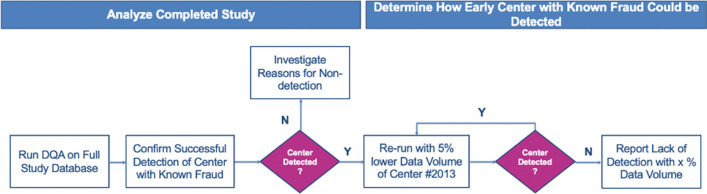
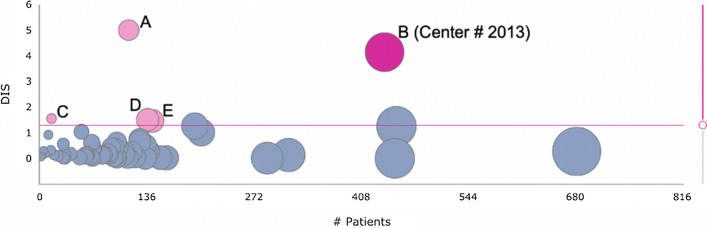
Background: A central statistical assessment of the quality of data collected in clinical trials can improve the quality and efficiency of sponsor oversight of clinical investigations. Material and Methods: The database of a large randomized clinical trial with known fraud was reanalyzed with a view to identifying, using only statistical monitoring techniques, the center where fraud had been confirmed. The analysis was conducted with an unsupervised statistical monitoring software using mixed-effects statistical models. The statistical analyst was unaware of the location, nature, and extent of the fraud. Results: Five centers were detected as atypical, including the center with known fraud (which was ranked 2). An incremental analysis showed that the center with known fraud could have been detected after only 25% of its data had been reported. Conclusion: An unsupervised approach to central monitoring, using mixed-effects statistical models, is effective at detecting centers with fraud or other data anomalies in clinical trials.
Overview
The claims and statistics of this paper haven’t been checked yet.
Free: it reads the open-access text and checks the first 5 claims that cite a source we can check. Create a free account to check every claim.
Integrity signals
Registry
Cites
Statistics
Figures
Verification
Claims the paper makes
The claims and statistics of this paper haven’t been checked yet.
Free: it reads the open-access text and checks the first 5 claims that cite a source we can check. Create a free account to check every claim.
Claims other papers make about this one
Each is checked against this paper’s own text: does it say what the citing paper says it does?
The cited source says what the claim attributes to it.
In the citing paper
“Although many tools have been developed [13, 14, 15, 16, 17], none of them have been formally validated, as highlighted by Khan et al. [18]”
From Trustworthiness assessment as an inclusion criterion for systematic reviews—What is the impact on results? (2023) · cites this paper as [14]
Self-check
Percentages, sums and reported differences re-computed from the paper’s own numbers.
The self-check needs the paper’s full text.
Citations
Cites
Fanelli, D. (2009) · PLoS ONE · doi:10.1371/journal.pone.0005738 · Cited by 1,911 · cited 1×
“In contrast with other types of experiments, very few publications have been made of fraud cases and no systematic review has been conducted [19].”
ResultDiener, H. C., Cunha, L., Forbes, C., Sivenius, J., Smets, P., & Lowenthal, A. (1996) · Journal of the Neurological Sciences · doi:10.1016/s0022-510x(96)00308-5 · Cited by 1,577
Forbes, C., & Collaborators, E. (1997) · International Journal of Clinical Practice · doi:10.1111/j.1742-1241.1997.tb11433.x · Cited by 1,411
Are these data real? Statistical methods for the detection of data fabrication in clinical trials
Al-Marzouki, S., Evans, S., Marshall, T., & Roberts, I. (2005) · BMJ · doi:10.1136/bmj.331.7511.267 · Cited by 131 · cited 1×
“This hypothesis has since been confirmed both experimentally [23] and in actual clinical trial datasets [24].”
ResultData fraud in clinical trials.
George, S. L., & Buyse, M. (2015) · Clinical Investigation · doi:10.4155/cli.14.116 · Cited by 126 · cited 2×
“Our own experience with central statistical monitoring suggests that overt fraud is rare and limited, although other causes of data errors (including sloppiness and lack of understanding or training) are quite common [3, 5, 7, 8, 10].”
BackgroundMethodSelf-citationA statistical approach to central monitoring of data quality in clinical trials
Venet, D., Doffagne, E., Burzykowski, T., Beckers, F., Tellier, Y., Genevois-Marlin, E., Becker, U., Bee, V., Wilson, V., Legrand, C., et al. (2012) · Clinical Trials · doi:10.1177/1740774512447898 · Cited by 107 · cited 2×
“Our own experience with central statistical monitoring suggests that overt fraud is rare and limited, although other causes of data errors (including sloppiness and lack of understanding or training) are quite common [3, 5, 7, 8, 10].”
BackgroundMethodSelf-citationResearch misconduct and data fraud in clinical trials: prevalence and causal factors
George, S. L. (2015) · International Journal of Clinical Oncology · doi:10.1007/s10147-015-0887-3 · Cited by 95 · cited 1×
“The true prevalence of fraud in clinical trials is largely unknown [18].”
BackgroundCentral statistical monitoring: Detecting fraud in clinical trials
Pogue, J. M., Devereaux, P., Thorlund, K., & Yusuf, S. (2013) · Clinical Trials · doi:10.1177/1740774512469312 · Cited by 51
Linear mixed‐effects models for central statistical monitoring of multicenter clinical trials
Desmet, L., Venet, D., Doffagne, E., Timmermans, C., Burzykowski, T., Legrand, C., & Buyse, M. (2014) · Statistics in Medicine · doi:10.1002/sim.6294 · Cited by 41 · cited 3×
“Our own experience with central statistical monitoring suggests that overt fraud is rare and limited, although other causes of data errors (including sloppiness and lack of understanding or training) are quite common [3, 5, 7, 8, 10].”
BackgroundMethodSelf-citationData-driven risk identification in phase III clinical trials using central statistical monitoring
Timmermans, C., Venet, D., & Burzykowski, T. (2015) · International Journal of Clinical Oncology · doi:10.1007/s10147-015-0877-5 · Cited by 28
Research works printed but not linked: 1
- Evans S. Statistical aspects of the detection of fraud. In: Fraud and misconduct in medical research, 3rd edn. BMJ Publishing Group, London; 2001. pp. 186–204.
Cited by
Olawade, D. B., Fidelis, S. C., Marinze, S., Egbon, E., Osunmakinde, A., & Osborne, A. (2025) · International Journal of Medical Informatics · doi:10.1016/j.ijmedinf.2025.106141 · Cited by 96
Weeks, J., Cuthbert, A., & Alfirevic, Z. (2023) · Cochrane Evidence Synthesis and Methods · doi:10.1002/cesm.12037 · Cited by 42
Assessing the Integrity of Clinical Trials Included in Evidence Syntheses
Núñez‐Núñez, M., Ibáñez, N. C., Zamora, J., Bueno‐Cavanillas, A., & Khan, K. S. (2023) · International Journal of Environmental Research and Public Health · doi:10.3390/ijerph20126138 · Cited by 26
de Viron, S., Trotta, L., Steijn, W., Young, S., & Buyse, M. (2024) · Therapeutic Innovation & Regulatory Science · doi:10.1007/s43441-024-00613-w · Cited by 9
Self-citationDoes Central Monitoring Lead to Higher Quality? An Analysis of Key Risk Indicator Outcomes
de Viron, S., Trotta, L., Steijn, W., Young, S., & Buyse, M. (2023) · Therapeutic Innovation & Regulatory Science · doi:10.1007/s43441-022-00470-5 · Cited by 9
Self-citationA Clustering Ensemble Method for Drug Safety Signal Detection in Post-Marketing Surveillance
Chakraborty, S., & Tiwari, R. C. (2024) · Therapeutic Innovation & Regulatory Science · doi:10.1007/s43441-024-00705-7 · Cited by 8
“…non-critical conditions in patients undergoing cardiac surgery [3], detecting clinical decision support malfunctions [4], selecting clinical study sites and monitoring clinical trials for data fraud [5–8], identifying drug safety signals from post-market safety databases [9], among many others.”
Central statistical monitoring in clinical trial management: A scoping review
Fronc, M., Jakubczyk, M., Love, S., Talbot, S. M., & Rolfe, T. (2025) · Clinical Trials · doi:10.1177/17407745241304059 · Cited by 4
Regional variation in clinical-trial risks: a large-scale analysis of 585 clinical trials
de Viron, S., Young, S., Trotta, L., & Buyse, M. E. (2025) · BMJ Open · doi:10.1136/bmjopen-2024-094950 · Cited by 1
Self-citationLessons and Insights from a Case Study on Clinical Trial Fraud
McGuire, C., Sellers, J. W., Grandinetti, C. A., Fedowitz, M., & Ayalew, K. (2026) · Therapeutic Innovation & Regulatory Science · doi:10.1007/s43441-026-00939-7 · Cited by 1
Dirks, A., de Viron, S., McFarlane, K., & Getz, K. A. (2026) · Therapeutic Innovation & Regulatory Science · doi:10.1007/s43441-026-01002-1 · Cited by 1
“Studies have also shown that targeted SDV, SDM, KRIs, and QTLs can improve oversight effectiveness and direct monitoring resources more efficiently [ 8, 9, 17, 18].”
Ménard, T. (2022) · Clinical Trials · doi:10.1177/17407745221078991
Emerging Conflict of Interests for the Rhinologic Surgeon Entrepreneur
Carney, A. S. (2023) · Current Otorhinolaryngology Reports · doi:10.1007/s40136-023-00472-3
Niangoran, B. (2023) · theses.fr (ABES) · doi:10.70675/f84001dcz53f4z497czb392zfdd1c1d3af14
Niangoran, S., Barbieri, A., Badjé, A., Journot, V., Kouamé, G. M., Marcy, O., Anglaret, X., & Alioum, A. (2024) · Statistics in Biopharmaceutical Research · doi:10.1080/19466315.2024.2404631
“Most CSM methods proposed in the literature concern quantitative variables (Pogue et al. 2013; Desmet et al. 2014; de Viron et al. 2022).”
Detection of Outlying Correlation Coefficients in Multicenter Clinical Trials
Desmet, L., Venet, D., Trotta, L., Burzykowski, T., & Buyse, M. E. (2025) · Pharmaceutical Statistics · doi:10.1002/pst.70013
Self-citationAssessing the integrity of raw data in clinical trials: a scoping review of statistical methods
Tercero-Hidalgo, J. R. (2025) · Institutional Repository of the University of Granada (University of Granada)
Criminalisation of fraud and misconduct in clinical trials on medicinal products
Gutorova, N. O., Pashkov, V., & Soloviov, O. (2025) · Wiadomości Lekarskie · doi:10.36740/wlek/214796
Karthikeyan, H., Biradar, V., Polineni, T. N. S., Rao, S. S., Josephine, J. A., & S, N. C. (2026) · International Conference on Intelligent Computing, Networks, and Security (IC-ICNS) · doi:10.1109/ic-icns68863.2026.11552383
Burgula, K. R., Akkala, A. K., Srinivas, R. V., Kokila, M., Varma, K. P., & Ghildiyal, N. (2026) · International Conference on Trends in Engineering Systems and Technologies (ICTEST) · doi:10.1109/ictest69239.2026.11722879
Somasundaram, K., Negi, R. S., G, C. P. K., Ravindra, S., Sundaramoorthy, G., & Rekhadevi, B. (2026) · doi:10.1109/icosics70095.2026.11746748
“PMB: A Positive Multi-Behavior Sequential recommendation model with temporal-aware contrastive learning and self-attention [4].”
Metadata
- Authors
- de Viron, S., Trotta, L., Schumacher, H., Lomp, H.-J., Höppner, S., Young, S., & Buyse, M.
- Affiliations
- Boehringer Ingelheim (Germany) (DE)
- International Drug Development Institute (Belgium) (BE)
- Venue
- Therapeutic Innovation & Regulatory Science
- Published
- 2021-09-29
- Volume
- 56
- Issue
- 1
- Pages
- 130-136
- ISSN
- 2168-4790 (ISSN-L)
- 2168-4804
- PMC
- PMC8688378
- OpenAlex
- W3203182584
- Cited by
- 16
- References
- 23
- Citations by year
- 2026: 4 · 2025: 4 · 2024: 3 · 2023: 3 · 2022: 2
- FWCI
- 1.49
- Type
- journal article
- Language
- en
- Open access
- hybrid
- doi.org
- Licence
- cc-by
- creativecommons.org/licenses/by/4.0 (tdm)
- creativecommons.org/licenses/by/4.0 (vor)
- Locations
- Therapeutic Innovation & Regulatory Science (publishedVersion, cc-by)
- PubMed Central (publishedVersion, cc-by)
- PubMed (publishedVersion)
- Document Server@UHasselt (UHasselt) (submittedVersion, cc-by)
- Funders
- Boehringer Ingelheim
- CluePoints
- Topics
- Physical Sciences › Mathematics › Statistics and Probability › Benford’s Law and Fraud Detection
- Physical Sciences › Mathematics › Statistics and Probability › Statistical Methods in Clinical Trials
- Social Sciences › Education › Academic integrity and plagiarism
- Keywords
- mixed models, data anomalies, randomized controlled trials, incremental analysis, data quality
- MeSH terms
- Fraud, Models, Statistical, Randomized Controlled Trials as Topic
About these checks
Registry, retraction, Cites and statistics results are computed, not judged, with one exception: a printed reference that no index lists is read once by a model before it counts as a citation error. Claims are extracted by a model and kept only when their quote appears verbatim in the text; each cited source is then checked, with a model’s help, for whether it says what the claim relies on. Those verdicts can be wrong — read the claim’s quote and the cited source before relying on one.
Statistics and arithmetic are recomputed, not judged.
Confidence bands are shown only for fields calibrated on our annotated test set. None is calibrated yet, so no band is shown.
What counts as a claim ›How we measure confidence ›How we check this ›
Are you an author, or do you see a problem with this page? Request a review
Data sources
Bibliographic data: Semantic Scholar, OpenAlex, Crossref.
Contains information from the Semantic Scholar Academic Graph Datasets, made available under the ODC Attribution License (ODC-BY 1.0).
Semantic Scholar’s data is described in: Kinney, R., et al. (2023). The Semantic Scholar Open Data Platform. arXiv:2301.10140.
