

Predicting compressive strength of recycled aggregate concrete using AI with experimental validation
Open accessThe DOI matches its Crossref record; 44 of the 44 references it cites were found in a registry or an index; none of the 63 sources its claims cite is checked for support yet.
Abstract
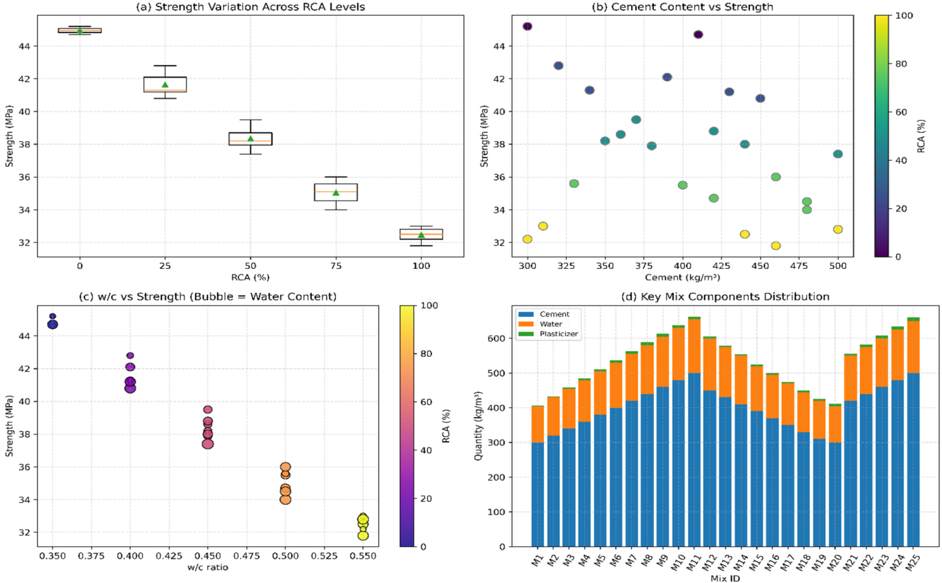
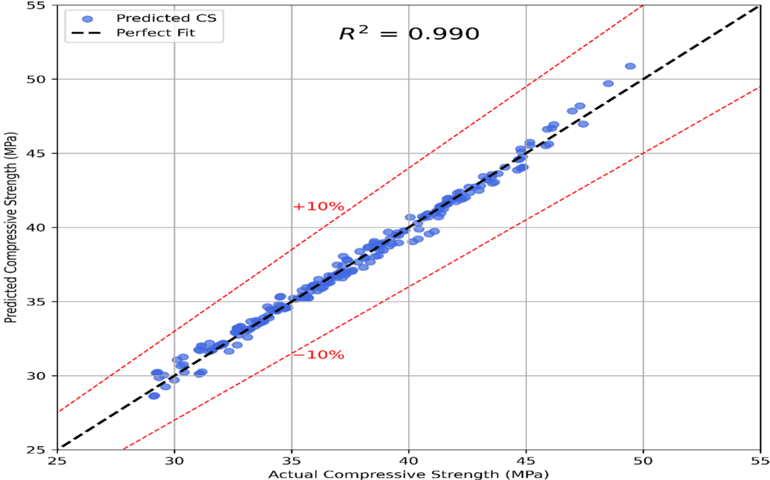
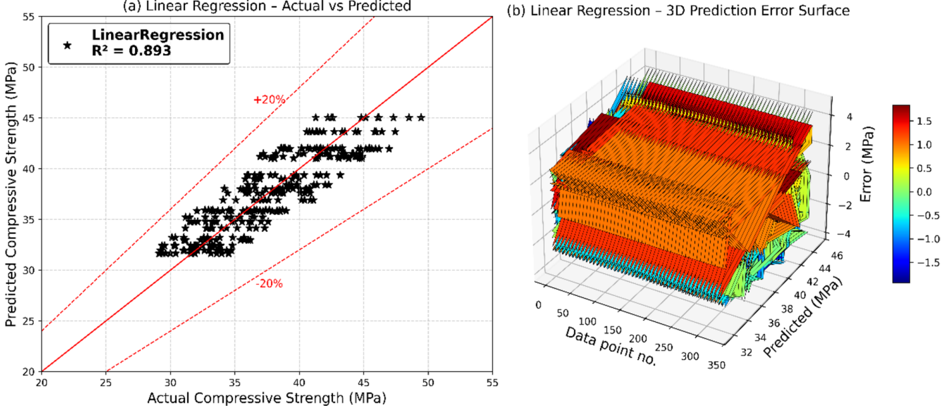
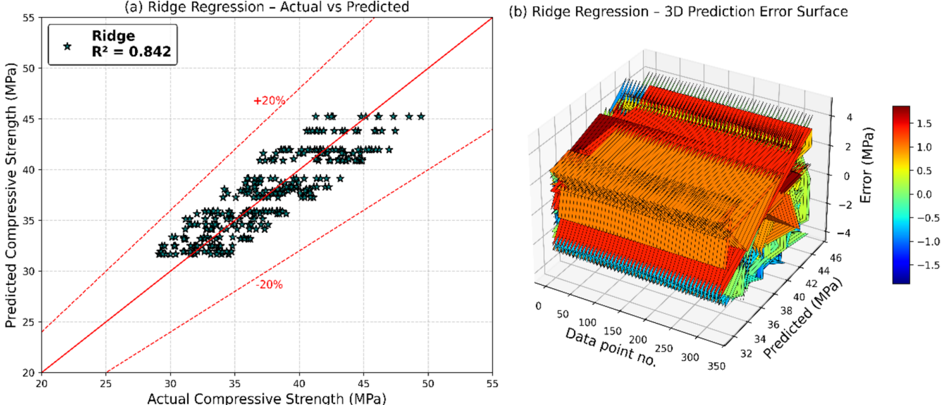
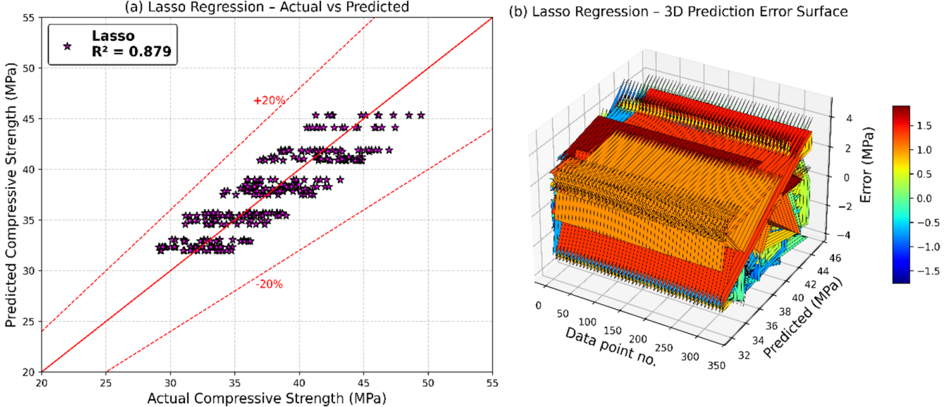
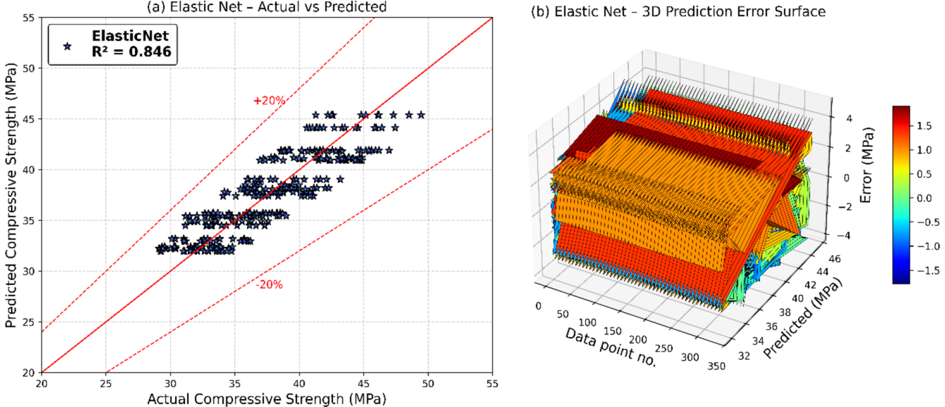
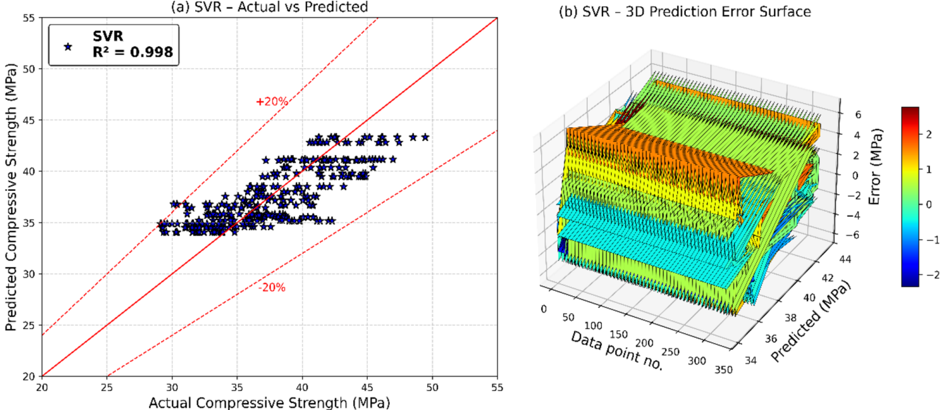
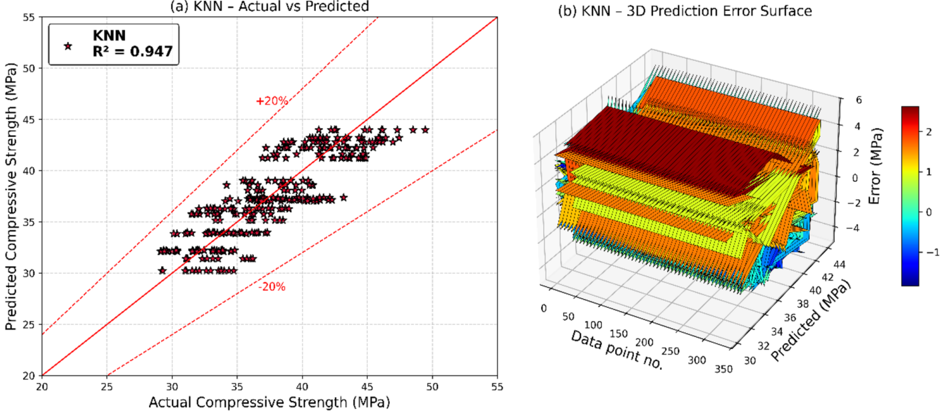
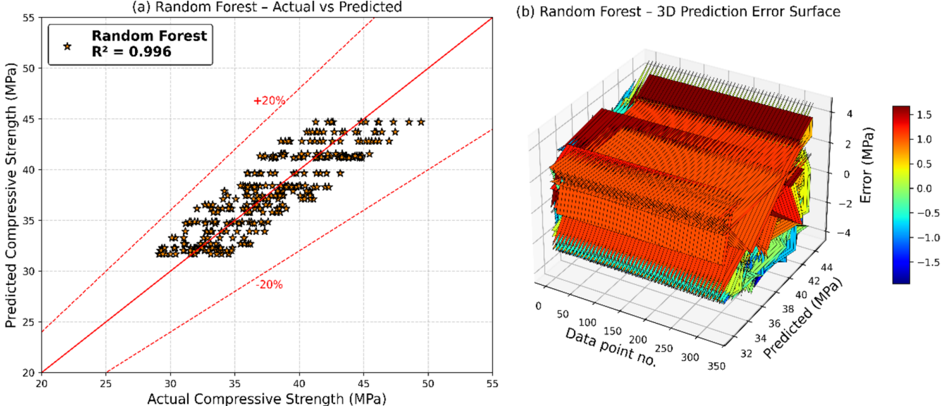
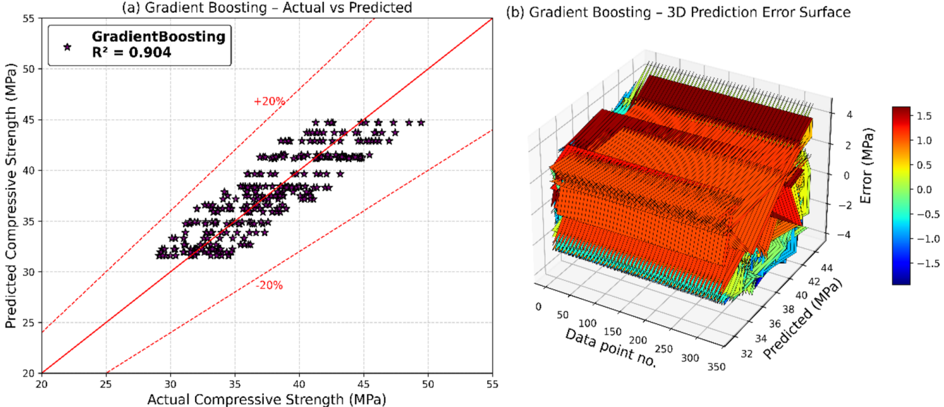
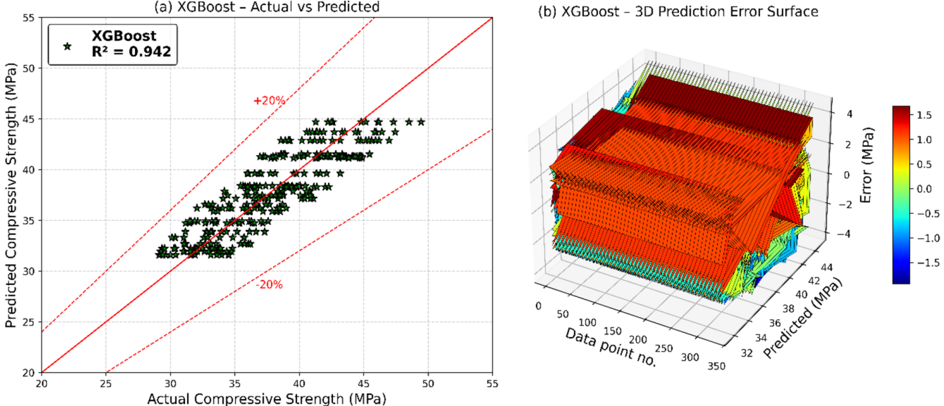
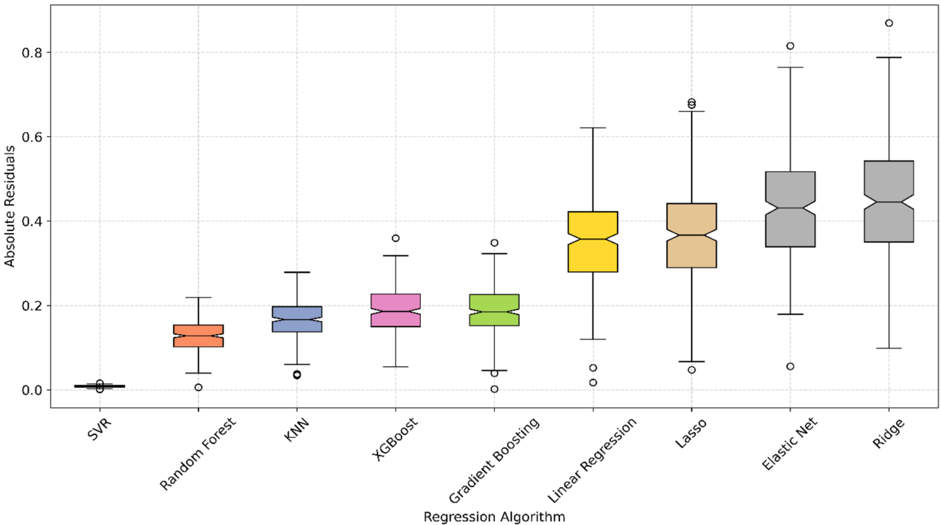
Growing concerns about environmental impact and rising construction costs have encouraged the use of recycled aggregates in concrete. This study offers an experimental and AI-driven assessment of the compressive strength of recycled aggregate concrete. Concrete was prepared by varying recycled fine and coarse aggregates, water-cement ratios, plasticizer content, and parent concrete strength. The measured 28-day compressive strength ranged from 31.8 to 45.2 MPa, and a steady reduction was observed as recycled aggregate levels and water absorption increased. The results highlight how aggregate quality, abrasion resistance, and replacement percentage influence mechanical performance. To extend the laboratory findings, nine machine learning models were developed to estimate compressive strength based on all mix parameters. Support Vector Regression delivered the strongest performance with an R 2 of 0.998, followed by Random Forest (0.996). K-Nearest Neighbors and XGBoost achieved R 2 values of 0.947 and 0.942, while Gradient Boosting, Linear Regression, Lasso, Elastic Net, and Ridge obtained R 2 scores of 0.904, 0.893, 0.879, 0.846, and 0.842. Nonlinear algorithms clearly performed better than linear models. The results show that AI tools can reliably predict compressive strength, reducing the need for extensive testing and helping streamline mix design for recycled aggregate concrete.
Overview
CoChat Summary
TL;DR
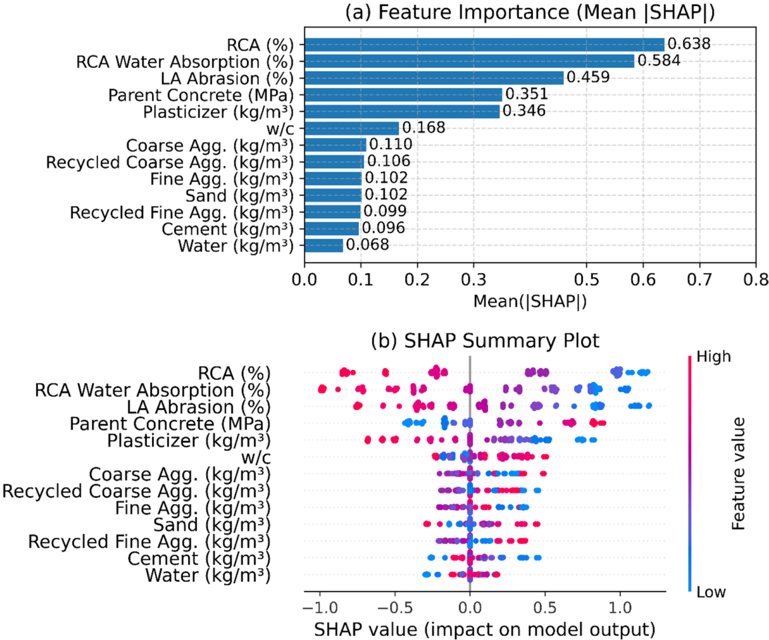
This study combines a 25-mix laboratory program on recycled aggregate concrete (RAC) with nine machine learning models to predict 28-day compressive strength, reporting that nonlinear algorithms (SVR R² = 0.998, RF 0.996) far outperform linear ones. SHAP analysis identifies recycled coarse aggregate replacement percentage, RCA water absorption, and Los Angeles abrasion value as the most influential predictors within the tested range.
Key findings
- Measured 28-day compressive strength ranged from 31.8 MPa (100% recycled aggregates) to 45.2 MPa (all-natural aggregates), with strength decreasing steadily as recycled aggregate levels and water absorption increased; mixes with 75–100% RCA showed the lowest strengths, and the authors conclude ~25–75% replacement can yield satisfactory strength with appropriate mix design.
- Model performance (Table 5): SVR R² = 0.998 (MAE 0.008 MPa, RMSE 0.011 MPa), RF 0.996 (MAE 0.128, RMSE 0.179), KNN 0.947, XGBoost 0.942, Gradient Boosting 0.904, Linear Regression 0.893, Lasso 0.879, Elastic Net 0.846, Ridge 0.842. A stacking ensemble is also reported at R² = 0.999 (train) / 0.998 (test), MAE ≈ 0.0099, RMSE ≈ 0.0137.
- SHAP mean absolute values on the SVR model: RCA replacement percentage 0.638, RCA water absorption 0.584, LA abrasion 0.459, parent concrete strength 0.351, superplasticizer 0.346, w/c 0.168; cement content (0.096) and water content (0.068) were lowest, which the authors attribute to their intentionally narrow experimental ranges rather than lower engineering importance.
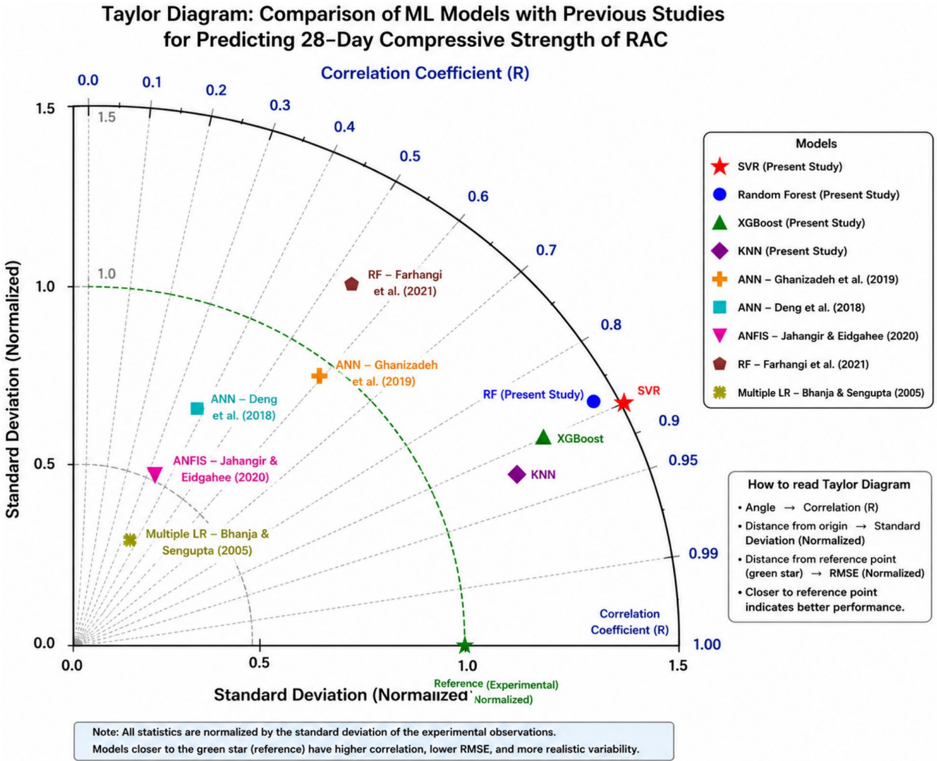
- A Taylor diagram comparison places the proposed SVR closest to the reference observation relative to previously published ANN, ANFIS, and regression models (Table 6 comparison values are left blank in the text).
Methods
- Experimental program: 25 concrete mixes varying recycled fine and coarse aggregate replacement (0–100%), w/c ratio (0.30–0.35), plasticizer content, and parent concrete strength (25–45 MPa); 150 × 150 × 150 mm cubes cured in water at 23 ± 2 °C for 28 days before compressive strength testing. Recycled aggregates were characterized for water absorption and LA abrasion.
- Data augmentation: each of the 25 experimental mixes was expanded into 45 synthetic samples via random perturbations within ±10% of measured input values, giving 1,125 records; 13 input variables (cement, natural sand, fine aggregate, RFA, coarse aggregate, RCA, water, superplasticizer, w/c, RCA replacement %, parent concrete strength, RCA water absorption, LA abrasion) with 28-day compressive strength as target.
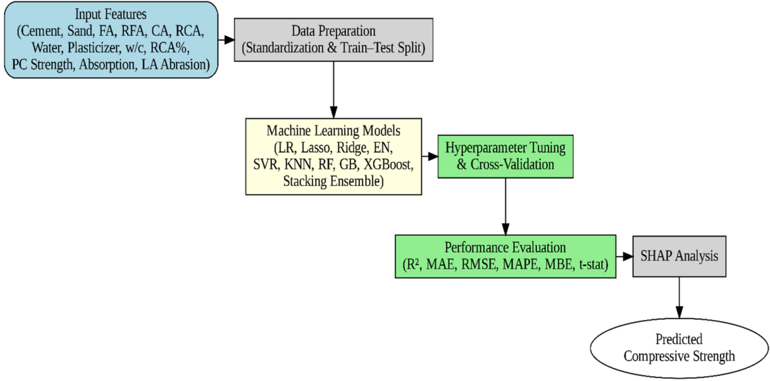
- Modeling: nine supervised algorithms (SVR, RF, KNN, XGBoost, GB, LR, Lasso, Ridge, Elastic Net) plus a stacking ensemble; StandardScaler fitted on training data only; 80/20 hold-out split; hyperparameter tuning via Grid Search and Randomized Search with cross-validation (described as five-fold in one section and k = 10 in another); evaluation by R², MAE, MSE, RMSE, MAPE, MBE, and paired t-statistic; SHAP for interpretability; Python 3.11 with scikit-learn 1.5.1, XGBoost 2.1.1, SHAP 0.46.0.
Limitations
- Stated by the authors: only 25 laboratory-tested mixtures, requiring data augmentation; models omit curing conditions, environmental exposure, chemical composition, microstructural properties, and long-term durability; validation used only the available dataset, so independent multi-laboratory/geographic validation is needed before large-scale implementation; SHAP rankings are specific to this dataset's statistical distribution and should not be generalized to datasets with different variable ranges.
- Evident from the text: the reported R² values are computed on a test set drawn from the same synthetically augmented pool as training, so they likely overstate performance on genuinely new mixes; the paper contains internal inconsistencies — the abstract and conclusion describe nine models while a tenth (stacking) is reported, the introduction retains an unfilled "R² = XX" placeholder, Table 6's benchmark values are blank, cross-validation is described as both five-fold and 10-fold, and Table 2 lists a compressive strength range of 28.74–49.45 MPa that does not match the 31.8–45.2 MPa stated elsewhere.
Model-written summary. Check it against the paper before relying on it.
Integrity signals
Registry
Cites
Statistics
Figures
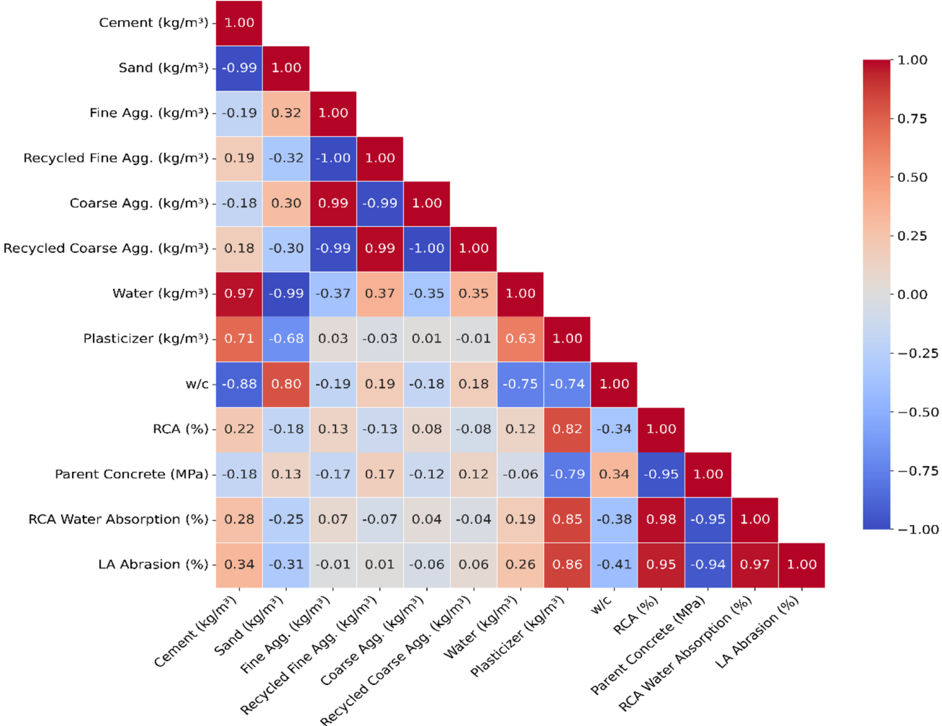
Verification
Claims the paper makes
0 Valid · 0 Not valid · 36 Not checked · 107 Own results and interpretations
A result the paper reports from its own data — it cites no other source for it, so there is none to check. The quote shows it is in the paper.
In the paper
“K-Nearest Neighbors and XGBoost achieved R 2 values of 0.947 and 0.942”
- Also stated in: § 3 Machine learning modeling · boosted
“The KNN and XGBoost models demonstrated satisfactory predictive performance with R 2 values of 0.947 and 0.942, respectively”
§ Predicting compressive strength of recycled aggregate concrete using AI with experimental validation > Abstract
boostedstates an association- Asserted: passes — The authors put it forward as true.
- Checkable: passes — It can be checked against evidence.
- Load-bearing: unclear — It is unclear whether the paper’s conclusions depend on it.
- Based: passes — The paper gives a reason why it holds.
- Rests on 2 assumptions not shown here.
- Also stated in: § 3 Machine learning modeling · boosted
A result the paper reports from its own data — it cites no other source for it, so there is none to check. The quote shows it is in the paper.
In the paper
“Support Vector Regression delivered the strongest performance with an R 2 of 0.998”
- Also stated in: § 3 Machine learning modeling · plain
“Support Vector Regression (SVR) achieved the highest predictive accuracy, yielding an R 2 of 0.998, MAE of 0.008 MPa, and RMSE of 0.011 MPa”
§ Predicting compressive strength of recycled aggregate concrete using AI with experimental validation > Abstract
plainstates an association- Asserted: passes — The authors put it forward as true.
- Checkable: passes — It can be checked against evidence.
- Load-bearing: passes — The paper’s conclusions depend on it.
- Based: passes — The paper gives a reason why it holds.
- Rests on 2 assumptions not shown here.
- Also stated in: § 3 Machine learning modeling · plain
A result the paper reports from its own data — it cites no other source for it, so there is none to check. The quote shows it is in the paper.
In the paper
“K-Nearest Neighbors and XGBoost achieved R 2 values of 0.947 and 0.942”
- Also stated in: § 3 Machine learning modeling · boosted
“The KNN and XGBoost models demonstrated satisfactory predictive performance with R 2 values of 0.947 and 0.942, respectively”
§ Predicting compressive strength of recycled aggregate concrete using AI with experimental validation > Abstract
boostedstates an association- Asserted: passes — The authors put it forward as true.
- Checkable: passes — It can be checked against evidence.
- Load-bearing: unclear — It is unclear whether the paper’s conclusions depend on it.
- Based: passes — The paper gives a reason why it holds.
- Rests on 2 assumptions not shown here.
- Also stated in: § 3 Machine learning modeling · boosted
A result the paper reports from its own data — it cites no other source for it, so there is none to check. The quote shows it is in the paper.
In the paper
“The measured 28-day compressive strength ranged from 31.8 to 45.2 MPa”
- Also stated in: § 2 Materials and methods · plain
“The 28-day compressive strength of the mixes varied from 31.8 to 45.2 MPa”
- Also stated in: § 1 Introduction · hedged
“The experimentally measured 28-day compressive strengths range from approximately 31.8 to 45.2 MPa.”
§ Predicting compressive strength of recycled aggregate concrete using AI with experimental validation > Abstract
plain- Asserted: passes — The authors put it forward as true.
- Checkable: passes — It can be checked against evidence.
- Load-bearing: unclear — It is unclear whether the paper’s conclusions depend on it.
- Based: passes — The paper gives a reason why it holds.
- Also stated in: § 2 Materials and methods · plain
A result the paper reports from its own data — it cites no other source for it, so there is none to check. The quote shows it is in the paper.
In the paper
“Gradient Boosting, Linear Regression, Lasso, Elastic Net, and Ridge obtained R 2 scores of 0.904, 0.893, 0.879, 0.846, and 0.842.”
§ Predicting compressive strength of recycled aggregate concrete using AI with experimental validation > Abstract
plain- Asserted: passes — The authors put it forward as true.
- Checkable: passes — It can be checked against evidence.
- Load-bearing: unclear — It is unclear whether the paper’s conclusions depend on it.
- Based: passes — The paper gives a reason why it holds.
- Rests on 2 assumptions not shown here.
68 more claims
Create a free account to see all 143 claims and to verify the 52 references still open.
- It may state two separate claims as one. 47
- Probably not a substantial claim. 33
Self-check
Percentages, sums and reported differences re-computed from the paper’s own numbers.
Each contradiction between two passages listed here was confirmed by an independent check.
Rated major: it would touch a result — a value a result rests on, reported and recomputed p-values on opposite sides of the significance level, two passages that conflict with no sign which is right, or a cited work retracted before this paper was published.
In the paper
§ Predicting compressive strength of recycled aggregate concrete using AI with experimental validation > 3.1.9 Hyperparameter tuning and cross-validation
“systematic hyperparameter optimization was performed for all algorithms using Grid Search in conjunction with five-fold cross-validation.”
§ Predicting compressive strength of recycled aggregate concrete using AI with experimental validation > 4.2 Regression diagnostics and model evaluation
“Grid search and randomized search methods were employed in conjunction with k-fold crossvalidation (k = 10) to ensure robust parameter selection and prevent overfitting”
Rated major: it would touch a result — a value a result rests on, reported and recomputed p-values on opposite sides of the significance level, two passages that conflict with no sign which is right, or a cited work retracted before this paper was published.
In the paper
§ Predicting compressive strength of recycled aggregate concrete using AI with experimental validation > 3 Machine learning modeling
“The results indicated that the water-to-cement ratio, recycled coarse aggregate content, and parent concrete strength were the most significant predictors of RAC compressive strength; whereas superplasticizer dosage and fine aggregate proportions exhibited relatively smaller contributions.”
§ Predicting compressive strength of recycled aggregate concrete using AI with experimental validation > 4.3 Model interpretability and feature importance
“Parent concrete strength (0.351), superplasticizer dosage (0.346), and the water-tocement ratio (0.168) demonstrated moderate contributions to the model predictions.”
Rated major: it would touch a result — a value a result rests on, reported and recomputed p-values on opposite sides of the significance level, two passages that conflict with no sign which is right, or a cited work retracted before this paper was published.
In the paper
§ Predicting compressive strength of recycled aggregate concrete using AI with experimental validation > 3.1.2 Random Forest
“the maximum tree depth (12) and the number of estimators (400)”
§ Predicting compressive strength of recycled aggregate concrete using AI with experimental validation > 5.2 Future scope
“| Random Forest (RF) | Number of Trees | 300 | | | Maximum Depth | 20 |”
Rated major: it would touch a result — a value a result rests on, reported and recomputed p-values on opposite sides of the significance level, two passages that conflict with no sign which is right, or a cited work retracted before this paper was published.
In the paper
§ Predicting compressive strength of recycled aggregate concrete using AI with experimental validation > 3.1.4 Gradient Boosting and XGBoost
“XGBoost used 600 trees, a learning rate of 0.03, a max depth of 5, and a subsampling of 0.9.”
§ Predicting compressive strength of recycled aggregate concrete using AI with experimental validation > 5.2 Future scope
“| XGBoost | Number of Trees | 300 | | | Learning Rate | 0.05 | | | Maximum Depth | 6 | | | Subsample | 0.80 |”
Citations
Cites
Breiman, L. (2001) · Machine Learning · doi:10.1023/a:1010933404324 · Cited by 133,538 · cited 2×
“These tree-based ensembles are highly effective for tabular datasets with heterogeneous input features (Breiman, 2001; Geurts et al., 2006).”
InfluentialXGBoost: A Scalable Tree Boosting System
Chen, T., & Guestrin, C. (2016) · Proceedings of the 22nd ACM SIGKDD International Conference on Knowledge Discovery and Data Mining · doi:10.1145/2939672.2939785 · Cited by 54,569 · cited 3×
“Extensive hyperpa-rameter tuning and 5-fold cross-validation were applied to prevent overfitting and improve generalization (Chen & Guestrin, 2016; Friedman, 2001).”
Greedy function approximation: A gradient boosting machine
Friedman, J. H. (2001) · The Annals of Statistics · doi:10.1214/aos/1013203451 · Cited by 30,731 · cited 2×
“Extensive hyperpa-rameter tuning and 5-fold cross-validation were applied to prevent overfitting and improve generalization (Chen & Guestrin, 2016; Friedman, 2001).”
InfluentialThe Elements of Statistical Learning
Hastie, T., Tibshirani, R., & Friedman, J. (2009) · Springer Series in Statistics · doi:10.1007/978-0-387-84858-7 · Cited by 25,970 · cited 5×
“However, the linear framework limits its capacity to fully capture complex interactions among mix parameters (Hastie et al., 2009).”
InfluentialA Unified Approach to Interpreting Model Predictions
Lundberg, S., & Lee, S.-I. (2017) · arXiv · doi:10.48550/arxiv.1705.07874 · Cited by 23,707 · cited 1×
“Unlike conventional sensitivity analysis, SHAP captures complex nonlinear relationships and interactions among input variables, thereby providing both global feature importance and instance-level explanations of model behavior (Lundberg & Lee, 2017; Molnar, 2020).”
Regularization and Variable Selection Via the Elastic Net
Zou, H., & Hastie, T. (2005) · Journal of the Royal Statistical Society Series B: Statistical Methodology · doi:10.1111/j.1467-9868.2005.00503.x · Cited by 20,957
A tutorial on support vector regression
Smola, A. J., & Schölkopf, B. (2004) · Statistics and Computing · doi:10.1023/b:stco.0000035301.49549.88 · Cited by 13,387 · cited 2×
“Hyperparam-eter tuning of the kernel type, penalty parameter (C), and epsilon margin was critical to optimizing SVR performance (Smola & Scholkopf, 2004).”
(2016) · Cited by 11,679
Ridge regression: Biased estimation for nonorthogonal problems
Hoerl, A. E., & Kennard, R. W. (1970) · Technometrics · doi:10.1080/00401706.1970.10488634 · Cited by 9,648
Geurts, P., Ernst, D., & Wehenkel, L. (2006) · Machine Learning · doi:10.1007/s10994-006-6226-1 · Cited by 9,300 · cited 1×
“These tree-based ensembles are highly effective for tabular datasets with heterogeneous input features (Breiman, 2001; Geurts et al., 2006).”
Wolpert, D. H. (1992) · Neural Networks · doi:10.1016/s0893-6080(05)80023-1 · Cited by 7,951
An Introduction to Kernel and Nearest-Neighbor Nonparametric Regression
Altman, N. S. (1992) · The American Statistician · doi:10.1080/00031305.1992.10475879 · Cited by 5,708 · cited 2×
“KNN performed moderately well (R 2 = 0.947) but is sensitive to feature scaling and outliers, highlighting the importance of pre-processing and standardization (Altman, 1992).”
InfluentialChicco, D., Warrens, M. J., & Jurman, G. (2021) · PeerJ Computer Science · doi:10.7717/peerj-cs.623 · Cited by 5,380
Composition and microstructure of alkali activated fly ash binder: Effect of the activator
Fernández-Jiménez, A., & Palomo, A. (2005) · Cement and Concrete Research · doi:10.1016/j.cemconres.2005.03.003 · Cited by 1,144
Properties of concrete made with recycled aggregate from partially hydrated old concrete
Katz, A. (2003) · Cement and Concrete Research · doi:10.1016/s0008-8846(02)01033-5 · Cited by 865
Properties of concrete incorporating fine recycled aggregate
Khatib, J. M. (2005) · Cement and Concrete Research · doi:10.1016/j.cemconres.2004.06.017 · Cited by 737 · cited 2×
“However, a number of intrinsic factors—such as the strength and quality of the parent concrete, the quantity of mortar adhered, the porosity of the recycled particles, and water absorption properties— have a significant impact on RAC’s effectiveness (Ajduk-iewicz & Kliszczewicz, 2002; Khatib, 2005).”
Influence of recycled aggregates on mechanical properties of HS/HPC
Ajdukiewicz, A., & Kliszczewicz, A. (2002) · Cement and Concrete Composites · doi:10.1016/s0958-9465(01)00012-9 · Cited by 678
Influence of field recycled coarse aggregate on properties of concrete
Rao, M. C., Bhattacharyya, S. K., & Barai, S. V. (2010) · Materials and Structures · doi:10.1617/s11527-010-9620-x · Cited by 513 · cited 2×
“RAs can be obtained by crushing and purifying demolished concrete after impurities such as wood, plastics, and steel reinforcement are removed (Chakradhara Rao et al., 2011).”
Bilim, C., Atiş, C. D., Tanyildizi, H., & Karahan, O. (2009) · Advances in Engineering Software · doi:10.1016/j.advengsoft.2008.05.005 · Cited by 335 · cited 5×
“…(ANN), Support Vector Regression (SVR), Random Forest (RF), Gradient Boosting (GB), and Extreme Gradient Boosting (XGBoost), have been successfully employed for predicting concrete properties with high accuracy (Bilim et al., 2009a, 2009b, 2009c; Farhangi et al., 2021; Jahangir & Eidgahee, 2020).”
InfluentialPlevris, V., Solorzano, G., Bakas, N., & Seghier, M. E. A. B. (2022) · European Congress on Computational Methods in Applied Sciences and Engineering (ECCOMAS) · doi:10.23967/eccomas.2022.155 · Cited by 330 · cited 1×
“…analysis and machine learning applications for modeling engineering materials and structural behavior, providing a comprehensive and reliable assessment of predictive accuracy (Chicco & Warrens, 2021; Emmert-Streib & Dehmer, 2019; Miller, 2024; Plevris et al., 2022; Steurer et al., 2021).”
Strength of Recycled Concrete MadeFrom Crushed Concrete Coarse Aggregate
Hansen, T. C., & Narud, H. (1983) · ACI Concrete International · Cited by 324
Dantas, A. T. A., Batista Leite, M., & de Jesus Nagahama, K. (2013) · Construction and Building Materials · doi:10.1016/j.conbuildmat.2012.09.026 · Cited by 314 · cited 1×
“However, when factors interact nonlinearly or the dataset is high-dimensional, these approaches frequently fail (Dantas et al., 2013; Shin & Kim, 2013; Yeh, 2007).”
Evaluation of Regression Models: Model Assessment, Model Selection and Generalization Error
Emmert‐Streib, F., & Dehmer, M. (2019) · Machine Learning and Knowledge Extraction · doi:10.3390/make1010032 · Cited by 177 · cited 1×
“…analysis and machine learning applications for modeling engineering materials and structural behavior, providing a comprehensive and reliable assessment of predictive accuracy (Chicco & Warrens, 2021; Emmert-Streib & Dehmer, 2019; Miller, 2024; Plevris et al., 2022; Steurer et al., 2021).”
Metrics for evaluating the performance of machine learning based automated valuation models
Steurer, M., Hill, R. J., & Pfeifer, N. (2021) · Journal of Property Research · doi:10.1080/09599916.2020.1858937 · Cited by 174 · cited 1×
“…analysis and machine learning applications for modeling engineering materials and structural behavior, providing a comprehensive and reliable assessment of predictive accuracy (Chicco & Warrens, 2021; Emmert-Streib & Dehmer, 2019; Miller, 2024; Plevris et al., 2022; Steurer et al., 2021).”
Jäger, A.-K., & Weber, A. (2020) · Journal of Cleaner Production · doi:10.1016/j.jclepro.2020.120543 · Cited by 162
Mechanical Properties and Durability of Geopolymer Recycled Aggregate Concrete: A Review
Zhang, P., Sun, X., Wang, F., & Wang, J. (2023) · Polymers · doi:10.3390/polym15030615 · Cited by 161 · cited 2×
“These characteristics stem from the old, adhered mortar and microcracks that develop during crushing (Zhang et al., 2023a, 2023b).”
Akbar, A., & Liew, K. M. (2020) · Journal of Cleaner Production · doi:10.1016/j.jclepro.2020.123001 · Cited by 158 · cited 2×
“Recent analyses show that the cement industry remains a substantial source of CO ₂ through energy consumption and chemical processes (e.g., decarbonation of limestone) (Akbar & Liew, 2020b; Khalil & AbouZeid, 2025).”
Jahangir, H., & Rezazadeh Eidgahee, D. (2021) · Composite Structures · doi:10.1016/j.compstruct.2020.113160 · Cited by 120
Khan, K., Ahmad, W., Amin, M. N., Aslam, F., Ahmad, A., & Al-Faiad, M. A. (2022) · Materials · doi:10.3390/ma15103430 · Cited by 74 · cited 1×
“…predict compressive strength by considering influential parameters such as water-to-cement ratio, cement content, recycled aggregate replacement ratio, parent concrete strength, aggregate density, water absorption, and aggregate abrasion resistance (Khan et al., 2022; Zhang et al., 2023a, 2023b).”
Zhang, X., Dai, C., Li, W., & Chen, Y. (2023) · Frontiers in Earth Science · doi:10.3389/feart.2023.1112105 · Cited by 66 · cited 2×
“These characteristics stem from the old, adhered mortar and microcracks that develop during crushing (Zhang et al., 2023a, 2023b).”
Zhang, Z., Wang, H., Geng, J., Jiang, W., Deng, X., & Miao, W. (2022) · Engineering Applications of Artificial Intelligence · doi:10.1016/j.engappai.2021.104610 · Cited by 55 · cited 2×
“To enhance the accuracy of the predictions, a stacking ensemble model was created, integrating the capabilities of the best-performing algorithms (Zhang et al., 2022).”
Onyelowe, K. C., Gnananandarao, T., Ebid, A. M., Mahdi, H. A., Ghadikolaee, M. R., & Al-Ajamee, M. (2022) · Civil Engineering Journal · doi:10.28991/cej-2022-08-08-011 · Cited by 43 · cited 1×
“Onyelowe et al. (2022) developed an Artificial Neural Network model for predicting the compressive strength of RAC and demonstrated substantial improvements in prediction accuracy compared with conventional approaches.”
Onyelowe, K. C., Gnananandarao, T., Jagan, J., Ahmad, J., & Ebid, A. M. (2023) · Asian Journal of Civil Engineering · doi:10.1007/s42107-022-00558-1 · Cited by 34 · cited 2×
“Onyelowe et al. (2022) developed an Artificial Neural Network model for predicting the compressive strength of RAC and demonstrated substantial improvements in prediction accuracy compared with conventional approaches.”
Onyelowe, K. C., Kamchoom, V., Hanandeh, S., Anandha Kumar, S., Zabala Vizuete, R. F., Santillán Murillo, R. O., Zurita Polo, S. M., Torres Castillo, R. M., Ebid, A. M., Awoyera, P., et al. (2025) · Scientific Reports · doi:10.1038/s41598-025-91980-3 · Cited by 30 · cited 1×
“More recently, Onyelowe et al. (2025) introduced a physics-informed machine learning framework for predicting the splitting tensile strength of RAC by integrating engineering principles with advanced AI algorithms, thereby improving both prediction accuracy and model interpretability.”
Yang, S.-Y. (2009) · Expert Systems with Applications · doi:10.1016/j.eswa.2008.03.011 · Cited by 24
Khalil, E., & AbouZeid, M. (2025) · Construction Materials · doi:10.3390/constrmater5020020 · Cited by 17 · cited 2×
“Recent analyses show that the cement industry remains a substantial source of CO ₂ through energy consumption and chemical processes (e.g., decarbonation of limestone) (Akbar & Liew, 2020b; Khalil & AbouZeid, 2025).”
Pal, R., & Singh, S. (2024) · Journal of Materials in Civil Engineering · doi:10.1061/jmcee7.mteng-17400 · Cited by 16 · cited 2×
“The disposal of C&D debris not only burdens landfills but also risks material loss and environmental degradation (Cakiroglu et al., 2023; Pal & Singh, 2024).”
Multiple AI predictive models for compressive strength of recycled aggregate concrete
Ebid, A. M., Ulloa, N. A., Onyelowe, K. C., Rodríguez, M., Andrade-Valle, A. I., & Villacrés, A. N. Z. (2024) · Cogent Engineering · doi:10.1080/23311916.2024.2385621 · Cited by 10
Islam, Z. U., Farooq, S., Shoaib, M., Ishfaq, M., Ahmad, T., & Ahmad, H. (2025) · Discover Civil Engineering · doi:10.1007/s44290-025-00336-3 · Cited by 9
Predicting Compressive Strength of Recycled Aggregate Concrete by Multiple Regression Analysis
Shin, Y. S., & Kim, G. H. (2012) · Applied Mechanics and Materials · doi:10.4028/www.scientific.net/amm.253-255.546 · Cited by 7 · cited 1×
“However, when factors interact nonlinearly or the dataset is high-dimensional, these approaches frequently fail (Dantas et al., 2013; Shin & Kim, 2013; Yeh, 2007).”
Gu, R., Wang, J., Li, B., Qi, D., Gao, X., & Yang, Z. (2024) · Buildings · doi:10.3390/buildings14092761 · Cited by 6
Ushchapovskiy, D. Y., Frolenkova, S. V., Byk, M. V., Linyucheva, O. V., Motronyuk, T. I., & Klus, V. V. (2019) · Materials Today: Proceedings · doi:10.1016/j.matpr.2018.10.091 · Cited by 6
Xu, Y., Hua, E., & Haghani, A. (2021) · Materials Today Communications · doi:10.1016/j.mtcomm.2021.102633 · Cited by 4
Ebid, A. M. (2025) · JES. Journal of Engineering Sciences · doi:10.21608/jesaun.2025.396632.1566 · Cited by 3
Research works printed but not linked: 15
- Bilim, C., Ozbakkaloglu, T., & Tanyu, B. F. (2009c). Artificial neural networks for predicting compressive strength of concrete. ACI Materials Journal, 106(3), 203-211.
- Cakiroglu, M., Pal, S., & Sharma, R. (2023). Environmental challenges of con- struction waste: A review. Journal of Environmental Management, 335, 117142. https:// doi. org/ 10. 1016/j. jenvm an. 2023. 117142 · doi:10.1016/j.jenvman.2023.117142
- Field, A. (2013). Discovering statistics using IBM SPSS (4th ed.). Sage.
- Ghanizadeh, A., Naderpour, H., & Deng, Q. (2019). AI-based strength prediction for recycled concrete. Journal of Cleaner Production, 215, 376-385.
- Hansen, T. C., & Narud, H. (1983). Strength of recycled concrete with crushed aggregates. Concrete International, 5(1), 79-83.
- Jahangir, H., Farhangi, H., & Ghodrati, B. (2021). Ensemble prediction of RAC strength. Construction and Building Materials, 271, 121654.
- Miller, C. (2024). A review of model evaluation metrics for machine learning in regression, classification, and clustering. PeerJ Computer Science, 10, eXXX.
- Molnar, C. (2020). Interpretable machine learning: A guide for making black box models explainable. Lulu.com.
- Müller, A. C., & Guido, S. (2024). Introduction to machine learning with python (or the corresponding chapter in the cited Springer volume). In D. Schanafelt (Ed.), Machine learning. Springer.
- Naderpour, H., Ghanizadeh, M., & Behnood, A. (2018). RAC compressive strength prediction via ANN. Journal of Cleaner Production, 184, 640-650.
- Padmini, A. K., Ramamurthy, K., & Mathew, M. (2002). Influence of parent concrete on RAC properties. Cement and Concrete Research, 32(12), 1893-1901.
- Ryu, G. S. (2002). Strength and durability of recycled aggregate concrete. Construction and Building Materials, 16(1), 95-101.
- Tu, C., Belarbi, R., Pigeon, M., & Tam, V. (2006). Properties of concrete with recy- cled aggregate. Cement and Concrete Research, 36(1), 153-159.
- Yeh, I.-C. (2007). ML prediction of concrete properties. Cement and Concrete Research, 37(5), 676-685.
- Zain, M. F. M., Safiuddin, M., & Mahmud, H. B. (2002). Development of high- performance concrete using silica fume and superplasticizer. Cement and Concrete Research, 32(1), 115-122. https:// doi. org/ 10. 1016/ S0008- 8846(01) 00643-1 · doi:10.1016/s0008-8846(01)00643-1
Metadata
- Authors
- Gopal, S., & Kumar, A.
- Affiliations
- Sandip University Sijoul Madhubani Bihar (IN)
- Corresponding author
- Gopal, Swatantra
- Venue
- AI in Civil Engineering
- Published
- 2026-10-01
- Volume
- 5
- Issue
- 1
- Pages
- 26
- ISSN
- 2730-5392 (ISSN-L)
- 2097-0943
- OpenAlex
- W7214950925
- Cited by
- 0
- References
- 44
- FWCI
- 0.00
- Type
- journal article
- Language
- en
- Open access
- diamond
- doi.org
- Licence
- cc-by-nc-nd
- creativecommons.org/licenses/by-nc-nd/4.0 (tdm)
- creativecommons.org/licenses/by-nc-nd/4.0 (vor)
- Locations
- AI in Civil Engineering (publishedVersion, cc-by-nc-nd)
- DOAJ (DOAJ: Directory of Open Access Journals) (submittedVersion)
- Topics
- Physical Sciences › Engineering › Building and Construction › Recycled Aggregate Concrete Performance
- Physical Sciences › Engineering › Civil and Structural Engineering › Innovative concrete reinforcement materials
- Physical Sciences › Engineering › Civil and Structural Engineering › Concrete and Cement Materials Research
- Keywords
- recycled aggregate concrete, compressive strength prediction, recycled fine aggregate, recycled coarse aggregate, water-cement ratio, plasticizer content, water absorption, support vector regression, random forest, XGBoost, concrete mix design, machine learning
About these checks
Registry, retraction, Cites and statistics results are computed, not judged, with one exception: a printed reference that no index lists is read once by a model before it counts as a citation error. Claims are extracted by a model and kept only when their quote appears verbatim in the text; each cited source is then checked, with a model’s help, for whether it says what the claim relies on. Those verdicts can be wrong — read the claim’s quote and the cited source before relying on one.
A language model drew the claims from the paper on 2026-11-27, under version 3 of the claim definition (model deepseek-v4.1-flash, prompt extract-v3).
A second model labelled each claim on 2026-11-27 (model jev-1.13-20260917, definition revision gold-guideline-v0.2).
Statistics and arithmetic are recomputed, not judged.
Confidence bands are shown only for fields calibrated on our annotated test set. None is calibrated yet, so no band is shown.
What counts as a claim ›How we measure confidence ›How we check this ›
Are you an author, or do you see a problem with this page? Request a review
Data sources
Bibliographic data: Semantic Scholar, OpenAlex, Crossref.
Contains information from the Semantic Scholar Academic Graph Datasets, made available under the ODC Attribution License (ODC-BY 1.0).
Semantic Scholar’s data is described in: Kinney, R., et al. (2023). The Semantic Scholar Open Data Platform. arXiv:2301.10140.
