

The DOI matches its Crossref record; 2 of the 2 references it cites were found in a registry or an index.
Circular Economy of Water: Definition, Strategies and Challenges
Abstract
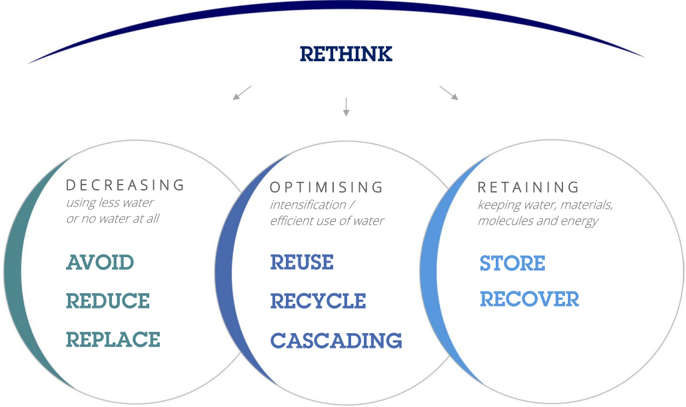
The circular economy has attracted considerable attention also in relation to water, an indispensable element to the sustainment of life and a critical input resource for the world economy. Despite a growing body of research on the circular economy of water (CEW), a consistent terminology and a clear conceptualisation of CEW strategies are lacking. Without such aspects, decision-makers, scientists and professionals may be hindered in developing a shared understanding of problems and solutions and exploiting new opportunities in the domain of the CEW. Furthermore, we argue that water is a unique element in the circular economy because it is a resource, a product and a service with no equivalent in the economic system and should be considered and valued as such in the CEW. Accordingly, we provide the definition of the CEW as an economic framework for reducing, preserving and optimising the use of water through waste avoidance, efficient utilisation and quality retention while ensuring environmental protection and conservation. Building on an analysis of academic literature and cases studies, we outline and illustrate a set of nine CEW strategies, including Rethink, Avoid, Reduce, Replace, Reuse, Recycle, Cascade, Store and Recover. Finally, we identify normative (legislation), governance (roles and responsibilities) and implementation (barriers and opportunities for application) challenges that need to be addressed to facilitate the transition to a comprehensive CEW.
Overview
The claims and statistics of this paper haven’t been checked yet.
Run the check — free, no account needed. It reads the open-access text and checks the sources it cites.
Integrity signals
Registry
Cites
Statistics
Figures
Verification
Claims the paper makes
The claims and statistics of this paper haven’t been checked yet.
Run the check — free, no account needed. It reads the open-access text and checks the sources it cites.
Claims other papers make about this one
Each is checked against this paper’s own text: does it say what the citing paper says it does?
In the citing paper
“Circular economy is a key strategy for sustainable development that can be applied to natural resources including soil, air, and water, and related activities from agriculture to services (Duncan and Pascucci, 2016; Hamam et al., 2021; Morseletto et al., 2022; Pomoni et al., 2024).”
From Win Together or Lose Alone: Circular Economy and Hybrid Governance for Natural Resource Commons (2024) · cites this paper as Morseletto et al., 2022
Self-check
Percentages, sums and reported differences re-computed from the paper’s own numbers.
The self-check needs the paper’s full text.
Citations
Cites
Circular nutrient solutions for agriculture and wastewater – a review of technologies and practices
Rosemarin, A., Macura, B., Carolus, J., Barquet, K., Ek, F., Järnberg, L., Lorick, D., Johannesdottir, S., Pedersen, S. M., Koskiaho, J., et al. (2020) · Current Opinion in Environmental Sustainability · doi:10.1016/j.cosust.2020.09.007 · Cited by 149
Let us discuss how cascading can help implement the circular economy and the bio-economy strategies
Bezama, A. (2016) · Waste Management & Research: The Journal for a Sustainable Circular Economy · doi:10.1177/0734242x16657973 · Cited by 90
Research works printed but not linked: 77
- Hoekstra AY, Chapagain AK (2011) Globalization of water: sharing the planet’s freshwater resources. John Wiley & Sons
- Koop SH, van Leeuwen CJ (2017) The challenges of water, waste and climate change in cities. Environ Dev Sustain 19(2):385–418 · DOI
- Boretti A, Rosa L (2019) Reassessing the projections of the world water development report. NPJ Clean Water 2(1):1–6 · DOI
- Falkenmark M (2020) Water resilience and human life support-global outlook for the next half century. Int J Water Resour Dev 36(2–3):377–396 · DOI
- Dolan F, Lamontagne J, Link R, Hejazi M, Reed P, Edmonds J (2021) Evaluating the economic impact of water scarcity in a changing world. Nat Commun 12(1):1–10 · DOI
- James L.D., Sharp Jr J., Herman J.S. (2017). Grand challenges facing the hydrologic sciences. In Singh V.P. (Ed) Handbook of applied hydrology. McGraw-Hill, 156–1 1567 (pp 1354–1383 of the PDF electronic version).
- Rögener, F. (2021). Upcoming challenges of water reclamation from unconventional sources. In Ribbe, L., Haarstrick, A., Babel, M., Dehnavi, S., Biesalski, H.K. (eds) Towards Water Secure Societies (pp. 79–87). Springer · DOI
- Gleick PH (2000) A look at twenty-first century water resources development. Water international 25(1):127–138 · DOI
- Bakker K (2014) The business of water: market environmentalism in the water sector. Annu Rev Environ Resour 39:469–494 · DOI
- Scholz M (2018) Sustainable water treatment: engineering solutions for a variable climate. Elsevier
- Voulvoulis N (2018) Water reuse from a circular economy perspective and potential risks from an unregulated approach. Curr Opin Environ Sci Health 2:32–45 · DOI · Paper page
- Sauvé S, Lamontagne S, Dupras J, Stahel W (2021) Circular economy of water: tackling quantity, quality and footprint of water. Environ Dev 39:100651 · DOI
- Brears RC (2020) Developing the Circular Water Economy. Palgrave Macmillan · DOI
- O’Shea G, Luoto S, Bor S, Hakala H, Nielsen IB (2021) The circular water economy and the seven Cs. In Jakobsen S, et al. (ed) Research Handbook of Innovation for a Circular Economy. Edward Elgar Publishing
- Oughton C, Anda M, Kurup B, Ho G (2021) Water circular economy at the Kwinana Industrial Area, Western Australia—the dimensions and value of industrial symbiosis. Circ Econ Sustain 1(3):995–1018 · DOI
- Morris JC, Georgiou I, Guenther E, Caucci S. (2021). Barriers in implementation of wastewater reuse: identifying the way forward in closing the loop. Circular Economy and Sustainability, pp 1–21 · DOI
- Manahan SE (2010) Water chemistry: green science and technology of nature’s most renewable resource. CRC Press · DOI
- Maurice PA (Ed) (2019). Encyclopedia of water: science, technology, and society. John Wiley & Sons, Inc. · DOI
- Green C (2003) Handbook of water economics: principles and practice. John Wiley & Sons
- Merli R, Preziosi M, Acampora A (2018) How do scholars approach the circular economy? A systematic literature review. J Clean Prod 178:703–722 · DOI
- Guerra-Rodríguez S, Oulego P, Rodríguez E, Singh DN, Rodríguez-Chueca J (2020) Towards the implementation of circular economy in the wastewater sector: Challenges and opportunities. Water 12(5):1431 · DOI
- Mbavarira TM, Grimm C (2021) A systemic view on circular economy in the water industry: learnings from a Belgian and Dutch case. Sustainability 13(6):3313 · DOI
- Mannina G, Badalucco L, Barbara L, Cosenza A, Di Trapani D, Gallo G, Helness H (2021) Enhancing a transition to a circular economy in the water sector: the EU Project WIDER UPTAKE. Water 13(7):946 · DOI
- Müller AB, Avellán T, Schanze J (2021) Translating the ‘water scarcity–water reuse’ situation into an information system for decision-making. Sustainability Science, pp 1–17 · DOI
- Kakwani NS, Kalbar PP (2020) Review of circular economy in urban water sector: challenges and opportunities in India. J Environ Manag 271:111010 · DOI
- Mounce SR (2020) Data science trends and opportunities for smart water utilities. Springer
- Laureano P (2001) The water atlas: traditional knowledge to combat desertification. UNESCO
- Mays LW (Ed) (2010). Lessons from the ancients on water resources sustainability. In Ancient Water Technologies (pp. 217–239). Springer · DOI
- O’Hogain S, McCarton L (2018) A technology portfolio of nature based solutions. Springer · DOI
- Atanasova N, Castellar JA, Pineda-Martos R, Nika CE, Katsou E, Istenič D, Langergraber G (2021) Nature-based solutions and circularity in cities. Circular Economy and Sustainability, pp 1–14 · DOI
- Song J, Guo Y, Wu P, Sun S (2018) The agricultural water rebound effect in China. Ecol Econ 146:497–506 · DOI
- Grafton RQ, Williams J, Perry CJ, Molle F, Ringler C, Steduto P, Udall B, Wheeler SA, Wang Y, Garrick D, Allen S (2018) The paradox of irrigation efficiency. Science 361:748–750 · DOI
- Morseletto P (2020) Targets for a circular economy. Resour Conserv Recycl 153:104553 · DOI
- Blomsma F, Brennan G (2017) The emergence of circular economy: a new framing around prolonging resource productivity. J Ind Ecol 21(3):603–614 · DOI · Paper page
- Morseletto P (2020) Restorative and regenerative: exploring the concepts in the circular economy. J Ind Ecol 24(4):763–773 · DOI
- Iacovidou E, Hahladakis JN, Purnell P (2020). A systems thinking approach to understanding the challenges of achieving the circular economy. Environmental Science and Pollution Research, pp 1–22 · DOI
- Kim JK, Smith R (2001) Cooling water system design. Chem Eng Sci 56(12):3641–3658 · DOI
- Vickers A (2017) Drought mitigation: water conservation tools for short-term and permanent water savings. In: Wilhite D, Pulwarty RS (eds) Drought and water crises: integrating science, management, and policy. CRC Press, pp 307–324
- Zaidy SS, Vacchi FI, Umbuzeiro GA, Freeman HS (2019) Approach to waterless dyeing of textile substrates—use of atmospheric plasma. Ind Eng Chem Res 58(40):18478–18487 · DOI
- Zille A (2020) Plasma technology in fashion and textiles. In: Nayak R (ed) Sustainable Technologies for Fashion and Textiles. Woodhead Publishing, pp 117–142 · DOI
- Van Hullebusch ED, Bani A, Carvalho M, Cetecioglu Z, De Gusseme B, Di Lonardo S, Zeeman G (2021) Nature-based units as building blocks for resource recovery systems in cities. Water 13(22):3153 · DOI
- Smol M, Adam C, Preisner M (2020) Circular economy model framework in the European water and wastewater sector. Journal of Material Cycles and Waste Management, pp 1–16 · DOI
- Demartini M, Pinna C, Aliakbarian B, Tonelli F, Terzi S (2018) Soft drink supply chain sustainability: a case based approach to identify and explain best practices and key performance indicators. Sustainability 10(10):3540 · DOI
- Razzaghi F, Obour PB, Arthur E (2020) Does biochar improve soil water retention? A systematic review and meta-analysis. Geoderma 361:114055 · DOI · Paper page
- Van Bakel PJT (1988) Using drainage systems for supplementary irrigation. Irrig Drain Syst 2(2):125–137 · DOI
- Perea RG, Poyato EC, Montesinos P, Díaz JAR (2019) Optimisation of water demand forecasting by artificial intelligence with short data sets. Biosys Eng 177:59–66 · DOI
- Hu M, Fan B, Wang H, Qu B, Zhu S (2016) Constructing the ecological sanitation: a review on technology and methods. J Clean Prod 125:1–21 · DOI
- Lenert A, Nam Y, Wang EN (2012) Heat transfer fluids. Ann Rev Heat Transf 15(15):93–129 · DOI
- Banchero M (2020) Recent advances in supercritical fluid dyeing. Color Technol 136(4):317–335 · DOI
- Vuppaladadiyam AK, Merayo N, Prinsen P, Luque R, Blanco A, Zhao M (2019) A review on greywater reuse: quality, risks, barriers and global scenarios. Rev Environ Sci Bio/Technol 18(1):77–99 · DOI
- Salgot M, Folch M (2018) Wastewater treatment and water reuse. Current Opin Environ Sci Health 2:64–74 · DOI
- Wang YP, Smith R (1994) Wastewater minimisation. Chem Eng Sci 49(7):981–1006 · DOI
- Rubio-Castro E, Serna-González M, Ponce-Ortega JM, El-Halwagi MM (2013) Synthesis of cooling water systems with multiple cooling towers. Appl Therm Eng 50(1):957–974 · DOI
- Saad SF, Zailan R, Alwi SW, Lim JS, Manan ZA (2019) Towards water integration in Eco-Industrial Park: an overview of water recovery from industries In IOP Conference Series. Mater Sci Eng 702(1):012015
- Cheremisinoff PN (2019) Handbook of water and wastewater treatment technology. Routledge · DOI
- Hendricks DW (2018) Water treatment unit processes: physical and chemical. CRC Press · DOI
- Faust SD, Aly OM (2018) Chemistry of water treatment. CRC Press
- Ho YC, Chua SC, Chong FK (2020) Coagulation-flocculation technology in water and wastewater treatment. In Handbook of Research on Resource Management for Pollution and Waste Treatment. IGI Global, pp 432–457 · DOI
- Walker J, Granjou C (2017) MELiSSA the minimal biosphere: human life, waste and refuge in deep space. Futures 92:59–69 · DOI
- Gacia E, Bernal S, Nikolakopoulou M, Carreras E, Morgado L, Ribot M, Marti E (2019) The role of helophyte species on nitrogen and phosphorus retention from wastewater treatment plant effluents. J Environ Manag 252:109585 · DOI
- Stefanakis A, Akratos CS, Tsihrintzis VA (2014) Vertical flow constructed wetlands: eco-engineering systems for wastewater and sludge treatment. Newnes
- Hasanbeigi A, Price L (2015) A technical review of emerging technologies for energy and water efficiency and pollution reduction in the textile industry. J Clean Prod 95:30–44 · DOI · Paper page
- Wester J, Timpano KR, Çek D, Broad K (2016) The psychology of recycled water: factors predicting disgust and willingness to use. Water Resour Res 52(4):3212–3226 · DOI
- Fielding KS, Dolnicar S, Schultz T (2019) Public acceptance of recycled water. Int J Water Resour Dev 35(4):551–586 · DOI
- Yang L, Chen G, Zhang N, Xu Y, Xu X (2019) Sustainable biochar-based solar absorbers for high-performance solar-driven steam generation and water purification. ACS Sustain Chem Eng 7(23):19311–19320 · DOI
- Gholizadeh Sarabi S, Rahnama MR (2021). From self-sufficient provision of water and energy to regenerative urban development and sustainability: exploring the potentials in Mashhad City, Iran. Journal of Environmental Planning and Management, pp 1–22 · DOI
- Algarni S, Saleel CA, Mujeebu MA (2018) Air-conditioning condensate recovery and applications—current developments and challenges ahead. Sustain Cities Soc 37:263–274 · DOI
- Mishra P, Arya M (2015) A review of literature on air cooled steam condenser (a heat exchanger used in steam power plant). Int J Res Aeronaut Mech Eng 3:1–8
- Chen CY, Li WT, Pan SY (2021) Performance evaluation of cascade separation for a humic substance and nutrient recovery from piggery wastewater toward a circular bioeconomy. ACS Sustain Chem Eng 9(24):8115–8124 · DOI
- Page D, Bekele E, Vanderzalm J, Sidhu J (2018) Managed aquifer recharge (MAR) in sustainable urban water management. Water 10(3):239 · DOI
- Megdal SB, Dillon P (2015) Policy and economics of managed aquifer recharge and water banking. Water 7:592–598 · DOI
- Hoekstra N, Pellegrini M, Bloemendal M, Spaak G, Gallego AA, Comins JR, Saccani C (2020) Increasing market opportunities for renewable energy technologies with innovations in aquifer thermal energy storage. Sci Total Environ 709:136142 · DOI
- Drinan JE, Spellman F (2012) Water and wastewater treatment: a guide for the nonengineering professional. CRC Press · DOI
- van Leeuwen K, de Vries E, Koop S, Roest K (2018) The energy & raw materials factory: role and potential contribution to the circular economy of the Netherlands. Environ Manage 61(5):786–795 · DOI · Paper page
- van der Hoek JP, Mol S, Giorgi S, Ahmad JI, Liu G, Medema G (2018) Energy recovery from the water cycle: thermal energy from drinking water. Energy 162:977–987 · DOI
- van der Roest E, Snip L, Fens T, van Wijk A (2020) Introducing Power-to-H3: combining renewable electricity with heat, water and hydrogen production and storage in a neighbourhood. Appl Energy 257:114024 · DOI
- Ramos HM, Dadfar A, Besharat M, Adeyeye K (2020) Inline pumped storage hydropower towards smart and flexible energy recovery in water networks. Water 12(8):2224 · DOI
Cited by
Sorted by citations
Microalgae-based wastewater treatment: Mechanisms, challenges, recent advances, and future prospects
Abdelfattah, A., Ali, S. S., Ramadan, H., El-Aswar, E. I., Eltawab, R., Ho, S.-H., Elsamahy, T., Li, S., El-Sheekh, M. M., Schagerl, M., et al. (2023) · Environmental Science and Ecotechnology · doi:10.1016/j.ese.2022.100205 · Cited by 894
Win Together or Lose Alone: Circular Economy and Hybrid Governance for Natural Resource Commons
Becchetti, L., Bova, D. M., & Raffaele, L. (2024) · doi:10.2139/ssrn.4880178 · Cited by 16
Metadata
- Authors
- Morseletto, P., Mooren, C. E., & Munaretto, S.
- ORCID
- Morseletto, Piero
- Venue
- Circular Economy and Sustainability
- Published
- 2022-03-29
- Volume
- 2
- Issue
- 4
- Pages
- 1463-1477
- ISSN
- 2730-597X
- 2730-5988
- Cited by
- 161
- References
- 2
- Language
- en
- Funders
- BTO-WiCE (776541)
About these checks
Registry, retraction, Cites and statistics results are computed, not judged, with one exception: a printed reference that no index lists is read once by a model before it counts as a citation error. Claims are extracted by a model and kept only when their quote appears verbatim in the text; each cited source is then checked, with a model’s help, for whether it says what the claim relies on. Those verdicts can be wrong — read the claim’s quote and the cited source before relying on one.
Statistics and arithmetic are recomputed, not judged.
Confidence bands are shown only for fields calibrated on our annotated test set. None is calibrated yet, so no band is shown.
What counts as a claim ›How we measure confidence ›How we check this ›
Are you an author, or do you see a problem with this page? Request a review
How to cite
Cite CoChat for the checks on this page, and the paper for its own findings.
- This page
- CoChat. (2026). Citation check: Circular Economy of Water: Definition, Strategies and Challenges. https://app.cochat.ai/papers/10.1007/s43615-022-00165-x
- The paper
- Morseletto, P., Mooren, C. E., & Munaretto, S. (2022). Circular Economy of Water: Definition, Strategies and Challenges. Circular Economy and Sustainability. https://doi.org/10.1007/s43615-022-00165-x
