

Pathways to asbestos-free and sustainable cities using multi-level perspective approach
Open accessThe DOI matches its Crossref record; 213 of the 213 references it cites were found in a registry or an index; none of the 161 sources its claims cite is checked for support yet.
Abstract
Urban policymakers, researchers, and municipal planners increasingly face the challenge of managing complex sustainability transitions, particularly in contexts involving persistent environmental hazards such as asbestos contamination. This systematic review applies the Multi-Level Perspective (MLP), which examines interactions between niche innovations, socio-technical regimes, and broader landscapes, to the underexplored area of asbestos-free urban transitions. The concept of an “asbestos-free city” is introduced in this paper as a novel analytical lens to describe urban transitions aiming to eliminate asbestos-related risks through systemic, sustainable interventions. The review was conducted through a structured qualitative analysis of peer-reviewed academic literature, guided by predefined thematic criteria and relevance to urban asbestos-related transitions. The review highlights the factors that enable or hinder the adoption of asbestos-free and strong sustainable solutions, as well as the role of various actors, such as policymakers, industry, and civil society, in driving these transitions. Despite the growing body of work on sustainability transitions, the integration of MLP into asbestos-related urban transformation remains limited. This paper fills that gap by offering a structured synthesis and proposing a roadmap for future research and practice. Our findings provide actionable insights for actors across policy, civil society, and industry seeking to accelerate transitions toward asbestos-free and sustainable cities.
Overview
CoChat Summary
TL;DR
This review applies the Multi-Level Perspective (MLP) to asbestos-free urban transitions and introduces the “asbestos-free city” as an analytical lens. It synthesizes literature on niche, regime, and landscape enablers/barriers and proposes a phased roadmap, while noting the synthesis remains largely conceptual.
Key findings
- The review identifies barriers across levels: legacy industry resistance, path dependency/lock-in, high abatement costs, regulatory sluggishness, fragmented governance, and unequal access to information/funding/infrastructure; enablers include stricter regulation, technological innovation, green financing, public-private partnerships, circular economy models, and public engagement.
- It reports background figures: approximately 125 million tons of asbestos were used worldwide in the 20th century, use peaked in the 1970s, bans exist in more than 50 countries, yet global consumption persists at an estimated 2 million tons per year.
- It proposes a four-phase asbestos-free transition: Preparation (0–5 years), Early transition (5–10 years), Accelerated transition (10–20 years), and Stabilization (20+ years), with associated processes, risks, stakeholders, and intervention instruments.
- It argues MLP integration into asbestos-related urban transformation remains limited and that MLP underplays agency, power dynamics, conflicts, and political contestation; complementary institutional theory or political economy perspectives are suggested.
Methods
- Design: systematic review/structured qualitative analysis of peer-reviewed academic literature, guided by predefined thematic criteria and relevance to urban asbestos-related transitions.
- Data/sample: no datasets were generated or analysed; the synthesis draws on reviewed literature and selected empirical examples, with no quantitative meta-analysis.
- Analysis: conceptual application of the MLP across niche, regime, and landscape levels; development of hypotheses H1–H3 and synthesis tables/figures on multilevel challenges, transition phases, and business model strategies.
Limitations
- The paper states the synthesis remains largely conceptual; it calls for more systematic empirical data, comparative case studies, or quantitative meta-analyses to improve robustness and generalizability.
- The paper states it does not provide a comprehensive geographic analysis of differences in regulatory stringency, implementation capacity, or transition progress across countries/regions.
- The paper states empirical data on practical implementation and effectiveness of business models are limited; the text also makes evident that the proposed hypotheses are not empirically tested and no systematic search protocol/database counts are reported.
Model-written summary. Check it against the paper before relying on it.
Integrity signals
Registry
Cites
Statistics
Figures
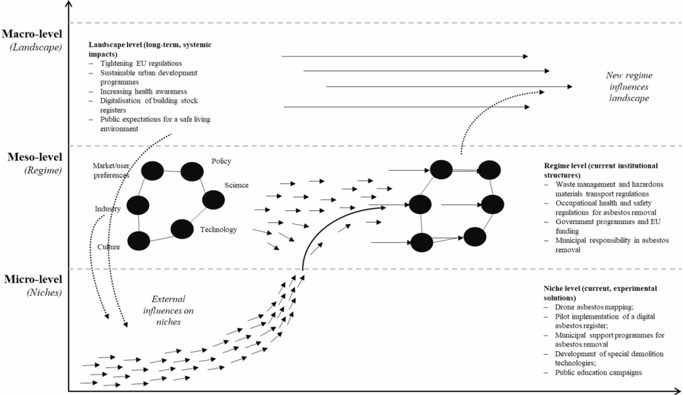
Verification
Claims the paper makes
0 Valid · 8 Not valid · 111 Not checked · 45 Own results and interpretations
In the paper
“Green financing initiatives, including government-backed subsidies and ESG (Environmental, Social, and Governance) investments, can help mitigate the financial burden on construction firms [35].”
What the sources say
- Not checked yetcites [35] Durrani N, Raziq A, Mahmood T, Khan MR. Barriers to adaptation of environmental sustainability in smes: a qualitative study. PLoS ONE. 2024;19:e0298580. https://doi.org/10.1371/journal.pone.0298580. source
plainstates a cause- Asserted: passes — The authors put it forward as true.
- Checkable: passes — It can be checked against evidence.
- Load-bearing: unclear — It is unclear whether the paper’s conclusions depend on it.
- Based: passes — The paper gives a reason why it holds.
In the paper
“Even when abatement measures, such as encapsulation or controlled removal, are implemented, the residual risks remain significant, particularly in aging infrastructure and inadequately regulated disposal sites [32].”
What the sources say
- Not checked yetcites [32] Nabango H, Majale C. Towards a circular economy: a review on asbestos waste management regulations in Kenya. East Afr J Environ Nat Resour. 2022;5:34–47. https://doi.org/10.37284/eajenr.5.1.548. source
plain- Asserted: passes — The authors put it forward as true.
- Checkable: passes — It can be checked against evidence.
- Load-bearing: passes — The paper’s conclusions depend on it.
- Based: passes — The paper gives a reason why it holds.
A conclusion the paper draws from its own results — it cites no other source for it, so there is none to check. The quote shows it is in the paper.
In the paper
“The systemic nature of asbestos-related risks underscores the challenges of reconciling sustainability with scenarios where environmental degradation is effectively irreversible without large-scale intervention.”
plainstates a cause- Asserted: passes — The authors put it forward as true.
- Checkable: unclear — It is unclear whether it could be checked against evidence.
- Load-bearing: unclear — It is unclear whether the paper’s conclusions depend on it.
- Based: passes — The paper gives a reason why it holds.
In the paper
“Unlike pollutants that can be effectively neutralized or biologically degraded, asbestos remains persistent once released into the environment [3].”
What the sources say
- Not checked yetcites [3] 3. Gualtieri AF. Naturally occurring asbestos: A global health concern? State of the Art and open issues. Environ Eng Geosci. 2020;26:3-8. https://doi.org/10.2113/EEG-2271. source
plain- Asserted: passes — The authors put it forward as true.
- Checkable: passes — It can be checked against evidence.
- Load-bearing: passes — The paper’s conclusions depend on it.
- Based: passes — The paper gives a reason why it holds.
In the paper
“The pervasive utilization of asbestos in industrial and construction settings has engendered long-term reliance [22].”
What the sources say
- Not checked yetcites [22] 22. Zimmer AT, Ha H. People, planet and profit: unintended consequences of legacy building materials. J Environ Manag. 2017;204:472-85. h t t p s : / / d o i . o r g / 1 0 . 1 0 1 6 / j . j e n v m a n . 2 0 1 7 . 0 9 . 0 2 6. source
plainstates a cause- Asserted: passes — The authors put it forward as true.
- Checkable: passes — It can be checked against evidence.
- Load-bearing: unclear — It is unclear whether the paper’s conclusions depend on it.
- Based: passes — The paper gives a reason why it holds.
59 more claims
Create a free account to see all 164 claims and to verify the 161 references still open.
- Probably not a substantial claim. 80
- It may state two separate claims as one. 41
Citations
Cites
Items 201–213 of 213
Detoxification of Asbestos and Recovery of Valuable Metals from Detoxified Asbestos
Hong, M. H., Choi, H. M., Yoon, J., & Kim, S. C. (2021) · Bulletin of the Korean Chemical Society · doi:10.1002/bkcs.12288 · Cited by 2 · cited 1×
“The regime encompasses key governmental agencies, regulatory bodies, industry actors, and professional associations that shape the prevailing discourse on urban safety, environmental sustainability, and public health regarding asbestos removal and mitigation [62, 180].”
Geiser, K. (2002) · NEW SOLUTIONS: A Journal of Environmental and Occupational Health Policy · doi:10.2190/nw04-ytll-c8pv-ufmh · Cited by 2
Ribeiro, L. A., Kunz, M., da Silva, T. L., & Benincá, L. (2020) · International Conference on Theory and Practice of Electronic Governance · doi:10.1145/3428502.3428602 · Cited by 2 · cited 1×
“Collaboration among stakeholders at this level is crucial for exchanging knowledge, reducing barriers, and accelerating the adoption of sustainable practices [121, 122].”
Sharma, D., Yadav, V., & Singh, D. (2023) · International Conference on Recent Advances in Science and Engineering (RAiSE) · doi:10.3390/engproc2023059098 · Cited by 1 · cited 1×
“Furthermore, innovative business models, such as product-service systems, can facilitate niche expansion by enabling companies to offer integrated demolition and asbestos-free reconstruction services, rather than merely selling materials [160, 161].”
Colding, J., Marcus, L., & Barthel, S. (2023) · Urban Transition - Perspectives on Urban Systems and Environments · doi:10.5772/intechopen.96642 · Cited by 1 · cited 1×
“However, external trends and outside factors play a key role in shaping asbestos-free urban transitions, showing the need to better incorporate the landscape level in these analyses [198, 199].”
Kropp, C., & Aicher, S. (2024) · TATuP - Zeitschrift für Technikfolgenabschätzung in Theorie und Praxis · doi:10.14512/tatup.7157 · Cited by 1 · cited 1×
“In the context of transitioning cities to be asbestos-free, niche innovations encompass novel asbestos-free construction materials, alternative demolition and waste management approaches, and policy-driven urban renewal initiatives [138, 139].”
Analysing formal transformations in sustainable urban structures in Kufa City, Iraq
Jedi, Z. A. J., & Al-Jawari, S. M. (2023) · Environmental & Socio-economic Studies · doi:10.2478/environ-2023-0011 · Cited by 1 · cited 1×
“Qualitative methods enable in-depth theoretical and conceptual investigation of transition processes [87, 88].”
Schmeller, D., & Sümeghy, D. (2024) · Regional Statistics · doi:10.15196/rs140201 · Cited by 1 · cited 1×
“For instance, studies on sustainable urban development have shown that grassroots initiatives focused on green architecture, circular construction methods, and policy-driven incentives play a vital role in transforming urban environments [107–110].”
Asbestos in Place: A Building Management Perspective
IRWIG, H. G., OLIVER, L. C., PAGE, T., WEGMAN, D. H., & ELLENBECKER, M. J. (1991) · Annals of the New York Academy of Sciences · doi:10.1111/j.1749-6632.1991.tb24510.x · Cited by 1
Proactive environmental management is the key to full compliance
Gallagher, T. P. (1991) · Environmental Quality Management · doi:10.1002/tqem.3310010107 · Cited by 1 · cited 1×
“Examining the influence of multifaceted elements on the transition to asbestos-free environments can bolster urban resilience and advance worldwide sustainability goals [58].”
Identification of Asbestos Content in Bulk Materials Imported in Nepal
Pathak, A., Giri, M., Pokhrel, B., & Wagle, M. N. (2020) · Scientific World · doi:10.3126/sw.v13i13.30481 · Cited by 1
Goforth, T., & Nock, D. (2021) · doi:10.21203/rs.3.rs-945021/v1 · Cited by 1 · cited 1×
“These considerations highlight the need for a comprehensive approach that goes beyond technical substitution to include social, economic, and political dimensions [211].”
Transitional Morphologies. Urban forms: Generation and Regeneration Processes. An Agenda
Trisciuoglio, M., Barosio, M., Ricchiardi, A., Tulumen, Z., Crapolicchio, M., & Gugliotta, R. (2021) · doi:10.20944/preprints202104.0037.v1
Cited by
Bódizs, D., Zseni, A., & Schmeller, D. (2026) · Energies · doi:10.3390/en19051128 · Cited by 3
Still killing millions by asbestos: global leadership and the urgent roadmap for actions
Aryal, A., Huang, Q., Chen, T., Meng, X., & Chhetri, T. B. (2026) · Journal of Public Health Policy · doi:10.1057/s41271-026-00632-x · Cited by 2
Narváez-Cuadro, M. A., Saba, M., Jiménez, L. F. T., Coronado-Hernández, Ó. E., & Sequeda-Sequeda, L. (2026) · Environments · doi:10.3390/environments13080451
“Although the health risks associated with airborne asbestos exposure are now well established, leading to restrictions or complete bans in many countries, millions of tons of asbestos-containing materials remain in service as part of existing urban infrastructure [5,6].”
Lefutso, D., Ogundeji, A. A., Nyam, Y. S., & Buthelezi, N. B. C. (2026) · International Journal of Disaster Risk Science · doi:10.1007/s13753-026-00767-1
“…has focused on the persistence of asbestos-containing materials, inventories, risk assessment, exposure pathways, occupational regulation, and waste disposal (Phillips et al. 2016; Thives et al. 2022; Frangioudakis Khatib et al. 2023; But-kevics and Atstaja 2025; Macher and Szigeti 2025).”
InfluentialAn ecosystem framework for municipal asbestos removal as a material legacy transition
Macher, G. Z. (2026) · Discover Sustainability · doi:10.1007/s43621-026-04247-w
“This characteristic challenges conventional transition models that emphasize niche innovation and market uptake, and instead calls for greater attention to governance capacity, public investment, and long-term stewardship of urban material stocks [49, 56].”
Self-citation
Metadata
- Authors
- Macher, G. Z., & Szigeti, C.
- Affiliations
- Széchenyi István University (HU)
- University of Applied Science Budapest (HU)
- Corresponding author
- Macher, Gergely Zoltán
- Venue
- Discover Sustainability
- Published
- 2025-09-29
- Volume
- 6
- Issue
- 1
- Pages
- 960
- ISSN
- 2662-9984 (ISSN-L)
- OpenAlex
- W4414592303
- Semantic Scholar
- e650941e984fa73961559cb8905bdd50c9b7b88d
- Cited by
- 8
- References
- 210
- Citations by year
- 2026: 7 · 2025: 1
- FWCI
- 1.78
- Type
- journal article
- Language
- en
- Open access
- gold
- doi.org
- Licence
- cc-by-nc-nd
- creativecommons.org/licenses/by-nc-nd/4.0 (tdm)
- creativecommons.org/licenses/by-nc-nd/4.0 (vor)
- Locations
- Discover Sustainability (publishedVersion, cc-by-nc-nd)
- DOAJ (DOAJ: Directory of Open Access Journals) (submittedVersion)
- Topics
- Physical Sciences › Environmental Science › Global and Planetary Change › Sustainability and Climate Change Governance
- Social Sciences › Urban Studies › Urban Planning and Governance
- Social Sciences › Sociology and Political Science › French Territorial Governance
- Keywords
- asbestos contamination, sustainability transitions, multi-level perspective, urban sustainability, socio-technical regimes, niche innovation, strong sustainability, urban policy, civil society, industry actors, hazardous waste management
About these checks
Registry, retraction, Cites and statistics results are computed, not judged, with one exception: a printed reference that no index lists is read once by a model before it counts as a citation error. Claims are extracted by a model and kept only when their quote appears verbatim in the text; each cited source is then checked, with a model’s help, for whether it says what the claim relies on. Those verdicts can be wrong — read the claim’s quote and the cited source before relying on one.
A language model drew the claims from the paper on 2026-11-26, under version 3 of the claim definition (model deepseek-v4.1-flash, prompt extract-v3).
A second model labelled each claim on 2026-11-26 (model jev-1.13-20260917, definition revision gold-guideline-v0.2).
Statistics and arithmetic are recomputed, not judged.
Confidence bands are shown only for fields calibrated on our annotated test set. None is calibrated yet, so no band is shown.
What counts as a claim ›How we measure confidence ›How we check this ›
Are you an author, or do you see a problem with this page? Request a review
Data sources
Bibliographic data: Semantic Scholar, OpenAlex, Crossref.
Contains information from the Semantic Scholar Academic Graph Datasets, made available under the ODC Attribution License (ODC-BY 1.0).
Semantic Scholar’s data is described in: Kinney, R., et al. (2023). The Semantic Scholar Open Data Platform. arXiv:2301.10140.
