

Air-breathing electric propulsion: mission characterization and design analysis
Open accessThe DOI matches its Crossref record; 23 of the 23 references it cites were found in a registry or an index.
Abstract
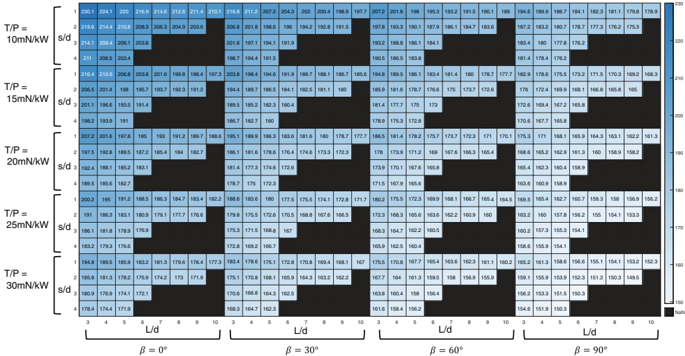
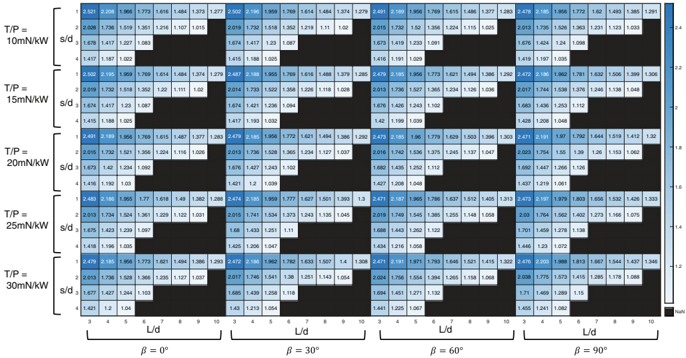
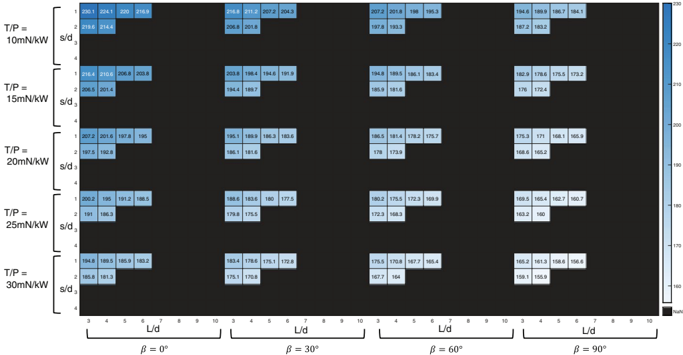
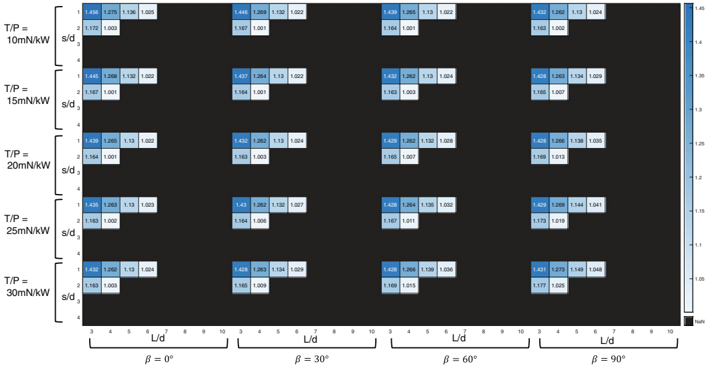
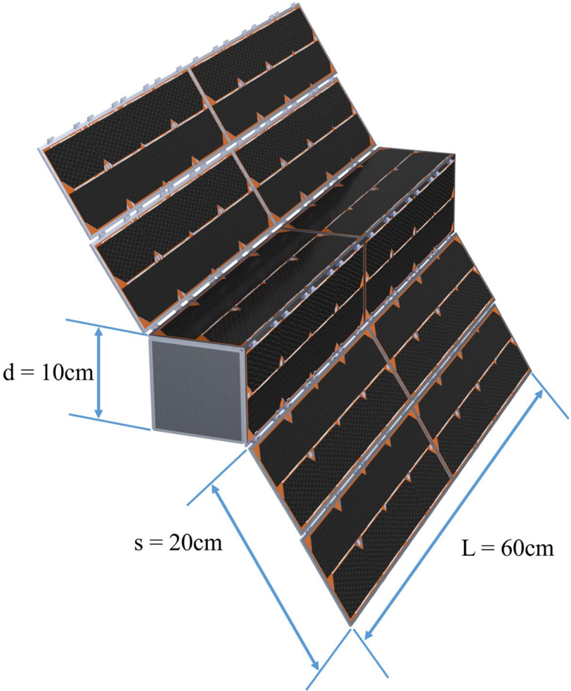
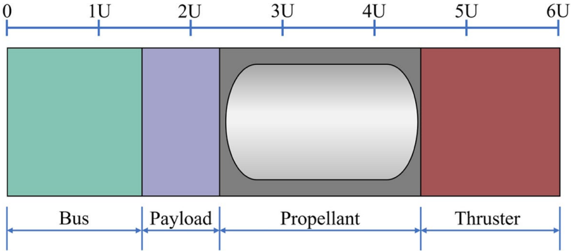
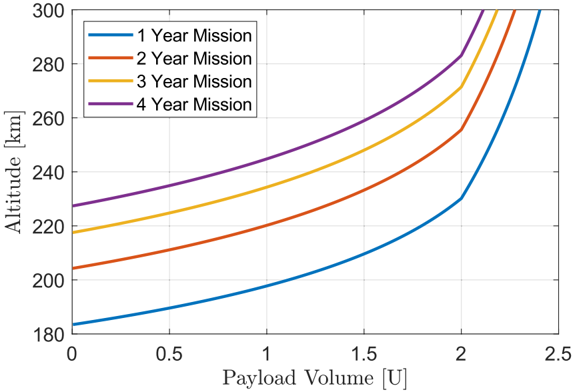
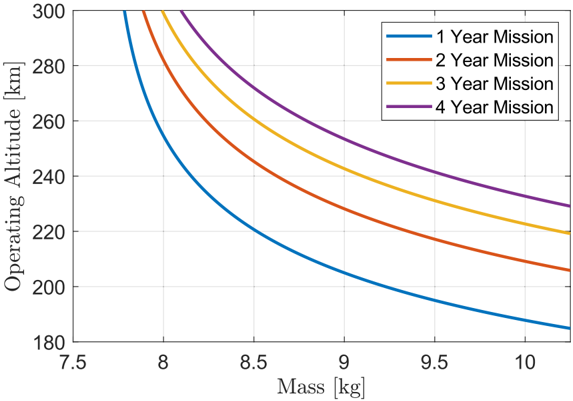
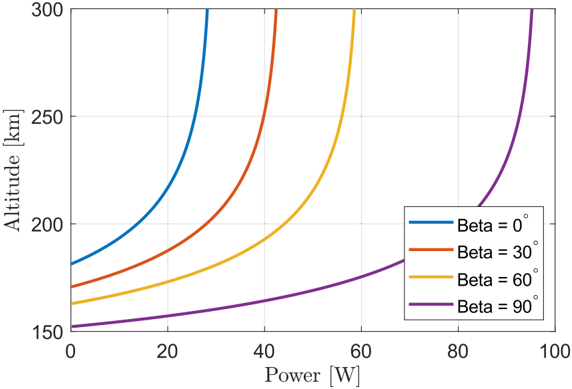
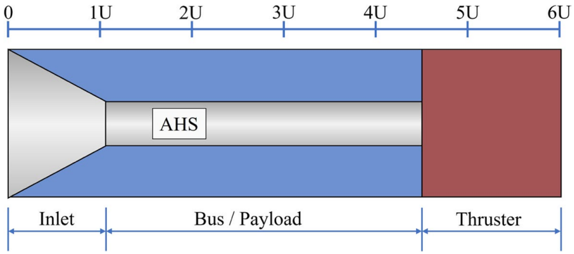
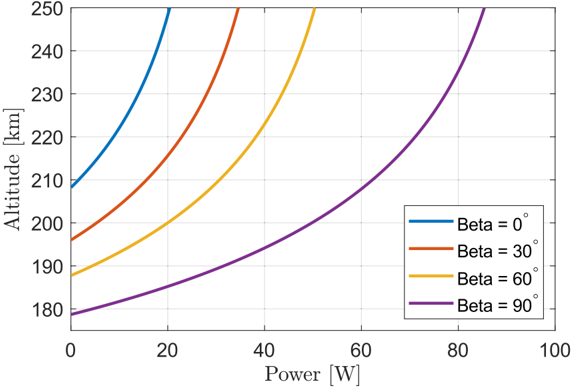
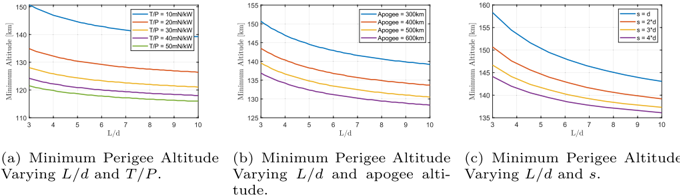
Air breathing electric propulsion (atmosphere-breathing electric propulsion) (ABEP) has attracted significant interest as an enabling technology for long duration space missions in very low Earth orbit (VLEO) altitudes below about 300 km. The ABEP spacecraft and mission analysis model developed allows parametric characterization of key spacecraft geometry and thruster performance parameters such as spacecraft length-to-diameter, the ratio of solar array span to spacecraft diameter, thrust-to-power, effective exhaust velocity, and inlet efficiency. For the missions analyzed ABEP generally outperforms conventional electric propulsion (EP) below 250 km altitude. Using a 6U spacecraft architecture the model shows that below 220 km ABEP is the only viable propulsion option for desirable mission lifetimes. Parametric evaluations of key spacecraft and ABEP characteristics show that the most significant technological improvements to ABEP spacecraft performance and range of applicability for VLEO missions will come from advancements in inlet efficiency, low drag materials, solar array efficiency, and thrust-to-power.
Overview
The claims and statistics of this paper haven’t been checked yet.
Free: it reads the open-access text and checks the first 5 claims that cite a source we can check. Create a free account to check every claim.
Integrity signals
Registry
Cites
Statistics
Figures
Verification
Claims the paper makes
The claims and statistics of this paper haven’t been checked yet.
Free: it reads the open-access text and checks the first 5 claims that cite a source we can check. Create a free account to check every claim.
Claims other papers make about this one
Each is checked against this paper’s own text: does it say what the citing paper says it does?
The source backs part of the claim, not all of it — or backs it for a different population, condition or comparison.
In the citing paper
“Due to illumination constraints, a minimum orbit inclination of 30 • seemed feasible depending on ABEP performance.”
From A review of air-breathing electric propulsion: from mission studies to technology verification (2022) · cites this paper as [53]
Experimental — accuracy not yet measuredThe cited source says what the claim attributes to it.
In the citing paper
“For mission durations above 3 years and altitudes below 240 km, the study also shows how ABEP would offer substantial volume savings for payload allocation compared to traditional EP with on-board propellant.”
From A review of air-breathing electric propulsion: from mission studies to technology verification (2022) · cites this paper as [53]
In the citing paper
“In general, it was showed how the minimum ABEP operating altitude is decreased for larger thrust to power ratios, and that larger ABEP specific impulses and aspect ratios are favorable.”
From A review of air-breathing electric propulsion: from mission studies to technology verification (2022) · cites this paper as [53]
Self-check
Percentages, sums and reported differences re-computed from the paper’s own numbers.
The self-check needs the paper’s full text.
Citations
Cites
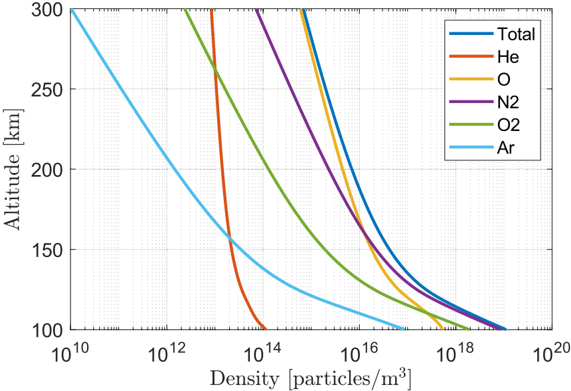
NRLMSISE‐00 empirical model of the atmosphere: Statistical comparisons and scientific issues
Picone, J. M., Hedin, A. E., Drob, D. P., & Aikin, A. C. (2002) · Journal of Geophysical Research: Space Physics · doi:10.1029/2002ja009430 · Cited by 3,749
The benefits of very low earth orbit for earth observation missions
Crisp, N. H., Roberts, P. C. E., Livadiotti, S., Oiko, V. T. A., Edmondson, S., Haigh, S. J., Huyton, C., Sinpetru, L. A., Smith, K. L., Worrall, S. D., et al. (2020) · Progress in Aerospace Sciences · doi:10.1016/j.paerosci.2020.100619 · Cited by 255 · cited 1×
“sensors, and the possibility of using aerodynamic surfaces for orbital maneuvers, attitude control, and momentum wheel desaturation [1].”
BackgroundPanton, R. L. (2013) · Wiley eBooks · doi:10.1002/9781118713075 · Cited by 253
FREE MOLECULE FLOW THEORY AND ITS APPLICATION TO THE DETERMINATION OF AERODYNAMIC FORCES
SENTMAN, L. H. (1961) · doi:10.21236/ad0265409 · Cited by 200
Semiempirical Model for Satellite Energy-Accommodation Coefficients
Pilinski, M. D., Argrow, B. M., & Palo, S. E. (2010) · Journal of Spacecraft and Rockets · doi:10.2514/1.49330 · Cited by 134
Drag and energy accommodation coefficients during sunspot maximum
Pardini, C., Anselmo, L., Moe, K., & Moe, M. M. (2009) · Advances in Space Research · doi:10.1016/j.asr.2009.08.034 · Cited by 121
Intake design for an Atmosphere-Breathing Electric Propulsion System (ABEP)
Romano, F., Espinosa-Orozco, J., Pfeiffer, M., Herdrich, G., Crisp, N. H., Roberts, P. C. E., Holmes, B. E. A., Edmondson, S., Haigh, S., Livadiotti, S., et al. (2021) · Acta Astronautica · doi:10.1016/j.actaastro.2021.06.033 · Cited by 95 · cited 2×
“Collimatoraccumulator type inlets have been proposed in literature with ηin ranging from 20% to > 45% [30, 31].”
BackgroundMethodAnalysis of atmosphere-breathing electric propulsion
Schonherr, T., Komurasaki, K., Romano, F., Massuti-Ballester, B., & Herdrich, G. (2015) · IEEE Transactions on Plasma Science · doi:10.1109/tps.2014.2364053 · Cited by 84 · cited 1×
“Current air-breathing gridded ion thrusters achieve T/P = 10 mN/kW, inductive plasma thrusters can achieve T/P = 20 mN/kW [8, 50], and current air-breathing HET thrusters can achieve T/P = 30 mN/kW [10].”
BackgroundSolar cycle effects on the upper atmosphere - Implications for satellite drag
Walterscheid, R. L. (1989) · Journal of Spacecraft and Rockets · doi:10.2514/3.26089 · Cited by 83
Tisaev, M., Ferrato, E., Giannetti, V., Paissoni, C., Baresi, N., Lucca Fabris, A., & Andreussi, T. (2022) · Acta Astronautica · doi:10.1016/j.actaastro.2021.11.011 · Cited by 64
A comprehensive review of atmosphere-breathing electric propulsion systems
Zheng, P., Wu, J., Zhang, Y., & Wu, B. (2020) · International Journal of Aerospace Engineering · doi:10.1155/2020/8811847 · Cited by 61 · cited 1×
“Multiple organizations are currently developing ABEP technologies based on a variety of EP devices [6].”
BackgroundAerodynamic Disturbances on Spacecraft in Free-Molecular Flow
Storch, J. A. (2002) · doi:10.21236/ada410696 · Cited by 57
Crisp, N. H., Roberts, P. C. E., Livadiotti, S., Macario Rojas, A., Oiko, V. T. A., Edmondson, S., Haigh, S. J., Holmes, B. E. A., Sinpetru, L. A., Smith, K. L., et al. (2021) · Acta Astronautica · doi:10.1016/j.actaastro.2020.12.024 · Cited by 56
Recommended Drag Coefficients for Aeronomic Satellites
Moe, M. M., Wallace, S., & Moe, K. (2011) · Geophysical monograph · doi:10.1029/gm087p0349 · Cited by 48
Design and analysis of vacuum air-intake device used in air-breathing electric propulsion
Li, Y., Chen, X., Li, D., Xiao, Y., Dai, P., & Gong, C. (2015) · Vacuum · doi:10.1016/j.vacuum.2015.06.011 · Cited by 46 · cited 1×
“While active inlets have been shown to achieve high ηin and high compression ratio, passive inlets are more widely covered in the literature; thus, this analysis will be limited to passive inlets [28, 29].”
BackgroundAir Intake Performance of Air Breathing Ion Engines
Fujita, K. (2004) · Journal of the Japan Society for Aeronautical and Space Sciences · doi:10.2322/jjsass.52.514 · Cited by 46 · cited 1×
“ABEP designs with no direct line-of-sight from the inlet through the thruster, such as the JAXA design described in [7], have Θ = 0.”
MethodDesign and Optimization of vacuum Intake for Atmosphere-Breathing electric propulsion (ABEP) system
Zheng, P., Wu, J., Zhang, Y., & Zhao, Y. (2022) · Vacuum · doi:10.1016/j.vacuum.2021.110652 · Cited by 34 · cited 2×
“Collimatoraccumulator type inlets have been proposed in literature with ηin ranging from 20% to > 45% [30, 31].”
BackgroundMethodBinder, T., Boldini, P. C., Romano, F., Herdrich, G., & Fasoulas, S. (2016) · AIP Conference Proceedings · doi:10.1063/1.4967689 · Cited by 29 · cited 3×
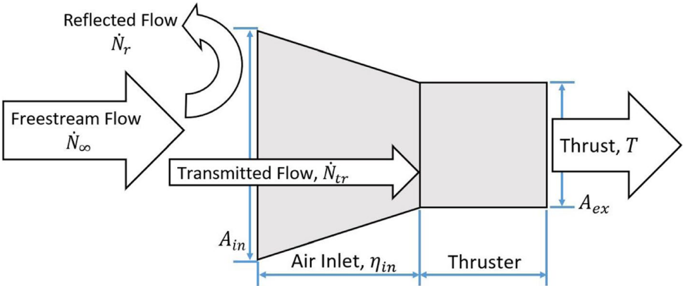
“The inlet efficiency ηin is defined as the ratio of incident mass flux that is transmitted through the inlet to the propulsion system [27]: The incident mass flux not transmitted through the inlet, Ṅreflected is reflected back out of the front of the inlet.”
BackgroundRarefied Flow Simulation of Conical Intake and Plasma Thruster for Very Low Earth Orbit Spaceflight
Ferrato, E., Giannetti, V., Tisaev, M., Lucca Fabris, A., Califano, F., & Andreussi, T. (2022) · Frontiers in Physics · doi:10.3389/fphy.2022.823098 · Cited by 27
The Deorbiting of ESA’s Gravity Mission GOCE - Spacecraft Operations in Extreme Drag Conditions
Steiger, C., Romanazzo, M., Emanuelli, P. P., Floberghagen, R., & Fehringer, M. (2014) · SpaceOps 2014 Conference · doi:10.2514/6.2014-1934 · Cited by 23
Design of an Air-Breathing Electric Thruster for CubeSat Applications
Jackson, S. W. (2017) · CU Scholar (University of Colorado Boulder) · doi:10.13140/rg.2.2.34587.57124 · Cited by 18
Maintaining continuous low orbit flight by using in-situ atmospheric gases for propellant
Young, M. (2001) · AIP conference proceedings · doi:10.1063/1.1407646 · Cited by 5
Parametric Analysis of High-Delta-V CubeSat Missions with a Miniature Ion Thruster
Samples, S., & Wirz, R. E. (2021) · Journal of Spacecraft and Rockets · doi:10.2514/1.a34827 · Cited by 5
Self-citation
Research works printed but not linked: 14
- Lotz B (2013) Plasma physical and material physical aspects of the application of atmospheric gases as a propellant for ion-thruster of the rit-type. Dissertation, University of Giessen, Gießen.
- Shabshelowitz A (2013) Study of rf plasma technology applied to air-breathing electric propulsion. Dissertation, University of Michigan, Ann Arbor.
- Andreussi T, Cifali G, Giannetti V, Piragino A, Ferrato E, Rossodivita A, Andrenucci M (2017) Development and experi- mental validation of a hall effect thruster ram-ep concept In: 35th International Electric Propulsion Conference, IEPC-2017-377. Electric Rocket Propulsion Society, Cleveland.
- Parodi P (2019) Analysis and simulation of an intake for air-breathing electric propulsion systems. Dissertation, University of Pisa, Pisa.
- Cara DD, del Amo JG, Santovincenzo A, Dominguez BC, Arcioni M, Caldwell A, Roma I (2007) Ram electric propulsion for low earth orbit operation: an esa study In: 30th International Electric Propulsion Conference, 2007-162. Univer- sity of Pisa, Pisa.
- Singh LA (2014) Very low earth orbit propellant collection feasibility assessment. Dissertation, Georgia Institute of Technology, Atlanta.
- Ferrato E, Giannetti V, Piragino A, Andrenucci M, Andreussi T (2019) Development roadmap of sitael's ram-ep system In: 36th International Electric Propulsion Conference, IEPC-2019-886. Electric Rocket Propulsion Society, Cleveland.
- Vallado DA (2007) Fundamentals of Astrodynamics and Applications. Microcosm Press, Torrance. 20. (1976)
- Cefola P, Volkov II, Suevalov VV (2008) Description of the Russian Upper Atmosphere Density Model GOST-2004 In: 37th COSPAR Scientific Assembly, vol. 37, 476. European Space Agency, Paris.
- Romano F, Binder T, Herdrich G, Fasoulas S (2015) Air-intake design investigation for an air-breathing electric propul- sion system In: 34th International Electric Propulsion Conference. Electric Rocket Propulsion Society, Cleveland.
- Parodi P, Quang DL, Bariselli F (2019) Study of a collector-intake system for vleo air-breathing platforms In: Inter- national Conference on Flight Vehicles, Aerothermodynamics and Re-entry Missions and Engineering (FAR). ESA Conference Bureau, Noordwijk.
- Prasanth P, Kakkassery J (2006) Direct simulation monte carlo (dsmc): A numerical method for transition-regime flows -a review. J Indian Inst Sci 86:169.
- Andreussi T, Ferrato E, Piragino A, Cifali G, Rossodivita A, Andrenucci M (2018) Development and experimental vali- dation of a hall effect thruster ram-ep concept In: 35th International Electric Propulsion Conference 2017. Electric Rocket Propulsion Society, Cleveland.
- Wertz JR, Larson WJ (1999) Space Mission Analysis and Design (Space Technology Library). Springer, Netherlands.
Cited by
A review of air-breathing electric propulsion: from mission studies to technology verification
Andreussi, T., Ferrato, E., & Giannetti, V. (2022) · Journal of Electric Propulsion · doi:10.1007/s44205-022-00024-9 · Cited by 94
“[53, 62, 63] extended the analysis to more general spacecraft geometries (including cubesats) and orbits, as the previous studies were mainly focused on dawn-dusk SSO orbits due to its favorable illumination conditions.”
BackgroundSecrecy-Rate Optimization of Double RIS-Aided Space–Ground Networks
Hoang, T. M., Xu, C., Vahid, A., Tuan, H. D., Duong, T. Q., & Hanzo, L. (2023) · IEEE Internet of Things Journal · doi:10.1109/jiot.2023.3262481 · Cited by 41
Giannetti, V., Ferrato, E., & Andreussi, T. (2024) · Acta Astronautica · doi:10.1016/j.actaastro.2024.04.042 · Cited by 19
“The investigated concepts primarily focus on operations in sun-synchronous orbits at altitudes below 250 km, with a lifespan of several years, a spacecraft mass ranging from 100 kg to 1000 kg, and available power from solar arrays in the range of 0.3 kW to 3 kW [13,15–25].”
InfluentialKo, Y., Kim, S., Moon, G., Yi, M., Park, K., Kim, Y., & Jun, E. (2023) · Acta Astronautica · doi:10.1016/j.actaastro.2023.07.043 · Cited by 19
Deflagration thruster for air-breathing electric propulsion in very low Earth orbit
Subhankar, V. S., Prathivadi, K. P., & Underwood, T. C. (2024) · Acta Astronautica · doi:10.1016/j.actaastro.2023.12.048 · Cited by 12
Metadata
- Authors
- Crandall, P., & Wirz, R. E.
- Affiliations
- University of California, Los Angeles (US)
- Corresponding author
- Crandall, Patrick
- Wirz, Richard E.
- Venue
- Journal of Electric Propulsion
- Published
- 2022-09-26
- Volume
- 1
- Issue
- 1
- ISSN
- 2731-4596 (ISSN-L)
- OpenAlex
- W4297224468
- Cited by
- 28
- References
- 23
- Citations by year
- 2026: 12 · 2025: 5 · 2024: 5 · 2023: 5 · 2022: 1
- FWCI
- 1.09
- Type
- journal article
- Language
- en
- Open access
- hybrid
- doi.org
- Licence
- cc-by
- creativecommons.org/licenses/by/4.0 (tdm)
- creativecommons.org/licenses/by/4.0 (vor)
- Locations
- Journal of Electric Propulsion (publishedVersion, cc-by)
- Funders
- Air Force Office of Scientific Research (FA9550-21-1-0067)
- The Aerospace Corporation (University Partnership Program 4600007031)
- Topics
- Physical Sciences › Engineering › Electrical and Electronic Engineering › Low-Pressure Plasma Processing and Diagnostics
- Physical Sciences › Engineering › Aerospace Engineering › Spacecraft Design and Technology
- Physical Sciences › Engineering › Aerospace Engineering › Space Satellite Systems and Control
- Keywords
- air-breathing electric propulsion, atmosphere-breathing electric propulsion, very low Earth orbit, spacecraft design, inlet efficiency, long-duration spaceflight
About these checks
Registry, retraction, Cites and statistics results are computed, not judged, with one exception: a printed reference that no index lists is read once by a model before it counts as a citation error. Claims are extracted by a model and kept only when their quote appears verbatim in the text; each cited source is then checked, with a model’s help, for whether it says what the claim relies on. Those verdicts can be wrong — read the claim’s quote and the cited source before relying on one.
Statistics and arithmetic are recomputed, not judged.
Confidence bands are shown only for fields calibrated on our annotated test set. None is calibrated yet, so no band is shown.
What counts as a claim ›How we measure confidence ›How we check this ›
Are you an author, or do you see a problem with this page? Request a review
Data sources
Bibliographic data: Semantic Scholar, OpenAlex, Crossref.
Contains information from the Semantic Scholar Academic Graph Datasets, made available under the ODC Attribution License (ODC-BY 1.0).
Semantic Scholar’s data is described in: Kinney, R., et al. (2023). The Semantic Scholar Open Data Platform. arXiv:2301.10140.
