

The DOI matches its Crossref record; 77 of the 77 references it cites were found in a registry or an index.
Molecular and epigenetic pathogenesis of germ cell tumors
Open accessAbstract
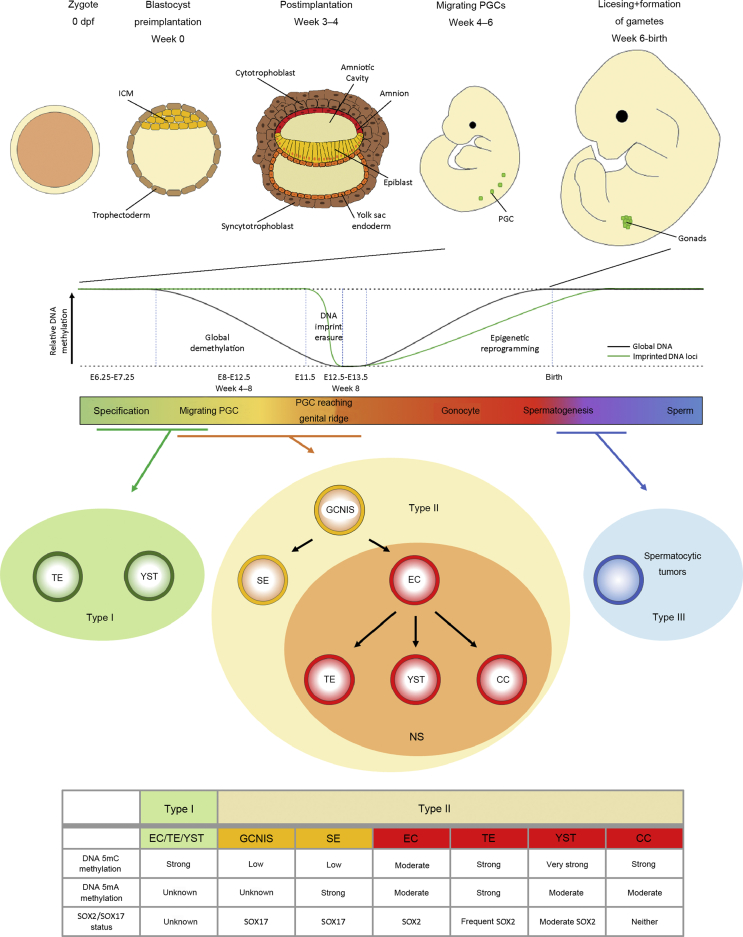
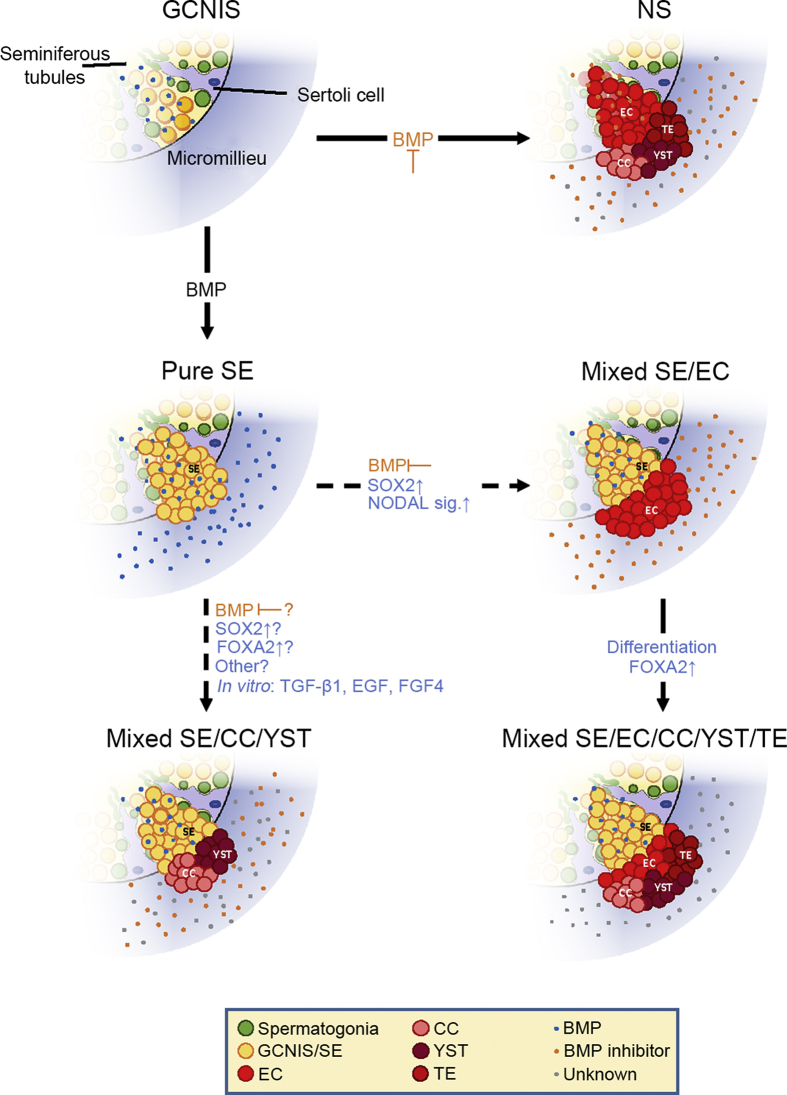
The development of germ cell tumors (GCTs) is a unique pathogenesis occurring at an early developmental stage during specification, migration or colonization of primordial germ cells (PGCs) in the genital ridge. Since driver mutations could not be identified so far, the involvement of the epigenetic machinery during the pathogenesis seems to play a crucial role. Currently, it is investigated whether epigenetic modifications occurring between the omnipotent two-cell stage and the pluripotent implanting PGCs might result in disturbances eventually leading to GCTs. Although progress in understanding epigenetic mechanisms during PGC development is ongoing, little is known about the complete picture of its involvement during GCT development and eventual classification into clinical subtypes. This review will shed light into the current knowledge of the complex epigenetic and molecular contribution during pathogenesis of GCTs by emphasizing on early developmental stages until arrival of late PGCs in the gonads. We questioned how misguided migrating and/or colonizing PGCs develop to either type I or type II GCTs. Additionally, we asked how pluripotency can be regulated during PGC development and which epigenetic changes contribute to GCT pathogenesis. We propose that SOX2 and SOX17 determine either embryonic stem cell-like (embryonal carcinoma) or PGC-like cell fate (seminoma). Finally, we suggest that factors secreted by the microenvironment, i.e. BMPs and BMP inhibiting molecules, dictate the fate decision of germ cell neoplasia in situ (into seminoma and embryonal carcinoma) and seminomas (into embryonal carcinoma or extraembryonic lineage), indicating an important role of the microenvironment on GCT plasticity.
Overview
The claims and statistics of this paper haven’t been checked yet.
Run the check — free, no account needed. It reads the open-access text and checks the sources it cites.
Integrity signals
Registry
Cites
Statistics
Figures
Verification
Claims the paper makes
The claims and statistics of this paper haven’t been checked yet.
Run the check — free, no account needed. It reads the open-access text and checks the sources it cites.
Claims other papers make about this one
Each is checked against this paper’s own text: does it say what the citing paper says it does?
The source backs part of the claim, not all of it — or backs it for a different population, condition or comparison.
In the citing paper
“In TGCTs, the relationship between malignant cells and the surrounding tumor microenvironment (TME) seems to play an important role in the disruption of this balance [16,17,18,19].”
From The Immune Landscape and Immunotherapeutic Strategies in Platinum-Refractory Testicular Germ Cell Tumors (2024) · cites this paper as [19]
Experimental — accuracy not yet measured
Self-check
Percentages, sums and reported differences re-computed from the paper’s own numbers.
The self-check needs the paper’s full text.
Citations
Cites
Takahashi, K., & Yamanaka, S. (2006) · Cell · doi:10.1016/j.cell.2006.07.024 · Cited by 26,673
Skakkebæk, N. E., Rajpert-De Meyts, E., & Main, K. M. (2001) · Human Reproduction · doi:10.1093/humrep/16.5.972 · Cited by 2,260
G-protein-coupled receptors and cancer
Dorsam, R. T., & Gutkind, J. S. (2007) · Nature reviews. Cancer · doi:10.1038/nrc2069 · Cited by 1,456
Reconstitution of the Mouse Germ Cell Specification Pathway in Culture by Pluripotent Stem Cells
Hayashi, K., Ohta, H., Kurimoto, K., Aramaki, S., & Saitou, M. (2011) · Cell · doi:10.1016/j.cell.2011.06.052 · Cited by 1,379
N6-methyladenosine modification destabilizes developmental regulators in embryonic stem cells
Wang, Y., Li, Y., Toth, J. I., Petroski, M. D., Zhang, Z., & Zhao, J. C. (2014) · Nature Cell Biology · doi:10.1038/ncb2902 · Cited by 1,290
Schwartz, S., Mumbach, M. R., Jovanovic, M., Wang, T., Maciag, K., Bushkin, G. G., Mertins, P., Ter-Ovanesyan, D., Habib, N., Cacchiarelli, D., et al. (2014) · Cell Reports · doi:10.1016/j.celrep.2014.05.048 · Cited by 1,216
m6A RNA Modification Controls Cell Fate Transition in Mammalian Embryonic Stem Cells
Batista, P. J., Molinie, B., Wang, J., Qu, K., Zhang, J., Li, L., Bouley, D. M., Lujan, E., Haddad, B., Daneshvar, K., et al. (2014) · Cell Stem Cell · doi:10.1016/j.stem.2014.09.019 · Cited by 1,203
Testicular germ-cell tumours in a broader perspective
Oosterhuis, J. W., & Looijenga, L. H. J. (2005) · Nature Reviews Cancer · doi:10.1038/nrc1568 · Cited by 916
Epigenetic events in mammalian germ-cell development: reprogramming and beyond
Sasaki, H., & Matsui, Y. (2008) · Nature Reviews Genetics · doi:10.1038/nrg2295 · Cited by 871
SOX17 Is a Critical Specifier of Human Primordial Germ Cell Fate
Irie, N., Weinberger, L., Tang, W. W. C., Kobayashi, T., Viukov, S. V., Manor, Y. S., Dietmann, S., Hanna, J. H., & Surani, M. A. (2014) · Cell · doi:10.1016/j.cell.2014.12.013 · Cited by 864
Cited by
Skowron, M. A., Eul, K., Stephan, A., Ludwig, G. F., Wakileh, G. A., Bister, A., Söhngen, C., Raba, K., Petzsch, P., Poschmann, G., et al. (2022) · Molecular Oncology · doi:10.1002/1878-0261.13282 · Cited by 20
Self-citationEvmorfopoulos, K., Marsitopoulos, K., Karachalios, R., Karathanasis, A., Dimitropoulos, K., Tzortzis, V., Zachos, I., & Vlachostergios, P. J. (2024) · Cancers · doi:10.3390/cancers16020428 · Cited by 11
“In TGCTs, the relationship between malignant cells and the surrounding tumor microenvironment (TME) seems to play an important role in the disruption of this balance [16–19].”
Background
Metadata
- Authors
- Müller, M. R., Skowron, M. A., Albers, P., & Nettersheim, D.
- Affiliations
- Düsseldorf University Hospital (DE)
- Corresponding author
- Nettersheim, Daniel
- Venue
- Asian Journal of Urology
- Publisher
- Elsevier BV
- Published
- 2021-04
- Volume
- 8
- Issue
- 2
- Pages
- 144-154
- ISSN
- 2214-3882 (ISSN-L)
- PMC
- PMC8099689
- OpenAlex
- W3030743858
- Cited by
- 50
- References
- 77
- Citations by year
- 2026: 11 · 2025: 8 · 2024: 11 · 2023: 10 · 2022: 7 · 2021: 3
- FWCI
- 1.13
- Type
- journal article
- Language
- en
- Open access
- diamond
- doi.org
- Licence
- cc-by-nc-nd
- www.elsevier.com/tdm/userlicense/1.0/ (tdm)
- www.elsevier.com/legal/tdmrep-license (tdm)
- creativecommons.org/licenses/by-nc-nd/4.0/ (vor)
- Locations
- Asian journal of urology (publishedVersion, cc-by-nc-nd)
- PubMed Central (publishedVersion, cc-by-nc-nd)
- PubMed (publishedVersion)
- DOAJ (DOAJ: Directory of Open Access Journals) (submittedVersion, cc-by-sa)
- Topics
- Health Sciences › Medicine › Surgery › Testicular diseases and treatments
- Life Sciences › Biochemistry, Genetics and Molecular Biology › Molecular Biology › Epigenetics and DNA Methylation
- Health Sciences › Medicine › Reproductive Medicine › Sperm and Testicular Function
- Keywords
- germ cell tumors, primordial germ cells, epigenetic modifications, SOX2, SOX17, embryonal carcinoma, seminoma, germ cell neoplasia in situ, BMP signaling, tumor microenvironment, pluripotency regulation, germ cell migration, tumor plasticity
About these checks
Registry, retraction, Cites and statistics results are computed, not judged, with one exception: a printed reference that no index lists is read once by a model before it counts as a citation error. Claims are extracted by a model and kept only when their quote appears verbatim in the text; each cited source is then checked, with a model’s help, for whether it says what the claim relies on. Those verdicts can be wrong — read the claim’s quote and the cited source before relying on one.
Statistics and arithmetic are recomputed, not judged.
Confidence bands are shown only for fields calibrated on our annotated test set. None is calibrated yet, so no band is shown.
What counts as a claim ›How we measure confidence ›How we check this ›
Are you an author, or do you see a problem with this page? Request a review
How to cite
Cite CoChat for the checks on this page, and the paper for its own findings.
- This page
- CoChat. (2026). Citation check: Molecular and epigenetic pathogenesis of germ cell tumors. https://app.cochat.ai/papers/10.1016/j.ajur.2020.05.009
- The paper
- Müller, M. R., Skowron, M. A., Albers, P., & Nettersheim, D. (2021). Molecular and epigenetic pathogenesis of germ cell tumors. Asian Journal of Urology. https://doi.org/10.1016/j.ajur.2020.05.009
Data sources
Bibliographic data: Semantic Scholar, OpenAlex, Crossref.
Contains information from the Semantic Scholar Academic Graph Datasets, made available under the ODC Attribution License (ODC-BY 1.0).
Semantic Scholar’s data is described in: Kinney, R., et al. (2023). The Semantic Scholar Open Data Platform. arXiv:2301.10140.
