

The effect of artificial light at night on sea turtle hatchling early dispersal: A systematic review of methods, impacts and findings
Open accessThe DOI matches its Crossref record; 124 of the 129 references it cites were found in a registry or an index, and 1 are not checked yet; none of the 176 sources its claims cite is checked for support yet.
Abstract
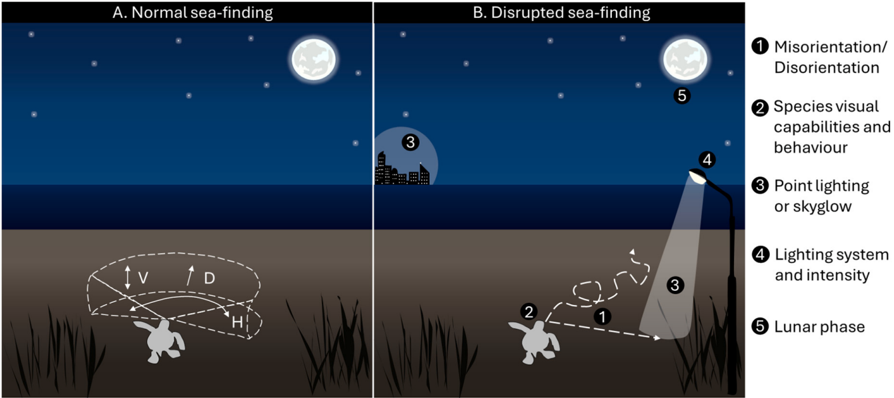
Artificial light at night (ALAN) is a rapidly expanding pollutant, raising concerns about its impact on species that rely on natural light cues for critical behaviours, such as for sea turtle early dispersal. After emergence, sea turtle hatchlings orient themselves using natural light cues to quickly crawl to the ocean (sea-finding) and swim offshore. Numerous studies have shown that artificial light disrupts their capacity to orient during their early dispersal with varying consequences, although variability exists in the methodologies used and the results. Here, we systematically reviewed the literature (74 publications) to summarise the methods and findings on the impacts of ALAN on sea turtle hatchlings during early dispersal. The review highlights key findings on how hatchling orientation during early dispersal is disrupted by different light types, light intensity, and distance to the light source. We review the visual capabilities of sea turtles and relate this ability to their behavioural attraction to different light types. Additionally, we discuss the availability of empirical evidence for energetic, behavioural, and physiological costs and consequences of disrupted orientation, along with management strategies that have been proposed to reduce the risk posed by ALAN. We conclude that more studies measuring the consequences of disrupted orientation are required to determine the long-term impacts of artificial lighting for turtle populations. Further, we suggest that research move towards identifying light intensity thresholds for artificial lights of different spectra and develop light exclusion zones to assist with management and promote best practice for lighting in coastal areas to protect these endangered species.
Checked 2026-11-24 · 1 reference not checked yet
Overview
CoChat Summary
TL;DR
This systematic review synthesizes 74 publications on how artificial light at night (ALAN) affects sea turtle hatchling early dispersal, covering visual capabilities, orientation disruption, costs, and management. It finds short-wavelength and broad-spectrum lights are most disruptive, while major gaps remain in light thresholds, skyglow, physiological costs, and species/geographic coverage.
Key findings
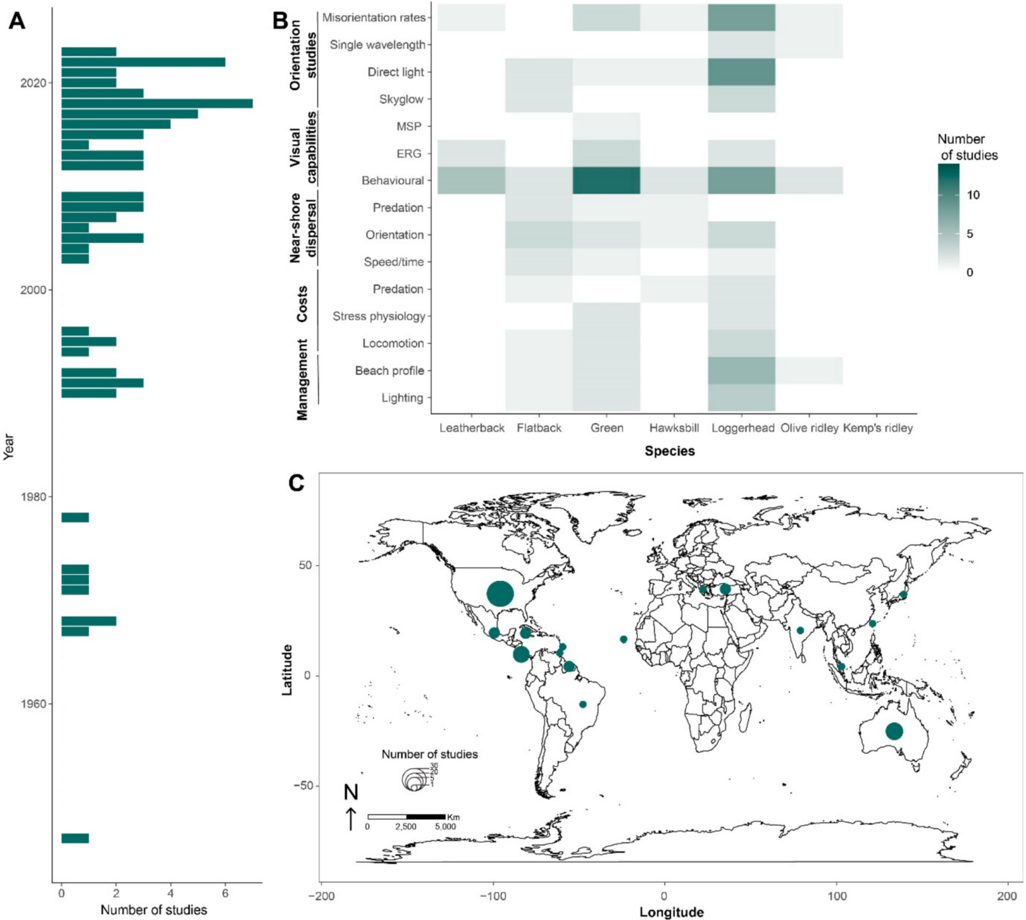
- Across 74 studies (1947–2023; 74% published since 2000), ALAN disrupts both sea-finding and nearshore dispersal. Onshore misorientation rates ranged from 2.9% to 62% (typical 10–20%), while nearshore studies reported misorientation rates of 20–80% of hatchlings.
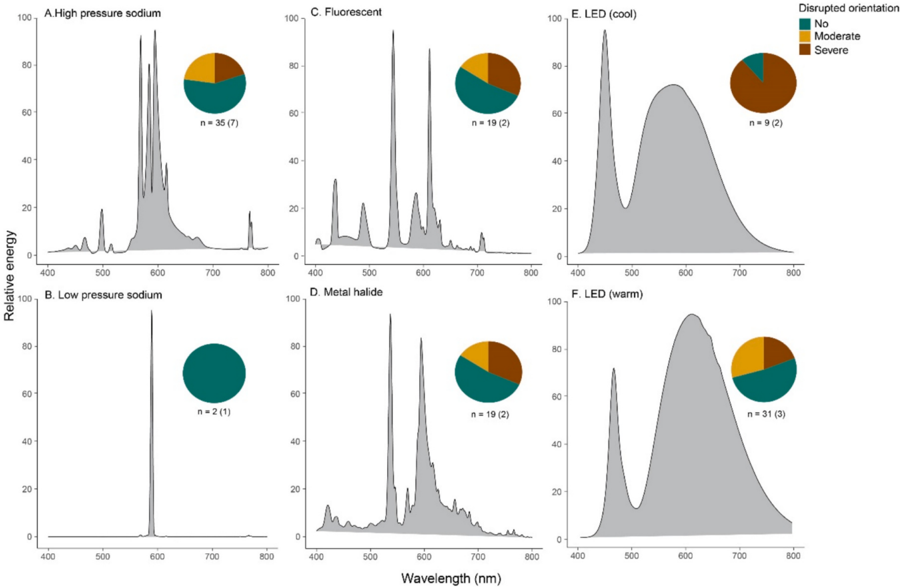
- Light type matters: low-pressure sodium (LPS) had no reported misorientation (n = 2 independent responses), metal halide (MH) showed moderate/severe misorientation in 45% of cases (9/20), and cool LEDs showed misorientation in 90% of trials (9/10).
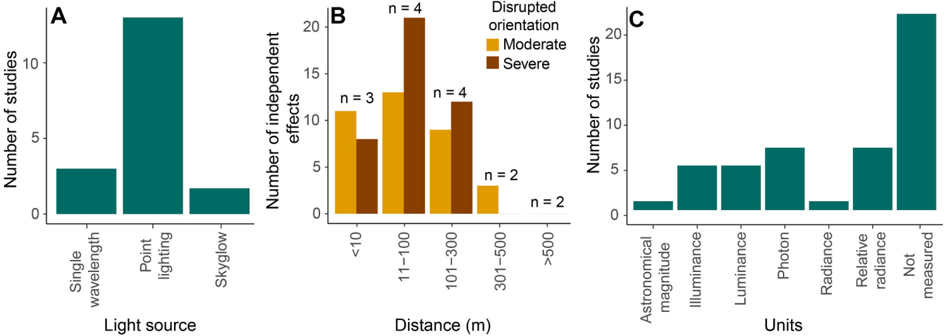
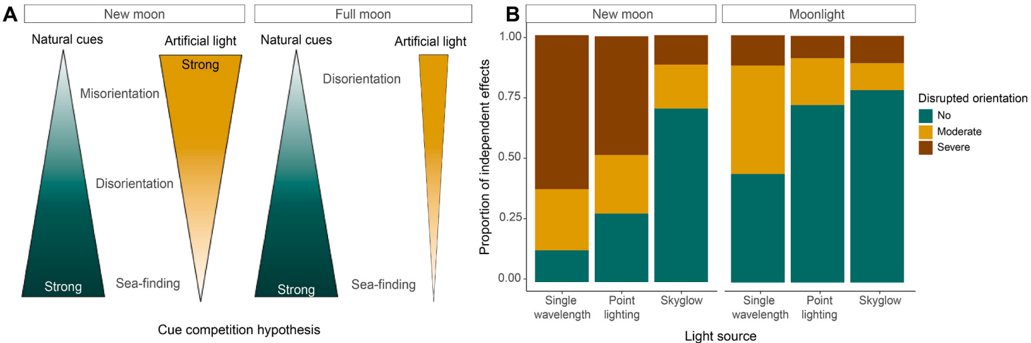
- Sea-finding was tested with lights at a mean distance of 164.8 m (median = 55 m, range = 1.5–800 m); no disrupted orientation was found beyond 500 m in the two studies testing that distance. Point-light disruption was reported in 29% of trials under moonlight versus 62% under new moon; skyglow disruption was ~30% regardless of moon phase.
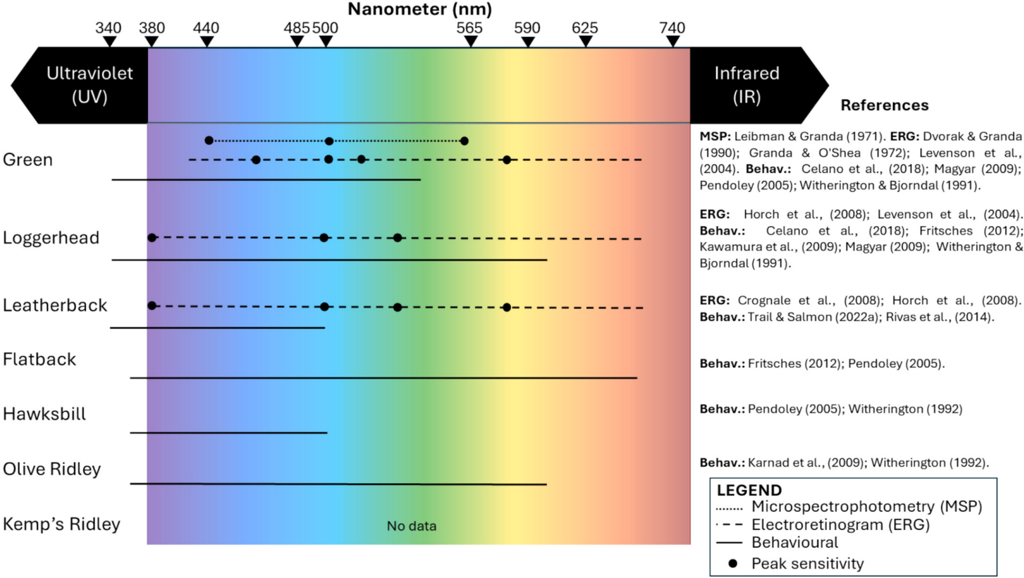
- Hatchlings are generally attracted to short wavelengths (360–500 nm) across six of seven species and avoid long wavelengths (>550 nm); red lights need to be ~five orders of magnitude more intense than blue lights for positive phototaxis. However, 46% of studies did not measure light intensity, and species coverage is biased toward loggerhead (n = 44) and green turtles (n = 28), with no data for Kemp’s ridley.
Methods
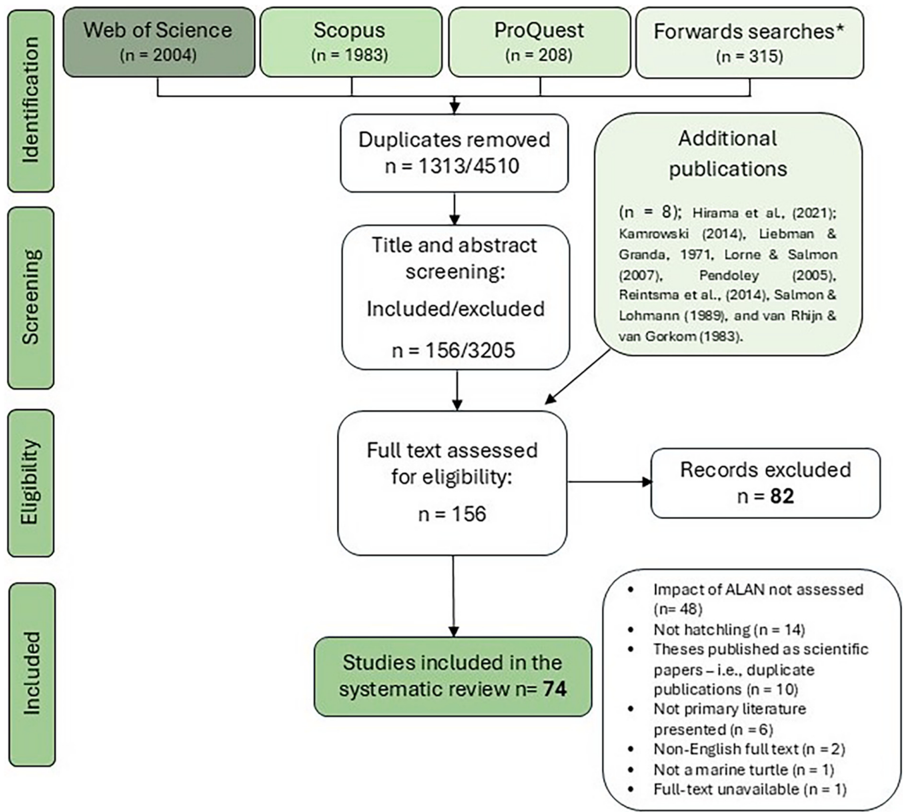
- Systematic review following PRISMA-EcoEvo and ROSES reporting standards. Searches were run on Scopus, Web of Science Core Collection, and ProQuest dissertations/theses on 23 July 2024 with no timespan limit, yielding 1983, 2004, and 208 records respectively; after duplicate removal, 3205 studies were title/abstract screened, 156 full texts screened, and 74 studies included.
- Eligibility required primary data on ALAN impacts on sea turtle hatchlings (not adults); reviews, meta-analyses, modelling studies, and duplicate theses were excluded. One publication’s full text was unavailable.
- Data were extracted into four themes: visual capabilities, light properties and orientation, costs/consequences, and management. Orientation disruption was classified using the Witherington et al. (1996) hatchling orientation index. Because comparable study designs were too few, no quantitative meta-analysis was possible; the review used vote counting and narrative synthesis, with plots in R/ggplot2.
Limitations
- Stated by the paper: the search was limited to English-language literature; one publication’s full text could not be obtained; a quantitative meta-analysis was not possible due to heterogeneous study designs; vote counting does not reflect effect magnitude, statistical power, variance, or sample size; grey literature on mitigation effectiveness was likely missed.
- Stated/evident from the text: strong species and geographic biases (loggerhead and green turtles dominate; Kemp’s ridley has no data; 45% of studies from the United States, 22% from Australia); skyglow evidence is limited to three studies; costs/consequences are covered by only seven studies; nearshore dispersal by ten studies; telemetry is limited to the nearshore; and 46% of studies did not measure light intensity, with inconsistent measurement units across studies.
- Evident from the text: claims that misorientation causes exhaustion, dehydration, and overheating are largely anecdotal or unsubstantiated; light intensity thresholds for specific light types are unavailable; long-term population consequences of disrupted orientation remain unknown.
Model-written summary. Check it against the paper before relying on it.
Integrity signals
Registry
Cites
Statistics
Figures
Verification
Claims the paper makes
0 Valid · 2 Not valid · 107 Not checked · 58 Own results and interpretations
A result the paper reports from its own data — it cites no other source for it, so there is none to check. The quote shows it is in the paper.
In the paper
“Here, we systematically reviewed the literature (74 publications) to summarise the methods and findings on the impacts of ALAN on sea turtle hatchlings during early dispersal.”
- Also stated in: § 2.2. Eligibility screening · plain
“The full text of 156 publications were screened, and 74 studies met our inclusion criteria.”
- Also stated in: § 3. Results and discussion · plain
“Our systematic review found 74 studies that examined the impact of artificial light on marine turtle hatchlings matching our selection criteria (Fig. 2).”
§ The effect of artificial light at night on sea turtle hatchling early dispersal: A systematic review of methods, impacts and findings ☆ > Abstract
plain- Asserted: passes — The authors put it forward as true.
- Checkable: passes — It can be checked against evidence.
- Load-bearing: passes — The paper’s conclusions depend on it.
- Based: passes — The paper gives a reason why it holds.
- Rests on an assumption not shown here.
- Also stated in: § 2.2. Eligibility screening · plain
A result the paper states — it cites no source for it, so there is none to check. The quote shows it is in the paper.
In the paper
“Anatomical data are only available for green turtles.”
§ The effect of artificial light at night on sea turtle hatchling early dispersal: A systematic review of methods, impacts and findings ☆ > 3.1. Visual capabilities of sea turtles: anatomical, physiological and behavioural insights
plain- Asserted: passes — The authors put it forward as true.
- Checkable: passes — It can be checked against evidence.
- Load-bearing: unclear — It is unclear whether the paper’s conclusions depend on it.
- Based: passes — The paper gives a reason why it holds.
A result the paper reports from its own data — it cites no other source for it, so there is none to check. The quote shows it is in the paper.
In the paper
“The responses of loggerhead (Caretta caretta; n = 44) and green (Chelonia mydas; n = 28) turtles to ALAN have been the primary focus of investigation.”
§ The effect of artificial light at night on sea turtle hatchling early dispersal: A systematic review of methods, impacts and findings ☆ > 3. Results and discussion
plainn = 44- Asserted: passes — The authors put it forward as true.
- Checkable: passes — It can be checked against evidence.
- Load-bearing: unclear — It is unclear whether the paper’s conclusions depend on it.
- Based: passes — The paper gives a reason why it holds.
- Rests on an assumption not shown here.
None of the sources cited for this claim have been checked yet.
In the paper
“Behavioural studies show that sea turtles are more attracted to shorter wavelength light (Fig. 4).”
§ The effect of artificial light at night on sea turtle hatchling early dispersal: A systematic review of methods, impacts and findings ☆ > 3.1. Visual capabilities of sea turtles: anatomical, physiological and behavioural insights
plainstates an association- Asserted: passes — The authors put it forward as true.
- Checkable: passes — It can be checked against evidence.
- Load-bearing: passes — The paper’s conclusions depend on it.
- Based: passes — The paper gives a reason why it holds.
A result the paper reports from its own data — it cites no other source for it, so there is none to check. The quote shows it is in the paper.
In the paper
“Studies placing lights beyond 500 m provided no evidence of disrupted orientation to point lighting at such distances.”
§ The effect of artificial light at night on sea turtle hatchling early dispersal: A systematic review of methods, impacts and findings ☆ > 3.2. Artificial light and sea turtle hatchling orientation
plainn = 2- Asserted: passes — The authors put it forward as true.
- Checkable: passes — It can be checked against evidence.
- Load-bearing: passes — The paper’s conclusions depend on it.
- Based: passes — The paper gives a reason why it holds.
79 more claims
Create a free account to see all 167 claims and to verify the 127 references still open.
- It may state two separate claims as one. 63
- Probably not a substantial claim. 23
Self-check
Percentages, sums and reported differences re-computed from the paper’s own numbers.
Each contradiction between two passages listed here was confirmed by an independent check.
Rated minor: it would not touch a result — a value no result rests on, a p-value that stays on the same side of the significance level, or a conflict that is clerical, resolved elsewhere in the paper, or outside its own findings.
In the paper
§ The effect of artificial light at night on sea turtle hatchling early dispersal: A systematic review of methods, impacts and findings ☆ > 2.3. Data extraction
“Articles were classified into four main research themes: (1) sea turtle visual capabilities; (2) properties of artificial light and hatchling orientation; (3) costs/consequences of disrupted orientation; and (4) ALAN management.”
§ The effect of artificial light at night on sea turtle hatchling early dispersal: A systematic review of methods, impacts and findings ☆ > 6. Conclusions
“The publications on the impact of artificial light on sea turtle hatchlings (n = 74 studies) classified into five main research themes”
Rated minor: it would not touch a result — a value no result rests on, a p-value that stays on the same side of the significance level, or a conflict that is clerical, resolved elsewhere in the paper, or outside its own findings.
In the paper
§ The effect of artificial light at night on sea turtle hatchling early dispersal: A systematic review of methods, impacts and findings ☆ > 3.3. Attraction to artificial lights during in-water dispersal
“misorientation rates ranging 20-80 % of hatchlings (Table 1).”
§ The effect of artificial light at night on sea turtle hatchling early dispersal: A systematic review of methods, impacts and findings ☆ > 6. Conclusions
“| Australia | Green | 88 % (MH) | Thums et al. (2016) |”
Citations
Cites
R: A Language and Environment for Statistical Computing
R Core Team (2025) · doi:10.32614/r.manuals · Cited by 352,181
Wickham, H. (2016) · Use R! · doi:10.1007/978-3-319-24277-4 · Cited by 33,115
Rayyan-a web and mobile app for systematic reviews.
Ouzzani, M., Hammady, H., Fedorowicz, Z., & Elmagarmid, A. (2016) · Systematic Reviews · doi:10.1186/s13643-016-0384-4 · Cited by 26,092
ggplot2: Elegant Graphics for Data Analysis
Ginestet, C. (2011) · Journal of the Royal Statistical Society Series A: Statistics in Society · doi:10.1111/j.1467-985x.2010.00676_9.x · Cited by 13,726
Synthesis without meta-analysis (SWiM) in systematic reviews: reporting guideline
Campbell, M., McKenzie, J. E., Sowden, A., Katikireddi, S. V., Brennan, S. E., Ellis, S., Hartmann-Boyce, J., Ryan, R., Shepperd, S., Thomas, J., et al. (2020) · BMJ · doi:10.1136/bmj.l6890 · Cited by 4,628
The new world atlas of artificial night sky brightness
Falchi, F., Cinzano, P., Duriscoe, D., Kyba, C. C. M., Elvidge, C. D., Baugh, K., Portnov, B. A., Rybnikova, N. A., & Furgoni, R. (2016) · Science Advances · doi:10.1126/sciadv.1600377 · Cited by 1,976
Meta-analysis and the science of research synthesis
Gurevitch, J., Koricheva, J., Nakagawa, S., & Stewart, G. (2018) · Nature · doi:10.1038/nature25753 · Cited by 1,709
Longcore, T., & Rich, C. (2004) · Frontiers in Ecology and the Environment · doi:10.1890/1540-9295(2004)002[0191:elp]2.0.co;2 · Cited by 1,423
Guidelines for systematic review in Conservation and environmental management
PULLIN, A. S., & STEWART, G. B. (2006) · Conservation Biology · doi:10.1111/j.1523-1739.2006.00485.x · Cited by 1,137
The ecological impacts of nighttime light pollution: a mechanistic appraisal
Gaston, K. J., Bennie, J., Davies, T. W., & Hopkins, J. (2013) · Biological Reviews · doi:10.1111/brv.12036 · Cited by 1,110
Research works printed but not linked: 5
- Hooker, D., 1911. Certain reactions to color in the young loggerhead turtle. Pap. Tortugas Lab. Carnegie Inst. 3, 69-76.
- Limpus, C., 1971. Sea turtle ocean finding behaviour. Search 2, 38.
- Salmon, M., 2003. Artificial night lighting and sea turtles. Biologist 50, 163-168.
- Witherington, B., Crady, C., Bolen, L., 1996. A "hatchling orientation index" for assessing orientation disruption from artificial lighting, In Keinath, JA, D. Barnard, J. Musick and B. Bell (comps.) Proceedings of the Fifteenth Annual Symposium on Sea Turtle Biology and Conservation. NOAA Tech. Mem. NMFS-SEFSC-387. pp. 344-347.
- Witherington, B.E., Martin, R.E., 2003. Understanding, assessing, and resolving light- pollution problems on sea turtle nesting beaches. 3. In: Florida Marine Research Institute Technical Report TR-2, 73 p. https://hdl.handle.net/10535/4387.
Cited by
Dimitriadis, C., Simantiris, N., Maffucci, F., Aksissou, M., Benabdi, M., Carlino, P., Casale, P., Demetropoulos, S., Fuller, W. J., Girondot, M., et al. (2026) · Marine Pollution Bulletin · doi:10.1016/j.marpolbul.2026.119476 · Cited by 4
The Role of Behavior in Responses to Anthropogenic Changes
Sheldon, K. S., Muñoz, M. M., Rosvall, K. A., Viana, J. V. D. A., Cornelius, J. M., Domínguez‐Guerrero, S. F., Ellis‐Soto, D., Kirkpatrick, W. H., O’Connell, L. A., Rebouças, R., et al. (2026) · Integrative and Comparative Biology · doi:10.1093/icb/icag050 · Cited by 2
Phendler, E., Garant, D., Réale, D. J. F., & Bergeron, P. (2026) · Canadian Journal of Zoology · doi:10.1139/cjz-2025-0158 · Cited by 1
Ellgutter, J. A. C., Rosell, F., Renssen, H., Hawkes, L. A., & Reinhardt, S. (2026) · Frontiers in Marine Science · doi:10.3389/fmars.2026.1746438
Why we need ecology and evolution for a better understanding of misdirected behaviourPreprint
Mensah, J. B., Freitas, B., Ringler, M., Antunes, D. F., & Ringler, E. (2026) · EcoEvoRxiv · doi:10.32942/x2m10j
Metadata
- Authors
- Gomez Isaza, D. F., Jones, R., Wilson, P., Pendoley, K., Fossette, S., & Thums, M.
- Affiliations
- Australian Institute of Marine Science (AU)
- The University of Western Australia (AU)
- ORCID
- Venue
- Biological Conservation
- Publisher
- Elsevier BV
- Published
- 2025-09
- Volume
- 309
- Pages
- 111327
- ISSN
- 0006-3207 (ISSN-L)
- OpenAlex
- W4411679812
- Cited by
- 8
- References
- 129
- Citations by year
- 2026: 7 · 2025: 1
- FWCI
- 0.64
- Type
- journal article
- Language
- en
- Open access
- hybrid
- doi.org
- Licence
- cc-by
- www.elsevier.com/tdm/userlicense/1.0/ (tdm)
- www.elsevier.com/legal/tdmrep-license (tdm)
- creativecommons.org/licenses/by/4.0/ (vor)
- Locations
- Biological Conservation (publishedVersion, cc-by)
- UWA Profiles and Research Repository (UWA) (publishedVersion, cc-by)
- Murdoch University Research Portal (submittedVersion, cc-by)
- Funders
- African Institute for Mathematical Sciences
- Woodside
- Australian Institute of Marine Science
- Topics
- Physical Sciences › Environmental Science › Nature and Landscape Conservation › Turtle Biology and Conservation
- Physical Sciences › Environmental Science › Global and Planetary Change › Impact of Light on Environment and Health
- Physical Sciences › Environmental Science › Pollution › Microplastics and Plastic Pollution
- Keywords
- artificial light at night, sea turtle hatchlings, hatchling orientation, light pollution, light intensity threshold, light spectrum, endangered species conservation
About these checks
Registry, retraction, Cites and statistics results are computed, not judged, with one exception: a printed reference that no index lists is read once by a model before it counts as a citation error. Claims are extracted by a model and kept only when their quote appears verbatim in the text; each cited source is then checked, with a model’s help, for whether it says what the claim relies on. Those verdicts can be wrong — read the claim’s quote and the cited source before relying on one.
A language model drew the claims from the paper on 2026-11-24, under version 3 of the claim definition (model deepseek-v4.1-flash, prompt extract-v3).
A second model labelled each claim on 2026-11-24 (model jev-1.13-20260917, definition revision gold-guideline-v0.2).
Statistics and arithmetic are recomputed, not judged.
Confidence bands are shown only for fields calibrated on our annotated test set. None is calibrated yet, so no band is shown.
What counts as a claim ›How we measure confidence ›How we check this ›
Are you an author, or do you see a problem with this page? Request a review
How to cite
Cite CoChat for the checks on this page, and the paper for its own findings.
- This page
- CoChat. (2026). Citation check: The effect of artificial light at night on sea turtle hatchling early dispersal: A systematic review of methods, impacts and findings. https://app.cochat.ai/papers/10.1016/j.biocon.2025.111327
- The paper
- Gomez Isaza, D. F., Jones, R., Wilson, P., Pendoley, K., Fossette, S., & Thums, M. (2025). The effect of artificial light at night on sea turtle hatchling early dispersal: A systematic review of methods, impacts and findings. Biological Conservation. https://doi.org/10.1016/j.biocon.2025.111327
Data sources
Bibliographic data: Semantic Scholar, OpenAlex, Crossref.
Contains information from the Semantic Scholar Academic Graph Datasets, made available under the ODC Attribution License (ODC-BY 1.0).
Semantic Scholar’s data is described in: Kinney, R., et al. (2023). The Semantic Scholar Open Data Platform. arXiv:2301.10140.
