

The DOI matches its Crossref record; 67 of the 69 references it cites were found in a registry or an index.
Adverse childhood experiences and trajectories of internalizing, externalizing, and prosocial behaviors from childhood to adolescence
Open accessAbstract
Background Adverse childhood experiences (ACEs) predict poorer mental health across the life course but most of the extant research has employed ACE scores or individual adversities using retrospective data.Objectives To study the impact of ACEs on later mental health using not only ACEs scores and individual ACEs, but also latent class analysis (LCA), which respects the clustering of adversities.Participants and setting 8823 members from the UK Millennium Cohort Study.Methods We investigated the impact of prospectively reported ACEs on mental health trajectories derived using the Strengths and Difficulties Questionnaire at age 3, 5, 7, 11 and 14. Associations between LCA-derived ACE clusters, ACE scores, individual ACEs and mental health trajectories were tested using linear mixed effects models.Results With statistical significance set at 5% level, ACE scores showed a graded association with internalizing (ACE score of 1: β = 0.057; ACE score of 2: β = 0.108; ACE score of 3: β = 0.202), externalizing (ACE score of 1: β = 0.142; ACE score of 2: β = 0.299; ACE score of 3: β = 0.415) and prosocial behaviors (ACE score of 1: β=-0.019; ACE score of 2: β=-0.042; ACE score of 3: β=-0.059). Harsh parenting and physical punishment were particularly strongly associated with externalizing (β = 0.270 and β = 0.256) and negatively associated with prosocial behaviors (β=-0.046 and β=-0.058). Parental discord and parental depression showed the strongest associations with internalizing problems (β = 0.125 and β = 0.113). LCA did not discriminate ACE clusters in this dataset.Conclusions ACEs have an important impact on mental health from childhood to adolescence. ACEs score approach yielded useful results, which were further enhanced by exploring individual ACEs.
Overview
The claims and statistics of this paper haven’t been checked yet.
Run the check — free, no account needed. It reads the open-access text and checks the sources it cites.
Integrity signals
Registry
Cites
Statistics
Figures
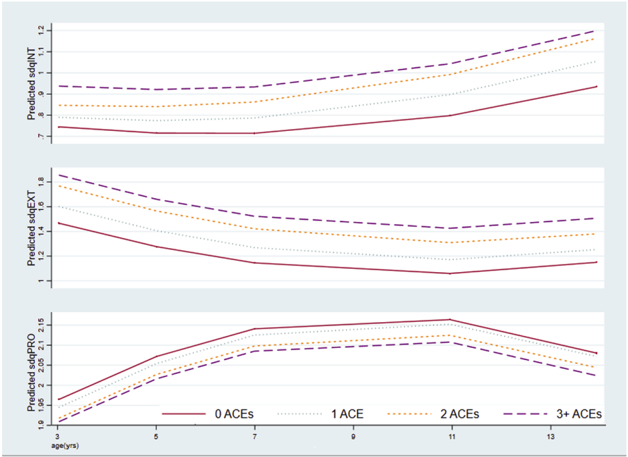
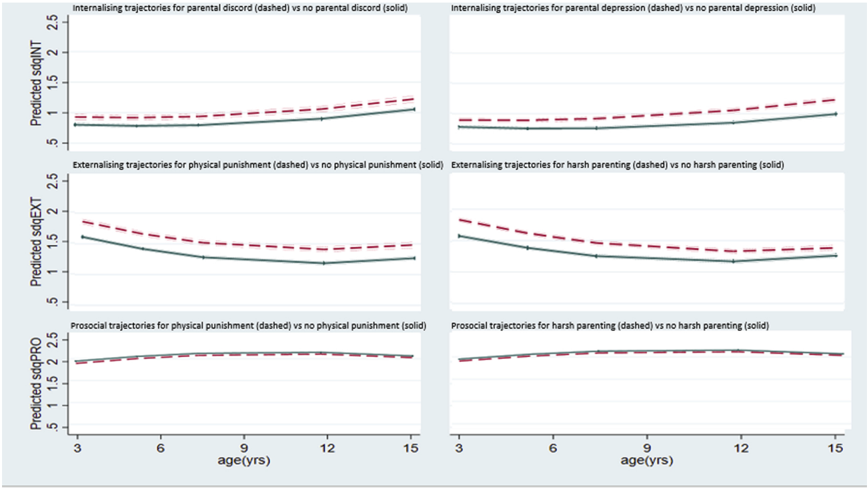
Verification
Claims the paper makes
The claims and statistics of this paper haven’t been checked yet.
Run the check — free, no account needed. It reads the open-access text and checks the sources it cites.
Claims other papers make about this one
Each is checked against this paper’s own text: does it say what the citing paper says it does?
In the citing paper
“Research by Bevilacqua et al. (2021) which used a nationally representative UK survey found no significant association between parental discord and children's prosocial behaviours, but the study did not measure DV exposure.”
From Risk and protective factors for children's psychopathology in the context of domestic violence – A study using nationally representative longitudinal survey data (2023) · cites this paper as Bevilacqua et al., 2021
In the citing paper
“The effect of ACEs was greater for externalising behaviours, compared to internalising and prosocial behaviours, which is largely in line with our own findings.”
From Risk and protective factors for children's psychopathology in the context of domestic violence – A study using nationally representative longitudinal survey data (2023) · cites this paper as Bevilacqua et al., 2021
Self-check
Percentages, sums and reported differences re-computed from the paper’s own numbers.
The self-check needs the paper’s full text.
Citations
Cites
Felitti, V. J., Anda, R. F., Nordenberg, D., Williamson, D. F., Spitz, A. M., Edwards, V., Koss, M. P., & Marks, J. S. (1998) · American Journal of Preventive Medicine · doi:10.1016/s0749-3797(98)00017-8 · Cited by 18,943
An Integrative Theory of Prefrontal Cortex Function
Miller, E. K., & Cohen, J. D. (2001) · Annual Review of Neuroscience · doi:10.1146/annurev.neuro.24.1.167 · Cited by 12,803
A Handbook of Child Psychology
(1932) · Nature · doi:10.1038/130331a0 · Cited by 10,133
Psychometric properties of the strengths and difficulties questionnaire
GOODMAN, R. (2001) · Journal of the American Academy of Child & Adolescent Psychiatry · doi:10.1097/00004583-200111000-00015 · Cited by 6,813
Measuring Intrafamily Conflict and Violence: The Conflict Tactics (CT) Scales
Straus, M. A. (1979) · Journal of Marriage and the Family · doi:10.2307/351733 · Cited by 6,187
Hughes, K., Bellis, M. A., Hardcastle, K. A., Sethi, D., Butchart, A., Mikton, C., Jones, L., & Dunne, M. P. (2017) · The Lancet Public Health · doi:10.1016/s2468-2667(17)30118-4 · Cited by 5,255 · cited 1×
“The importance of ACEs for poor lifelong health and mental health outcomes has been well documented (Hughes et al., 2017) and given that the impact of ACEs is both significant and long-term, ACEs are extremely costly for both individuals and society as a whole.”
BackgroundHalford, G. S., & Andrews, G. (2007) · Wiley eBooks · doi:10.1002/9780470147658 · Cited by 4,912
Anda, R. F., Felitti, V. J., Bremner, J. D., Walker, J. D., Whitfield, C., Perry, B. D., Dube, S. R., & Giles, W. H. (2006) · European archives of psychiatry and clinical neuroscience · doi:10.1007/s00406-005-0624-4 · Cited by 4,292 · cited 1×
“Earlier research into ACEs indicated a dose-response relationship between the number of ACEs (an ‘ACE score’) and several health and mental health conditions, such as obesity, alcohol and drug abuse, depression and suicide (Anda et al., 2006; Felitti et al., 1998).”
MethodStraus, M., Hamby, S., Finkelhor, D., Moore, D. W., & Runyan, D. K. (1998) · International Journal of Child Abuse & Neglect · doi:10.1016/s0145-2134(97)00174-9 · Cited by 2,528
Adverse childhood experiences and the risk of depressive disorders in adulthood
Chapman, D. P., Whitfield, C. L., Felitti, V. J., Dube, S. R., Edwards, V. J., & Anda, R. F. (2004) · Journal of Affective Disorders · doi:10.1016/j.jad.2003.12.013 · Cited by 2,267
Cited by
Sorted by citations
Gender differences in early adverse childhood experiences and youth psychological distress
Jones, M. S., Pierce, H., & Shafer, K. M. (2022) · Journal of Criminal Justice · doi:10.1016/j.jcrimjus.2022.101925 · Cited by 80
Zarei, K., Xu, G., Zimmerman, B., Giannotti, M., & Strathearn, L. (2021) · Children · doi:10.3390/children8090761 · Cited by 55
Barnhart, S., Garcia, A. R., & Karcher, N. R. (2022) · Journal of Youth and Adolescence · doi:10.1007/s10964-022-01671-9 · Cited by 61
Spanking and Corporal Punishment Parenting Practices and Child Development: A Systematic Review
Avezum, M. D. M. D. M., Altafim, E. R. P., & Linhares, M. B. M. (2022) · Trauma Violence & Abuse · doi:10.1177/15248380221124243 · Cited by 53
Gautam, N., Rahman, M. M., & Khanam, R. (2024) · Journal of Affective Disorders · doi:10.1016/j.jad.2024.07.064 · Cited by 54
Metadata
- Authors
- Bevilacqua, L., Kelly, Y., Heilmann, A., Priest, N., & Lacey, R. E.
- Affiliations
- University College London (GB)
- Australian National University (AU)
- Corresponding author
- Bevilacqua, Leonardo
- Venue
- Child Abuse & Neglect
- Publisher
- Elsevier BV
- Published
- 2021-02
- Volume
- 112
- Pages
- 104890
- ISSN
- 0145-2134 (ISSN-L)
- OpenAlex
- W3120713439
- Cited by
- 183
- References
- 69
- Citations by year
- 2026: 30 · 2025: 35 · 2024: 39 · 2023: 41 · 2022: 32 · 2021: 6
- FWCI
- 20.16
- Type
- journal article
- Language
- en
- Open access
- green
- discovery.ucl.ac.uk
- Licence
- Locations
- Child Abuse & Neglect (publishedVersion)
- PubMed (publishedVersion)
- UCL Discovery (University College London) (submittedVersion, cc-by-nc-nd)
- Minerva Access (University of Melbourne) (submittedVersion)
- ANU Open Research (Australian National University) (submittedVersion, cc-by-nc-nd)
- Funders
- Economic and Social Research Council
- Topics
- Social Sciences › Psychology › Clinical Psychology › Child Abuse and Trauma
- Social Sciences › Psychology › Clinical Psychology › Child and Adolescent Psychosocial and Emotional Development
- Social Sciences › Sociology and Political Science › Child Welfare and Adoption
- Keywords
- adverse childhood experiences, internalizing problems, externalizing problems, prosocial behavior, mental health trajectories, ACE score, latent class analysis, harsh parenting, corporal punishment, parental conflict, parental depression, childhood to adolescence, Millennium Cohort Study
- MeSH terms
- Adverse Childhood Experiences, Adolescent, Altruism, Humans, Retrospective Studies, Cohort Studies, Parenting
About these checks
Registry, retraction, Cites and statistics results are computed, not judged, with one exception: a printed reference that no index lists is read once by a model before it counts as a citation error. Claims are extracted by a model and kept only when their quote appears verbatim in the text; each cited source is then checked, with a model’s help, for whether it says what the claim relies on. Those verdicts can be wrong — read the claim’s quote and the cited source before relying on one.
Statistics and arithmetic are recomputed, not judged.
Confidence bands are shown only for fields calibrated on our annotated test set. None is calibrated yet, so no band is shown.
What counts as a claim ›How we measure confidence ›How we check this ›
Are you an author, or do you see a problem with this page? Request a review
