

Self-compacting concrete containing coarse recycled precast-concrete aggregate and its durability in marine-environment-related tests
Open accessThe DOI matches its Crossref record; 63 of the 63 references it cites were found in a registry or an index; none of the 62 sources its claims cite is checked for support yet.
Abstract
Marine environments are extremely challenging for the long-term durability of concrete. Prior validation of concrete durability is therefore a prerequisite to guarantee its adequate performance under marine environmental conditions. In this study, the performance of Self-Compacting Concrete (SCC) with variable contents of coarse Recycled Precast-Concrete Aggregate (RPCA) and two different cement contents is assessed in terms of capillary water absorption, natural and accelerated carbonation, resistance to SO2 attack, and moist/dry performance in drinking water, marine water, and sulfate water. These tests are intended to simulate the conditions of a marine environment. In general, the results showed that an SCC containing coarse RPCA of adequate durability under marine conditions could be produced. On the one hand, porosity due to the presence of RPCA increased less as the cement content was increased, which in turn reduced water absorption and SCC carbonation. For example, the effective porosity of the SCC was reduced by 25 % between day 28 and day 180, following the addition of 100 % coarse RPCA. On the other hand, both the SO2-attack and the moist/dry tests revealed that the weight of the SCC with RPCA underwent greater variations, due to the reactions of the cement-hydration products with chlorides and sulfates, as well as salt deposition. However, SCC compressive strength was never adversely affected, as the concrete strength increased up to 8 MPa after the drinking-water and the sulfate-water moist/dry tests when using RPCA. According to both Fick's and Parrot's models, the projected service life of all the mixes was over 100 years, regardless of the coarse RPCA content, making this sort of SCC a feasible option for construction in marine environments.
Overview
CoChat Summary
TL;DR
This study tested self-compacting concrete (SCC) with 0–100% coarse recycled precast-concrete aggregate (RPCA) and two cement contents under marine-related durability exposures. It concludes that RPCA did not adversely affect compressive strength and that all mixes had projected carbonation service lives over 100 years, supporting feasibility for marine environments.
Key findings
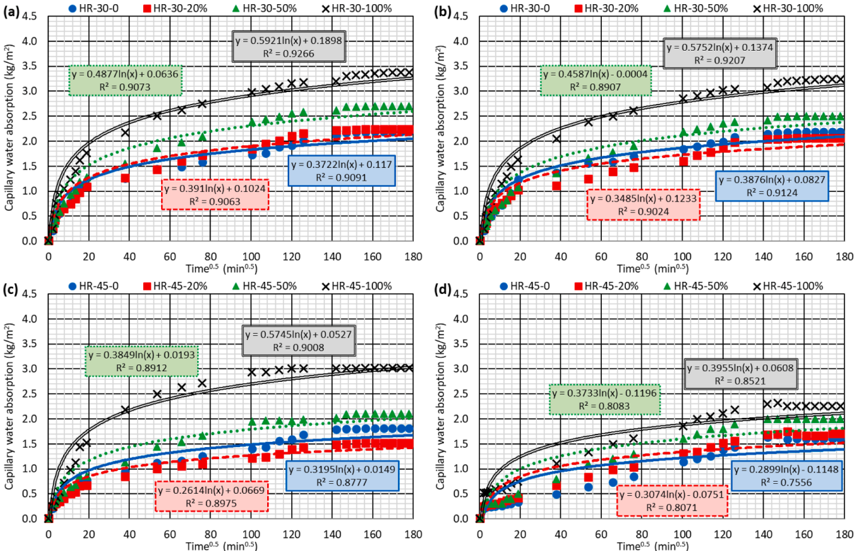
- Increasing cement content lowered effective porosity by 0.5 absolute units at both 28 and 180 days; adding coarse RPCA increased absorbed water, effective porosity, and the capillarity-absorption coefficient. The maximum increase in effective porosity with 100% coarse RPCA was 1.5 units, and for HR-45-100% effective porosity fell 25.3% from 28 to 180 days (4.03% to 3.01%).
- All mixes met structural-concrete requirements; HR-30 mixes were SF1 and HR-45 mixes SF2. Compressive strength increased by about 15% with 100% coarse RPCA (e.g., HR-45-100% 72.8 MPa vs. HR-45-0 63.4 MPa; HR-30-100% 56.8 MPa vs. HR-30-0 49.1 MPa).
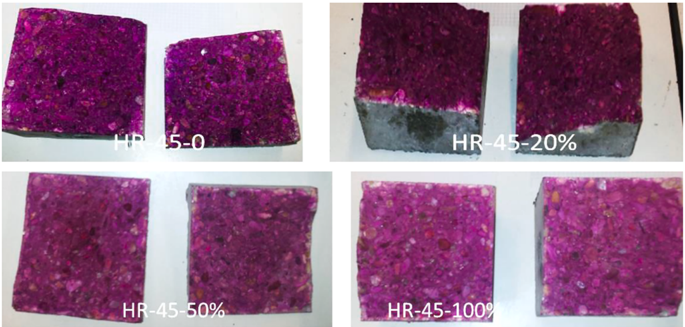
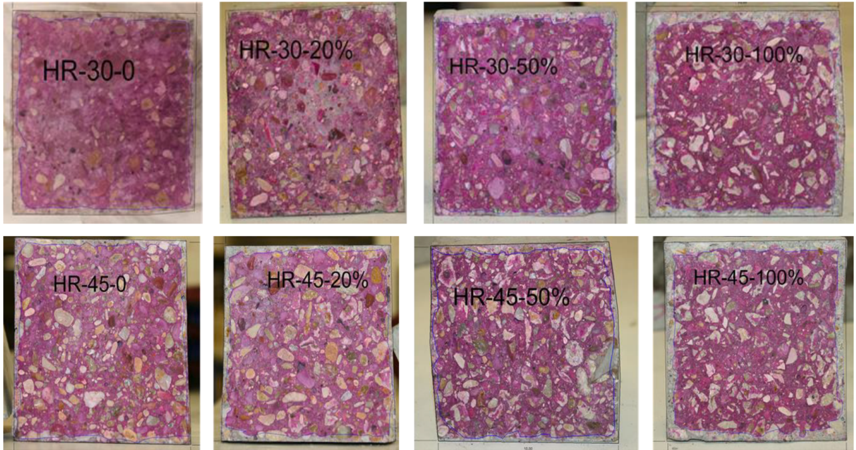
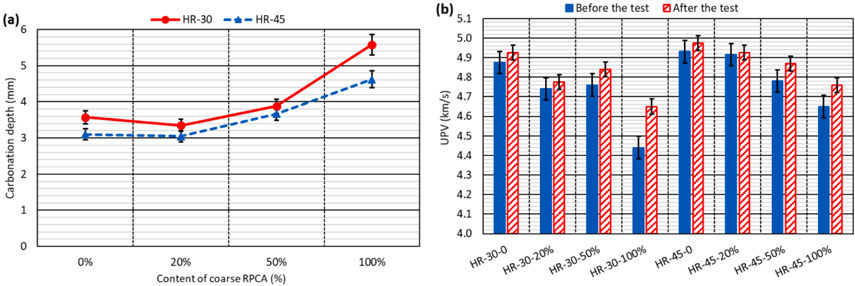
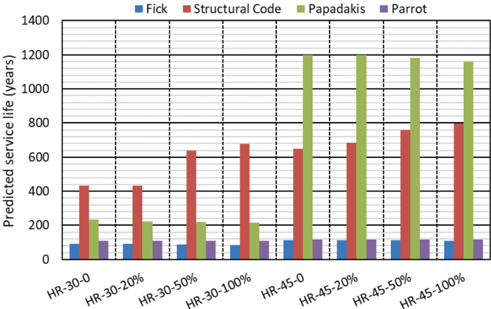
- Natural carbonation over one year was negligible. Accelerated carbonation depths were 3–4 mm for 0% coarse RPCA and 4.5–6 mm for 100% coarse RPCA. Fick’s and Parrot’s models gave service lives around 100 years for all mixes; the structural-code model gave 400–800 years and Papadakis’ model about 200 years for HR-30 and about 1200 years for HR-45.
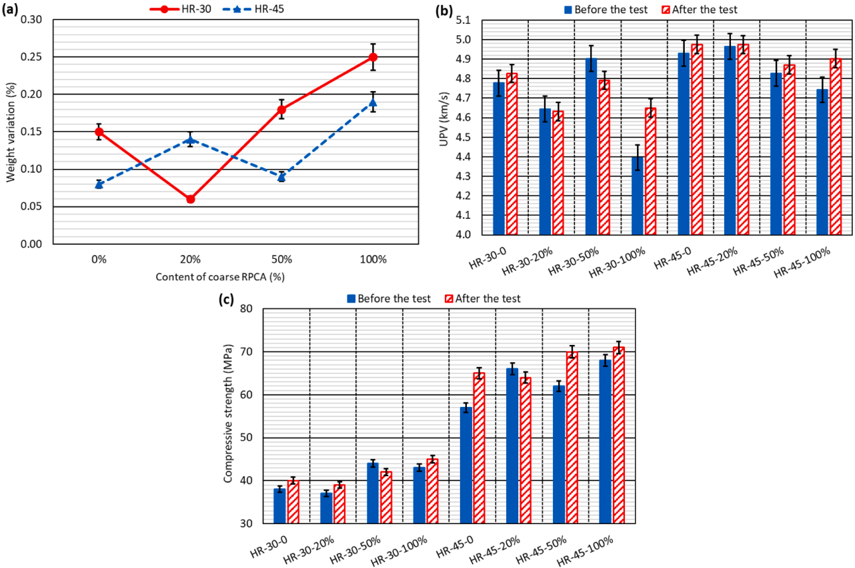
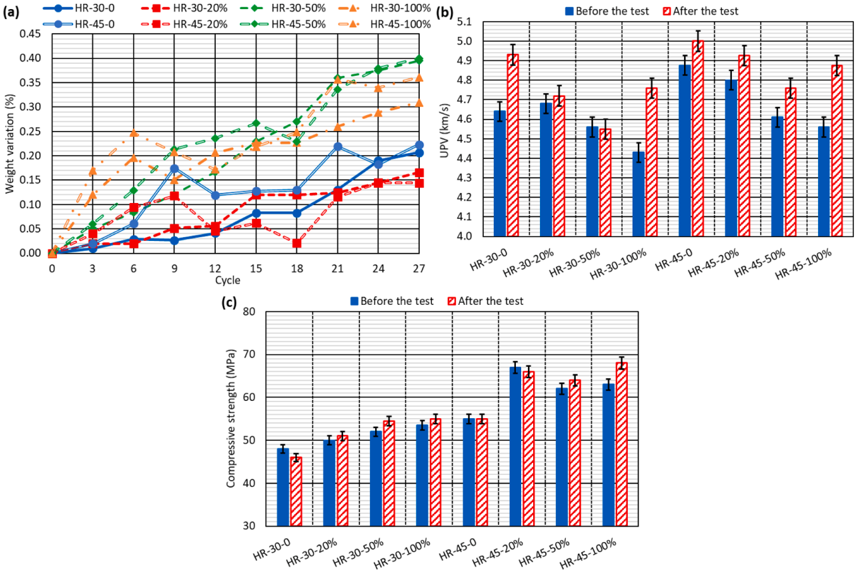
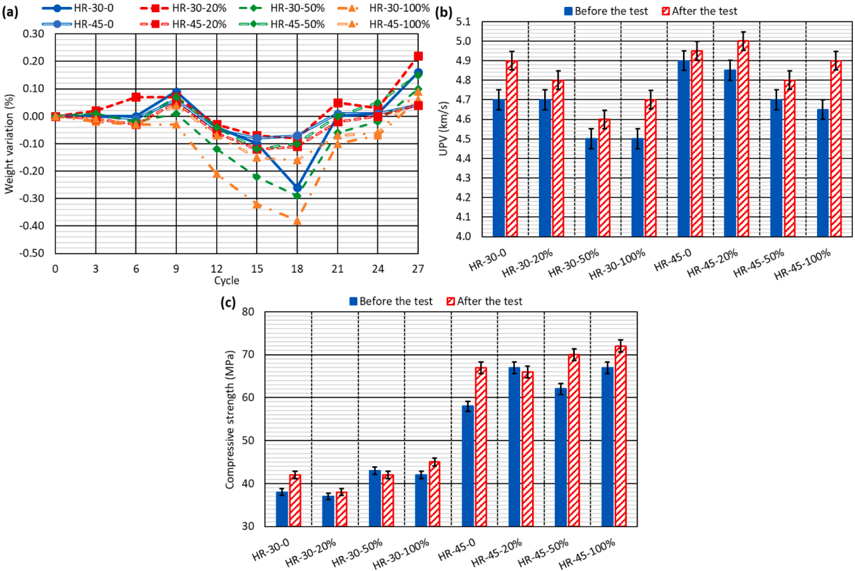
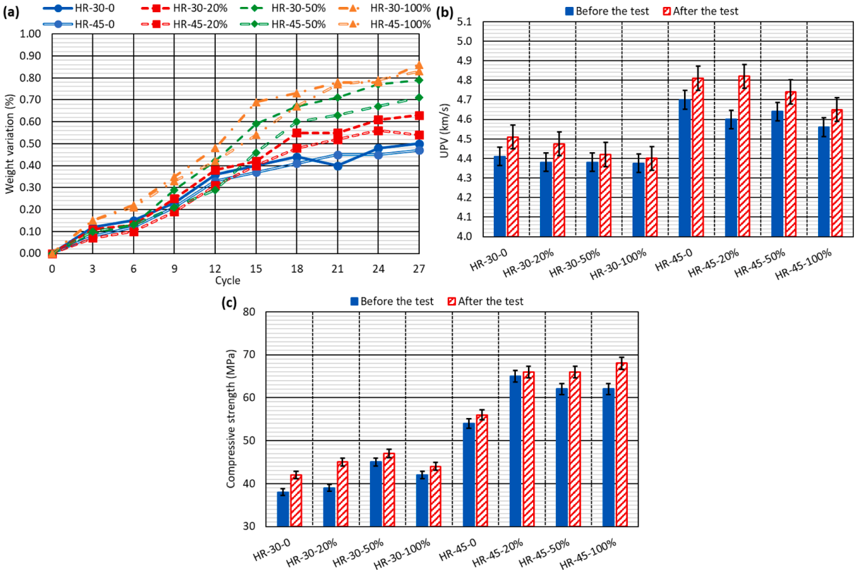
- SO₂ attack increased weight and compressive strength, with no clear trend from coarse RPCA. Moist/dry tests caused weight variations up to 0.80%; marine water first decreased then increased weight. Compressive strength increased in all moist/dry tests, up to 8 MPa after drinking-water and sulfate-water tests when using RPCA.
Methods
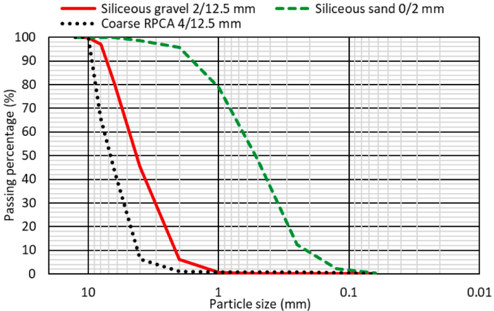
- SCC mixes used 0%, 20%, 50%, and 100% coarse RPCA (4/12.5 mm) replacing siliceous gravel, with two cement contents: 250 kg/m³ (HR-30, target 30 MPa) and 320 kg/m³ (HR-45, target 45 MPa). Raw materials included CEM I 52.5 R, limestone filler, admixtures, siliceous sand, and siliceous gravel; RPCA came from reject precast-concrete components.
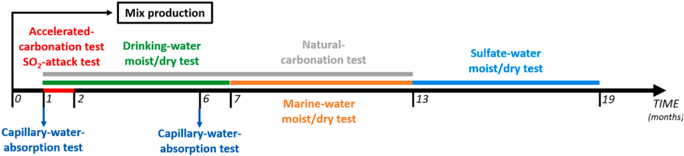
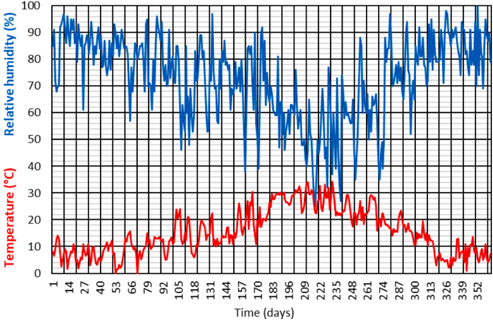
- Tests included slump-flow (EN 12350-8), mechanical properties at 28 days, capillary water absorption at 28 and 180 days, natural carbonation for one year outdoors, accelerated carbonation for four weeks (EN 13295) with UPV, Kesternich SO₂ attack for 15 cycles (EN ISO 6988), and three sequential moist/dry tests in drinking water, marine water, and sulfate water (27 cycles each). Each result was the arithmetic mean of three specimens.
- Service life was predicted from accelerated-carbonation results using Fick’s, Spanish Structural Code, Papadakis’, and Parrot’s models with a 20 mm concrete cover. Compressive strengths after durability tests were compared with non-durability-tested specimens kept in a humid chamber.
Limitations
- The paper states that the three moist/dry tests could not be performed simultaneously due to insufficient laboratory equipment and logistics problems; they were run one after the other, with no specific criteria for the order.
- The study used only coarse RPCA (4/12.5 mm); the text notes that because only the coarse fraction was used, the concrete skin was not affected by RPCA, unlike what could happen with fine RPCA.
- Evident from the text: only two cement contents and one RPCA source were tested; natural carbonation was limited to one year and accelerated carbonation to four weeks; service-life predictions varied widely by model, with the structural-code and Papadakis models overestimating service life, so the projected >100-year lives are model-dependent.
Model-written summary. Check it against the paper before relying on it.
Integrity signals
Registry
Cites
Statistics
Figures

Verification
Claims the paper makes
0 Valid · 0 Not valid · 56 Not checked · 101 Own results and interpretations
A result the paper reports from its own data — it cites no other source for it, so there is none to check. The quote shows it is in the paper.
In the paper
“The increase in the cement content led to a decrease of 0.5 units in absolute terms of the effective porosity ε e (Table 4) at both 28 days and 180 days”
§ Self-compacting concrete containing coarse recycled precast-concrete aggregate and its durability in marine-environment-related tests > 3.2. Capillarity water absorption
plainstates a cause- Asserted: passes — The authors put it forward as true.
- Checkable: passes — It can be checked against evidence.
- Load-bearing: passes — The paper’s conclusions depend on it.
- Based: passes — The paper gives a reason why it holds.
A result the paper reports from its own data — it cites no other source for it, so there is none to check. The quote shows it is in the paper.
In the paper
“Regarding coarse RPCA, it can be stated that there was no linear relationship between the content of this aggregate and the weight increase, although the mixes with less coarse RPCA content (0 % and 20 %) underwent lower weight increases than the mixes with 50 % and 100 % coarse RPCA.”
§ Self-compacting concrete containing coarse recycled precast-concrete aggregate and its durability in marine-environment-related tests > 3.5.1. Drinking water
plainstates an association- Asserted: passes — The authors put it forward as true.
- Checkable: passes — It can be checked against evidence.
- Load-bearing: unclear — It is unclear whether the paper’s conclusions depend on it.
- Based: passes — The paper gives a reason why it holds.
In the paper
“Fick's model showed a service life for all mixes of around 100 years, the maximum required by the structural design regulations [50].”
§ Self-compacting concrete containing coarse recycled precast-concrete aggregate and its durability in marine-environment-related tests > 3.3.3. Service-life prediction through carbonation
What the sources say
- Not matchedcites [50]
The reference list we hold has no entry [50].
plain- Asserted: passes — The authors put it forward as true.
- Checkable: passes — It can be checked against evidence.
- Load-bearing: passes — The paper’s conclusions depend on it.
- Based: passes — The paper gives a reason why it holds.
- Rests on an assumption not shown here.
- Not matched
A result the paper states — it cites no source for it, so there is none to check. The quote shows it is in the paper.
In the paper
“Furthermore, the fitting accuracy of the logarithmic model of the evolution of capillary water absorption as a function of time increased with the content of coarse RPCA due to the higher initial water absorption of the concrete mixes that incorporated this waste (Fig. 3).”
§ Self-compacting concrete containing coarse recycled precast-concrete aggregate and its durability in marine-environment-related tests > 3.2. Capillarity water absorption
plainstates a cause- Asserted: passes — The authors put it forward as true.
- Checkable: passes — It can be checked against evidence.
- Load-bearing: unclear — It is unclear whether the paper’s conclusions depend on it.
- Based: passes — The paper gives a reason why it holds.
A result the paper states — it cites no source for it, so there is none to check. The quote shows it is in the paper.
In the paper
“As expected, the weight of the mixes had increased after the test (Fig. 10a), due to the formation of the aforementioned compounds.”
§ Self-compacting concrete containing coarse recycled precast-concrete aggregate and its durability in marine-environment-related tests > 3.4. SO 2 attack
plainstates a cause- Asserted: passes — The authors put it forward as true.
- Checkable: passes — It can be checked against evidence.
- Load-bearing: unclear — It is unclear whether the paper’s conclusions depend on it.
- Based: passes — The paper gives a reason why it holds.
86 more claims
Create a free account to see all 157 claims and every source verdict.
- It may state two separate claims as one. 54
- The quote only partly states this claim. 1
- Probably not a substantial claim. 12
Self-check
Percentages, sums and reported differences re-computed from the paper’s own numbers.
Each contradiction between two passages listed here was confirmed by an independent check.
Rated minor: it would not touch a result — a value no result rests on, a p-value that stays on the same side of the significance level, or a conflict that is clerical, resolved elsewhere in the paper, or outside its own findings.
In the paper
§ Self-compacting concrete containing coarse recycled precast-concrete aggregate and its durability in marine-environment-related tests > 3.3.2. Accelerated carbonation
“the UPV increased in all mixes after the accelerated-carbonation test”
§ Self-compacting concrete containing coarse recycled precast-concrete aggregate and its durability in marine-environment-related tests > 3.3.2. Accelerated carbonation
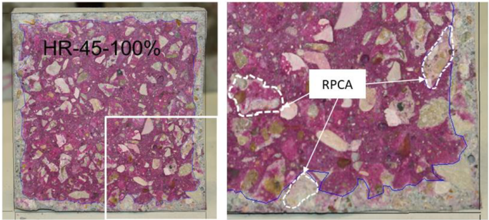
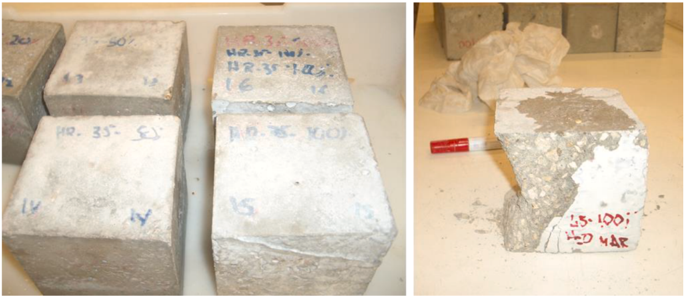
“the particles of coarse RPCA within the SCC were carbonated during the accelerated-carbonation test, as shown in Fig. 8, which improved their performance and caused the UPV of SCC to decrease”
Rated minor: it would not touch a result — a value no result rests on, a p-value that stays on the same side of the significance level, or a conflict that is clerical, resolved elsewhere in the paper, or outside its own findings.
In the paper
§ Self-compacting concrete containing coarse recycled precast-concrete aggregate and its durability in marine-environment-related tests > 3.1. Fresh and mechanical performance
“the HR-30 mixes presented an SF1 slump-flow class (slump flow of 600 ± 50 mm)”
§ Self-compacting concrete containing coarse recycled precast-concrete aggregate and its durability in marine-environment-related tests > 4. Conclusions
“| HR-30-0 | 680 | 4 | 49.1 | 37.0 | 5.2 | 6.2 |”
Rated minor: it would not touch a result — a value no result rests on, a p-value that stays on the same side of the significance level, or a conflict that is clerical, resolved elsewhere in the paper, or outside its own findings.
In the paper
§ Self-compacting concrete containing coarse recycled precast-concrete aggregate and its durability in marine-environment-related tests > 3.1. Fresh and mechanical performance
“the slump-flow class in the HR-45 mixes was SF2 (slump flow of 700 ± 50 mm)”
§ Self-compacting concrete containing coarse recycled precast-concrete aggregate and its durability in marine-environment-related tests > 4. Conclusions
“| HR-45-50 % | 600 | 4 | 66.8 | 38.0 | 5.0 | 7.9 |”
Rated minor: it would not touch a result — a value no result rests on, a p-value that stays on the same side of the significance level, or a conflict that is clerical, resolved elsewhere in the paper, or outside its own findings.
In the paper
§ Self-compacting concrete containing coarse recycled precast-concrete aggregate and its durability in marine-environment-related tests > 4. Conclusions
“marine water initially caused a decrease in weight and then a subsequent increase.”
§ Self-compacting concrete containing coarse recycled precast-concrete aggregate and its durability in marine-environment-related tests > 3.5.2. Marine water
“During the first 9 cycles, an increase in specimen weight was observed”
Citations
Cites
Durability of recycled aggregate concrete
Thomas, C., Setién, J., Polanco, J. A., Alaejos, P., & Sánchez de Juan, M. (2013) · Construction and Building Materials · doi:10.1016/j.conbuildmat.2012.11.106 · Cited by 703
Self-citationA review on corrosion detection and protection of existing reinforced concrete (RC) structures
Hu, J., Zhang, S. S., Chen, E., & Li, W. (2022) · Construction and Building Materials · doi:10.1016/j.conbuildmat.2022.126718 · Cited by 376
Bao, J., Li, S., Zhang, P., Ding, X., Xue, S., Cui, Y., & Zhao, T. (2020) · Construction and Building Materials · doi:10.1016/j.conbuildmat.2019.117845 · Cited by 314
SUITABILITY OF RECYCLED CONCRETE AGGREGATE FOR USE IN BS 5328 DESIGNATED MIXES.
DHIR, R. K., LIMBACHIYA, M. C., LEELAWAT, T., 5328, B., & 882, B. (1999) · Proceedings of the Institution of Civil Engineers - Structures and Buildings · doi:10.1680/istbu.1999.31568 · Cited by 273
Concrete with fine recycled aggregates: a review
Evangelista, L., & de Brito, J. (2014) · European Journal of Environmental and Civil Engineering · doi:10.1080/19648189.2013.851038 · Cited by 253
Self-compacting concrete with recycled aggregates – A literature review
Santos, S., da Silva, P. R., & de Brito, J. (2019) · Journal of Building Engineering · doi:10.1016/j.jobe.2019.01.001 · Cited by 219
Effect of composition, environmental factors and cement-lime mortar coating on concrete carbonation
Papadakis, V. G., Fardis, M. N., & Vayenas, C. G. (1992) · Materials and Structures · doi:10.1007/bf02472670 · Cited by 215
Study of the rheology of self-compacting concrete with fine recycled concrete aggregates
Carro‐López, D., González-Fonteboa, B., de Brito, J., Martínez‐Abella, F., González-Taboada, I., & da Silva, P. R. (2015) · Construction and Building Materials · doi:10.1016/j.conbuildmat.2015.08.091 · Cited by 215
Effects of using recycled concrete aggregates on the shrinkage of high performance concrete
Gonzalez-Corominas, A., & Etxeberria, M. (2016) · Construction and Building Materials · doi:10.1016/j.conbuildmat.2016.04.031 · Cited by 213
He, Z., Han, X., Zhang, M., Yuan, Q., Shi, J., & Zhan, P. (2021) · Powder Technology · doi:10.1016/j.powtec.2021.117075 · Cited by 203
Cited by
Zhao, R., Li, C., & Guan, X. (2024) · Buildings · doi:10.3390/buildings14061879 · Cited by 57
Yu, Y., Pacheco-Torgal, F., Zhao, X.-Y., & Wang, X. (2023) · European Journal of Environmental and Civil engineering · doi:10.1080/19648189.2023.2240882 · Cited by 52
A review of the repair measures for reinforced concrete affected by chloride ion corrosion
Zhao, P., Si, Z., Huang, L., He, Y., Liu, X., & Zhang, Y. (2025) · Journal of Building Engineering · doi:10.1016/j.jobe.2025.112028 · Cited by 42
Özkılıç, Y. O., Başaran, B., Aksoylu, C., Karalar, M., & Martins, C. H. (2023) · Case Studies in Construction Materials · doi:10.1016/j.cscm.2023.e02104 · Cited by 42
Revilla‐Cuesta, V., Faleschini, F., Pellegrino, C., Skaf, M., & Ortega‐López, V. (2024) · Developments in the Built Environment · doi:10.1016/j.dibe.2024.100374 · Cited by 35
Self-citation
Metadata
- Authors
- Fiol, F., Revilla-Cuesta, V., Thomas, C., & Manso, J. M.
- Affiliations
- Universidad de Burgos (ES)
- Universidad de Cantabria (ES)
- Venue
- Construction and Building Materials
- Publisher
- Elsevier BV
- Published
- 2023-05
- Volume
- 377
- Pages
- 131084
- ISSN
- 0950-0618 (ISSN-L)
- OpenAlex
- W4360602878
- Semantic Scholar
- 1a2dfa37be19befad958cb42d16612c9e1b41bb7
- Cited by
- 49
- References
- 63
- Citations by year
- 2026: 12 · 2025: 17 · 2024: 9 · 2023: 11
- FWCI
- 4.75
- Type
- journal article
- Language
- en
- Open access
- hybrid
- doi.org
- Licence
- cc-by-nc-nd
- www.elsevier.com/tdm/userlicense/1.0/ (tdm)
- www.elsevier.com/legal/tdmrep-license (tdm)
- creativecommons.org/licenses/by-nc-nd/4.0/ (vor)
- Locations
- Construction and Building Materials (publishedVersion, cc-by-nc-nd)
- Repositorio Institucional de la Universidad de Burgos (University of Burgos) (submittedVersion, cc-by-nc-nd)
- Funders
- Universidad de Burgos
- Ministerio de Ciencia e Innovación (.13039/501100011033, TED2021-129715 B–I00, 10.13039/501100011033/, 501100011033, PID2020-113837RB-I00)
- Junta de Castilla y León (UIC231)
- European Regional Development Fund (UIC‐231, 10.13039/501100011033, PID2020-113837RB-I00, 13039/501100011033, 501100011033, TED2021-129715B-I00)
- Agencia Estatal de Investigación (501100011033, 10.13039/501100011033, 13039, .13039/501100011033, 10.13039, TED2021-129715 B–I00, PID2020-113837RB-I00)
- Ministerio de Universidades
- NextGenerationEU
- Topics
- Physical Sciences › Engineering › Building and Construction › Recycled Aggregate Concrete Performance
- Physical Sciences › Engineering › Civil and Structural Engineering › Concrete Corrosion and Durability
- Physical Sciences › Engineering › Civil and Structural Engineering › Concrete and Cement Materials Research
- Keywords
- self-compacting concrete, recycled coarse aggregate, marine environment durability, capillary water absorption, carbonation, sulfate waters, chloride attack, porosity, service life prediction, compressive strength, cement content
About these checks
Registry, retraction, Cites and statistics results are computed, not judged, with one exception: a printed reference that no index lists is read once by a model before it counts as a citation error. Claims are extracted by a model and kept only when their quote appears verbatim in the text; each cited source is then checked, with a model’s help, for whether it says what the claim relies on. Those verdicts can be wrong — read the claim’s quote and the cited source before relying on one.
A language model drew the claims from the paper on 2026-11-27, under version 3 of the claim definition (model deepseek-v4.1-flash, prompt extract-v3).
A second model labelled each claim on 2026-11-27 (model jev-1.13-20260917, definition revision gold-guideline-v0.2).
Statistics and arithmetic are recomputed, not judged.
Confidence bands are shown only for fields calibrated on our annotated test set. None is calibrated yet, so no band is shown.
What counts as a claim ›How we measure confidence ›How we check this ›
Are you an author, or do you see a problem with this page? Request a review
Data sources
Bibliographic data: Semantic Scholar, OpenAlex, Crossref.
Contains information from the Semantic Scholar Academic Graph Datasets, made available under the ODC Attribution License (ODC-BY 1.0).
Semantic Scholar’s data is described in: Kinney, R., et al. (2023). The Semantic Scholar Open Data Platform. arXiv:2301.10140.
