

The DOI matches its Crossref record; 72 of the 72 references it cites were found in a registry or an index.
Do all psychological treatments really work the same in posttraumatic stress disorder?
Open accessAbstract
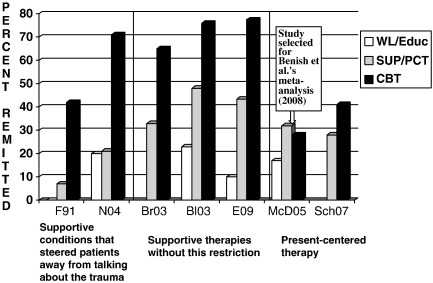
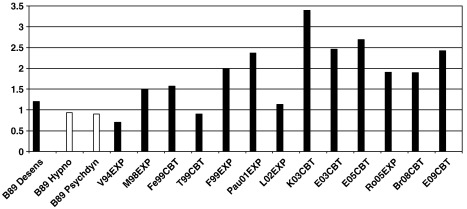
A recent meta-analysis by Benish, Imel, and Wampold (2008, Clinical Psychology Review, 28, 746-758) concluded that all bona fide treatments are equally effective in posttraumatic stress disorder (PTSD). In contrast, seven other meta-analyses or systematic reviews concluded that there is good evidence that trauma-focused psychological treatments (trauma-focused cognitive behavior therapy and eye movement desensitization and reprocessing) are effective in PTSD; but that treatments that do not focus on the patients' trauma memories or their meanings are either less effective or not yet sufficiently studied. International treatment guidelines therefore recommend trauma-focused psychological treatments as first-line treatments for PTSD. We examine possible reasons for the discrepant conclusions and argue that (1) the selection procedure of the available evidence used in Benish et al.'s (2008)meta-analysis introduces bias, and (2) the analysis and conclusions fail to take into account the need to demonstrate that treatments for PTSD are more effective than natural recovery. Furthermore, significant increases in effect sizes of trauma-focused cognitive behavior therapies over the past two decades contradict the conclusion that content of treatment does not matter. To advance understanding of the optimal treatment for PTSD, we recommend further research into the active mechanisms of therapeutic change, including treatment elements commonly considered to be non-specific. We also recommend transparency in reporting exclusions in meta-analyses and suggest that bona fide treatments should be defined on empirical and theoretical grounds rather than by judgments of the investigators' intent.
Overview
The claims and statistics of this paper haven’t been checked yet.
Run the check — free, no account needed. It reads the open-access text and checks the sources it cites.
Integrity signals
Registry
Cites
Statistics
Figures
Verification
Claims the paper makes
The claims and statistics of this paper haven’t been checked yet.
Run the check — free, no account needed. It reads the open-access text and checks the sources it cites.
Claims other papers make about this one
Each is checked against this paper’s own text: does it say what the citing paper says it does?
The check wasn’t confident either way, so it gives no verdict — never disputed.
In the citing paper
“Studies suggest that acupuncture may function by downregulating brain systems involved in activating the HPA axis and the sympathetic arm of the autonomic system.152–154”
From Fear and the Defense Cascade (2015) · cites this paper as [153]
Experimental — accuracy not yet measured
Self-check
Percentages, sums and reported differences re-computed from the paper’s own numbers.
The self-check needs the paper’s full text.
Citations
Cites
Posttraumatic Stress Disorder in the National Comorbidity Survey
Kessler, R. C. (1995) · Archives of General Psychiatry · doi:10.1001/archpsyc.1995.03950240066012 · Cited by 10,379
Moher, D., Cook, D. J., Eastwood, S., Olkin, I., Rennie, D., & Stroup, D. F. (1999) · The Lancet · doi:10.1016/s0140-6736(99)04149-5 · Cited by 4,826
Predictors of posttraumatic stress disorder and symptoms in adults: a meta-analysis
Ozer, E. J., Best, S. R., Lipsey, T. L., & Weiss, D. S. (2003) · Psychological Bulletin · doi:10.1037/0033-2909.129.1.52 · Cited by 3,322
Piaggio, G., Elbourne, D. R., Pocock, S. J., Evans, S. J. W., Altman, D. G., & CONSORT Group, F. T. (2012) · JAMA · doi:10.1001/jama.2012.87802 · Cited by 2,428
A Multidimensional Meta-Analysis of Psychotherapy for PTSD
Bradley, R., Greene, J., Russ, E., Dutra, L., & Westen, D. (2005) · American Journal of Psychiatry · doi:10.1176/appi.ajp.162.2.214 · Cited by 1,938
Freeman, A. M. (2001) · The Journal of Clinical Psychiatry · doi:10.4088/jcp.v62n1112 · Cited by 1,667
Foa, E. B., Rothbaum, B. O., Riggs, D. S., & Murdock, T. B. (1991) · Journal of Consulting and Clinical Psychology · doi:10.1037/0022-006x.59.5.715 · Cited by 1,444 · cited 2×
“…EMDR, and some treatments were only represented by one study (Brom et al., 1989: trauma desensitization vs. psychodynamic therapy vs. hypnotherapy: Foa et al., 1991, 1999: Prolonged Exposure vs. stress inoculation; Lee, Gavriel, Drummond, Richards, and Greenwald, 2002: EMDR vs. stress…”
BackgroundMethodFoa, E. B., Rothbaum, B. O., Riggs, D. S., & Murdock, T. B. (1991) · Journal of Consulting and Clinical Psychology · doi:10.1037//0022-006x.59.5.715 · Cited by 1,444
Hoffman, S. G., & Smits, J. A. J. (2008) · The Journal of Clinical Psychiatry · doi:10.4088/jcp.v69n0415 · Cited by 1,420
Resick, P. A., Nishith, P., Weaver, T. L., Astin, M. C., & Feuer, C. A. (2002) · Journal of Consulting and Clinical Psychology · doi:10.1037/0022-006x.70.4.867 · Cited by 1,294
Research works printed but not linked: 1
- Wampold, B. E. (2008). So it's good outcomes from me. And it's good outcomes from him. Is it the treatment or the therapist that works? Closing debate. Paper presented at the Savoy Conference on Psychological Therapies in the NHS, Science, Practice and Policy, London, 27th November 2008. http://www.newsavoypartnership.org/2008conference.htm
Cited by
Sorted by citations
Kozlowska, K., Walker, P., McLean, L., & Carrive, P. (2015) · Harvard Review of Psychiatry · doi:10.1097/hrp.0000000000000065 · Cited by 468
Expanding the lens of evidence-based practice in psychotherapy: A common factors perspective.
Laska, K. M., Gurman, A. S., & Wampold, B. E. (2014) · Psychotherapy · doi:10.1037/a0034332 · Cited by 443
The emerging evidence for Narrative Exposure Therapy: A review
Robjant, K., & Fazel, M. (2010) · Clinical Psychology Review · doi:10.1016/j.cpr.2010.07.004 · Cited by 397
Kohrt, B. A., Jordans, M. J. D., Rai, S., Shrestha, P., Luitel, N. P., Ramaiya, M. K., Singla, D. R., & Patel, V. (2015) · Behaviour Research and Therapy · doi:10.1016/j.brat.2015.03.009 · Cited by 370
Nexhmedin Morina, B., Wicherts, J. M., Lobbrecht, J., & Priebe, S. (2014) · Clinical Psychology Review · doi:10.1016/j.cpr.2014.03.002 · Cited by 321
Metadata
- Authors
- Ehlers, A., Bisson, J., Clark, D. M., Creamer, M., Pilling, S., Richards, D., Schnurr, P. P., Turner, S., & Yule, W.
- Affiliations
- King's College London (GB)
- Cardiff University (GB)
- University College London (GB)
- University of Exeter (GB)
- United States Department of Veterans Affairs (US)
- Corresponding author
- Ehlers, Anke
- ORCID
- Venue
- Clinical Psychology Review
- Publisher
- Elsevier BV
- Published
- 2010-03
- Volume
- 30
- Issue
- 2
- Pages
- 269-276
- ISSN
- 0272-7358 (ISSN-L)
- PMC
- PMC2852651
- OpenAlex
- W2101542507
- Cited by
- 199
- References
- 72
- Citations by year
- 2026: 4 · 2025: 1 · 2024: 3 · 2023: 2 · 2022: 20 · 2021: 10 · 2020: 9 · 2019: 10 · 2018: 16 · 2017: 13 · 2016: 17 · 2015: 22 · 2014: 22 · 2013: 21 · 2012: 11
- FWCI
- 1.36
- Type
- journal article
- Language
- en
- Open access
- hybrid
- doi.org
- Licence
- Locations
- Clinical Psychology Review (publishedVersion, cc-by)
- PubMed Central (publishedVersion, cc-by)
- PubMed (publishedVersion)
- UCL Discovery (University College London) (submittedVersion)
- Research Portal (King's College London) (submittedVersion)
- Funders
- Wellcome Trust Principal Research Fellowship (069777)
- Topics
- Social Sciences › Psychology › Clinical Psychology › Posttraumatic Stress Disorder Research
- Social Sciences › Psychology › Clinical Psychology › Psychotherapy Techniques and Applications
- Social Sciences › Psychology › Clinical Psychology › Psychoanalysis and Psychopathology Research
- Keywords
- post-traumatic stress disorder, trauma-focused cognitive behavioral therapy, EMDR, treatment content, meta-analysis bias, natural recovery, non-specific treatment effects, therapeutic mechanisms, treatment guidelines
- MeSH terms
- Clinical Trials as Topic, Humans, Life Change Events, Psychotherapy, Stress Disorders, Post-Traumatic, Meta-Analysis as Topic, Selection Bias
About these checks
Registry, retraction, Cites and statistics results are computed, not judged, with one exception: a printed reference that no index lists is read once by a model before it counts as a citation error. Claims are extracted by a model and kept only when their quote appears verbatim in the text; each cited source is then checked, with a model’s help, for whether it says what the claim relies on. Those verdicts can be wrong — read the claim’s quote and the cited source before relying on one.
Statistics and arithmetic are recomputed, not judged.
Confidence bands are shown only for fields calibrated on our annotated test set. None is calibrated yet, so no band is shown.
What counts as a claim ›How we measure confidence ›How we check this ›
Are you an author, or do you see a problem with this page? Request a review
