

Experimental study on sulfate resistance of concrete with recycled aggregate modified with polyvinyl alcohol (PVA)
Open accessThe DOI matches its Crossref record; 60 of the 60 references it cites were found in a registry or an index; none of the 30 sources its claims cite is checked for support yet.
Abstract
Using the wastes as a recycled concrete aggregate (RCA) is a promising technology to reduce the impact of construction and demolition wastes on the environment and the shortage of natural resources. However, higher permeability of RCA leads to greater absorption, affecting the RCA concrete's long-term performance. In general, the soil in Iraq contains a high sulfate level, accelerating concrete deterioration reducing concrete strength, and increasing concrete spalling and cracking. The aim of this study is to investigate the impact of sulfate environment on the mechanical properties of pretreated RCA concrete using a PVA agent. The normal aggregate was replaced in four portions of 8 %, 16 %, 24 %, and 32 % RCA, with the same grading and max size as normal aggregate. Two w/c ratios of 0.50 and 0.3 were used with two curing systems, namely sealed and unsealed conditions. The RCAs were socked in 0.5 % PVA of the water volume. The durability of RCA concrete was also experienced by sulfate attack immersing the concrete cubes in magnesium sulfate heptahydrate (MgSo4.nH2O) solution for 150 days after 28 days from casting with the wetting and drying cycle. The compressive strength results showed that the mixes with RCA pre-soaked in PVA have higher strength than the reference mix. For durability, the concrete mix with 32 % RCA exhibited the best durability. When the increased amount of RCA pre-soaked in PVA, the hydration increased, and internal voids decreased. Using 24 % RCA replacement with the sealed curing condition gives a 1.2 % increase in absorption, which is less than the unsealed curing condition of a 1.8 % increase in absorption.
Overview
CoChat Summary
TL;DR
This experimental study investigated sulfate resistance of concrete with recycled concrete aggregate (RCA) pretreated with polyvinyl alcohol (PVA). It reports that PVA-treated RCA improved compressive strength and sulfate durability, with 32% RCA generally best and sealed curing outperforming unsealed curing.
Key findings
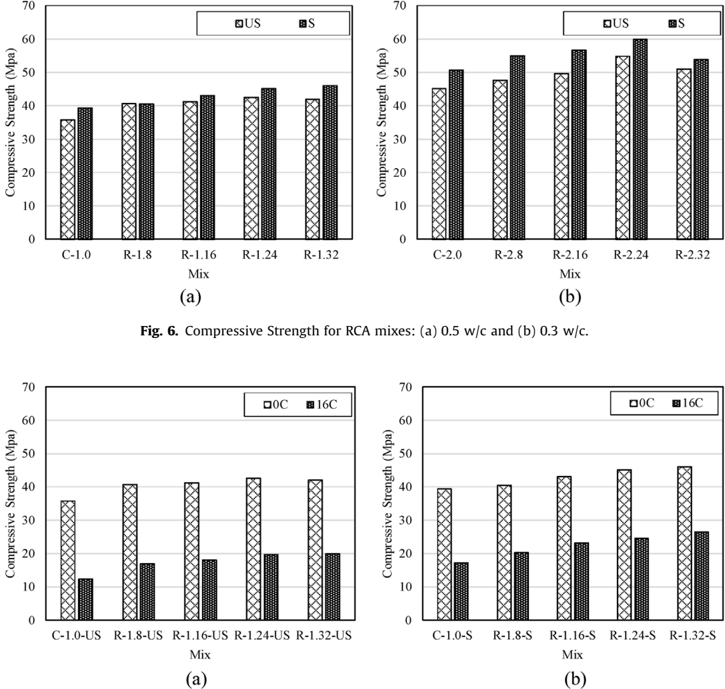
- Compressive strength increased with RCA replacement from 8% to 32%; sealed curing gave higher strength than unsealed for both w/c ratios. The highest reported compressive strength change was 22% in R-2.3-US-0C specimens.
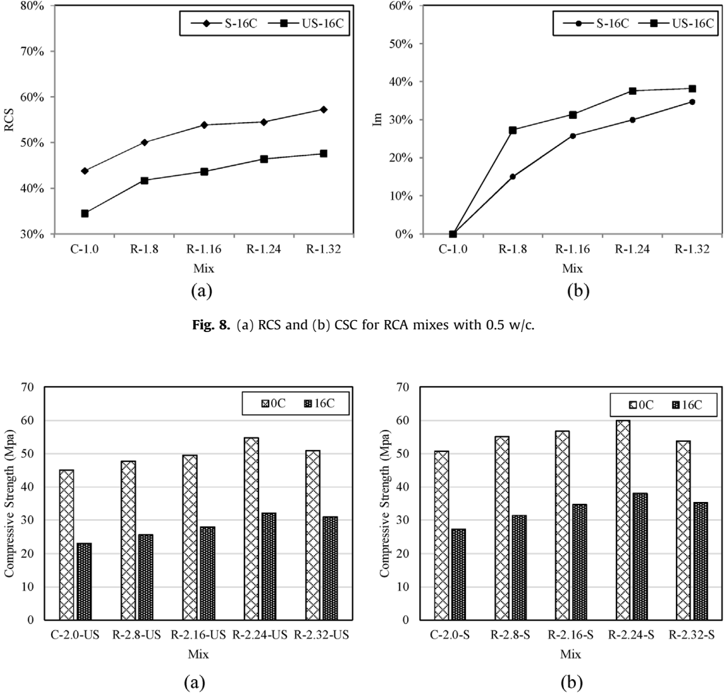
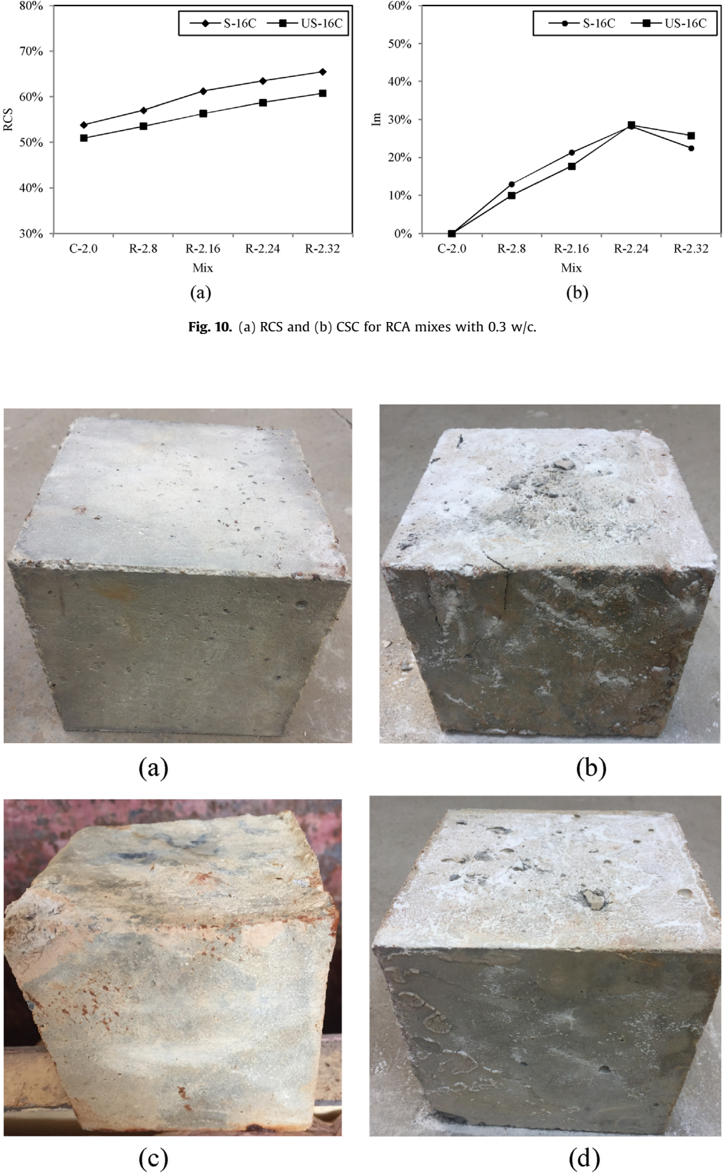
- After 16 sulfate cycles, 32% RCA was best for 0.5 w/c, with minimum compressive strength reduction of 43.7% for sealed specimens versus maximum 65.5% for the control unsealed mix. For 0.3 w/c, the paper states 24% RCA was best in one place, while also reporting minimum reduction of 35.25% for 32% RCA sealed versus 48.56% for the control.
- Surface cracking was less in PVA-treated RCA groups, especially sealed specimens; normal aggregate cracks propagated at the interfacial transition zone, while RCA cracks formed randomly.
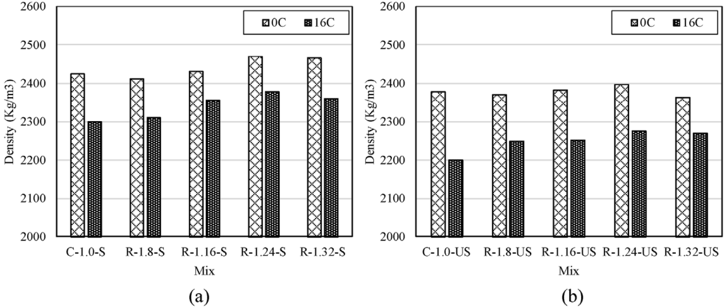
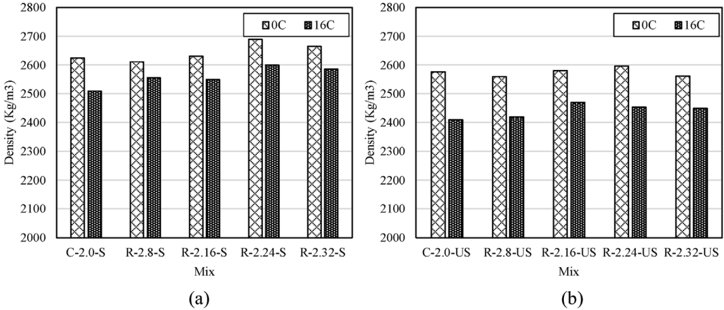
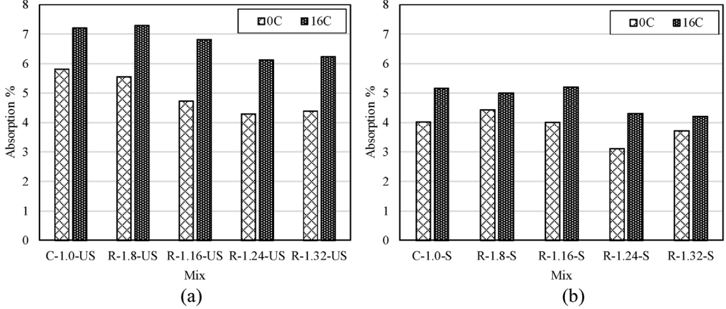
- Density increased with RCA, especially under sealed curing; maximum density at 24% RCA sealed was 2470 and 2680 kg/m³ for 0.5 and 0.3 w/c. At 24% RCA, absorption increase after sulfate cycles was 1.2% sealed versus 1.8% unsealed.
Methods
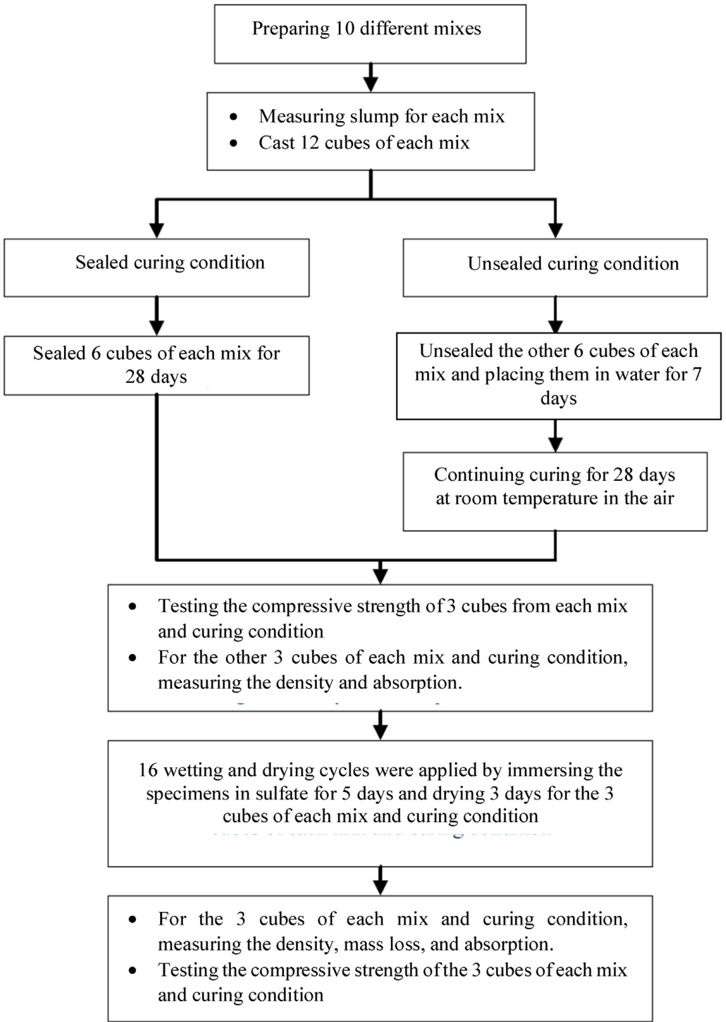
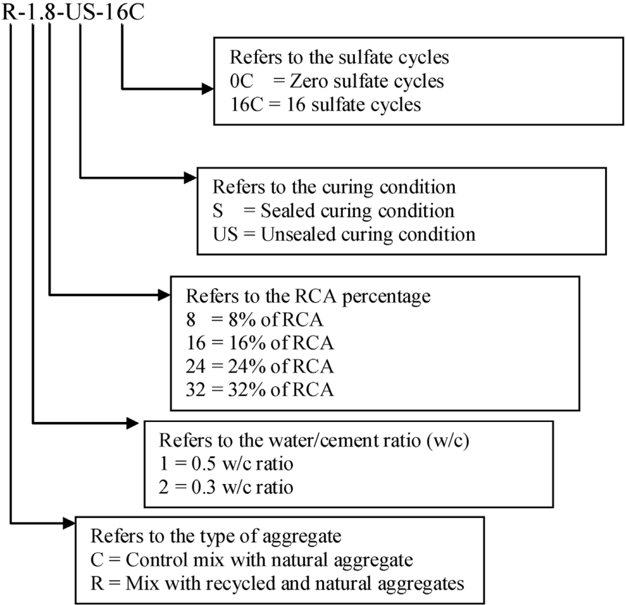
- Ten concrete mixes used 0%, 8%, 16%, 24%, and 32% RCA replacing coarse aggregate, with w/c ratios of 0.5 and 0.3. RCA was soaked in 0.5% PVA solution for 24 h to saturated surface dry; 150×150×150 mm cubes were cast, totaling 120 specimens in 40 groups of three.
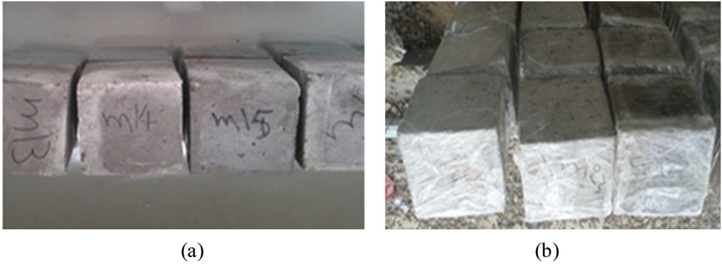
- Curing: 20 groups were sealed with water-resistant sheets for 28 days at room temperature; 20 groups were unsealed, cured in water for 7 days then air-cured to 28 days. After 28 days, 20 groups were tested for compressive strength, and 20 groups were immersed in MgSO₄·nH₂O solution (10 mg/L) for 150 days with 16 wetting/drying cycles (5 days wet, 3 days dry).
- Tests included slump, density, water absorption (ASTM C642), compressive strength (IQS 384), mass loss, and surface crack observation.
Limitations
- The paper does not include an explicit limitations section. Evident limitations include a single RCA source, a single PVA concentration (0.5%), a single sulfate solution concentration (10 mg/L), and one exposure duration (150 days/16 cycles), which limit generalizability.
- The paper reports inconsistent optimum RCA content for 0.3 w/c (24% vs 32%) and inconsistent absorption changes at 24% sealed RCA (1.01% decrease vs 1.2% increase), complicating interpretation.
- No microstructural characterization (e.g., SEM/XRD) is reported despite microstructure and hydration mechanisms being invoked; no statistical analysis is described.
Model-written summary. Check it against the paper before relying on it.
Integrity signals
Registry
Cites
Statistics
Figures

Verification
Claims the paper makes
0 Valid · 1 Not valid · 14 Not checked · 71 Own results and interpretations
A result the paper reports from its own data — it cites no other source for it, so there is none to check. The quote shows it is in the paper.
In the paper
“The compressive strength results showed that the mixes with RCA pre-soaked in PVA have higher strength than the reference mix.”
- Also stated in: § 4.1. Mechanical properties before sulfate exposure · plain
“Fig. 6 shows the increase in compressive strength with the increased percentages of RCA replacement pretreated by PVA solution with a dilution of 0.5 % by water weight.”
§ Experimental study on sulfate resistance of concrete with recycled aggregate modified with polyvinyl alcohol (PVA) > Abstract
plainstates a cause- Asserted: passes — The authors put it forward as true.
- Checkable: passes — It can be checked against evidence.
- Load-bearing: passes — The paper’s conclusions depend on it.
- Based: passes — The paper gives a reason why it holds.
- Also stated in: § 4.1. Mechanical properties before sulfate exposure · plain
A result the paper reports from its own data — it cites no other source for it, so there is none to check. The quote shows it is in the paper.
In the paper
“The highest rise of CSC percentage is 22 % in R-2.3-US-0C specimens.”
§ Experimental study on sulfate resistance of concrete with recycled aggregate modified with polyvinyl alcohol (PVA) > 4.1. Mechanical properties before sulfate exposure
plain- Asserted: passes — The authors put it forward as true.
- Checkable: passes — It can be checked against evidence.
- Load-bearing: unclear — It is unclear whether the paper’s conclusions depend on it.
- Based: passes — The paper gives a reason why it holds.
A result the paper states — it cites no source for it, so there is none to check. The quote shows it is in the paper.
In the paper
“Therefore, the sealed curing condition also improves the compressive strength more than the unsealed curing condition for both 0.5 and 0.30 water to cement ratios.”
§ Experimental study on sulfate resistance of concrete with recycled aggregate modified with polyvinyl alcohol (PVA) > 4.1. Mechanical properties before sulfate exposure
plainstates a cause- Asserted: passes — The authors put it forward as true.
- Checkable: passes — It can be checked against evidence.
- Load-bearing: passes — The paper’s conclusions depend on it.
- Based: passes — The paper gives a reason why it holds.
A result the paper reports from its own data — it cites no other source for it, so there is none to check. The quote shows it is in the paper.
In the paper
“The sealed curing condition specimens show a lower reduction in compression strength than with the unsealed curing condition for both 0.5 and 0.3 w/c ratios.”
§ Experimental study on sulfate resistance of concrete with recycled aggregate modified with polyvinyl alcohol (PVA) > 4.2. Compressive strength after sulfate exposure
plainstates a cause- Asserted: passes — The authors put it forward as true.
- Checkable: passes — It can be checked against evidence.
- Load-bearing: passes — The paper’s conclusions depend on it.
- Based: passes — The paper gives a reason why it holds.
A result the paper states — it cites no source for it, so there is none to check. The quote shows it is in the paper.
In the paper
“It should be mentioned that the compressive strength of R-1.4-S-16C and R-2.4-S-16C increased compared to other mixes.”
§ Experimental study on sulfate resistance of concrete with recycled aggregate modified with polyvinyl alcohol (PVA) > 4.2. Compressive strength after sulfate exposure
plainstates a cause- Asserted: passes — The authors put it forward as true.
- Checkable: passes — It can be checked against evidence.
- Load-bearing: passes — The paper’s conclusions depend on it.
- Based: passes — The paper gives a reason why it holds.
53 more claims
Create a free account to see all 86 claims and every source verdict.
- It may state two separate claims as one. 19
- Probably not a substantial claim. 9
Self-check
Percentages, sums and reported differences re-computed from the paper’s own numbers.
Each contradiction between two passages listed here was confirmed by an independent check.
Rated major: it would touch a result — a value a result rests on, reported and recomputed p-values on opposite sides of the significance level, two passages that conflict with no sign which is right, or a cited work retracted before this paper was published.
In the paper
§ Experimental study on sulfate resistance of concrete with recycled aggregate modified with polyvinyl alcohol (PVA) > 4.2. Compressive strength after sulfate exposure
“For the 0.3 w/c ratio, the mix with 24 % RCA was considered the best mix due to a minimum reduction in the compressive strength (see Fig. 9).”
§ Experimental study on sulfate resistance of concrete with recycled aggregate modified with polyvinyl alcohol (PVA) > 4.2. Compressive strength after sulfate exposure
“The mixes with water to the cement ratio of 0.3 show the maximum reduction in the compressive strength in the control mix 48.56 and minimum reduction in the compressive strength in the mix 32 % RCA for sealed system 35.25 % as shown in Fig. 10.”
Rated minor: it would not touch a result — a value no result rests on, a p-value that stays on the same side of the significance level, or a conflict that is clerical, resolved elsewhere in the paper, or outside its own findings.
In the paper
§ Experimental study on sulfate resistance of concrete with recycled aggregate modified with polyvinyl alcohol (PVA) > ̶ ̶
“the other 20 specimen groups were immersed in magnesium sulfate heptahydrate (MgSo 4 .nH 2 O) solution after 28 days from casting to the age of 150 days.”
§ Experimental study on sulfate resistance of concrete with recycled aggregate modified with polyvinyl alcohol (PVA) > ̶ ̶
“16 wetting and drying cycles were applied by immersing the specimens in sulfate for 5 days and drying for 3 days (see Table 6).”
Rated minor: it would not touch a result — a value no result rests on, a p-value that stays on the same side of the significance level, or a conflict that is clerical, resolved elsewhere in the paper, or outside its own findings.
In the paper
§ Experimental study on sulfate resistance of concrete with recycled aggregate modified with polyvinyl alcohol (PVA) > 4.4. Mass loss after sulfate exposure
“It should be noted that the density increased when RCA increased, especially in the sealed curing condition due to internal curing from stored water in RCA and cement's continuous hydration.”
§ Experimental study on sulfate resistance of concrete with recycled aggregate modified with polyvinyl alcohol (PVA) > 4.4. Mass loss after sulfate exposure
“The maximum density in the mix with 24 % RCA with sealed curing conditions is 2470 and 2680 kg/m 3 for 0.5 and 0.3 w/c ratios, respectively.”
Citations
Cites
Test Method for Density, Absorption, and Voids in Hardened Concrete
C09 Committee (2013) · ASTM Standards · doi:10.1520/c0642-13 · Cited by 1,306
Silva, R. V., de Brito, J., & Dhir, R. K. (2014) · Construction and Building Materials · doi:10.1016/j.conbuildmat.2014.04.117 · Cited by 1,229
Behera, M., Bhattacharyya, S. K., Minocha, A. K., Deoliya, R., & Maiti, S. (2014) · Construction and Building Materials · doi:10.1016/j.conbuildmat.2014.07.003 · Cited by 1,188
Performance enhancement of recycled concrete aggregate – A review
Shi, C., Li, Y., Zhang, J., Li, W., Chong, L., & Xie, Z. (2016) · Journal of Cleaner Production · doi:10.1016/j.jclepro.2015.08.057 · Cited by 1,157
Comparative environmental assessment of natural and recycled aggregate concrete
Marinković, S., Radonjanin, V., Malešev, M., & Ignjatović, I. (2010) · Waste Management · doi:10.1016/j.wasman.2010.04.012 · Cited by 818
Use of selected waste materials in concrete mixes
Batayneh, M., Marie, I., & Asi, I. (2007) · Waste Management · doi:10.1016/j.wasman.2006.07.026 · Cited by 786
Ohama, Y. (1998) · Cement and Concrete Composites · doi:10.1016/s0958-9465(97)00065-6 · Cited by 675
Comparison of CO2 emissions from OPC and recycled cement production
Zhi-jun, H., Zhu, X., Wang, J., Mu, M., & Wang, Y. (2019) · Construction and Building Materials · doi:10.1016/j.conbuildmat.2019.03.289 · Cited by 464
Performance of recycled aggregate concrete monitored by durability indexes
Olorunsogo, F. T., & Padayachee, N. (2002) · Cement and Concrete Research · doi:10.1016/s0008-8846(01)00653-6 · Cited by 434
Specification for aggregates from natural sources for concrete
(1992) · BSI Standards · doi:10.3403/02522741 · Cited by 428
Thong, C. C., Teo, D. C. L., & Ng, C. K. (2016) · Construction and Building Materials · doi:10.1016/j.conbuildmat.2015.12.188 · Cited by 359
Fonseca, N., de Brito, J., & Evangelista, L. (2011) · Cement and Concrete Composites · doi:10.1016/j.cemconcomp.2011.04.002 · Cited by 343
Handbook of Polymer-Modified Concrete and Mortars: Properties and Process Technology
Ohama, Y. (1995) · Cited by 338
Dilbas, H., Şimşek, M., & Çakır, Ö. (2014) · Construction and Building Materials · doi:10.1016/j.conbuildmat.2014.02.057 · Cited by 334
Resistance of concrete and mortar against combined attack of chloride and sodium sulphate
Maes, M., & De Belie, N. (2014) · Cement and Concrete Composites · doi:10.1016/j.cemconcomp.2014.06.013 · Cited by 299
Strength and Durability Evaluation of Recycled Aggregate Concrete
Yehia, S., Helal, K., Abusharkh, A., Zaher, A., & Istaitiyeh, H. (2015) · International Journal of Concrete Structures and Materials · doi:10.1007/s40069-015-0100-0 · Cited by 278
Chen, L., Wang, L., Cho, D.-W., Tsang, D. C. W., Tong, L., Zhou, Y., Yang, J., Hu, Q., & Poon, C. S. (2019) · Journal of Cleaner Production · doi:10.1016/j.jclepro.2019.03.057 · Cited by 274
Concrete with fine recycled aggregates: a review
Evangelista, L., & de Brito, J. (2014) · European Journal of Environmental and Civil Engineering · doi:10.1080/19648189.2013.851038 · Cited by 253
Evaluation of Relationship between Water Absorption and Durability of Concrete Materials
Zhang, S. P., & Zong, L. (2014) · Advances in Materials Science and Engineering · doi:10.1155/2014/650373 · Cited by 248
Nuaklong, P., Sata, V., & Chindaprasirt, P. (2018) · Construction and Building Materials · doi:10.1016/j.conbuildmat.2017.11.152 · Cited by 234
Wang, J., Mu, M., & Liu, Y. (2018) · Construction and Building Materials · doi:10.1016/j.conbuildmat.2018.09.181 · Cited by 229
Low-carbon and low-alkalinity stabilization/solidification of high-Pb contaminated soil
Wang, L., Yu, K., Li, J.-S., Tsang, D. C. W., Poon, C. S., Yoo, J.-C., Baek, K., Ding, S., Hou, D., & Dai, J.-G. (2018) · Chemical Engineering Journal · doi:10.1016/j.cej.2018.06.118 · Cited by 224
Xie, J., Fang, C., Lu, Z., Li, Z., & Li, L. (2018) · Journal of Cleaner Production · doi:10.1016/j.jclepro.2018.06.237 · Cited by 180
Structure and properties of poly(vinyl alcohol)-modified mortar and concrete
Kim, J. H., Robertson, R. E., & Naaman, A. E. (1999) · Cement and Concrete Research · doi:10.1016/s0008-8846(98)00246-4 · Cited by 172
Xie, J., Huang, L., Guo, Y.-C., Li, Z., Fang, C., Li, L., & Wang, J. (2018) · Construction and Building Materials · doi:10.1016/j.conbuildmat.2018.05.136 · Cited by 168
Xie, J., Zhang, Z., Lu, Z., & Sun, M. (2018) · Construction and Building Materials · doi:10.1016/j.conbuildmat.2018.07.035 · Cited by 167
Wang, J., Liu, E., & Li, L. (2019) · Journal of Cleaner Production · doi:10.1016/j.jclepro.2019.02.122 · Cited by 164
Wang, L., Chen, L., Tsang, D. C. W., Li, J., Baek, K., Hou, D., Ding, S., & Poon, C. S. (2018) · Journal of Cleaner Production · doi:10.1016/j.jclepro.2018.07.165 · Cited by 152
Qi, B., Gao, J., Chen, F., & Shen, D. (2017) · Construction and Building Materials · doi:10.1016/j.conbuildmat.2017.02.022 · Cited by 148
Li, Y., Wang, R., Li, S., Zhao, Y., & Qin, Y. (2018) · Construction and Building Materials · doi:10.1016/j.conbuildmat.2018.01.084 · Cited by 142
Evaluation of sulfate resistance of concrete with recycled and natural aggregates
Bulatović, V., Melešev, M., Radeka, M., Radonjanin, V., & Lukić, I. (2017) · Construction and Building Materials · doi:10.1016/j.conbuildmat.2017.06.161 · Cited by 131
Effect of polyvinyl alcohol on the hydration of cement with rice husk ash
Singh, N. B., & Rai, S. (2001) · Cement and Concrete Research · doi:10.1016/s0008-8846(00)00475-0 · Cited by 131
Sulfate Resistance of Recycled Aggregate Concrete with GGBS and Fly Ash-Based Geopolymer
Xie, J., Zhao, J., Wang, J., Wang, C., Huang, P., & Fang, C. (2019) · Materials · doi:10.3390/ma12081247 · Cited by 129
Radlińska, A., Rajabipour, F., Bucher, B. E., Henkensiefken, R., Sant, G., & Weiss, J. (2008) · Transportation Research Record Journal of the Transportation Research Board · doi:10.3141/2070-08 · Cited by 129
Effects of Polyvinyl Alcohol on Aggregate-Paste Bond Strength and the Interfacial Transition Zone
Kim, J. H., & Robertson, R. E. (1998) · Advanced Cement Based Materials · doi:10.1016/s1065-7355(98)00009-1 · Cited by 128
Sustainable Concrete Performance—CO2-Emission
Latawiec, R., Woyciechowski, P., & Kowalski, K. J. (2018) · Environments · doi:10.3390/environments5020027 · Cited by 110
Yaowarat, T., Horpibulsuk, S., Arulrajah, A., Mirzababaei, M., & Rashid, A. S. A. (2018) · Journal of Materials in Civil Engineering · doi:10.1061/(asce)mt.1943-5533.0002233 · Cited by 92
Improving performance of recycled aggregate concrete with superfine pozzolanic powders
Wang, H., Wang, J., Sun, X., & Jin, W. (2013) · Journal of Central South University · doi:10.1007/s11771-013-1899-7 · Cited by 87
Prevention of air void formation in polymer-modified cement mortar by pre-wetting
Kim, J. H., & Robertson, R. E. (1997) · Cement and Concrete Research · doi:10.1016/s0008-8846(97)00001-x · Cited by 87
Elastoplastic-damaged meso-scale modelling of concrete with recycled aggregates
Mazzucco, G., Xotta, G., Pomaro, B., Salomoni, V. A. L., & Faleschini, F. (2017) · Composites Part B Engineering · doi:10.1016/j.compositesb.2017.12.018 · Cited by 71
Development of Internally Cured Concrete for Increased Service Life
Schlitter, J., Henkensiefken, R., & Castro, J. (2010) · Purdue e-Pubs (Purdue University System) · doi:10.5703/1288284314262 · Cited by 70
Permeability of Concrete with Recycled Concrete Aggregate and Pozzolanic Materials under Stress
Wang, H., Sun, X., Wang, J., & Monteiro, P. J. M. (2016) · Materials · doi:10.3390/ma9040252 · Cited by 65
Allahverdi, A., Kianpur, K., & Moghbeli, M. R. (2010) · Iranian journal materials science and engineering · Cited by 65
Performance of recycled concretes exposed to sulphate soil for 10 years
Zega, C. J., Coelho Dos Santos, G. S., Villagrán-Zaccardi, Y. A., & Di Maio, A. A. (2016) · Construction and Building Materials · doi:10.1016/j.conbuildmat.2015.11.025 · Cited by 57
Yaowarat, T., Horpibulsuk, S., Arulrajah, A., Mohammadinia, A., & Chinkulkijniwat, A. (2019) · Journal of Materials in Civil Engineering · doi:10.1061/(asce)mt.1943-5533.0002751 · Cited by 54
Effects of an internal sulfate attack and an alkali-aggregate reaction in a concrete dam
Campos, A., López, C. M., Blanco, A., & Aguado, A. (2018) · Construction and Building Materials · doi:10.1016/j.conbuildmat.2018.01.180 · Cited by 51
Corral-Higuera, R., Arredondo-Rea, S. P., Neri-Flores, M. A., Gómez-Soberón, J. M., Almeraya Calderón, F., Castorena-González, J. H., & Almaral-Sánchez, J. L. (2011) · International Journal of Electrochemical Science · doi:10.1016/s1452-3981(23)15020-6 · Cited by 38
Concrete design towards complete recycling
Noguchi, T., & Tamura, M. (2001) · Structural Concrete · doi:10.1680/stco.2001.2.3.155 · Cited by 37
Effects of poly(vinyl alcohol) on fiber cement interfaces. Part I: Bond stress-slip response
Najm, H., Naaman, A. E., Chu, T.-J., & Robertson, R. E. (1994) · Advanced Cement Based Materials · doi:10.1016/1065-7355(94)90042-6 · Cited by 37
Szweda, Z., Ponikiewski, T., & Katzer, J. (2017) · Journal of Cleaner Production · doi:10.1016/j.jclepro.2017.04.072 · Cited by 33
Cement stabilisation of recycled concrete aggregate modified with polyvinyl alcohol
Yaowarat, T., Horpibulsuk, S., Arulrajah, A., Maghool, F., Mirzababaei, M., Rashid, A. S. A., & Chinkulkijniwat, A. (2020) · International Journal of Pavement Engineering · doi:10.1080/10298436.2020.1746311 · Cited by 32
Lightweight aggregates as an internal curing agent for low-cracking high-performance concrete
Reynolds, D. (2009) · KU ScholarWorks (The University of Kansas) · Cited by 29
Reinforcement Corrosion-Resisting Characteristics of Silica-Fume Blended-Cement Concrete
Rasheeduzzafar, Al‐Saadoun, S. S., & Al-Gahtani, A. S. (1992) · ACI Materials Journal · doi:10.14359/2554 · Cited by 26
Specifications for Highway Construction
Aashto (1998) · Cited by 22
DISTRIBUTION OF SULFATE CONTENT AND ORGANIC MATTER IN AN-NAJAF AND AL-KUFA CITIES’ SOIL USING GIS
Al-Mamoori, S. K., Al-Maliki, L. A. J., Hussain, H. M., & Al-Ali, M. (2021) · Kufa Journal of Engineering · doi:10.30572/2018/kje/090308 · Cited by 16
Seitl, S., Miarka, P., Klusák, J., Domski, J., Katzer, J., Šimonová, H., & Keršner, Z. (2018) · Key engineering materials · doi:10.4028/www.scientific.net/kem.761.111 · Cited by 14
Water-soluble polymers for modification of cement mortars
Knapen, E., & Gemert, D. A. V. (2006) · Cited by 14
The Effect of Sulfates in Groundwater on Some Mechanical Properties of Self-Compacting Concrete
Habeeb, G. M., & Hadi, A. M. (2011) · Maǧallaẗ ǧāmiʻaẗ Karbalāʼ/Maǧallaẗ ǧāmiʻaẗ karbalāʼ · Cited by 7
Kim, H. (2009) · University Libraries (University of Maryland) · Cited by 7
(2003) · doi:10.1061/(asce)0899-1561(2003)15:4(314
Research works printed but not linked: 5
- S. Mandal, S. Chakraborty, A. Gupta, Some studies on durability of recycled aggregate concrete, Indian Concrete J. 76 (6) (2002).
- B.S. Mahdi, Properties of Self-Compacted Reactive Powder Concrete Exposed to Saline Solution Ph.D. thesis, University of Technology, Iraq, 2009.
- ASTM C494-99, Chemical admixture for concrete, Annual Book of ASTM Standards American Society for Testing and Materials, Vol. 04-02(1999) , pp. 245-252.
- Steven H. Kosmatka, William C. Panarese, Beatrix Kerkhoff, Design and Control of Concrete Mixtures, Vol. 5420, Portland Cement Association, Skokie, IL, 2002.
- ASTM C.150 150, Specification for Portland cement, Annual Book of ASTM Standards, vol. 04.01, ASTM West Conshohocken, PA, 1998.
Cited by
A scientometric review of waste material utilization in concrete for sustainable construction
Ahmad, W., Ahmad, A., Ostrowski, K. A., Aslam, F., & Joyklad, P. (2021) · Case Studies in Construction Materials · doi:10.1016/j.cscm.2021.e00683 · Cited by 170
Sustainable approach of using sugarcane bagasse ash in cement-based composites: A systematic review
Ahmad, W., Ahmad, A., Ostrowski, K. A., Aslam, F., Joyklad, P., & Zajdel, P. (2021) · Case Studies in Construction Materials · doi:10.1016/j.cscm.2021.e00698 · Cited by 157
A comprehensive overview of geopolymer composites: A bibliometric analysis and literature review
Yang, H., Liu, L., Wu, Y., Liu, H., Ahmad, W., Ahmad, A., Aslam, F., & Joyklad, P. (2021) · Case Studies in Construction Materials · doi:10.1016/j.cscm.2021.e00830 · Cited by 148
An overview of geopolymer composites for stabilization of soft soils
Ayub, F., & Khan, S. A. (2023) · Construction and Building Materials · doi:10.1016/j.conbuildmat.2023.133195 · Cited by 122
Danish, A., & Mosaberpanah, M. A. (2021) · European Journal of Environmental and Civil engineering · doi:10.1080/19648189.2021.1946721 · Cited by 73
Metadata
- Authors
- Al-Baghdadi, H. M.
- Affiliations
- University of Babylon (IQ)
- Corresponding author
- Al-Baghdadi, Haider M.
- Venue
- Case Studies in Construction Materials
- Publisher
- Elsevier BV
- Published
- 2021-06
- Volume
- 14
- Pages
- e00527
- ISSN
- 2214-5095 (ISSN-L)
- OpenAlex
- W3135900620
- Cited by
- 55
- References
- 60
- Citations by year
- 2026: 8 · 2025: 10 · 2024: 8 · 2023: 12 · 2022: 11 · 2021: 6
- FWCI
- 3.87
- Type
- journal article
- Language
- en
- Open access
- gold
- doi.org
- Licence
- cc-by
- www.elsevier.com/tdm/userlicense/1.0/ (tdm)
- www.elsevier.com/legal/tdmrep-license (tdm)
- creativecommons.org/licenses/by/4.0/ (vor)
- Locations
- Case Studies in Construction Materials (publishedVersion, cc-by)
- DOAJ (DOAJ: Directory of Open Access Journals) (submittedVersion)
- Topics
- Physical Sciences › Engineering › Building and Construction › Recycled Aggregate Concrete Performance
- Physical Sciences › Engineering › Civil and Structural Engineering › Concrete and Cement Materials Research
- Physical Sciences › Engineering › Civil and Structural Engineering › Innovative concrete reinforcement materials
- Keywords
- recycled concrete aggregate, sulfate resistance, polyvinyl alcohol, concrete durability, sulfate attack, magnesium sulfate heptahydrate, compressive strength, water absorption, curing conditions, construction and demolition waste, wetting-drying cycles
About these checks
Registry, retraction, Cites and statistics results are computed, not judged, with one exception: a printed reference that no index lists is read once by a model before it counts as a citation error. Claims are extracted by a model and kept only when their quote appears verbatim in the text; each cited source is then checked, with a model’s help, for whether it says what the claim relies on. Those verdicts can be wrong — read the claim’s quote and the cited source before relying on one.
A language model drew the claims from the paper on 2026-11-27, under version 3 of the claim definition (model deepseek-v4.1-flash, prompt extract-v3).
A second model labelled each claim on 2026-11-27 (model jev-1.13-20260917, definition revision gold-guideline-v0.2).
Statistics and arithmetic are recomputed, not judged.
Confidence bands are shown only for fields calibrated on our annotated test set. None is calibrated yet, so no band is shown.
What counts as a claim ›How we measure confidence ›How we check this ›
Are you an author, or do you see a problem with this page? Request a review
Data sources
Bibliographic data: Semantic Scholar, OpenAlex, Crossref.
Contains information from the Semantic Scholar Academic Graph Datasets, made available under the ODC Attribution License (ODC-BY 1.0).
Semantic Scholar’s data is described in: Kinney, R., et al. (2023). The Semantic Scholar Open Data Platform. arXiv:2301.10140.
